
Scaling Medical SEO Automation: Enhancing London Clinic Visibility
Scaling medical SEO automation empowers London clinics to achieve dominant online visibility by streamlining content strategy. This article details how Ruxi Data, an LLM-driven semantic engine, automates topical map generation and Entity-Attribute-Value (EAV) structuring. This approach builds comprehensive medical content networks, significantly reducing the search engine’s cost of retrieval (CoR). It ensures content precisely aligns with search intent, enhancing E-E-A-T and establishing deep topical authority for healthcare providers. This automation transforms healthcare digital strategy, moving beyond manual, keyword-centric SEO.
Abdurrahman Şimşek, a Semantic SEO Strategist, outlines a framework for advanced medical SEO automation. His approach emphasizes semantic engineering and LLM-driven solutions to optimize healthcare digital strategies, ensuring robust online presence and authority.
To explore your options, contact us to schedule your consultation. You can also reach us via: Book a Semantic SEO Audit, Direct WhatsApp Strategy Line: +90 506 206 86 86, Hire as Semantic SEO Architect
Scaling medical SEO automation is crucial for London clinics aiming for dominant online visibility. This article explores how leveraging Ruxi Data and advanced semantic engineering can transform your digital strategy, establishing deep topical authority and minimizing search engine cost of retrieval (CoR) for sustainable growth. By automating complex content mapping and entity structuring, healthcare providers can achieve significant organic reach. This approach ensures content aligns precisely with search intent, enhancing both user experience and search engine understanding of clinical expertise.
What is Scaling Medical SEO Automation with Ruxi Data?
Scaling medical SEO automation involves using advanced tools and methodologies to streamline the creation, optimization, and deployment of content for healthcare websites. Ruxi Data serves as a core infrastructure, leveraging large language models (LLMs) and semantic engineering to automate the generation of topical maps and Entity-Attribute-Value (EAV) structures. This transformation moves beyond traditional keyword-centric SEO, enabling medical clinics to build comprehensive, authoritative content networks efficiently, particularly in competitive markets like London.
The Challenge of Manual Medical SEO & Content Production
Manual SEO for medical clinics, especially in a dynamic market such as London, presents significant challenges. The process is resource-intensive, requiring extensive research to identify relevant topics, map content clusters, and ensure compliance with YMYL (Your Money Your Life) guidelines. Producing high-quality, E-E-A-T (Experience, Expertise, Authoritativeness, Trustworthiness) compliant content at scale manually is often cost-prohibitive and slow. This limits a clinic’s ability to cover its specialty exhaustively and establish dominant topical authority.
Introducing Ruxi Data’s Semantic Engine for Healthcare
Ruxi Data’s semantic engine provides an LLM-driven infrastructure designed to overcome these manual limitations. It automates the intricate process of content mapping and entity structuring, making the scaling of medical SEO efficient and precise. By analyzing vast amounts of medical information, Ruxi Data identifies key entities (e.g., medical procedures, conditions, treatments) and their relationships, then organizes them into structured data. This automation allows clinics to generate comprehensive topical maps and content briefs, ensuring every piece of content contributes to a cohesive, authoritative digital presence.
How Does Ruxi Data Automate Topical Maps for London Clinics?
Ruxi Data automates topical map generation by systematically identifying and structuring all relevant entities and their attributes within a medical domain. For London aesthetic clinics, this means transforming complex clinical expertise into an organized content framework. The process begins with deep analysis of search intent, competitor landscapes, and existing medical knowledge bases. This data is then processed through LLM-driven algorithms to create interconnected content clusters, ensuring comprehensive coverage of specific medical topics and procedures.
Entity-Attribute-Value (EAV) Modeling for Clinical Expertise
Entity-Attribute-Value (EAV) modeling is fundamental to Ruxi Data’s automation. It structures medical knowledge into machine-readable formats, enhancing semantic understanding for search engines. For example, a medical procedure (entity) like “Rhinoplasty” might have attributes such as “cost,” “recovery time,” “benefits,” and “risks,” each with specific values. This granular structuring allows for precise content generation and internal linking, ensuring that every aspect of a topic is covered comprehensively. This approach is detailed further in discussions on automated topic cluster workflow and EAV modeling for medical SEO.
Generating Comprehensive Topical Authority Networks
Ruxi Data builds interconnected content clusters that cover entire topics exhaustively. This process involves mapping out all related sub-topics, questions, and long-tail queries associated with a central medical entity. For a London clinic specializing in dermatology, this could mean generating a network of content around “acne treatments,” including articles on “types of acne,” “causes of adult acne,” “laser acne treatment London,” and “post-acne scar removal.” This systematic approach establishes deep topical authority, signaling to search engines that the clinic is a definitive source of information for its specialty.
Minimizing Cost of Retrieval: A Strategic Advantage for Healthcare SEO
Search Engine Cost of Retrieval (CoR) refers to the computational resources a search engine expends to crawl, process, and index a website’s content. For large medical content networks, optimizing CoR is a critical, yet often overlooked, strategic advantage. Efficient semantic engineering, powered by Ruxi Data, significantly reduces this cost, leading to faster indexing, improved crawl budget allocation, and ultimately, enhanced search visibility. This efficiency ensures that valuable medical content is discovered and ranked more effectively by search engines.
Understanding Search Engine Cost of Retrieval (CoR)
CoR directly impacts a website’s crawl budget and indexing efficiency. Search engines allocate a finite amount of resources to crawl websites. If a site’s structure is inefficient, with redundant content, poor internal linking, or bloated code, the search engine expends more resources for less valuable information. This can lead to important pages being crawled less frequently or even missed, hindering overall search visibility. For a deeper technical understanding, refer to Google’s documentation on crawling and indexing.
Ruxi Data’s Role in CoR Optimization for Medical Content
Ruxi Data’s semantic engineering approach is designed to minimize CoR. By creating highly structured, entity-rich content and optimizing internal linking, it ensures that search engines can efficiently understand and categorize medical information. This involves generating clean, semantically optimized HTML, implementing precise JSON-LD schema markup (e.g., MedicalBusiness, Physician, MedicalProcedure), and eliminating content redundancies. The result is a lean, highly organized content network that is easier for search engines to process, leading to better indexing and ranking for critical medical terms. This infrastructure is vital for medical web development, ensuring performance metrics like LCP < 2.0s and clean semantic HTML5 structure.
The Semantic Engineering Framework: Abdurrahman Şimşek’s Approach
Abdurrahman Şimşek, a London-based Semantic SEO Strategist and Semantic Engineer with over 10 years of experience, specializes in building high-authority Semantic Content Networks for medical clinics. His unique Semantic SEO Framework leverages Ruxi Data as a core infrastructure to transform clinical expertise into structured, search-engine-friendly content. This framework is designed to achieve dominant topical authority for plastic surgeons and aesthetic practices, focusing on precision and efficiency in information retrieval.
Leveraging 10+ Years in Search Engineering for Medical SEO
With a decade of experience in search engineering since 2015, Abdurrahman Şimşek brings a deep understanding of algorithmic changes and information retrieval principles to medical SEO. His methodology goes beyond traditional keyword research, focusing on entity relationships and semantic understanding. This expertise is crucial for navigating the complexities of the YMYL search landscape, ensuring that medical content is not only visible but also trusted and authoritative. As a Director at EGE DIGITAL LTD in London, his work involves pioneering Ruxi Data semantic infrastructure integration for healthcare clients.
Integrating LLM-Driven Content and Data Engineering
The framework integrates LLM-driven content generation with robust data engineering principles. Ruxi Data, as a semantic engine, automates the extraction of entities and attributes from medical literature, patient queries, and competitor content. This data then informs the creation of highly relevant and semantically rich content. This process ensures that every piece of content is optimized for search engine understanding, reducing the “cost of retrieval” and enhancing overall site performance. This advanced approach to content creation is a key differentiator for clinics seeking a competitive edge in digital marketing, as explored in AI content at scale with SERP data.
Expected Outcomes and ROI from Advanced Medical SEO Automation
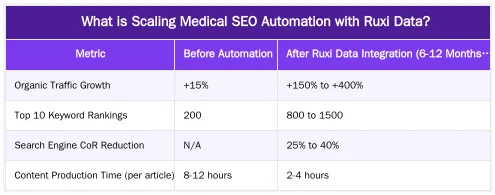
Implementing advanced medical SEO automation with Ruxi Data yields significant, measurable outcomes for London clinics. The primary benefits include substantial organic growth, improved operational efficiency, and a stronger competitive position. By systematically building topical authority and optimizing for search engine understanding, clinics can expect a clear return on investment through increased patient inquiries and reduced marketing spend on less effective channels. This strategic investment ensures long-term digital dominance.
Quantifiable Growth in Organic Visibility
The structured nature of Ruxi Data’s content networks leads to a direct increase in organic visibility. By covering topics exhaustively and establishing deep authority, websites rank for a broader spectrum of relevant queries. This translates into higher organic traffic, more qualified leads, and ultimately, a greater number of patient bookings. Clinics can observe significant improvements in key performance indicators such as keyword rankings, organic traffic volume, and conversion rates for specific medical procedures.
Operational Efficiency and Resource Allocation
Automating topical map generation and content structuring frees up valuable internal resources. Instead of spending countless hours on manual research and content planning, clinic staff can focus on patient care and other core business activities. The efficiency gained from this type of medical SEO automation allows for a higher volume of high-quality content to be produced with fewer resources, optimizing operational costs and improving overall marketing ROI. This strategic shift ensures that content efforts are both effective and economically viable.
Choosing the Right Partner for Your Healthcare Digital Strategy
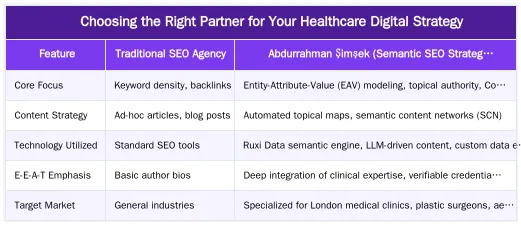
Selecting an SEO partner with specialized expertise in medical content and advanced semantic engineering is crucial for London clinics. Abdurrahman Şimşek offers a unique blend of 10+ years of search engineering experience and a proven Semantic SEO Framework, specifically designed for the healthcare sector. His approach, powered by Ruxi Data, ensures that your digital strategy is not just about rankings, but about building enduring topical authority and minimizing search engine cost of retrieval. This specialized focus is essential for navigating the complexities of medical SEO and achieving sustainable online growth.
Conclusion
The future of medical SEO for London clinics lies in strategic automation and semantic engineering. By embracing Ruxi Data’s capabilities for topical map generation and EAV modeling, healthcare providers can establish dominant online visibility, enhance E-E-A-T, and significantly reduce search engine cost of retrieval. This approach, championed by Abdurrahman Şimşek, transforms digital strategy into a precise, scalable, and highly effective engine for growth. For clinics ready to build a robust semantic content network and achieve unparalleled topical authority, exploring these advanced methodologies is the next step. To learn more about how this specialized framework can benefit your practice, contact us today. You can also Book a Semantic SEO Audit, reach out via Direct WhatsApp Strategy Line: +90 506 206 86 86, or Hire as Semantic SEO Architect.
Frequently Asked Questions
How does Ruxi Data specifically help in scaling medical SEO automation for London clinics?
Ruxi Data automates the complex process of topical map generation and Entity-Attribute-Value (EAV) modeling. This allows London clinics to significantly scale their content production and establish deep topical authority without extensive manual effort, making scaling medical SEO automation highly efficient and effective.
What types of medical clinics benefit most from scaling medical SEO automation with Ruxi Data?
Medical clinics, particularly those in competitive fields like plastic surgery and aesthetics in London, benefit immensely. Ruxi Data’s ability to build comprehensive, machine-readable knowledge bases is crucial for achieving dominant online visibility and successfully scaling medical SEO automation.
How does Ruxi Data ensure content accuracy when automating for medical topics?
Ruxi Data leverages advanced Large Language Models (LLMs) and is meticulously configured with clinical expertise and E-E-A-T principles. This ensures that all automated content aligns with medical accuracy and authority, which is vital for effective content strategies in the healthcare sector.
What is the “Cost of Retrieval” and how does Ruxi Data reduce it for medical websites?
The “Cost of Retrieval” refers to the computational effort search engines expend to understand and rank content. Ruxi Data reduces this by creating highly structured, semantically coherent content, making medical websites easier for search engines to process and rank efficiently. This optimization is key for improving organic visibility and reducing operational costs for search engines.
How can London clinics get started with scaling medical SEO automation using Abdurrahman Şimşek’s semantic engineering framework?
London clinics interested in scaling medical SEO automation can begin by booking a Semantic SEO Audit with Abdurrahman Şimşek. This initial step helps identify specific needs and outlines a tailored strategy to leverage Ruxi Data and his proven methodology for optimal results. You can book an audit via his website: Book a Semantic SEO Audit.
Can Ruxi Data integrate with existing content management systems to facilitate scaling medical SEO automation?
Yes, Ruxi Data is specifically designed for seamless integration with various CMS platforms, including popular ones like WordPress. This capability automates content deployment and structured data implementation, significantly facilitating the process of scaling medical SEO automation.
Ruxi Data brings together multi-model AI, automated website crawling, live indexation checks, topical authority mapping, E-E-A-T enrichment, schema generation, and full pipeline automation — from crawl to WordPress publish to social posting — all in one platform built for agencies and freelancers who run on results.