
Scaling Agency Operations: Automate SEO for Sustainable Growth
Scaling agency operations in SEO requires a strategic shift to intelligent automation, transforming manual tasks into an efficient, comprehensive workflow. This article details how an automated SEO workflow, from client audit to content publication, enhances agency efficiency and client capacity. Implementing standardized processes and a robust tech stack allows agencies to overcome growth bottlenecks, maintain consistent service quality, and free resources for high-level strategy and client relationship management. This approach ensures sustainable growth and improved profit margins by optimizing the content pipeline and client reporting.
This content provides actionable insights for SEO agencies seeking to optimize their processes and achieve scalable growth. It outlines practical strategies for implementing automation across various operational aspects, drawing on principles of efficiency and strategic resource allocation.
To explore your options, contact us to schedule your consultation.
Achieving sustainable scaling agency operations in the competitive SEO landscape of 2026 demands a strategic shift from manual, labor-intensive tasks to intelligent automation. This article explores how implementing a comprehensive automated SEO workflow can transform an agency’s efficiency, from initial client audits to final content publication. By streamlining core processes, agencies can overcome common growth bottlenecks, maintain consistent service quality, and free up valuable team resources for high-level strategy and client relationship management. Understanding and applying these automation principles is crucial for any agency aiming for significant, profitable expansion.
What is Scaling Agency Operations in SEO?
Scaling agency operations in SEO refers to the ability to significantly increase client volume and revenue without a proportional increase in operational costs or staff. It differentiates from mere growth, which might involve simply adding more people to handle more work. True scalability involves implementing systems and processes that allow for exponential output with linear or even sub-linear resource growth, primarily driven by automation and standardization.
- Increased Client Capacity: Handling more clients simultaneously without compromising service quality.
- Optimized Resource Allocation: Ensuring team members focus on strategic tasks rather than repetitive, manual work.
- Consistent Service Delivery: Maintaining high standards across all projects, regardless of volume.
- Enhanced Profit Margins: Reducing the cost-per-client as the agency grows.
- Sustainable Growth Model: Building a framework that supports long-term expansion and adaptability.
Why Automation is the Engine for Sustainable Growth
Automation addresses critical challenges inherent in agency growth, such as bottlenecks, inconsistent quality, and resource limitations. By automating repetitive tasks, agencies can process more data, generate more content, and manage more clients with the same or even fewer resources. This shift allows teams to focus on high-value activities like strategic planning, client communication, and business development, directly contributing to enhanced operational efficiency and sustainable growth.
The Automated SEO Workflow: Audit to Publication
An automated SEO workflow integrates technology and standardized procedures to create a seamless, efficient process from a client’s initial engagement to the final publication of optimized content. This comprehensive approach minimizes manual intervention, reduces errors, and ensures consistency across all projects. It begins with automated data collection and analysis, moves through content strategy and creation, and culminates in direct publishing and performance monitoring.
Key stages like initial SERP analysis, keyword research, and content brief generation can be largely automated. This foundational data then feeds into content production, where AI assists in drafting and optimizing. Finally, automated publishing tools ensure content goes live correctly, followed by automated reporting to track performance. This integrated approach ensures a smooth flow, allowing agencies to manage a higher volume of work effectively.
Streamlining Client Onboarding and Project Management
Automating client onboarding begins with digital forms for data collection, integrating directly into a project management system. This ensures all necessary information, from access credentials to strategic goals, is captured efficiently. Tools can then automatically create project timelines, assign initial tasks, and set up communication channels. This streamlined process reduces administrative overhead, accelerates project initiation, and ensures a consistent, professional start for every new client, laying the groundwork for an efficient automated SEO workflow.
Building an Efficient Content Production Pipeline
An efficient content production pipeline is central to scaling an SEO agency. It starts with automated keyword research and competitive analysis, generating comprehensive content briefs that outline topics, target keywords, search intent, and structural requirements. AI-powered tools then assist in drafting content, ensuring it aligns with the brief and incorporates semantic entities. This process significantly reduces the time from ideation to a ready-to-publish draft, allowing agencies to produce high volumes of quality content consistently.
The pipeline extends to on-page optimization, where automated checks verify keyword usage, meta descriptions, and image alt text. Finally, direct publishing integrations push content to client websites, often with pre-configured semantic HTML structuring. This end-to-end automation ensures that content is not only created quickly but also optimized and published correctly, ready to perform in search results.
Leveraging AI for E-E-A-T Content & Semantic HTML
AI tools are increasingly sophisticated at generating content that adheres to Google’s E-E-A-T guidelines (Experience, Expertise, Authoritativeness, Trustworthiness). These tools can analyze vast datasets to synthesize information, ensuring factual accuracy and comprehensive coverage of topics. They can also assist in structuring content with appropriate semantic HTML tags (e.g., `
`, `
`, `
`, `
- `, `
- `, ``) to enhance readability and search engine understanding. This dual capability allows agencies to produce high-quality, semantically rich content at scale, a critical component for scaling content operations effectively.
Optimizing Your Tech Stack for Agency Efficiency
A robust and integrated tech stack is the backbone of agency efficiency and scalability. It comprises a suite of tools that automate various SEO tasks, from research and content creation to reporting and project management. The key is not just having individual tools, but ensuring they communicate and integrate seamlessly, creating a cohesive ecosystem. This integration minimizes manual data transfer, reduces errors, and provides a unified view of client projects and performance.
For agencies looking to expand, white-label SEO solutions become invaluable. These allow agencies to offer a broader range of services under their own brand without needing to build specialized teams for every niche. Integrating white-label services into an automated workflow ensures consistent quality and efficient delivery, enhancing client offerings while maintaining profitability.
Key SEO Automation Tools & Their Impact
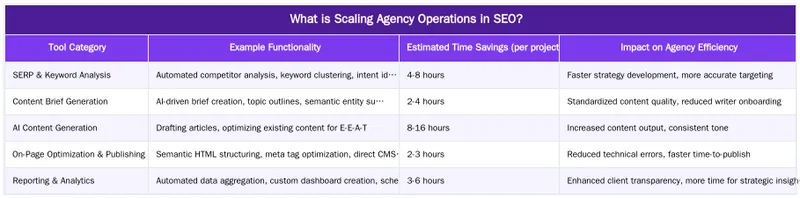
Implementing Robust SOPs for Consistent Quality
Standard Operating Procedures (SOPs) are crucial for maintaining consistent service quality across a growing team and diverse client base, even with automation. SOPs document every step of the automated workflow, outlining how tools are used, data is interpreted, and decisions are made. They ensure that every team member follows the same best practices, reducing variability and ensuring that the output from automated processes meets agency standards. This standardization is a cornerstone of project management best practices and essential for efficient scaling.
Comparison of Workflow Automation Methods
| Method | Pros | Cons |
|---|---|---|
| Manual Processes | High human oversight, custom solutions possible | Slow, prone to errors, not scalable, high labor cost |
| Partial Automation (Tool-Specific) | Automates specific tasks, reduces some manual effort | Integration challenges, data silos, still requires manual bridging |
| Integrated Automation (End-to-End) | High efficiency, consistent quality, scalable, reduced errors | Initial setup complexity, requires robust tech stack, potential vendor lock-in |
How Automation Transforms Client Reporting and Relationships?
Automated client reporting fundamentally changes the dynamic of agency-client relationships. Instead of spending hours manually compiling data, agencies can leverage integrated dashboards and reporting tools to generate comprehensive, branded reports automatically. This not only saves significant time but also ensures accuracy and consistency in data presentation. Clients receive timely updates on key performance indicators, fostering transparency and building trust through consistent communication.
By automating the mundane aspects of reporting, agency teams are freed to focus on strategic analysis and client consultation. This allows for more in-depth discussions about performance trends, future strategies, and opportunities for growth, rather than simply reviewing numbers. The ability to quickly demonstrate value and adapt strategies based on real-time data strengthens client relationships and significantly improves retention rates.
Measuring ROI and Proving Value to Clients
Automated reporting platforms excel at clearly demonstrating the return on investment (ROI) for clients. By integrating data from various sources—such as Google Analytics, Search Console, and ranking trackers—agencies can present a holistic view of performance. Customizable dashboards highlight key metrics like organic traffic growth, keyword rankings, conversion rates, and lead generation. This clear, data-driven evidence of success reinforces the value of the agency’s services, leading to stronger client relationships and improved client retention. The ability to show tangible results consistently is paramount for long-term partnerships.
Ready to Scale Your SEO Agency Operations?
Embracing automation is no longer an option but a necessity for agencies aiming to thrive in 2026 and beyond. By implementing an intelligent, automated SEO workflow, you can overcome growth limitations, enhance service quality, and significantly boost your agency’s profitability. This strategic shift allows your team to focus on what truly matters: delivering exceptional results and building lasting client relationships. If you’re ready to transform your agency’s efficiency and unlock its full potential, explore how tailored automation solutions can empower your business to achieve unprecedented growth. Visit abdurrahmansimsek.com to learn more about streamlining your processes and achieving your scaling goals.
Conclusion
Achieving true scalability for your SEO agency in 2026 demands a shift from manual effort to intelligent automation. By implementing a comprehensive automated workflow from audit to publication, optimizing your tech stack, and standardizing processes, you can overcome growth plateaus and deliver consistent, high-quality results to more clients. Embrace automation not just as a tool, but as the strategic backbone for your agency’s future success. Ready to transform your operations and unlock unprecedented growth? Discover how our solutions can empower your agency to scale efficiently at abdurrahmansimsek.com.
Frequently Asked Questions
How does automation help with scaling agency operations?
Automation handles the most time-consuming parts of the SEO workflow, such as SERP analysis, content strategy creation, and even publishing. This allows your team to focus on high-level strategy and client relationships instead of manual execution, which is fundamental for scaling agency operations effectively.
What is the first process to automate for scaling agency operations?
Client reporting is often the most impactful first step for improving agency scalability. Using tools to automatically pull data from GSC and GA4 into branded reports saves dozens of hours monthly. This ensures consistent, data-driven communication, a key component of scaling agency operations successfully.
How do you maintain content quality when scaling agency operations with AI?
The key to maintaining quality while scaling agency operations is a “human-in-the-loop” approach. Use AI for the heavy lifting of data analysis and first-draft creation, but ensure human experts perform a final review and edit. This strategy combines the efficiency of automation with the critical nuance and expertise of your team.
What is a common bottleneck that prevents agencies from scaling their operations?
Content creation is the most common bottleneck that hinders an agency’s ability to scale. Building a large team of high-quality writers is difficult and expensive. Leveraging advanced AI content platforms provides a strategic advantage, allowing you to increase output without a linear increase in headcount.
How can an agency standardize its technical audit process for better scalability?
To standardize audits for improved scalability, develop a detailed checklist and use tools like Screaming Frog or Ahrefs with a consistent configuration. This creates a repeatable and efficient process for every new client. Automating the content recommendations based on the audit’s findings further streamlines onboarding and supports agency growth.
Ruxi Data brings together multi-model AI, automated website crawling, live indexation checks, topical authority mapping, E-E-A-T enrichment, schema generation, and full pipeline automation — from crawl to WordPress publish to social posting — all in one platform built for agencies and freelancers who run on results.