
ROI of SEO: Measuring Surgical Practice Profitability
Understanding the roi of seo for a surgical practice requires tracking beyond vanity metrics. This article details how to measure the financial return of organic search by focusing on patient acquisition and lifetime value. It outlines implementing robust tracking using Google Analytics 4 for phone calls and form submissions, calculating patient lifetime value (PLV) and cost per acquisition (CPA), and leveraging marketing attribution to connect SEO efforts directly to revenue. This approach demonstrates the true return on investment for marketing spend.
Abdurrahman Şimşek, a Semantic SEO Strategist, specializes in developing precise SEO strategies for surgical practices. His approach focuses on entity-based SEO and robust tracking to ensure measurable returns and clear financial impact from organic search efforts.
To explore your options, contact us to schedule your consultation. You can also reach us via: Book a Semantic SEO Audit, Direct WhatsApp Strategy Line: +90 506 206 86 86
For surgical practices, understanding the roi of seo is essential for justifying investment. This guide explains how to measure the financial return of SEO by focusing on patient acquisition and long-term value. It details tracking mechanisms, KPIs, and strategies to demonstrate profitability from organic search, helping clinics make informed decisions about marketing spend.
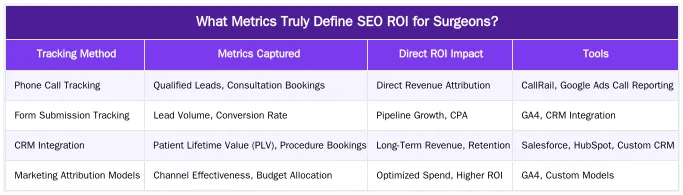
What Metrics Truly Define SEO ROI for Surgeons?
Measuring SEO ROI for a surgical practice is more than tracking website traffic or keyword rankings. Value lies in the direct impact on patient acquisition and revenue. Track the patient journey from search query to booked procedure to connect SEO efforts to the clinic’s financial health.
Beyond Rankings: Why Deeper Metrics Matter
Keyword rankings and organic traffic indicate visibility but don’t equal revenue. A high ranking for a non-converting keyword or traffic that doesn’t lead to inquiries has little business value. Surgical practices need metrics reflecting patient engagement and conversion, such as qualified leads and booked consultations. Vanity metrics obscure an SEO strategy’s effectiveness.
Key Performance Indicators (KPIs) for Surgical SEO Success
Specific KPIs clarify SEO effectiveness for surgical practices: qualified leads (from phone calls and form submissions), lead-to-consultation rate, consultation-to-procedure rate, average revenue per procedure, and patient lifetime value (PLV). These metrics demonstrate the financial impact of organic search and show the investment return.
Implementing Robust Tracking: From Leads to Lifetime Value
Accurate SEO performance measurement requires a tracking infrastructure. Configure analytics platforms to capture interactions from website visit to procedure booking. Clear conversion goals and integrated data are essential to understand financial return.
Setting Up Conversion Tracking in Google Analytics 4 (GA4)
Google Analytics 4 (GA4) tracks user behavior and conversions. For surgical practices, configure events for goal completions like phone calls (via click-to-call or call tracking numbers), form submissions for consultation requests, and virtual appointment bookings. Custom dimensions segment data for analysis of procedure inquiries or geographic interest. This event tracking provides data to understand how organic traffic becomes qualified leads, a core component of a comprehensive plastic surgery SEO blueprint.
Calculating Patient Lifetime Value (PLV) and Cost Per Acquisition (CPA)
Patient Lifetime Value (PLV) is vital for assessing ROI. PLV is the average revenue per patient multiplied by the average number of procedures or visits. Cost Per Acquisition (CPA) is the total SEO investment divided by new patients acquired through organic channels. Integrating a CRM (Customer Relationship Management) system with analytics is crucial for tracking PLV, providing a complete view of patient interactions and revenue over time. This integration attributes revenue to specific organic marketing efforts.
The Semantic Advantage: How Entity-Based SEO Boosts Measurable Returns
A semantic SEO approach changes how search engines understand and rank a surgical practice’s website. By structuring content around entities and their attributes, algorithms can better comprehend a site, improving visibility and ROI. This method builds topical authority beyond keywords.
Reducing Cost of Retrieval (CoR) for Enhanced Visibility
Google’s Cost of Retrieval (CoR) is the computational resource used to crawl, process, and understand website content. A semantically optimized site with clear entity-attribute-value (EAV) modeling is easier for search engines to interpret. This efficiency improves crawl budget allocation and ranking potential because Google can identify and present information more easily. Reducing CoR helps a surgical practice gain organic visibility, boosting financial return by increasing content reach. This provides a competitive edge, as detailed in an analysis of competitor SEO strategies.
Building Topical Authority for Sustainable Growth
Topical authority is crucial for sustainable organic growth. Semantic content networks, like those from Ruxi Data, help a surgical practice demonstrate expertise across its specialties. This requires interconnected content covering a topic’s facets, from procedures to recovery. Authoritative websites rank higher for more high-value queries. This impacts lead generation, as qualified patients find the practice via organic search, increasing ROI over time.
Partnering for Precision: Why a Specialist SEO Strategist Matters
For surgical practices, especially in competitive markets like London’s private healthcare sector, complex SEO requires specialist expertise. A medical SEO strategist understands regulatory, ethical, and patient-centric requirements, ensuring strategies are effective, compliant, and trustworthy. This knowledge is critical for maximizing and measuring SEO’s financial return.
Navigating YMYL and E-E-A-T in Medical SEO
Medical content is in Google’s Your Money Your Life (YMYL) category, which requires E-E-A-T (Experience, Expertise, Authoritativeness, Trustworthiness). A specialist SEO strategist understands how to navigate these guidelines to ensure content is accurate, authored by professionals, and trustworthy. Prioritizing E-E-A-T improves rankings and builds patient confidence, which is foundational for conversions and ROI. Showcasing surgeon credentials and patient testimonials builds authority and trust. More information is in Google’s own guidelines for helpful content.
The Value of Fixed-Price Strategic Consulting
Abdurrahman Şimşek’s fixed-price strategic consulting provides a transparent, predictable investment aligned with a surgical practice’s ROI objectives. Unlike hourly billing, this model focuses on measurable outcomes and strategic frameworks for growth. The focus is on long-term patient acquisition and profitability, not billable hours. It clarifies scope and deliverables, helping directors budget and see a path to ROI.
Forecasting and Reporting: Demonstrating Tangible Growth
Communicating SEO value to clinic directors requires clear forecasting and data-driven reporting. Setting realistic expectations and linking SEO metrics to financial outcomes demonstrates growth and secures investment.
Setting Realistic Expectations for SEO ROI
SEO is a long-term investment, with results appearing over months, not weeks. For competitive medical niches, significant growth can take 6-12 months, with substantial ROI after 12-24 months. Educate stakeholders on these timelines and SEO’s compounding benefits. Initial efforts build a foundation and topical authority, leading to patient acquisition. These timelines are crucial for evaluating SEO profitability. A Search Engine Journal study provides more insight into SEO timelines.
Presenting ROI to Clinic Directors: A Data-Driven Approach
ROI reports for clinic directors should be concise and focus on financial impact. Include new qualified leads from organic search, conversion rates through the patient funnel, total revenue from organic patients, and the calculated ROI. Visualizations like graphs showing month-over-month growth in leads and revenue are impactful. The report should connect SEO activities (e.g., content creation, technical optimizations) to financial outcomes, showing how the investment contributes to the bottom line. Harvard Business Review offers guidance on business reporting.
Unlock Your Surgical Practice’s Full Organic Potential
Measuring the financial return of SEO is necessary for surgical practices. By implementing precise tracking, using semantic SEO principles, and partnering with a specialist strategist, clinics can make their online presence a source of patient acquisition. A data-driven approach demonstrates profitability and sustainable growth.
Conclusion
Measuring SEO ROI for a surgical practice requires a data-centric approach. Focus on qualified leads, conversion rates, patient lifetime value, and financial impact. Using tracking tools like Google Analytics 4, semantic SEO principles, and a specialist partner who understands medical E-E-A-T helps surgical practices assess and maximize organic search profitability. This framework ensures SEO investment translates into patient acquisition and revenue growth. To explore how a tailored semantic SEO strategy can benefit your practice, contact us. You can also Book a Semantic SEO Audit or reach out via WhatsApp Strategy Line: +90 506 206 86 86.
Frequently Asked Questions
What metrics are included when calculating the roi of seo for a surgical clinic?
To calculate the true roi of seo, you must track more than just rankings. Key metrics include the number of qualified leads (phone calls, form fills), lead-to-consultation rate, consultation-to-procedure rate, and the average revenue per procedure, all weighed against the total investment in the SEO strategy.
How can accurate tracking help determine the true return on investment from organic search?
Accurate tracking is vital for understanding your marketing’s financial impact. This involves setting up goal completions in Google Analytics 4 for form submissions, implementing dynamic call tracking to identify calls from organic visitors, and using unique tracking parameters in your CRM. This meticulous approach is fundamental to assessing the financial impact of your SEO efforts.
What is a good benchmark for the roi of seo in the surgical field?
While it varies based on market competitiveness, a successful SEO campaign in a competitive market like London can generate an roi of seo of 5:1 to 10:1 or higher. This is largely due to the high Patient Lifetime Value (PLV) of a single new patient acquired through search, which can often cover the annual SEO investment.
Why is Patient Lifetime Value (PLV) important for measuring SEO success?
PLV is crucial because a patient acquired for one procedure may return for others, or refer friends and family, extending their value beyond the initial service. Factoring in this long-term value provides a more accurate picture of the overall return on investment, as the initial SEO investment continues to generate revenue over time.
How long does it typically take to see a positive roi of seo?
Generally, you can expect to see a positive roi of seo within 12 to 18 months. The initial months are an investment in building foundational authority and content, with the financial returns accelerating significantly in the second year and beyond as your practice gains prominence in search results.
How can a surgical practice begin to measure its organic search performance and potential?
Abdurrahman Şimşek, a Semantic SEO Strategist, offers a Semantic SEO Audit to help practices understand their current organic visibility and potential return on investment from organic search. You can book a Semantic SEO Audit or contact directly via the website or WhatsApp at +90 506 206 86 86 to discuss a tailored strategy.
Ruxi Data brings together multi-model AI, automated website crawling, live indexation checks, topical authority mapping, E-E-A-T enrichment, schema generation, and full pipeline automation — from crawl to WordPress publish to social posting — all in one platform built for agencies and freelancers who run on results.