
Real-time SERP Intelligence: Optimizing Content for Dynamic Search
Real-time SERP intelligence provides immediate, actionable insights into search engine results pages, crucial for dynamic content strategy. This live data enables swift adaptation to Google algorithm shifts, competitor movements, and evolving user intent. By analyzing current SERP features and identifying content gaps, businesses can enhance topical authority and improve rankings. Leveraging real-time SERP intelligence ensures content remains relevant and visible in a constantly changing search landscape, driving effective digital presence.
This article, from abdurrahmansimsek.com, details how leveraging live SERP data and AI models can automate content optimization and refine keyword research. It provides practical strategies for adapting content to maintain relevance and visibility in search results.
To explore your options, contact us to schedule your consultation.
Understanding the dynamic nature of search engine results pages (SERPs) is crucial for effective digital strategy. Real-time SERP intelligence provides up-to-the-minute insights into search rankings, competitor movements, and user intent. This immediate data allows content creators and SEO professionals to adapt strategies swiftly, ensuring their content remains relevant and visible. By leveraging live SERP analysis, businesses can identify emerging trends, uncover content gaps, and optimize their digital presence for maximum impact. This article explores how dynamic SERP data powers content strategy, from understanding search intent to adapting to Google’s algorithm shifts.
Definition and Importance of Real-Time SERP Intelligence
Real-time SERP intelligence refers to the continuous monitoring and analysis of search engine results pages as they evolve. This involves collecting live data on rankings, featured snippets, People Also Ask sections, local packs, and other SERP features for specific keywords. Unlike historical data, which provides a snapshot from the past, real-time data reflects the immediate state of the search landscape.
Its importance stems from the dynamic nature of search. Google’s algorithms are constantly updating, and user search behaviors shift rapidly. Without current insights, content strategies can quickly become outdated. Access to live SERP data enables businesses to make informed decisions, react to changes promptly, and maintain a competitive edge. It provides a granular view of what is currently ranking, why it is ranking, and how user intent is being addressed by top-performing content.
For a deeper understanding of how search engines operate, resources like Wikipedia’s entry on Search Engine Optimization offer foundational knowledge. This foundational understanding, combined with live data, forms a robust framework for content optimization.
How Real-Time SERP Analysis Works
Real-time SERP analysis involves systematically querying search engines for specific keywords and capturing the resulting data instantaneously. This process typically uses automated systems that simulate user searches from various locations and devices.
The analysis works by:
- Automated Scraping: Tools send requests to search engines for target keywords, mimicking a user’s browser.
- Data Extraction: Information such as ranking URLs, titles, descriptions, SERP features (e.g., featured snippets, image packs, video carousels), and ad placements are extracted.
- Contextualization: The raw data is then processed to identify patterns, changes, and opportunities. This includes analyzing the types of content ranking, the search intent they fulfill, and the competitive landscape.
- Continuous Monitoring: This process is not a one-time event but an ongoing cycle, allowing for the detection of subtle shifts in rankings or SERP features as they occur.
This continuous data feed provides an immediate understanding of the current search environment, allowing for agile content adjustments.
Benefits for Content Strategy: Search Intent and Competitor Analysis
Leveraging live SERP data significantly enhances content strategy by providing clarity on search intent and enabling precise competitor analysis. Understanding the current intent behind a query is paramount. Real-time SERP analysis reveals the types of content Google is currently prioritizing for a given keyword, indicating whether the intent is informational, navigational, transactional, or commercial investigation. For example, if SERPs for a “best running shoes” query show primarily product review roundups and comparison tables, the intent is likely commercial investigation, not just informational. This informs content creation to align directly with user needs.
For competitor analysis, live SERP data offers an immediate view of who is ranking for target keywords and how. It identifies new entrants, tracks changes in competitor content, and highlights their strategies for capturing SERP features. This allows content teams to pinpoint content gaps, understand competitor strengths, and develop counter-strategies. Analyzing competitor content in real-time helps identify what elements contribute to their current success, from content depth to media usage. For practical insights into this, explore live competitor analysis.
Furthermore, understanding search intent through live SERP data helps refine existing content. If a piece of content is underperforming, analyzing the current SERP can reveal a mismatch between the content’s intent and what Google is now prioritizing. This allows for targeted updates, ensuring content remains relevant and effective. For more on deconstructing intent, see deconstructing SERP intent.
AI-Driven Real-Time SERP Intelligence and Content Automation
The integration of artificial intelligence (AI) models has transformed the capabilities of real-time SERP intelligence. AI algorithms can process vast amounts of live SERP data with speed and accuracy, identifying complex patterns and correlations that human analysts might miss. This includes discerning subtle shifts in search intent, predicting algorithm changes, and pinpointing emerging topics.
AI-driven systems automate the entire content lifecycle, from ideation to optimization. They can analyze live SERP data to suggest new content topics, identify optimal keyword clusters, and even generate content outlines that align with current ranking factors. For instance, an AI model can detect that Google is now favoring long-form guides over short blog posts for a specific query and recommend adjustments to content length and structure. This level of automation streamlines content production, ensuring that new content is always optimized for the current search landscape.
Content automation, powered by AI and live SERP data, extends beyond initial creation. AI can continuously monitor content performance against real-time SERP changes, suggesting updates, expansions, or even complete rewrites to maintain rankings. This proactive approach ensures content remains competitive without constant manual oversight. For more on scaling content with AI, refer to AI content at scale with SERP data.
Strategies for Adapting Content to Real-Time Google Algorithm Shifts
Google’s algorithm updates are a constant in the SEO landscape. Adapting content to these shifts in real-time requires a proactive and data-driven approach. The first strategy involves continuous monitoring of core web vitals and other technical SEO metrics, as algorithm updates often emphasize user experience. Tools that provide live performance data can flag issues immediately after an update.
Secondly, closely observe SERP feature changes for your target keywords. If an update causes a shift from traditional organic listings to more video carousels or image packs, it signals a change in preferred content formats. Adapting means diversifying content types to match these new preferences. For instance, if video content gains prominence, consider creating video summaries or tutorials for existing articles.
Thirdly, analyze the content characteristics of new top-ranking pages post-update. Look for changes in content depth, readability, use of internal/external links, and overall topical coverage. If new top performers are more comprehensive or authoritative, your content may need expansion or additional expert contributions. Staying informed through official channels like the Google Search Central Blog also provides context for observed changes.
Practical Implementation and Best Practices for Live SERP Data
Implementing live SERP data effectively requires a structured approach. Begin by defining your key performance indicators (KPIs) and target keywords. This ensures that the data collected is relevant to your strategic goals. Prioritize keywords that are critical for your business, focusing on those with high search volume and conversion potential.
Next, integrate live SERP monitoring into your existing SEO workflow. This means setting up automated alerts for significant ranking drops or gains, new SERP features appearing, or competitor movements. Regular review of these alerts allows for timely content adjustments. For example, if a competitor suddenly ranks for a target keyword, analyze their content immediately to understand their approach.
Best practices include segmenting your data by device, location, and search intent. Mobile SERPs often differ significantly from desktop results, and local searches have unique characteristics. Analyzing these segments provides a more nuanced understanding of the search landscape. Regularly audit your content against live SERP data to identify opportunities for optimization, such as updating outdated information or expanding on underrepresented topics. A case study on live SERP analysis can provide further context: live SERP analysis case study.
Tools and Platforms for Real-Time SERP Intelligence
A variety of tools and platforms facilitate real-time SERP intelligence, ranging from comprehensive SEO suites to specialized monitoring services. These tools typically offer features like keyword tracking, competitor monitoring, SERP feature analysis, and historical data comparisons. The choice of tool often depends on the scale of operations, budget, and specific data requirements.
Some platforms provide granular data on specific SERP elements, such as the exact text of featured snippets or the number of images in an image pack. Others focus on broader trends, identifying shifts in overall search intent across a category. Many tools also integrate with other marketing platforms, allowing for a holistic view of digital performance. When selecting a tool, consider its data refresh rate, geographic coverage, and API capabilities for custom integrations.
Comparison of SERP Analysis Methods
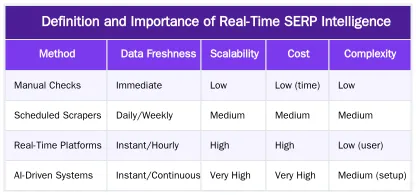
Impact of SERP Data Update Frequency
| Update Frequency | Ranking Volatility Detection | Content Adaptation Speed | Competitor Strategy Insight |
|---|---|---|---|
| Daily | Moderate (60%) | Moderate (50%) | Moderate (55%) |
| Hourly | High (85%) | High (80%) | High (80%) |
| Continuous | Very High (95%) | Very High (90%) | Very High (90%) |
Ruxi Data: Enhancing Content Strategy with Live SERP Insights
Ruxi Data provides comprehensive solutions for leveraging live SERP data to optimize content strategy. The platform offers immediate access to dynamic search results, enabling businesses to monitor keyword performance, analyze competitor movements, and identify emerging search trends as they happen. Ruxi Data’s capabilities extend to granular SERP feature analysis, providing insights into what types of content are currently dominating the search landscape.
By integrating Ruxi Data into content workflows, teams can ensure their content aligns with current search intent and algorithm preferences. This allows for proactive adjustments, whether it’s optimizing existing articles or developing new content based on fresh opportunities. For those seeking to elevate their content strategy with current search insights, explore the capabilities of Ruxi Data today. Visit abdurrahmansimsek.com to learn more.
Conclusion
Real-time SERP intelligence is an indispensable asset for modern content strategy. It moves beyond static analysis, providing immediate, actionable insights into the ever-changing search landscape. By understanding current search intent, monitoring competitor activity, and adapting to algorithm shifts with live data, businesses can create more relevant, authoritative, and high-ranking content. Embracing dynamic SERP analysis ensures content remains competitive and visible, driving sustained organic growth. To harness the power of live SERP data for your content strategy, visit abdurrahmansimsek.com.
Frequently Asked Questions
What is real-time SERP intelligence and why is it important for content strategy?
Real-time SERP intelligence involves continuously analyzing live search engine results pages to understand current search intent, competitor strategies, and trending topics. This immediate data is crucial for creating highly relevant and rank-worthy content that resonates with users. It allows content creators to adapt strategies swiftly, ensuring their content remains visible and effective in a dynamic search landscape.
How does Ruxi Data integrate real-time SERP intelligence into its platform?
Ruxi Data integrates real-time SERP intelligence by feeding live SERP data directly into its 7 advanced AI models. This enables the platform to generate content that is precisely aligned with current search intent, topical authority, and technical requirements. By continuously monitoring SERP changes, Ruxi Data ensures its content recommendations are always up-to-date and highly effective.
What are the advantages of using live SERP data over static keyword research?
Live SERP data provides up-to-the-minute insights into what’s currently ranking, including evolving SERP features, competitor content, and dynamic user intent. This offers a significant advantage over static, potentially outdated, keyword research, which can quickly lose relevance. Dynamic SERP analysis ensures your content strategy is always informed by the most current search landscape.
Can real-time SERP intelligence help in outranking competitors?
Yes, real-time SERP intelligence is highly effective for outranking competitors. By deconstructing top-ranking content and understanding the nuances of SERP intent in real-time, businesses can identify gaps and create superior content. This targeted approach allows for the development of content specifically designed to meet and exceed current ranking factors.
How does Ruxi Data’s approach to real-time SERP intelligence ensure E-E-A-T compliance?
Ruxi Data’s approach to dynamic SERP analysis helps ensure E-E-A-T compliance by identifying authoritative sources and entities directly from live search results. Its AI models then leverage this information to generate content that demonstrates expertise, experience, authority, and trustworthiness. This method ensures content is not only relevant but also credible and reliable according to Google’s guidelines.
Ruxi Data brings together multi-model AI, automated website crawling, live indexation checks, topical authority mapping, E-E-A-T enrichment, schema generation, and full pipeline automation — from crawl to WordPress publish to social posting — all in one platform built for agencies and freelancers who run on results.