
Topic Cluster Impact: Quantifying Business Growth
Quantifying topic cluster impact extends beyond simple organic traffic, directly linking content strategy to measurable business growth. This guide details how to establish comprehensive topical authority, measure content performance, and attribute revenue to content efforts for tangible SEO ROI. Readers will learn to implement data-driven frameworks that demonstrate how content investments drive lead generation, customer acquisition, and ultimately, increased revenue, moving past vanity metrics to verifiable business outcomes. This approach ensures content efforts are optimized for maximum business growth.
This guide provides a data-driven approach to content strategy, emphasizing the importance of accurate measurement and revenue attribution. It offers practical insights for businesses seeking to optimize their content investments and achieve measurable SEO ROI, aligning content efforts with core business objectives.
To explore your options, contact us to schedule your consultation.
Understanding the true topic cluster impact goes far beyond simple organic traffic metrics. This guide explores how to quantify the real business growth driven by your content strategy, moving from vanity metrics to tangible ROI. We will demonstrate the profound value of topical authority, detailing how to measure content performance and attribute revenue directly to your content efforts. By focusing on data-driven insights, businesses can unlock significant growth and optimize their content investments effectively in 2026.
What is Topic Cluster Impact and Why Measure It?
Topic cluster impact refers to the measurable business outcomes generated by a strategically organized group of interconnected content pieces. These clusters, comprising a central pillar page and supporting cluster content, establish comprehensive topical authority around a specific subject. Measuring their impact is critical because it shifts the focus from superficial metrics like raw organic traffic to tangible business growth. It allows organizations to understand how their content strategy directly contributes to lead generation, customer acquisition, and ultimately, revenue. This approach ensures content investments are justified and aligned with overarching business objectives, providing a clear picture of ROI beyond mere visibility.
A well-executed content strategy built on topic clusters enhances search engine visibility and user engagement. By thoroughly covering a subject, businesses signal expertise to search engines, improving keyword rankings across a broad spectrum of related terms. This holistic approach not only drives more qualified organic traffic but also positions the brand as a thought leader. Quantifying this impact involves analyzing how users interact with the content, progress through the sales funnel, and convert into paying customers. It moves beyond simply counting page views to understanding the true value each piece of content delivers to the bottom line.
From Traffic to Revenue: Attributing Business Growth to Content
The journey from a website visitor to a loyal customer is complex. For content marketers, the challenge lies in proving that content isn’t just a cost center but a powerful revenue driver. Attributing business growth directly to content requires moving beyond basic organic traffic analysis. It demands a sophisticated understanding of how topic clusters influence every stage of the customer journey, from initial awareness to final conversion and retention. This shift in perspective is crucial for demonstrating the true SEO ROI of your content strategy and securing further investment.
Understanding the Content-to-Revenue Funnel
Topic cluster content plays a vital role at each stage of the customer journey. At the awareness stage, pillar pages and broad cluster content attract new audiences searching for solutions or information. As users move to consideration, more specific cluster articles provide in-depth comparisons, guides, and use cases, nurturing their interest. Finally, at the decision stage, content like case studies, product reviews, and FAQs directly addresses purchasing intent, guiding users towards conversion. Each piece of content, strategically linked within its cluster, acts as a touchpoint, influencing the user’s path toward becoming a customer.
Key Metrics for Revenue Attribution
To truly measure the business impact of your content, it’s essential to track metrics that directly correlate with revenue and profitability. These go beyond traditional SEO metrics like keyword rankings and organic traffic volume. Focus on how content influences lead generation, conversion rates, and customer value.
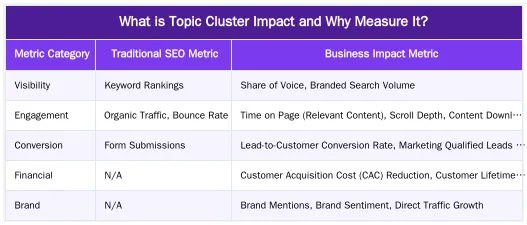
By focusing on metrics like lead-to-customer conversion rates and the reduction in Customer Acquisition Cost (CAC) for content-generated leads, businesses can clearly see the financial benefits. Furthermore, analyzing how content influences Customer Lifetime Value (CLV) provides a long-term view of content’s profitability. This granular approach to revenue attribution paints a comprehensive picture of your content’s contribution to overall business growth.
Implementing a Data-Driven Topic Cluster Measurement Framework
Establishing a robust framework is paramount for accurately measuring the impact of your topic clusters. This involves a systematic approach to defining objectives, selecting appropriate tools, and setting up precise tracking mechanisms. A data-driven content strategy ensures that every piece of content serves a purpose and its performance can be objectively evaluated against business goals. This framework provides the clarity needed to optimize content investments and demonstrate tangible SEO ROI.
Defining KPIs and Setting Baselines for Success
The first step is to clearly define Key Performance Indicators (KPIs) that align with your business objectives. These should extend beyond traffic to include conversion-focused metrics. For example, if your goal is lead generation, KPIs might include MQLs generated per cluster or lead-to-opportunity conversion rates. For SaaS businesses, tracking free trial sign-ups or demo requests directly attributed to specific content is crucial. Once KPIs are established, set baselines by analyzing historical data. This allows you to measure progress accurately and identify areas for improvement. For a deeper dive into establishing these metrics, explore our guide on building a topic cluster ROI framework.
Tools and Technologies for Comprehensive Tracking
Effective measurement relies on the right toolkit. Essential platforms include:
- Google Analytics 4 (GA4): For tracking organic traffic, user behavior, engagement metrics, and conversion events. GA4’s event-driven model is ideal for custom conversion tracking. Learn more about setting up events in Google Analytics documentation.
- Google Search Console: Provides insights into keyword rankings, impressions, clicks, and search performance, helping identify content gaps and opportunities.
- CRM Systems (e.g., Salesforce, HubSpot): Crucial for connecting content interactions to lead status, sales pipeline progression, and closed-won deals. This enables true revenue attribution.
- SEO Tools (e.g., Ahrefs, Semrush): For competitive analysis, keyword research, backlink monitoring, and tracking content performance against competitors.
- Heatmap & Session Recording Tools (e.g., Hotjar): To understand user behavior on pages, identifying areas of interest and friction points within your topic clusters.
Integrating these tools provides a holistic view of content performance, from initial search visibility to final revenue generation. This comprehensive approach to conversion tracking is fundamental for a data-driven content strategy.
Leveraging Ruxi Data for Advanced Topic Cluster ROI
While standard analytics tools provide foundational data, truly understanding the topic cluster impact and maximizing SEO ROI often requires more advanced platforms. This is where specialized solutions like Ruxi Data come into play, offering capabilities that go beyond basic reporting to deliver deep, actionable insights. Abdurrahman Simsek’s expertise in data-driven SEO and SaaS content strategy emphasizes the power of such platforms in transforming content performance analysis.
Beyond Standard Analytics: Deep Dive into Ruxi’s Capabilities
Ruxi Data is designed to bridge the gap between content performance metrics and actual business outcomes. It excels in several key areas:
- Granular Revenue Attribution: Ruxi can track the entire user journey, attributing specific revenue figures to individual content pieces or entire topic clusters. This moves beyond last-click attribution to a more comprehensive multi-touch model.
- Conversion Path Analysis: The platform visualizes how users interact with different content within a cluster before converting, identifying critical touchpoints and content sequences.
- Content ROI Forecasting: By analyzing historical data and market trends, Ruxi can help forecast the potential ROI of new content initiatives, guiding strategic investment decisions.
- Competitive Content Intelligence: It offers insights into competitor content performance, helping identify untapped opportunities and refine your own topic cluster strategy.
These advanced capabilities allow businesses to pinpoint exactly which content drives the most value, enabling precise optimization and resource allocation. For more on this, see our detailed article on measuring topic cluster ROI.
Case Studies: Real-World Impact with Advanced Data
Businesses leveraging advanced data platforms for their topic clusters consistently report significant improvements in their content’s financial contribution. For instance, a B2B SaaS company might use Ruxi Data to discover that a specific cluster on “API integrations” generates 30% of their qualified leads, despite only accounting for 10% of their overall organic traffic. This insight allows them to double down on similar content, optimizing their content strategy for maximum impact. Another example could be an e-commerce platform identifying that their “product comparison guides” cluster significantly reduces customer acquisition costs by nurturing users more effectively. Such data-driven insights are crucial for demonstrating the tangible value of content. For further reading on content ROI, consider exploring case studies from industry leaders like HubSpot’s content marketing ROI examples.
What Business Growth Can You Expect from Optimized Topic Clusters?
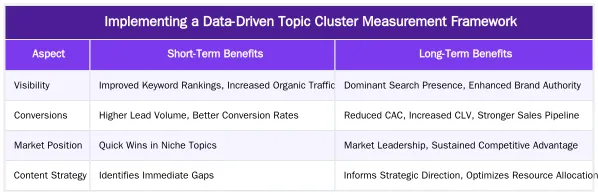
An optimized topic cluster strategy, meticulously measured and refined, delivers far more than just improved search rankings. It lays the groundwork for sustainable business growth, market leadership, and enhanced operational efficiency. By consistently focusing on the topic cluster impact, businesses can transform their content into a powerful asset that drives long-term value in 2026 and beyond.
Long-Term Benefits: Sustained Authority and Market Share
Consistent optimization of topic clusters builds deep topical authority. This means search engines recognize your brand as the definitive source of information for specific subjects. Over time, this authority translates into higher organic visibility, increased brand trust, and a stronger competitive advantage. As your authority grows, you naturally capture a larger share of voice in your niche, attracting more qualified leads and expanding your market share. This sustained growth is a direct result of a well-executed and data-backed content strategy that prioritizes comprehensive coverage and user value.
Mitigating Risks and Maximizing Efficiency
A data-driven approach to topic clusters helps businesses make informed decisions, mitigating risks associated with content investment. By understanding which content performs best and contributes most to revenue, resources can be allocated more efficiently. This means less wasted effort on underperforming content and more focus on high-impact areas. It also allows for agile adjustments to the content strategy based on real-time performance data, ensuring maximum efficiency and a higher SEO ROI. This strategic approach minimizes content production costs while maximizing the return on every piece of content created.
Ready to Unlock Your Topic Cluster’s Full Potential?
Quantifying the true topic cluster impact is no longer optional; it’s essential for any business aiming for sustainable growth. Moving beyond vanity metrics to concrete revenue attribution transforms your content strategy from a cost center into a powerful engine for business expansion. If you’re ready to implement a data-driven approach, optimize your content investments, and achieve measurable SEO ROI, Abdurrahman Simsek is here to help. Discover how expert guidance can elevate your content strategy and drive tangible results.
Take the next step towards a content strategy that delivers real business growth. Explore our services today and start measuring what truly matters.
Conclusion
The journey to understanding and maximizing topic cluster impact is a strategic imperative for businesses in 2026. By shifting focus from mere organic traffic to comprehensive revenue attribution, organizations can unlock the full potential of their content strategy. Implementing a data-driven framework, leveraging advanced analytics platforms like Ruxi Data, and consistently optimizing for business growth ensures that every content investment yields a measurable SEO ROI. This approach not only builds lasting topical authority but also drives sustainable market share and enhances overall profitability. Embrace data to transform your content into a powerful engine for success.
To learn more about optimizing your content strategy for measurable business growth, visit abdurrahmansimsek.com.
Frequently Asked Questions
How can businesses quantify the true topic cluster impact beyond just organic traffic?
Businesses can quantify topic cluster impact by tracking metrics like lead generation, conversion rates, and customer acquisition cost reduction. This also includes monitoring brand mentions and overall revenue directly attributed to the content, providing a holistic view of ROI.
What role does Ruxi Data play in measuring topic cluster impact?
Ruxi Data’s platform assists in creating highly relevant and authoritative topic clusters, which are foundational for strong performance. While primarily focused on content generation, the structured data and performance insights it enables are crucial for subsequent, accurate ROI analysis of your topic cluster impact.
Why is it crucial to look “beyond traffic” when evaluating topic cluster impact?
Looking beyond traffic allows businesses to understand the true value of topic clusters in terms of qualified leads, sales, and enhanced brand authority. This broader perspective helps quantify the overall contribution of your content strategy to the bottom line, revealing the full topic cluster impact.
What is a data-driven framework for attributing revenue to the topic cluster impact?
A data-driven framework involves setting clear conversion goals and meticulously tracking user journeys from topic cluster content to conversion points. Employing advanced analytics and attribution models then allows businesses to assign revenue credit accurately, revealing the financial topic cluster impact.
How do topic clusters contribute to long-term business growth and sustained topic cluster impact?
Topic clusters build deep topical authority and establish your brand as an expert in its field. This attracts highly qualified audiences, leading to sustained organic traffic, increased brand trust, and a consistent pipeline for long-term business growth, demonstrating significant topic cluster impact.
What kind of business growth can be expected from optimizing topic cluster impact?
Optimized topic clusters lead to significant business growth by attracting highly qualified leads and improving conversion rates. Businesses can expect enhanced brand authority, reduced customer acquisition costs, and a measurable increase in revenue, showcasing the direct topic cluster impact on the bottom line.
Ruxi Data brings together multi-model AI, automated website crawling, live indexation checks, topical authority mapping, E-E-A-T enrichment, schema generation, and full pipeline automation — from crawl to WordPress publish to social posting — all in one platform built for agencies and freelancers who run on results.