
Programmatic SEO WordPress: Scalable Content Generation
Implementing programmatic SEO WordPress enables businesses to automate large-scale content generation, significantly boosting organic traffic and operational efficiency. This approach leverages structured data and content templates within the WordPress environment to create thousands of unique, targeted web pages. Readers will learn how to utilize custom post types, API integration, and automated publishing to build a scalable content infrastructure. The article details strategies for capturing niche search demand and enhancing search visibility through efficient pSEO implementation on WordPress.
This guide provides a comprehensive overview of programmatic SEO, detailing its implementation within the WordPress ecosystem. It outlines practical steps for leveraging data sources and content automation to achieve significant gains in organic search performance. The insights presented are designed to help businesses build robust, scalable content strategies.
To explore your options, contact us to schedule your consultation.
Implementing programmatic SEO on WordPress offers a robust, data-driven approach to automate large-scale content generation, significantly boosting organic traffic and operational efficiency. This model enables businesses to create thousands of unique, targeted web pages by leveraging structured data and content templates. This guide explores how to harness this powerful strategy to transform your content production, enhance search visibility, and achieve a scalable content infrastructure. Understanding its core principles and WordPress-specific advantages is crucial for maximizing its impact in 2026.
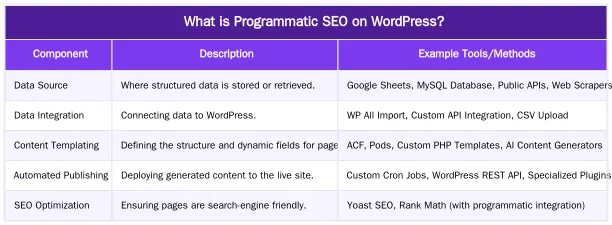
What is Programmatic SEO on WordPress?
Programmatic SEO involves generating a high volume of targeted web pages automatically using structured data and content templates. When applied to WordPress, this means leveraging the platform’s flexibility to create thousands of unique pages, each optimized for specific long-tail keywords. This method allows businesses to capture niche search demand that traditional, manual content creation cannot efficiently address.
The process typically begins with identifying a large dataset of keywords or entities. This data is then mapped to a pre-designed content template, which includes dynamic fields. WordPress, with its robust database and custom post type capabilities, serves as an ideal backend for storing this data and rendering these templates into distinct, SEO-friendly pages. Each page is unique, featuring specific data points relevant to its target query, ensuring relevance and value for search engine users.
Benefits and Importance of Programmatic SEO
Programmatic content generation offers several strategic advantages for businesses aiming to scale their online presence. Primarily, it enables the creation of content at a volume and speed unattainable through manual efforts. This efficiency translates into significant cost savings over time, as the initial setup automates subsequent content production.
A key benefit is the ability to target a vast array of long-tail keywords. These specific queries often have lower search volume individually but collectively represent substantial organic traffic potential. By addressing these niche demands with precise, data-driven content, businesses can capture highly qualified leads and improve conversion rates. Furthermore, a comprehensive programmatic SEO strategy enhances overall domain authority and establishes a brand as an authoritative source across numerous related topics. This broad coverage makes a website more visible and competitive in search engine results.
How Programmatic SEO Works: Implementation Steps
Implementing a programmatic SEO strategy involves a structured workflow, beginning with meticulous data preparation and culminating in automated publishing. The initial step is identifying a valuable dataset. This could include product specifications, location data, service details, or any structured information relevant to your target audience’s search queries. Data sources often include internal databases, public APIs, or scraped information.
Once data is acquired, the next phase involves designing content templates. These templates are frameworks that define the structure and common elements of your programmatic pages, incorporating placeholders for dynamic data. For example, a template for “best [product] in [city]” would have placeholders for product names and city names. The data is then integrated into these templates, often via API connections or direct database imports, to generate unique content variations. Finally, an automated publishing system pushes these generated pages live on your WordPress site, ensuring they are indexed by search engines. This entire process requires careful planning to maintain content quality and SEO best practices.
For a deeper dive into establishing your data pipeline, consider exploring resources on SEO data pipeline guide.
WordPress-Specific Advantages for Programmatic SEO
WordPress provides a highly adaptable and robust environment for programmatic content generation. Its core strengths, such as Custom Post Types (CPTs) and a flexible database structure, are particularly beneficial. CPTs allow developers to define unique content structures beyond standard posts and pages, perfectly suited for housing programmatic data. For instance, a CPT named “Service Location” could store fields like “City,” “Service Type,” and “Local Contact Information.”
The WordPress database, powered by MySQL, is well-suited for managing large volumes of structured data. Plugins like Advanced Custom Fields (ACF) or Pods extend this capability, making it easier to create and manage custom fields associated with CPTs. Furthermore, WordPress’s extensive plugin ecosystem offers solutions for API integration, bulk content import, and even automated publishing, streamlining the entire pSEO workflow. This inherent flexibility, combined with its widespread adoption and developer community, makes WordPress a powerful platform for scalable content initiatives.
The Role of AI in Programmatic Content Enrichment
While programmatic SEO traditionally relies on templates and structured data, artificial intelligence significantly elevates the quality and uniqueness of generated content. AI models can move beyond simple placeholder replacement, enriching raw data into more comprehensive and engaging narratives. For example, an AI can take basic product specifications and generate descriptive paragraphs, feature comparisons, or even user-benefit statements.
AI can also analyze existing high-ranking content for similar queries and suggest additional entities, keywords, or structural elements to include in programmatic pages. This helps ensure that each automatically generated page is not just unique in its data points but also competitive in its depth and relevance. Furthermore, AI can assist in generating meta descriptions, titles, and even internal linking suggestions, optimizing pages for search engines and user experience. This integration of AI transforms templated content into more sophisticated, long-form assets, addressing the “uniqueness” challenge often associated with large-scale automated content.
To understand more about AI-driven content scaling, refer to our guide on scaling content production with AI workflow.
Tools and Infrastructure for Programmatic SEO
Building an effective programmatic content generation system requires a combination of tools and a well-defined infrastructure. At its core, a robust data management system is essential, often involving databases like MySQL or PostgreSQL, or even Google Sheets for smaller projects. Data acquisition tools, such as web scrapers or API connectors, are crucial for gathering the necessary information.
For WordPress, plugins like WP All Import/Export facilitate bulk data handling, while custom development or specialized plugins can manage CPTs and custom fields. Content generation engines, which can range from simple templating scripts to advanced AI writing assistants, process the data and templates. Finally, an automated publishing mechanism, often a custom script or a plugin, ensures that new pages are created and updated efficiently. The goal is to establish an end-to-end solution that seamlessly integrates data, templates, and the WordPress publishing environment, minimizing manual intervention.
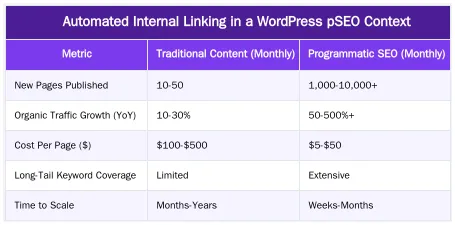
Automated Internal Linking in a WordPress pSEO Context
Internal linking is a critical SEO factor, and automating this process within a programmatic WordPress setup significantly enhances crawlability, indexability, and page authority distribution. For programmatic pages, a systematic approach to internal linking is essential. This can involve defining rules based on shared attributes within your dataset. For example, all pages about “services in London” could link to a central “London Services” hub page, and pages about “product X” could link to other “product X” variations.
WordPress offers several ways to implement automated internal linking. Custom code can be developed to query the database for related posts based on custom field values or taxonomies and then insert links dynamically into content or sidebars. Plugins can also assist in this, though custom solutions often provide more granular control for programmatic content. The objective is to create a logical, interconnected web of content that guides both users and search engine crawlers through your vast programmatic content library, improving the overall SEO performance of the site.
For detailed strategies on this, explore our guide on automated internal linking.
Challenges and Solutions in Programmatic SEO
While programmatic SEO offers immense potential, it comes with its own set of challenges. One primary concern is maintaining content quality and uniqueness across thousands of automatically generated pages. Without careful templating and enrichment, pages can appear repetitive or thin, potentially leading to search engine penalties. The solution involves robust template design, incorporating AI for content variation, and ensuring each page provides distinct value based on its specific data points.
Another challenge is managing the technical complexity of data integration, template rendering, and automated publishing. This often requires development expertise and a solid understanding of WordPress’s backend. Scalability issues, such as database performance with a high volume of posts, also need consideration. Solutions include optimizing database queries, using caching mechanisms, and potentially leveraging a CDN. Regular monitoring of search engine indexing and traffic is also crucial to identify and address any issues promptly, ensuring the long-term success of the strategy.
Programmatic SEO Results and Case Studies
Businesses that successfully implement programmatic content generation often report substantial gains in organic traffic and search visibility. These results typically manifest as a significant increase in indexed pages, leading to a broader footprint in search engine results for long-tail queries. For instance, a real estate portal might generate thousands of pages for “apartments for rent in [city, neighborhood, number of bedrooms],” capturing highly specific local search demand.
The return on investment (ROI) for programmatic content can be considerable, as the initial development cost is amortized over a vast number of pages that continue to drive traffic over time. Companies have observed traffic increases ranging from 50% to over 500% within months of launching a well-executed programmatic strategy. This growth is often accompanied by improved lead generation and conversions, as the content directly addresses user intent. The key to these successes lies in meticulous planning, high-quality data, and continuous optimization.
Transform Your Content Strategy with Programmatic SEO
Programmatic content generation on WordPress offers a powerful pathway to scale your content efforts, capture niche search demand, and drive significant organic growth. By leveraging structured data, intelligent templating, and WordPress’s flexible architecture, businesses can unlock new levels of efficiency and market reach. This approach is not merely about automation; it’s about strategic content expansion that delivers measurable results.
Ready to explore how a tailored programmatic SEO solution can revolutionize your digital presence and content strategy? Discover how to implement these advanced techniques and achieve scalable content generation. Learn more about our programmatic SEO solutions and services.
Conclusion
Programmatic SEO on WordPress represents a strategic imperative for businesses aiming to dominate their niche in 2026. By automating the creation of vast amounts of targeted content, it addresses the challenges of scalability, cost, and long-tail keyword coverage. The flexibility of WordPress, combined with intelligent data management and AI-driven content enrichment, provides a robust framework for success. Implementing this model requires careful planning and execution, but the potential for exponential organic traffic growth and enhanced search visibility makes it a worthwhile investment. Embrace programmatic content generation to build a truly scalable and impactful content strategy.
Frequently Asked Questions
How does Ruxi Data simplify programmatic SEO on WordPress?
Ruxi Data provides a comprehensive platform for implementing programmatic SEO on WordPress. It connects to various data sources, uses AI to transform raw data into unique, long-form content based on customizable templates, and automates the entire publishing process. This includes generating thousands of optimized pages directly within your WordPress environment.
What kind of data sources are suitable for a programmatic SEO WordPress campaign?
You can leverage a wide array of structured data sources for these campaigns,
Ruxi Data brings together multi-model AI, automated website crawling, live indexation checks, topical authority mapping, E-E-A-T enrichment, schema generation, and full pipeline automation — from crawl to WordPress publish to social posting — all in one platform built for agencies and freelancers who run on results.