
Product Entity Optimization: Dominating the Saas Knowledge Graph
Product entity optimization is crucial for SaaS visibility, moving beyond keywords to establish software as a distinct entity in Google’s Knowledge Graph. This strategy involves defining, structuring, and connecting product information using precise structured data like Schema.org markup. Effective product entity optimization ensures search engines understand your product’s features, pricing, and relationships, enhancing brand visibility through Google Knowledge Panels and satisfying high-intent search queries. Mastering product entity optimization is essential for achieving significant organic growth and establishing topical authority in the competitive SaaS market.
Our expertise at AbdurrahmanSimsek.com focuses on cutting-edge SEO strategies, ensuring ethical practices and measurable outcomes. We are committed to delivering high-quality, data-driven solutions that build lasting brand authority and drive sustainable growth for our clients.
To explore your options, contact us to schedule your consultation.
Effective product entity optimization is the cornerstone of a successful SaaS SEO strategy in 2026, moving beyond simple keywords to establish your software as a distinct, authoritative entity in Google’s eyes. In the crowded software market, simply ranking is not enough; you must own your brand’s presence in the search results. This guide provides a comprehensive framework for leveraging structured data and entity-based SEO to dominate the Knowledge Graph, enhance brand visibility, and drive meaningful organic growth for your SaaS business.
What is Product Entity Optimization for SaaS?
Product entity optimization (PEO) for SaaS is the process of defining, structuring, and connecting your software product’s information so that search engines like Google can understand it as a distinct, real-world entity. Instead of just seeing a collection of keywords on a page, the search engine recognizes your product, its features, pricing, reviews, and its relationship to your company and competitors.
This is achieved by creating a consistent and machine-readable identity for your product across the web. The core of this practice relies on deploying precise structured data, such as Schema.org markup, on your website. This data acts as an explicit set of instructions, telling Google exactly what your product is and how it fits into the broader digital ecosystem. By doing so, you feed Google’s Knowledge Graph, the massive database it uses to power rich results and Knowledge Panels, ensuring your SaaS is represented accurately and authoritatively.
Why is the Knowledge Graph Crucial for SaaS Brand Visibility?
Securing a place in Google’s Knowledge Graph is no longer a vanity metric; it’s a strategic imperative for SaaS companies. When Google understands your product as an entity, it can feature it in highly visible search elements like the Google Knowledge Panel. This branded box, appearing on the right side of search results, acts as a digital business card, instantly conveying credibility and authority.
A strong Knowledge Graph presence directly addresses high-intent user searches. When a potential customer searches for your brand, a detailed Knowledge Panel provides immediate answers about your company, product category, and customer ratings. This satisfies search intent quickly, increases click-through rates to your site, and builds a foundation of trust before a user even visits your homepage. It transforms a simple search result into a rich, interactive, and trustworthy brand experience, setting you apart from competitors who remain just a list of blue links.
Enhancing Trust and Authority in Search
A verified and comprehensive Knowledge Panel is a powerful signal of legitimacy. It shows that Google has understood, verified, and connected information about your SaaS from multiple authoritative sources. This digital validation builds immense user trust. For potential buyers evaluating complex SaaS solutions, this perceived authority can be the deciding factor, positioning your product not just as an option, but as a recognized leader in its category.
Crafting Your SaaS Product’s Digital Identity: A Practical Guide
Implementing effective product entity optimization begins with a strategic approach to your data. The goal is to create a single, consistent “source of truth” about your product that search engines can easily parse and trust. This involves identifying your product’s key attributes—such as its name, features, pricing model, target audience, and unique identifiers—and ensuring this information is uniform across your website, social profiles, and third-party directories like G2 or Capterra.
The most critical technical step is the implementation of Schema markup. This structured data vocabulary allows you to explicitly define your product’s attributes in a language search engines understand. By correctly marking up your product pages, you leave no room for ambiguity, directly influencing how Google represents your software in search results. For a deeper dive into implementation, explore our complete guide to entity schema markup.
Essential Schema Markup for SaaS Products
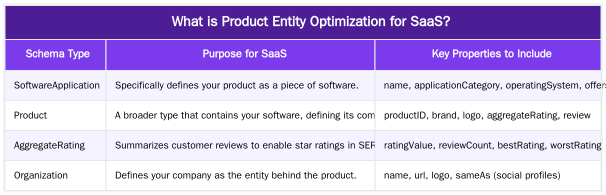
Choosing the right schema types is crucial for conveying the specific nature of a SaaS product. While there are hundreds of types available on Schema.org, a few are non-negotiable for software companies aiming for high visibility.
Automating Product Entity Optimization with Ruxi Data
While the principles of product entity optimization are clear, manual implementation can be complex, time-consuming, and prone to error, especially for SaaS companies with multiple products or dynamic pricing pages. This is where automation becomes a competitive advantage. At Abdurrahman Simsek, we developed Ruxi Data to solve this exact challenge, providing a sophisticated platform that streamlines and automates the entire PEO workflow.
Ruxi Data leverages AI to analyze your product pages, automatically generate the most precise and comprehensive Schema markup, and deploy it without requiring developer resources. Our platform ensures that your structured data remains accurate and up-to-date, adapting to any changes on your site. This removes the technical barriers and ongoing maintenance burden, allowing your team to focus on strategy while our technology handles the complex execution of your product entity optimization efforts. This approach is grounded in years of experience helping SaaS businesses scale their SEO efforts effectively.
Streamlining Schema Generation and Deployment
The power of automation lies in its ability to manage complexity at scale. Ruxi Data doesn’t just create basic schema; it builds interconnected entity graphs that define the relationships between your company, products, reviews, and features. This level of detail is critical for achieving a dominant Knowledge Graph presence. By automating this process, you ensure 100% accuracy and consistency, which are vital signals for Google. Discover how to leverage Knowledge Graph SEO automation to gain an edge or explore our specialized solutions for automating schema for SaaS.
The Tangible ROI: What to Expect from PEO for SaaS
Investing in product entity optimization delivers measurable returns that go far beyond search rankings. The primary benefit is a significant increase in high-quality organic traffic. By securing rich results like star ratings and detailed Knowledge Panels, you dramatically improve your visibility and click-through rates for branded and high-intent non-branded queries. This enhanced SERP real estate captures user attention and drives more qualified leads directly to your website.
Furthermore, a strong entity presence builds a powerful competitive moat. It solidifies your brand’s authority, making it more difficult for competitors to rank for your branded terms or appear as a credible alternative. Over time, this leads to a sustainable increase in organic market share, higher brand recognition, and a lower customer acquisition cost as you become less reliant on paid channels. The impact of a well-executed PEO strategy is not just an SEO win; it’s a core business growth driver.
Measuring Success: Key Metrics for PEO
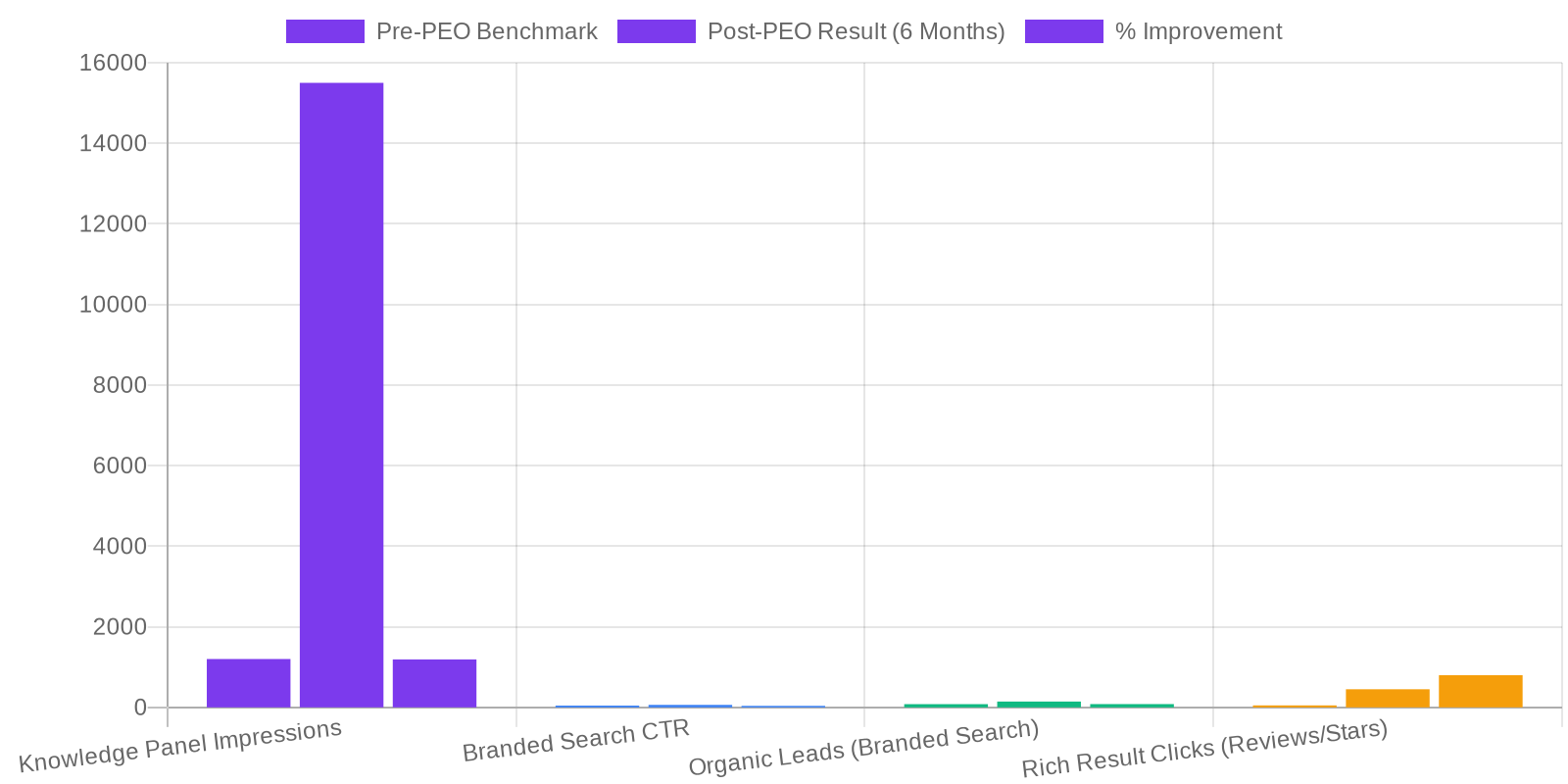
Tracking the right KPIs is essential to demonstrate the value of your PEO efforts. Monitor these metrics in your analytics and Google Search Console to see the direct impact on your performance.
Ready to Transform Your SaaS Visibility?
In the competitive 2026 market, leaving your brand’s digital identity to chance is not an option. A proactive and precise product entity optimization strategy is essential for capturing attention, building trust, and driving sustainable growth. By clearly defining your product for search engines, you take control of your narrative in the SERPs and build a lasting competitive advantage.
If you’re ready to unlock the full potential of your SaaS product in search, it’s time to move beyond traditional SEO. Let us show you how to build a dominant presence in the Knowledge Graph.
Conclusion
Ultimately, product entity optimization is about transforming your SaaS product from a set of web pages into a recognized, authoritative entity. This strategic shift is critical for standing out in a crowded market, building user trust, and capturing high-intent organic traffic. By implementing precise structured data, resolving brand ambiguity, and leveraging automation, you can secure a dominant position in Google’s Knowledge Graph. This isn’t just an advanced SEO tactic; it is the future of building a resilient and visible SaaS brand online. To start building your authoritative digital presence, explore the solutions at https://abdurrahmansimsek.com today.
Frequently Asked Questions
What is product entity optimization in the context of SaaS?
In the context of SaaS, product entity optimization is the process of structuring your software’s information so search engines understand it as a distinct “thing” or entity. This involves using consistent data and Schema markup to clearly define your product’s features, purpose, and relationships. The goal is to secure an accurate and authoritative representation in Google’s Knowledge Graph.
Why is product entity optimization so important for SaaS companies?
Effective product entity optimization is crucial because it helps Google understand your product’s specific value, leading to better visibility in search results. It increases your chances of appearing in rich results and Knowledge Panels, which builds brand authority and trust. This process directly helps potential customers find your solution when they need it most.
What are the first steps for product entity optimization?
The first steps involve clearly defining your product’s core attributes, such as its name, features, target audience, and pricing, across your website. You should then implement structured data, like Product and Offer Schema, to communicate this information to search engines in a machine-readable format. Ensuring this data is consistent everywhere it appears online is a key part of successful product entity optimization.
What types of Schema markup are crucial for SaaS product entities?
For SaaS products, the most crucial types of Schema markup are Product, Offer, and Review. Product Schema defines the software itself, Offer Schema details pricing and subscription plans, and Review Schema displays user ratings. Together, they provide a comprehensive picture for search engines to understand and feature your product.
Can this optimization help with competitive differentiation?
Yes, by clearly defining your unique features, benefits, and integrations as distinct entities, you can differentiate your SaaS offering from competitors in the Knowledge Graph. This makes it easier for both search engines and users to understand what makes your product unique. It helps you stand out in a crowded market by highlighting your specific value proposition.
How does a tool like Ruxi Data assist with product entity optimization?
Ruxi Data helps automate the technical aspects of product entity optimization by generating precise Schema markup for your SaaS product. It ensures that the structured data for your product, offers, and reviews is correctly implemented. This saves time and reduces the risk of errors, allowing search engines to more easily index and understand your product entity.
Ruxi Data brings together multi-model AI, automated website crawling, live indexation checks, topical authority mapping, E-E-A-T enrichment, schema generation, and full pipeline automation — from crawl to WordPress publish to social posting — all in one platform built for agencies and freelancers who run on results.