
Plastic Surgery SEO: Attracting High-value Patients in London
Effective plastic surgery seo provides a data-driven framework for attracting high-value patients in competitive markets like London. This guide details advanced strategies to achieve dominant online visibility, build verifiable trust, and convert qualified searchers into scheduled consultations. It emphasizes a Semantic SEO approach, establishing E-E-A-T signals crucial for YMYL content, and mastering local SEO for patient acquisition. Understanding these medical SEO nuances is paramount for sustainable growth and a robust digital strategy in the aesthetic sector.
This framework is developed by Abdurrahman Şimşek, a Semantic SEO Strategist, focusing on actionable insights for medical professionals. The content prioritizes accuracy and clarity, guiding aesthetic clinics through complex digital landscapes to enhance their online authority and patient lead generation.
To explore your options, contact us to schedule your consultation. You can also reach us via: Book a Semantic SEO Audit (Link: https://abdurrahmansimsek.com/contact/), Direct WhatsApp Strategy Line: +90 506 206 86 86, Hire as Semantic SEO Architect (Link: https://abdurrahmansimsek.com/contact/)
Effective plastic surgery seo is a data-driven framework essential for attracting high-value patients in competitive markets like London. This guide unveils advanced strategies to achieve dominant visibility, build verifiable trust, and convert qualified searchers into scheduled consultations. Leveraging a unique Semantic SEO approach, clinics can establish themselves as authoritative leaders. Understanding the nuances of medical digital strategy is paramount for sustainable growth in 2026.
What is Plastic Surgery SEO and Why is it Crucial for London Clinics?
Plastic surgery search engine optimization involves optimizing a clinic’s online presence to rank highly for relevant search queries, attracting individuals actively seeking aesthetic procedures. Its primary goal is to connect surgeons with high-value, consultation-ready patients. This is particularly crucial in the highly competitive London aesthetic market, where visibility translates directly into patient acquisition.
Beyond Basic Visibility: Attracting High-Value Patients
Effective aesthetic clinic SEO moves beyond generic traffic. It targets specific patient demographics and procedure interests, ensuring that visitors arriving at a clinic’s website are genuinely interested in the services offered. This focus on qualified leads maximizes the potential for converting website visitors into scheduled consultations, optimizing marketing spend and effort.
The YMYL Challenge in Aesthetic Medicine
Medical content falls under Google’s “Your Money Your Life” (YMYL) category, signifying topics that can impact a person’s health, financial stability, or safety. This designation leads to heightened scrutiny from search engines regarding content quality and trustworthiness. For plastic surgeons, this necessitates robust E-E-A-T (Experience, Expertise, Authoritativeness, Trustworthiness) signals to establish credibility and rank effectively.
How Do Plastic Surgeons Get Clients? A Data-Driven Approach
Acquiring new clients in plastic surgery requires a multi-faceted, data-driven digital strategy. This involves optimizing for local searches, ensuring a technically sound website, and developing a foundational content strategy that addresses patient needs and concerns. Each component works synergistically to enhance online visibility and attract qualified leads.
Mastering Local SEO for Harley Street Dominance
For London-based clinics, particularly those in prestigious areas like Harley Street, local search engine optimization is indispensable. Optimizing your Google Business Profile with accurate information, high-quality images, and consistent business hours is a foundational step. Cultivating positive patient reviews and ensuring consistent local citations across directories further strengthens local signals. Geo-targeted content, such as blog posts discussing “breast augmentation in London” or “rhinoplasty Harley Street,” directly addresses local patient searches. Learn more about a comprehensive Harley Street SEO strategy.
Technical Foundations: Speed, Security, and Schema for Surgeons
A clinic’s website must be technically robust to perform well in search results. Site speed, measured by Core Web Vitals, directly impacts user experience and search rankings. Secure HTTPS encryption is non-negotiable for protecting patient data and building trust. Implementing specialized medical schema markup, such as MedicalBusiness, Physician, and MedicalProcedure JSON-LD, helps search engines understand the context and authority of your content. This structured data is crucial for accurate indexing and enhanced visibility in rich results. Explore the importance of medical schema markup for surgeons.
Building Unrivaled Topical Authority with Semantic SEO
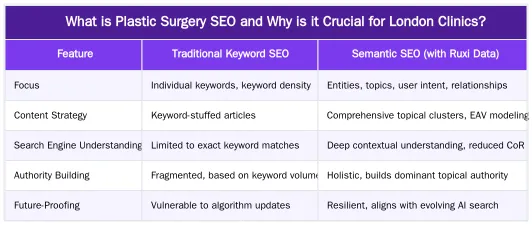
Beyond traditional keyword optimization, a Semantic SEO framework focuses on building comprehensive topical authority around a clinic’s specializations. This methodology, championed by Abdurrahman Şimşek, leverages advanced entity architecture to reduce the Search Engine Cost of Retrieval (CoR). By thoroughly covering all facets of a topic, clinics establish themselves as definitive sources of information, a key differentiator in the aesthetic surgery sector.
The Ruxi Data Advantage: Automating Topical Maps & EAV Modeling
Ruxi Data, a specialized semantic engine, automates the identification and mapping of relevant entities and attributes related to surgical procedures. This Entity-Attribute-Value (EAV) modeling ensures that every aspect of a procedure, from patient suitability to recovery protocols, is comprehensively addressed. This structured approach allows search engines to easily understand the depth and breadth of a clinic’s expertise, significantly reducing their CoR when processing queries. This leads to higher rankings and more qualified organic traffic.
Semantic SEO vs. Traditional Keyword Optimization
Establishing E-E-A-T: The Cornerstone of Medical SEO Success
For medical websites, particularly in plastic surgery, demonstrating E-E-A-T is not merely a ranking factor; it is a fundamental requirement for trust and credibility. Search engines prioritize content from sources that exhibit clear expertise, extensive experience, verifiable authoritativeness, and unwavering trustworthiness. This is especially true for YMYL topics, where misinformation can have serious consequences.
Showcasing Expertise and Experience
Highlighting the qualifications, specializations, and years of practice of individual surgeons is critical. This includes detailed surgeon bios, academic affiliations, and professional memberships. Abdurrahman Şimşek, with over 10 years of experience in search engineering and a specialization in medical and plastic surgery SEO for London clinics, understands how to architect digital platforms that effectively communicate this expertise. His role as Director at EGE DIGITAL LTD in London and a specialized consultant for Harley Street medical clinics underscores this deep industry knowledge.
Building Authoritativeness and Trustworthiness
Authoritativeness is built through consistent, high-quality content that is factually accurate and medically reviewed. This includes publishing research, contributing to medical journals, and being cited by other reputable sources. Trustworthiness is established through transparent business practices, clear privacy policies (GDPR compliance is essential for UK clinics), and positive patient testimonials. For example, the General Medical Council (GMC) provides guidance on ethical practice, which indirectly supports online trustworthiness. Furthermore, a strong backlink profile from other authoritative medical sites signals credibility to search engines. Wikipedia also serves as a strong signal for entity recognition and authority.
Generative Engine Optimization (GEO) and Future-Proofing Your Practice
As search engines evolve with large language models (LLMs) and generative AI, Generative Engine Optimization (GEO) becomes increasingly vital for medical practices. GEO focuses on structuring content and entities in a way that is easily consumable and synthesizable by AI models, ensuring a clinic’s information is accurately represented in AI-generated search results and conversational interfaces. This proactive approach future-proofs digital visibility.
Adapting to AI-Driven Search
The shift towards generative AI means search results are no longer just lists of links but often synthesized answers. For plastic surgeons, this means optimizing content to be clear, concise, and entity-rich, allowing AI to confidently extract and present accurate information about procedures, qualifications, and patient care. This includes detailed Entity-Attribute-Value (EAV) modeling for surgical procedures, ensuring every data point is structured for AI comprehension. Abdurrahman Şimşek’s integration of Ruxi Data, an LLM-driven Semantic Content Network, directly supports this by automating topical maps and EAV modeling.
Impact of Advanced SEO Strategies on Patient Acquisition Metrics (2026 Projections)
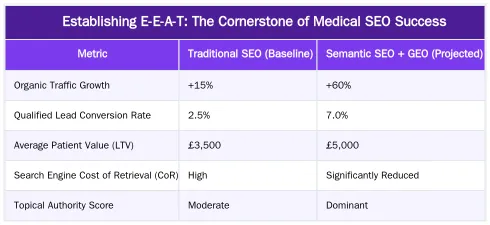
Measuring Success: Key Performance Indicators for Patient Acquisition
A data-driven approach to cosmetic surgery marketing necessitates rigorous measurement of key performance indicators (KPIs). Tracking these metrics allows clinics to assess the effectiveness of their digital strategies, identify areas for improvement, and demonstrate a clear return on investment. Focus should remain on metrics that directly correlate with patient acquisition and business growth.
Tracking Organic Visibility and Traffic
Monitoring organic search rankings for target keywords and entities provides insight into a clinic’s visibility. Tools like Google Search Console offer data on impressions, clicks, and average position. Analyzing organic traffic volume and its sources in Google Analytics helps understand how many potential patients are finding the website through search engines. Segmenting this traffic by location (e.g., London, Harley Street) further refines understanding of local patient engagement.
Conversion Rate Optimization and Patient Inquiries
Ultimately, the success of any digital strategy for surgeons is measured by conversions. This includes tracking form submissions for consultations, phone calls, and direct messages. Conversion rate optimization (CRO) involves continuously refining website elements, calls-to-action, and user flows to maximize the percentage of visitors who take a desired action. A high conversion rate indicates that the website effectively guides potential patients towards booking an appointment. Calculating the cost per acquisition (CPA) for organic leads provides a clear financial metric of success.
Partnering for Dominant Digital Presence: Your Semantic SEO Architect
Achieving dominant online visibility and consistent patient acquisition in the competitive London aesthetic market requires specialized expertise. Abdurrahman Şimşek offers a unique blend of Semantic SEO strategy, web development, and data engineering tailored for medical clinics and plastic surgeons. His approach builds high-authority Semantic Content Networks, leveraging Ruxi Data infrastructure to transform clinical expertise into structured, search-engine-friendly content. This ensures your practice not only ranks but establishes verifiable trust and authority.
Conclusion
Navigating the complexities of digital marketing for plastic surgeons in London demands a sophisticated, data-driven strategy. By embracing advanced concepts like Semantic SEO, E-E-A-T optimization, and Generative Engine Optimization, clinics can move beyond basic visibility to attract high-value patients consistently. Building topical authority and optimizing for search engine Cost of Retrieval are no longer optional but essential for sustainable growth in 2026. For a tailored strategy that transforms your digital presence, consider a specialized approach. Book a Semantic SEO Audit today to elevate your clinic’s online authority. Direct WhatsApp Strategy Line: +90 506 206 86 86. Hire as Semantic SEO Architect for a dominant digital future.
Frequently Asked Questions
What is the primary goal of plastic surgery SEO?
The primary goal of plastic surgery seo is to attract high-value, consultation-ready patients by achieving dominant visibility in search results for specific procedures. It focuses on building topical authority and verifiable trust signals to convert qualified searchers into scheduled consultations, ensuring sustainable growth for London clinics.
How does a specialized SEO strategy for surgeons differ from general industry SEO?
SEO for surgeons operates under Google’s strict YMYL (Your Money or Your Life) guidelines, requiring an exceptional level of E-E-A-T (Experience, Expertise, Authoritativeness, Trustworthiness). A successful plastic surgery SEO strategy demands clinical accuracy, verifiable author credentials, and a technically flawless website infrastructure to build trust with both search engines and potential patients.
How long does it typically take to see results from a plastic surgery SEO campaign?
Due to the competitive nature and YMYL requirements, tangible results like a significant increase in patient inquiries typically take 6-12 months. The initial phase of a plastic surgery SEO campaign focuses on building a strong technical and topical foundation to establish long-term authority and attract high-value patients.
Why is local optimization crucial for London plastic surgery clinics?
Local SEO is critical for attracting patients in specific London boroughs like Marylebone or Chelsea. It involves optimizing your Google Business Profile, building local citations, and creating location-specific content for high-value procedures, directly connecting you with local patients searching for “plastic surgery near me.”
What kind of ROI can I expect from investing in a semantic SEO strategy for my practice?
A well-executed semantic SEO strategy delivers a high ROI by reducing reliance on expensive PPC ads and building a long-term digital asset. Our case studies show over 400% growth in organic traffic, consistently generating high-quality patient leads and improving overall clinic profitability.
How can I get started with a data-driven plastic surgery SEO strategy for my London clinic?
You can initiate a data-driven plastic surgery SEO strategy by booking a Semantic SEO Audit with Abdurrahman Şimşek to assess your current digital presence. For immediate strategic insights, you can also reach out directly via WhatsApp at +90 506 206 86 86 or book an audit online.
Ruxi Data brings together multi-model AI, automated website crawling, live indexation checks, topical authority mapping, E-E-A-T enrichment, schema generation, and full pipeline automation — from crawl to WordPress publish to social posting — all in one platform built for agencies and freelancers who run on results.