
Pillar Page SEO: Maximizing Authority and Organic Traffic
Mastering pillar page SEO is essential for building unparalleled digital authority and driving organic traffic. This guide details how to structure hub content effectively, transforming your website into a recognized expert. By implementing a robust pillar page SEO strategy, you will learn to create comprehensive topic clusters, leverage the hub-and-spoke model, and optimize internal linking for semantic relevance. This approach ensures your content satisfies user intent, leading to higher search engine visibility and sustained organic growth through effective pillar page SEO implementation.
AbdurrahmanSimsek.com is committed to delivering high-quality, actionable SEO insights that drive tangible results. Our content prioritizes accuracy, ethical practices, and practical strategies designed to empower businesses. We aim to build trust and establish expertise by providing reliable, outcome-focused guidance for digital success.
To explore your options, contact us to schedule your consultation.
Mastering the pillar page SEO strategy is crucial for unlocking unparalleled SEO authority and driving organic traffic in 2026. This comprehensive guide will walk you through structuring hub content effectively, transforming your website into a recognized expert in your niche and outranking competitors. By understanding semantic relevance, user intent, and strategic internal linking, you can build a robust content architecture that Google rewards with higher visibility and sustained organic growth.
What is a Pillar Page SEO Strategy?
A pillar page SEO strategy centers around creating a comprehensive, authoritative piece of content that broadly covers a core topic. This “pillar” then links out to more specific, in-depth articles, known as cluster content, forming a cohesive topic cluster. This hub-and-spoke model signals to search engines that your website is a definitive authority on the overarching subject, improving rankings and user experience.
Defining Pillar Pages vs. Blog Posts
The fundamental difference between a pillar page and a traditional blog post lies in their scope and purpose. A blog post typically addresses a narrow, specific query, often targeting a long-tail keyword. For example, “best SEO tools for small businesses.” In contrast, a pillar page tackles a broad subject, such as “SEO Strategy,” providing a high-level overview and acting as a central resource. It aims to answer many related questions, serving as a gateway to more detailed content.
The Core Concept of Topic Clusters
Pillar pages are the central hub of a topic cluster. Imagine a wheel: the pillar page is the hub, and the spokes are the individual cluster content pieces. Each spoke delves deeper into a subtopic mentioned on the pillar page. For instance, a “Content Marketing” pillar page might link to cluster content on “Keyword Research,” “Blogging Best Practices,” and “Content Promotion Strategies.” This interconnected structure builds semantic relevance and strengthens internal linking, crucial for modern SEO.
How to Structure a Pillar Page for Maximum Impact
Creating an effective pillar page requires meticulous planning and a user-centric approach. The goal is to build a piece of content that is both exhaustive for search engines and easy to navigate for human readers. A well-structured pillar page acts as a definitive guide, ensuring all essential subtopics are covered and interconnected.
Mapping User Intent and Comprehensive Subtopics
The first step in structuring a pillar page is to deeply understand user intent. Go beyond basic keyword research to uncover the underlying questions and problems users are trying to solve. Conduct thorough content gap analysis by examining top-ranking competitors and “People Also Ask” sections. Identify all essential subtopics that collectively provide a complete overview of your broad pillar topic. This ensures your pillar page is truly comprehensive, addressing every facet of the user’s journey. Consider the various stages of the buyer’s journey – awareness, consideration, decision – and ensure your pillar page offers relevant information for each.
Crafting a Robust Internal Linking Strategy
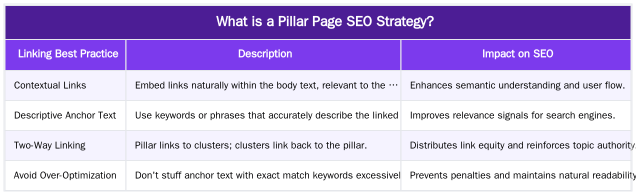
Internal linking is the backbone of a successful pillar page SEO strategy. The pillar page should link to all relevant cluster content, and conversely, all cluster content should link back to the pillar page. This creates a strong, interconnected web that distributes link equity and signals semantic relationships to search engines. Use descriptive, keyword-rich anchor text that accurately reflects the content of the linked page. For more on building effective content relationships, explore how to build topic clusters.
Automating Pillar Page Strategy with AI Tools
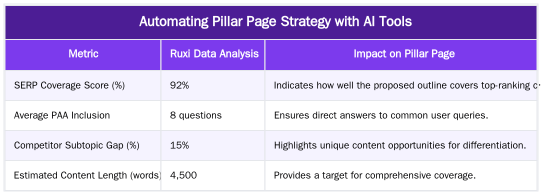
The complexity of researching, outlining, and structuring a comprehensive pillar page can be significantly streamlined using advanced AI tools. Platforms like Ruxi Data leverage sophisticated algorithms to analyze vast amounts of SERP data, providing invaluable insights that accelerate the creation of high-impact pillar content. This integration of technology showcases a commitment to efficiency and data-driven content creation, enhancing E-E-A-T.
Identifying Core Subtopics with Ruxi Data
Ruxi Data plays a pivotal role in identifying the essential subtopics for a comprehensive pillar page. By analyzing top-ranking results, “People Also Ask” (PAA) sections, related searches, and competitor content, Ruxi Data can generate a detailed list of subtopics that a pillar page must cover to be truly authoritative. This process goes beyond basic keyword research, delving into the semantic relationships and user queries that define a topic. For example, for a “SaaS SEO” pillar, Ruxi Data might identify subtopics like “churn rate impact on SEO,” “API integration for data analysis,” and “LTV optimization strategies,” ensuring exhaustive coverage. This answers the question, “How does Ruxi Data help create a pillar page SEO strategy?” by providing a data-backed blueprint.
Streamlining Outline Generation and Content Planning
Once core subtopics are identified, AI tools like Ruxi Data can further assist in structuring content into logical H2s and H3s. This automated outline generation ensures that the pillar page covers all necessary angles in a coherent, user-friendly manner. It helps content teams efficiently plan their writing process, allocate resources, and ensure no critical information is missed. This not only saves time but also guarantees a higher quality, more comprehensive output, making the pillar page SEO process more scalable and effective.
Implementing 10x Content Principles for Pillar Pages
Creating a pillar page isn’t just about covering a topic; it’s about creating content that is 10 times better than anything else currently available. This “10x content” philosophy, popularized by Rand Fishkin, is particularly vital for pillar pages, as they are designed to be the ultimate resource. It requires going above and beyond in terms of depth, originality, and presentation.
Beyond Basic Research: Deep Dive into Content Gaps
To achieve 10x content, your research must extend far beyond what competitors are doing. This involves a rigorous content gap analysis, not just identifying missing keywords, but uncovering unmet user needs and unaddressed angles within a topic. Look for areas where existing content is superficial, outdated, or poorly explained. This might involve conducting original research, interviewing experts, or analyzing proprietary data. The goal is to offer unique insights and a level of detail that no other resource provides, making your pillar page SEO truly stand out.
User-Centric Design and Multimedia Integration
Exceptional content isn’t just about text; it’s about how that information is presented and consumed. A 10x pillar page prioritizes user-centric design, employing clear headings, short paragraphs, and a logical flow. Integrate diverse multimedia elements such as custom infographics, explanatory videos, interactive tools, and high-quality images. These elements not only enhance engagement and understanding but also cater to different learning styles, making your pillar page an indispensable resource. Consider how a comprehensive topic cluster strategy workflow can help you plan this integration.
Information Architecture: The Foundation of Effective Pillar Pages
While internal linking is crucial, the broader concept of information architecture (IA) forms the fundamental framework for successful pillar pages. IA is about organizing and labeling content in an effective and sustainable way, ensuring users can easily find information and search engines can efficiently crawl and index your site. It’s the blueprint for your entire content ecosystem.
Structuring Content Silos for Optimal Crawlability
Effective information architecture creates clear content silos, which are thematic groupings of related pages. A pillar page naturally forms the entry point to a content silo. By ensuring that all cluster content related to a pillar is deeply interconnected and logically organized, you create a strong signal of topical authority. This structure helps search engine crawlers understand the relationships between your pages, improving their ability to index your content accurately and efficiently. Learn more about how to structure content silos for maximum SEO benefit.
Navigational Design for Enhanced User Flow
Beyond search engines, robust information architecture significantly enhances the user experience. A well-designed pillar page includes a clear table of contents, breadcrumbs, and intuitive navigation that allows users to move seamlessly between the pillar and its cluster content. This reduces friction, keeps users on your site longer, and encourages deeper exploration of your expertise. A positive user experience, characterized by easy navigation and quick access to information, is a strong ranking signal for Google, reinforcing the power of your pillar page SEO efforts.
Measuring Pillar Page Success and ROI
Implementing a pillar page strategy is a significant investment, and measuring its success is crucial for demonstrating value and optimizing future efforts. Tracking the right metrics allows you to understand the impact on organic traffic, authority, and ultimately, your business’s bottom line.
Key Performance Indicators (KPIs) to Track
To assess the effectiveness of your pillar page SEO, monitor a range of KPIs:
- Organic Traffic: Track the total organic sessions to your pillar page and its associated cluster content. Look for sustained growth over time.
- Keyword Rankings: Monitor rankings for your broad pillar keyword and the long-tail keywords targeted by your cluster content.
- Backlinks: Observe the number and quality of backlinks acquired by your pillar page, as this indicates its growing authority.
- Engagement Metrics: Analyze bounce rate, time on page, and pages per session for both the pillar and cluster content.
- Conversions: Measure how many users convert after interacting with your pillar page or its cluster content.
These metrics provide a holistic view of your content’s performance and its contribution to your SEO goals.
Calculating the Long-Term ROI of Topic Clusters
Calculating the Return on Investment (ROI) for pillar pages and topic clusters requires a long-term perspective. This isn’t about immediate sales but about building sustainable organic authority. Consider the cumulative value of increased organic traffic, improved brand visibility, reduced customer acquisition costs, and enhanced lead generation over months and years. By attributing conversions and leads to your content clusters, you can quantify the financial impact. For a detailed framework, refer to our guide on calculating the ROI of topic clusters. This strategic investment pays dividends by establishing your site as a trusted resource in your niche.
Ready to Transform Your SEO with Pillar Pages?
Implementing a robust pillar page SEO strategy can fundamentally change your website’s organic performance, establishing unparalleled authority and driving sustainable traffic. It’s a strategic investment in your content architecture that yields long-term benefits. If you’re ready to move beyond fragmented content and build a powerful, interconnected content hub, we can help. Discover how our expertise and tools can streamline your pillar page creation and elevate your SEO. Visit abdurrahmansimsek.com to learn more and start building your authoritative content clusters today.
Conclusion
The pillar page SEO strategy is more than just a content organization tactic; it’s a foundational approach to building true topical authority and enhancing user experience. By creating comprehensive hub content, strategically linking to detailed cluster pages, and leveraging advanced tools for research and planning, you can significantly boost your organic rankings and establish your brand as an industry leader. Embrace this powerful methodology to future-proof your SEO efforts and drive sustained growth in the competitive digital landscape of 2026. Start structuring your content for maximum impact and watch your authority soar.
This article was originally published on abdurrahmansimsek.com.
Frequently Asked Questions
What is a pillar page in SEO?
A pillar page is a comprehensive, central piece of content that broadly covers a core topic. It functions as a “hub” that links out to more detailed “cluster” pages, which explore specific sub-topics in depth. This structure signals topical authority to search engines and provides a clear, organized journey for users.
How should internal linking work in a pillar page SEO strategy?
In a proper pillar page seo strategy, the main pillar page must link out to every related cluster page. In turn, each cluster page must link back to the central pillar page. This creates a tightly-knit topic cluster that reinforces semantic relevance and helps search engines understand your site’s expertise.
What is the best way to structure content for pillar page SEO?
The best structure starts with a broad overview, followed by clearly defined sections using H2s and H3s that address key sub-topics. Each of these sections should briefly introduce the sub-topic and then link to a more detailed cluster page. This logical organization improves user experience and helps search engines crawl your content hierarchy effectively.
What makes a modern pillar page SEO strategy successful?
Beyond just comprehensive content, a successful pillar page seo strategy requires a strong information architecture and clean, semantic HTML. The content should also be treated as a living document, regularly updated to maintain accuracy and relevance. This focus on quality, structure, and freshness is key to achieving and maintaining high rankings.
How do you measure the success of a pillar page SEO strategy?
Measure success by tracking the organic traffic and keyword rankings for the entire topic cluster, not just the pillar page. A successful pillar page seo approach will show the pillar page ranking for broad terms while the cluster pages capture long-tail traffic. This combined lift in visibility demonstrates the strategy’s true return on investment.
Ruxi Data brings together multi-model AI, automated website crawling, live indexation checks, topical authority mapping, E-E-A-T enrichment, schema generation, and full pipeline automation — from crawl to WordPress publish to social posting — all in one platform built for agencies and freelancers who run on results.