
Multilingual SEO Automation: Scaling Global Content With AI Efficiency
Multilingual SEO automation leverages AI to transform international content strategies, enabling businesses to achieve global topical authority without extensive human translation. This approach goes beyond simple translation, focusing on semantic understanding, intent matching, and automating critical elements like hreflang implementation. It allows for rapid content localization and regional optimization, significantly reducing the cost and time associated with expanding digital presence across diverse language markets while maintaining SEO integrity.
Abdurrahman Şimşek, a Holistic SEO Strategist, emphasizes strategic content localization and AI-driven processes for achieving global topical authority. His insights highlight the importance of balancing automation with human oversight to ensure quality and E-E-A-T in multilingual content.
To explore your options, contact us to schedule your consultation.
Multilingual SEO automation is transforming how businesses scale their international content strategies, offering a powerful alternative to traditional translation methods. This guide explores how AI-powered solutions, like those leveraging Ruxi Data, enable brands to achieve dominant topical authority across global markets without relying solely on human translators. It ensures semantic accuracy and cultural relevance, addressing the core challenge of expanding digital presence efficiently and effectively in 2026.
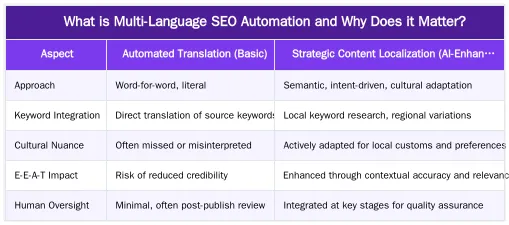
What is Multi-Language SEO Automation and Why Does it Matter?
Multi-language SEO automation refers to the use of artificial intelligence and machine learning to generate, translate, and optimize web content for multiple languages and regions. This process extends beyond simple word-for-word translation, focusing instead on adapting content to local search intent, cultural nuances, and specific SEO requirements for each target market. It matters because it allows businesses to achieve global reach and establish topical authority with unprecedented efficiency.
This approach signifies a fundamental shift from laborious manual translation workflows to scalable, AI-driven processes. By automating content localization, businesses can expand their digital footprint rapidly, penetrate new markets, and engage diverse audiences without the traditional overheads. The significance lies in its ability to maintain SEO integrity across all language versions, ensuring content ranks effectively in local search results. This efficiency translates directly into broader market penetration and a stronger international presence.
How Does AI-Powered Multilingual SEO Automation Work?
AI-powered multilingual SEO automation integrates advanced machine learning models with semantic engines to streamline the entire international content lifecycle. These systems analyze source content, identify key entities and concepts, and then generate or adapt content for target languages. This process involves more than just linguistic conversion; it encompasses understanding local search queries, keyword variations, and cultural contexts.
The automation extends to technical SEO elements crucial for international visibility. This includes the correct implementation of hreflang tags, managing URL structures, and ensuring proper language targeting. By leveraging AI, businesses can ensure consistency, accuracy, and compliance with search engine guidelines across all their global properties. This holistic approach to content and technical optimization is what makes automated international SEO a powerful strategy for global expansion.
Beyond Translation: Semantic Understanding and Intent Matching
Advanced AI goes beyond literal translation to understand and adapt content for local search intent and cultural nuances. This ensures the semantic meaning is preserved and optimized for target markets. Unlike basic machine translation, which often produces grammatically correct but contextually awkward text, semantic engines analyze the underlying meaning and purpose of the content. They then reconstruct it in the target language to resonate with local audiences and align with their search behavior.
For instance, a medical term might have different common usage or associated concepts in various regions. A semantic engine, like those integrated with Ruxi Data, identifies these differences and adapts the content accordingly. This deep understanding of language and intent is crucial for effective automated SEO workflow, ensuring content is not just translated, but truly localized and optimized for discovery.
Automating Hreflang and International Site Structure
Automation plays a pivotal role in managing the complexities of hreflang implementation and international site structure. Hreflang tags signal to search engines the relationship between different language versions of a page, preventing duplicate content issues and ensuring users land on the correct language version. Manually managing these tags for large, multilingual sites is prone to errors.
Automated systems generate and maintain hreflang tags, ensuring correct syntax, self-referencing, and bidirectional linking. They also assist in structuring international sites, whether through subdomains, subdirectories, or country-code top-level domains (ccTLDs). This minimizes technical SEO errors, improves crawlability, and ensures proper language targeting, which is essential for global search visibility.
Ensuring Quality & E-E-A-T in Automated Multilingual Content
Maintaining content quality, accuracy, and E-E-A-T (Experience, Expertise, Authoritativeness, Trustworthiness) is a critical challenge with automated translation, especially for YMYL (Your Money Your Life) content like medical information. While AI offers efficiency, human oversight, specialized AI models, and structured data are essential for high-quality, trustworthy multilingual content. For sensitive topics, such as those in the medical or plastic surgery sectors, precision and credibility are paramount.
Advanced AI systems are trained on vast datasets, including specialized medical glossaries and authoritative sources, to improve accuracy. However, the nuanced understanding of cultural sensitivities and ethical considerations often requires human review. Integrating structured data, such as JSON-LD schema for MedicalBusiness or Physician, further enhances E-E-A-T signals for search engines, providing clear, verifiable information about the content’s origin and expertise.
Balancing Automation with Human Oversight for Critical Content
Even with advanced automation, human review and editing remain necessary for sensitive or high-impact content. This ensures cultural appropriateness, factual accuracy, and brand voice consistency. For sectors like healthcare, where misinformation can have serious consequences, a hybrid approach combining AI efficiency with expert human validation is crucial. Human editors can catch subtle errors, adapt tone, and ensure content aligns with local regulations and ethical standards.
This balance ensures that while the bulk of content generation and translation is automated, critical pieces benefit from the nuanced judgment and specialized knowledge that only human experts can provide. This layered approach safeguards content quality and maintains the trust of the audience.
Leveraging EAV Models for Consistent Entity Representation Across Languages
Entity-Attribute-Value (EAV) modeling, as utilized by Ruxi Data, ensures consistent and accurate representation of entities across different languages. For example, medical procedures, conditions, or surgical techniques must be described uniformly and accurately, regardless of the language. EAV models define these entities and their attributes in a structured way, allowing AI to generate content that maintains semantic integrity across all linguistic versions.
This consistency is crucial for semantic SEO and E-E-A-T. Search engines can more easily understand and categorize content when entities are clearly defined and consistently presented. This structured approach helps build consistent entity representation, improving the content’s authority and trustworthiness in global search results.
Optimizing for Global Topical Authority: An Expert’s Perspective
As a London-based Holistic SEO Strategist and Semantic Engineer, Abdurrahman Şimşek emphasizes that multilingual SEO automation, when integrated into a holistic strategy, significantly contributes to building dominant topical authority across international markets. This is particularly vital for specialized niches like plastic surgery, where establishing expertise and trust is paramount. By systematically expanding content across languages, businesses can demonstrate comprehensive knowledge to search engines and users worldwide.
This strategic approach involves mapping out entire topical landscapes and then automating the creation and optimization of content for each language. It moves beyond simply translating existing content; it’s about generating new, semantically rich content tailored to local search demands. This method not only broadens reach but also solidifies a brand’s position as an authoritative source in its field globally.
Reducing Search Engine Cost of Retrieval (CoR) with Semantic Automation
Ruxi Data’s semantic engine and automated processes help reduce the computational ‘Cost of Retrieval’ (CoR) for search engines. By providing highly structured, relevant, and semantically clear content in multiple languages, search engines can more efficiently process, index, and rank information. This efficiency is achieved through precise entity-attribute-value modeling and the generation of clean, semantically rich HTML.
When content is organized logically and semantically, search engines expend less computational effort to understand its meaning and relevance. This can lead to improved indexing rates and potentially better rankings. For complex medical topics, ensuring this clarity across languages is a significant advantage, making content more accessible and understandable for both users and algorithms. Learn more about reducing Search Engine Cost of Retrieval (CoR).
Strategic Content Localization vs. Pure Translation for YMYL Domains
For YMYL content, such as medical advice or financial information, the strategic importance of localization far outweighs mere translation. Localization involves cultural adaptation and regional keyword research, ensuring content resonates deeply with local audiences and builds trust. This means understanding not just the language, but also the local regulations, cultural sensitivities, and common practices.
For example, a description of a cosmetic procedure might need different phrasing or emphasis in a market with distinct beauty standards or regulatory environments. Pure translation risks alienating audiences or, worse, providing inaccurate or inappropriate information. Strategic localization, supported by AI and human expertise, ensures content is not only accurate but also culturally relevant and trustworthy.
What ROI Can You Expect from Multilingual SEO Automation?
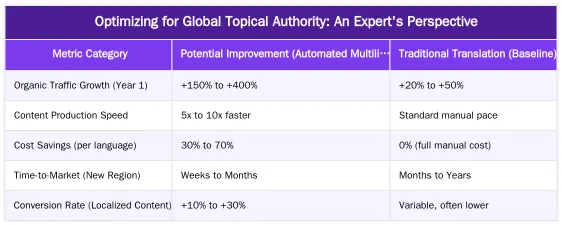
Implementing multilingual SEO automation yields tangible returns on investment. Businesses can expect significantly increased organic traffic from new international markets, expanding their global reach without proportional increases in manual effort. This leads to higher conversion rates as localized content resonates more effectively with regional audiences, fostering trust and engagement.
Furthermore, there are substantial cost savings compared to traditional, manual translation methods. Automation reduces the need for extensive human translation teams, proofreaders, and technical SEO specialists for each language. This efficiency also translates into faster time-to-market for new content and new regional launches, allowing businesses to capitalize on global opportunities more quickly. The combined effect is a powerful boost to revenue and market share.
Measuring Success: Key Metrics for International SEO Campaigns
To evaluate the effectiveness of multilingual SEO automation, specific KPIs and metrics must be monitored. These include localized organic traffic, which tracks visits from target regions and languages. Conversion rates per language or region provide insights into how well content is performing in driving business objectives.
Other important metrics include bounce rates and engagement metrics (e.g., time on page, pages per session) for each language version, indicating content relevance and user experience. Tracking keyword rankings in local search results and monitoring the overall growth in global topical authority are also crucial for assessing the long-term impact of an automated international SEO strategy.
Ready to Scale Your Global Reach with Automated SEO?
Expanding your digital presence across international markets requires a strategic approach that leverages the power of AI and semantic engineering. If your medical clinic or plastic surgery practice aims to achieve dominant topical authority and connect with a global audience, advanced multilingual SEO automation is the solution. Abdurrahman Şimşek specializes in building high-authority Semantic Content Networks, transforming clinical expertise into structured, globally optimized content. Discover how a holistic SEO strategy, powered by Ruxi Data infrastructure, can minimize search engine ‘Cost of Retrieval’ and elevate your international visibility.
Take the next step in global digital expansion. Visit abdurrahmansimsek.com to explore how tailored strategies can help you achieve unparalleled reach and authority.
Conclusion
Multi-language SEO automation is no longer a futuristic concept but a strategic imperative for businesses aiming for global dominance. By embracing AI-powered semantic engineering and holistic SEO frameworks, companies can transcend traditional language barriers. This approach ensures not just translation, but true localization that resonates culturally and drives measurable ROI. It allows for the achievement of significant topical authority and a reduction in the ‘Cost of Retrieval’ for search engines. Partnering with an expert in this field can transform your international content strategy, positioning your brand for sustained global growth in 2026 and beyond.
Frequently Asked Questions
How does Ruxi Data ensure translation quality for SEO?
Ruxi Data employs specialized AI models trained specifically for SEO, understanding search intent, optimal keyword placement, and cultural nuances. This ensures each translation maintains semantic accuracy while being optimized for local search behavior and achieving dominant topical authority.
Can automation handle region-specific keywords?
Yes, our system conducts thorough research into local search volumes and user intent for each target market. It intelligently adapts content to incorporate region-appropriate terminology and search phrases, ensuring maximum relevance and visibility for automated international SEO solutions.
What about duplicate content across languages?
Proper hreflang implementation is crucial to prevent duplicate content issues when deploying content via multilingual seo automation. Ruxi Data automatically generates and validates hreflang tags across all language variants, signaling to search engines that these are localized versions, not duplicates.
How does multilingual seo automation reduce costs and time?
Multilingual SEO automation significantly reduces both costs and deployment time compared to traditional human translation. Clients can save up to 85% on translation expenses, with a 100-page site in five languages taking days, not months, to deploy.
What is multilingual seo automation and why does it matter for global topical authority?
Multilingual SEO automation leverages AI-powered solutions, such as the Ruxi Data Semantic Engine, to generate and optimize international content at scale without relying solely on human translators. It matters because it enables brands to efficiently achieve dominant topical authority across global markets by ensuring semantic accuracy and cultural relevance in every language.
How can businesses get started with multilingual SEO automation using Ruxi Data?
Businesses can begin by contacting Abdurrahman Şimşek, a Holistic SEO Strategist, for an initial consultation. He will assess your international content strategy needs and demonstrate how Ruxi Data’s AI-powered solutions can scale your global presence and topical authority.
Ruxi Data brings together multi-model AI, automated website crawling, live indexation checks, topical authority mapping, E-E-A-T enrichment, schema generation, and full pipeline automation — from crawl to WordPress publish to social posting — all in one platform built for agencies and freelancers who run on results.