
Multi-model AI SEO: Streamlining Agency Workflows for 2026
The future of agency success in 2026 hinges on advanced multi-model ai seo, a strategy that orchestrates specialized AI models like GPT-4o, Claude, and Gemini for superior results. This article details the Ruxi Data workflow, demonstrating how multi-model ai seo moves beyond single-tool solutions to master SERP intelligence, content automation, and technical optimization. Agencies will learn to leverage this synergistic approach to build unbreakable topical authority, streamline WordPress publishing, and achieve greater scalability, ensuring superior client outcomes through comprehensive multi-model ai seo implementation.
Abdurrahman Simsek, through the Ruxi Data framework, is committed to delivering cutting-edge, ethical, and results-driven AI solutions for SEO agencies. Our expertise ensures clients achieve measurable growth and sustained digital presence, building trust and authority in a rapidly evolving landscape.
To explore your options, contact us to schedule your consultation.
The future of agency success hinges on advanced multi-model ai seo, a strategy that moves beyond single-tool solutions to create a powerful, integrated workflow. In 2026, relying on one AI for every task is no longer sufficient. This article details the Ruxi Data workflow, a system that orchestrates specialized models like GPT-4o, Claude, and Gemini to master everything from SERP intelligence and content automation to technical optimization. For agencies aiming to scale operations, build unbreakable topical authority, and deliver superior client results, understanding this synergistic approach is paramount.
What is Multi-Model AI in SEO?
Multi-model AI for SEO is an advanced strategy that utilizes a network of specialized artificial intelligence models, each chosen for its unique strengths, to execute a wide range of search engine optimization tasks. Instead of relying on a single, generalist AI, this approach assembles a “dream team” of models to achieve superior results.
Think of it like building a high-performance team. You wouldn’t ask your best writer to also be your lead data scientist and your top web developer. Similarly, a multi-model ai seo system assigns tasks to the most suitable AI. One model might excel at analyzing complex SERP data, another at crafting nuanced, long-form content, and a third at generating precise technical code like schema markup. This division of labor ensures that every component of your SEO strategy is handled by a specialist, leading to higher quality, greater efficiency, and more comprehensive optimization than any single model could achieve alone.
The Ruxi Data Workflow: A Synergy of Leading AI Models
The true power of multi-model ai seo is unlocked through intelligent orchestration. At Ruxi Data, we’ve developed a proprietary workflow that seamlessly integrates the distinct capabilities of today’s leading AI models—GPT-4o, Claude 3 Opus, and Gemini 1.5 Pro—to create a cohesive and powerful SEO engine. This isn’t just about using different tools; it’s about creating a production line where each model builds upon the work of the last.
Our process begins with Gemini, which leverages its vast context window and direct connection to Google’s ecosystem for unparalleled SERP intelligence. It analyzes top-ranking pages, identifies content gaps, and extracts key entities to build a data-driven content brief. This brief is then passed to Claude, renowned for its sophisticated writing style and ability to produce coherent, long-form narratives. Claude drafts the core article, focusing on readability and logical flow. Finally, GPT-4o acts as the refiner and optimizer, enhancing the draft with creative hooks, generating compelling meta descriptions, and structuring the content with perfect semantic HTML.
AI Model Roles in the Ruxi Data Workflow

This synergistic workflow ensures that every piece of content is not only well-written but also strategically aligned with search intent and technically flawless from the ground up. It’s a core component of an effective SEO workflow automation strategy for modern agencies.
Beyond Content Generation: Technical SEO and SERP Intelligence
While high-quality content is crucial, a successful multi-model ai seo strategy extends deep into the technical foundations of a website. In 2026, manual technical SEO is a bottleneck. Our workflow automates these complex tasks, ensuring that every piece of content is perfectly optimized for search engine crawlers from the moment it’s created.
One of the most significant advantages is the automated generation of semantic HTML and schema markup. Using a model like GPT-4o, our system can read the final content draft and instantly produce the correct JSON-LD schema (e.g., Article, FAQPage, HowTo) that explicitly tells search engines what the page is about. This drastically improves the chances of earning rich snippets and enhances visibility on the SERP.
Furthermore, the workflow integrates real-time SERP intelligence. Before any content is written, our system analyzes the current search landscape to understand user intent, common questions, and the formats that are performing best. This data-first approach ensures we’re not just creating content, but creating content engineered to rank. The final step is seamless publishing through our WordPress publishing integration, which immediately pings search engines via IndexNow integration. This reduces the time from creation to indexing from days to mere minutes, giving our clients a critical speed advantage.
Scalability and ROI: The Agency Game-Changer
For SEO agencies, the primary challenge has always been balancing quality with scale. The Ruxi Data multi-model ai seo workflow directly addresses this challenge, transforming it into a competitive advantage. By automating the most time-consuming aspects of content creation and technical optimization, agencies can dramatically increase their output without sacrificing quality or hiring a massive team.
This level of content automation allows senior SEO strategists to shift their focus from tedious execution to high-value activities like client strategy, competitive analysis, and exploring new growth opportunities. The return on investment (ROI) is multifaceted: reduced operational costs, faster delivery of client results, and the ability to take on more clients without a linear increase in overhead. This is the essence of scaling content production with an AI workflow.
Consider the efficiency gains. A process that once took a team of writers, editors, and SEO specialists 10-15 hours per article can now be completed in a fraction of the time, with greater data accuracy and technical precision. This is not about replacing human talent but augmenting it, creating a hybrid model where human expertise guides a powerful automation engine.
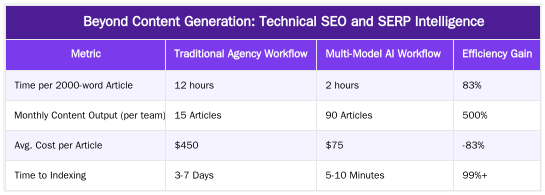
This data illustrates why adopting a multi-model ai seo framework is no longer optional for agencies that want to remain competitive and profitable in 2026. For a complete overview, see our agency SEO workflow automation guide.
Future-Proof Your Agency with Multi-Model AI
The SEO landscape of 2026 is defined by speed, intelligence, and scale. Relying on outdated, manual processes or single-model AI solutions is a recipe for falling behind. The Ruxi Data workflow represents the next evolution, providing a comprehensive system that leverages the best of AI to deliver consistent, high-quality results.
By embracing a multi-model ai seo strategy, your agency can move faster, operate more efficiently, and build deeper topical authority than ever before. This is your opportunity to stop managing tedious tasks and start architecting dominant search strategies for your clients. Don’t just adapt to the future of SEO—build it.
Conclusion
The shift towards multi-model ai seo is a defining moment for the industry. By intelligently combining the strengths of specialized models like GPT-4o, Claude, and Gemini, agencies can automate complex workflows, achieve unprecedented scale, and build formidable topical authority. The Ruxi Data system demonstrates that this is not a distant future, but a practical reality for 2026. To stay competitive and deliver exceptional value, agencies must adopt these integrated, data-driven strategies. Explore how to implement this transformative workflow for your agency at https://abdurrahmansimsek.com.
Frequently Asked Questions
What is multi-model AI for SEO?
Multi-model AI for SEO is an advanced strategy that uses a network of specialized AI models, like GPT-4o and Gemini, instead of relying on a single one. This approach allows agencies to assign the best AI for each specific task, from technical analysis to content creation. The Ruxi Data workflow exemplifies how a synergistic multi-model ai seo system can outperform single-model solutions.
Which AI models are used in Ruxi Data’s multi-model AI SEO workflow?
Ruxi Data’s platform integrates a suite of leading AI models to power its multi-model ai seo capabilities. This includes advanced large language models like GPT-4o for creative content, Claude for nuanced analysis, and Gemini for data synthesis. By orchestrating these specialized models, the system ensures optimal performance across all SEO functions.
How does multi-model AI SEO improve topical authority?
A multi-model ai seo strategy enhances topical authority by using different AI models to comprehensively analyze SERP data, identify content gaps, and generate E-E-A-T compliant articles. This layered approach ensures content is not only semantically rich and coherent but also precisely aligned with search intent. By covering a topic from multiple angles with specialized AI, it builds a more robust and authoritative presence.
Why is a multi-model AI SEO approach better than using a single AI tool?
Relying on a single AI tool creates limitations, as no single model excels at every SEO task. A multi-model ai seo approach assembles a “dream team” of specialized AIs, using each for its specific strengths in areas like data analysis or content generation. This synergy produces higher quality, more accurate, and more competitive results than any single-model solution can achieve.
How does Ruxi Data prevent generic AI content?
Ruxi Data avoids generic content by feeding its network of AI models with live SERP intelligence and proprietary data, not just generic training sets. This data-driven foundation ensures the output is relevant, timely, and tailored to specific search queries. The platform’s focus on technical perfection and E-E-A-T compliance further refines the content, making it rank-worthy and distinct.
Can Ruxi Data automate publishing for its multi-model AI SEO content?
Yes, automation is a core component of the Ruxi Data workflow. The platform includes automated publishing directly to WordPress, complete with built-in IndexNow integration. This ensures that the high-quality content generated by the system is published, crawled, and indexed by search engines with maximum speed and efficiency.
Ruxi Data brings together multi-model AI, automated website crawling, live indexation checks, topical authority mapping, E-E-A-T enrichment, schema generation, and full pipeline automation — from crawl to WordPress publish to social posting — all in one platform built for agencies and freelancers who run on results.