
Mobile-first Indexing Medical: Strategic Responsive Design for Clinics
Mobile-first indexing medical is critical for healthcare providers, as Google prioritizes mobile site versions for ranking. This article details how designing responsive websites for the patient journey enhances search visibility and user experience. It covers implementing responsive web design principles, optimizing for Core Web Vitals (LCP, CLS, FID), and understanding mobile usability to ensure medical content reaches prospective patients effectively. A strategic shift towards mobile-first development is essential for clinics aiming to improve patient acquisition and engagement through an optimized digital presence.
This content provides strategic insights for healthcare web development, emphasizing the importance of aligning technical SEO with patient needs. Abdurrahman Şimşek, a Semantic SEO Strategist, offers expertise in optimizing digital assets to meet Google’s evolving indexing standards and improve online visibility for medical practices.
To explore your options, contact us to schedule your consultation. You can also reach us via: Book a Semantic SEO Audit, Direct WhatsApp Strategy Line: +90 506 206 86 86
For medical clinics and plastic surgeons, mobile-first indexing medical is a requirement in 2026. Responsive websites designed for the patient journey enhance search rankings and user experience, ensuring your expertise reaches prospective patients on their preferred devices from initial research to booking consultations.
What is Mobile-First Indexing and Why Does it Matter for Doctors?
Mobile-first indexing means Google predominantly uses the mobile version of your website for crawling, indexing, and ranking. This is crucial for doctors because many patients access health information and research practitioners via mobile devices. An unoptimized mobile site directly impacts search visibility, making it harder for potential patients to find your services.
Google historically indexed desktop versions of sites. With most users now on mobile, the mobile version became the primary determinant of search performance. For medical practices, where patient research often begins on a phone or tablet, a comprehensive and user-friendly mobile site is paramount for patient acquisition.
Responsive Web Design: Crafting Seamless Patient Journeys on Mobile
Responsive web design ensures a website’s layout and content adapt to various screen sizes and orientations. For medical clinics, this delivers a consistent user experience (UX) across all devices, from desktop monitors to smartphone screens. This adaptability guides patients through their journey, from initial symptom research to booking a consultation.
Responsive design ensures critical information like service descriptions, doctor bios, and contact details is accessible on any device. The viewport meta tag is fundamental, instructing browsers how to control page dimensions and scaling. Without it, mobile browsers may render pages at desktop width, making text tiny and navigation difficult. A seamless experience builds trust and facilitates patient engagement, supporting the journey from discovery to conversion.
Key Elements of a Mobile-Optimized Patient Experience
- Intuitive Navigation: Simplified menus (e.g., “hamburger” icon) with clear pathways to essential information like services, about us, and contact pages.
- Readable Fonts: Text sized for mobile screens with sufficient contrast to prevent eye strain and ensure medical information is digestible.
- Touch-Friendly Elements: Buttons, links, and form fields large enough and spaced adequately for accurate tapping, reducing user frustration.
- Clear Calls-to-Action: Prominent, actionable buttons (e.g., “Book an Appointment,” “Call Now,” “Request a Consultation”) placed for easy conversion on smaller screens.
Core Web Vitals: Enhancing Mobile Performance for Medical Content
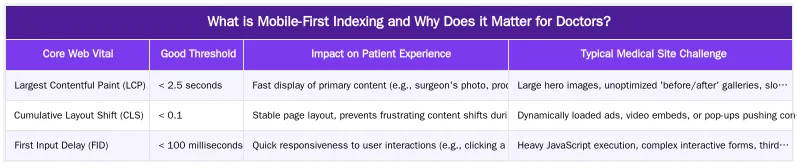
Core Web Vitals are metrics Google uses to quantify webpage user experience, directly impacting search rankings. For medical websites, optimizing these metrics—Largest Contentful Paint (LCP), Cumulative Layout Shift (CLS), and First Input Delay (FID)—is essential for patient perception and SEO. They assess loading performance, visual stability, and interactivity.
Medical site challenges include optimizing high-resolution ‘before and after’ galleries, which impact LCP. Video testimonials or dynamic content can cause CLS if elements shift during loading. Responsive and quick interactive forms for appointments are crucial for FID. Addressing these elements enhances the mobile user experience, signaling a high-quality interaction to Google.
Optimizing Visuals and Interactivity for Patient Trust
Image compression, lazy loading, and smooth transitions are vital for medical imagery and interactive elements. This optimization must not compromise quality or E-E-A-T (Experience, Expertise, Authoritativeness, Trustworthiness), especially for sensitive medical content. Optimizing high-resolution ‘before and after’ image galleries for LCP involves using modern image formats like WebP, implementing responsive images with `srcset`, and deferring off-screen images.
Core Web Vitals targets and their impact on patient engagement:
Beyond Mobile-Friendly: A Strategic Shift for Healthcare SEO
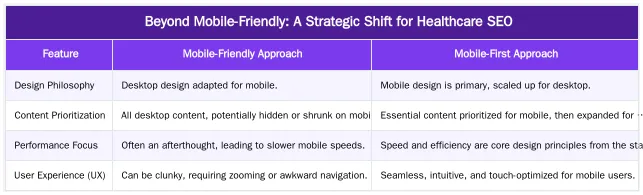
The distinction between a “mobile-friendly” and a “mobile-first” website is significant for YMYL (Your Money Your Life) medical content. A mobile-friendly site adapts desktop content for smaller screens by shrinking or stacking elements. A mobile-first site is designed with the mobile user experience as the priority, optimizing all content, functionality, and performance for smaller screens first; the desktop version is an adaptation of this mobile foundation.
For plastic surgery SEO in London, this shift is critical. Abdurrahman Şimşek’s expertise in semantic SEO and ‘Cost of Retrieval’ highlights how a mobile-first approach, integrated with entity-attribute-value (EAV) modeling, signals higher E-E-A-T to search engines. This structured delivery of information improves crawl efficiency for Googlebot, benefiting rankings for London clinics. An advanced technical SEO framework is essential.
The ‘Cost of Retrieval’ Advantage in Mobile-First Indexing
‘Cost of Retrieval’ is the resources (time, processing power, bandwidth) Google expends to crawl, index, and understand content. A streamlined, mobile-optimized site reduces this cost. A lean, fast, and semantically rich mobile experience helps Googlebot process complex medical information efficiently. This efficiency can lead to more frequent crawls, better indexing, and improved visibility and authority in search results. Understanding how to reduce the Cost of Retrieval is a key component of healthcare web development.
Implementing Mobile-First Best Practices: A Checklist for Clinics
To audit and optimize for mobile-first indexing, use tools like Google’s Mobile-Friendly Test and PageSpeed Insights. Improve page speed, ensure touch targets are appropriately sized, and confirm content is readable without zooming. Common pitfalls include hidden mobile content, slow loading from unoptimized images, and intrusive interstitials. Addressing these ensures a strong Harley Street SEO strategy.
Regularly test your site on various mobile devices to catch rendering inconsistencies. Prioritize a clean, semantic HTML5 structure to aid user experience and search engine understanding. An effective mobile-first indexing medical strategy requires continuous monitoring and iterative improvements to adapt to evolving user expectations and algorithm updates.
Ensuring Content Parity and Structured Data on Mobile
Content parity is a critical aspect of mobile-first indexing. All critical content (text, images, videos, internal links) on the desktop version must also be available and correctly rendered on the mobile version. Content missing from the mobile site will not be indexed by Google, regardless of its presence on desktop. All structured data (e.g., MedicalBusiness, Physician, MedicalProcedure schema) must also be present and correct on the mobile version to help search engines understand your practice’s entities and attributes.
Consider the differences between mobile-friendly and mobile-first approaches:
Future-Proofing Your Practice: Why Mobile-First is Non-Negotiable
A mobile-first strategy future-proofs your medical practice beyond current SEO compliance. Long-term benefits include enhanced patient acquisition, a stronger brand reputation, and resilience against future algorithm updates. As mobile technology evolves, a mobile-first foundation ensures your website remains accessible and effective for most of your target audience.
In the competitive London private healthcare market, a superior mobile experience is a key differentiator. Patients expect immediate, clear, and easy access to information. A site that delivers this, with strong E-E-A-T signals, positions a clinic as a trusted authority. This approach ensures sustained organic growth and a consistent flow of patients, securing your practice’s digital longevity.
Dominate Mobile Search: Partner with a Specialist SEO Strategist
Mobile-first indexing and semantic SEO require specialized expertise, particularly in the medical niche. Abdurrahman Şimşek offers tailored strategies for London’s private clinics, plastic surgeons, and aesthetic practices. His decade of experience in search engineering helps ensure your website exceeds Google’s mobile-first requirements, driving patient acquisition and establishing your authority. To discuss a bespoke strategy, contact us.
Book a Semantic SEO Audit or reach out directly via WhatsApp Strategy Line: +90 506 206 86 86.
Frequently Asked Questions
Why is mobile-first indexing critical for a healthcare website’s visibility?
Google predominantly uses the mobile version of a website for crawling, indexing, and ranking. For healthcare providers, understanding mobile-first indexing medical is crucial because it directly impacts search visibility. Since most patients research health concerns and clinics on their phones, a site not optimized for this approach will rank poorly, becoming invisible to a huge segment of your target audience.
What is the most important factor in designing for the mobile patient journey?
Simplicity and speed are paramount for an effective mobile patient journey. It must be frictionless, featuring clear calls-to-action like ‘Book Consultation,’ easily tappable buttons, and lightning-fast page loads. Any delay or confusion can lead to a prospective patient abandoning your site.
Does responsive design alone ensure readiness for mobile indexing?
While responsive design forms the essential foundation, it doesn’t guarantee complete readiness for mobile indexing. True optimization also requires ensuring content parity between desktop and mobile, properly optimized images, rapid loading times, and structured data correctly implemented on the mobile version of your site.
How do Core Web Vitals impact a medical site’s performance in the mobile-first index?
Core Web Vitals (Largest Contentful Paint, First Input Delay, Cumulative Layout Shift) are key user experience metrics that Google considers for ranking. For effective mobile-first indexing medical, these metrics are assessed based on your mobile site’s performance. A poor score indicates a frustrating user experience, directly harming your rankings and patient engagement.
Can a slow mobile site affect my clinic’s ‘near me’ search visibility?
Yes, absolutely. Mobile page speed is a significant ranking factor for local searches, especially for medical clinics. When patients search for services like ‘plastic surgeon near me,’ Google prioritizes websites that offer a fast, seamless mobile experience, which is crucial for attracting local patients.
How can Abdurrahman Şimşek help my medical practice optimize for mobile search?
<p
Ruxi Data brings together multi-model AI, automated website crawling, live indexation checks, topical authority mapping, E-E-A-T enrichment, schema generation, and full pipeline automation — from crawl to WordPress publish to social posting — all in one platform built for agencies and freelancers who run on results.