
Lazy Loading Vs Eager Loading: Optimizing Medical Imagery Performance
This article explores lazy loading vs eager loading as critical image optimization strategies for medical websites. It details how lazy loading defers non-critical image requests, reducing initial page load times and improving Core Web Vitals like Largest Contentful Paint (LCP). Conversely, eager loading ensures immediate visibility for above-the-fold medical images, crucial for perceived performance and user experience. Understanding these techniques enables medical sites to enhance page speed, improve SEO rankings, and build patient trust through faster content delivery.
Abdurrahman Şimşek, a Semantic SEO Strategist, provides expert insights into implementing these image loading strategies. This guidance helps medical and aesthetic websites improve their digital presence and patient engagement through enhanced site performance and search visibility.
To explore your options, contact us to schedule your consultation. You can also reach us via: Book a Semantic SEO Audit, Direct WhatsApp Strategy Line: +90 506 206 86 86
For medical and aesthetic websites, every millisecond counts for patient experience and search engine rankings. This article covers lazy loading vs eager loading for medical imagery and how these image optimization techniques impact Core Web Vitals, page speed, and search visibility.
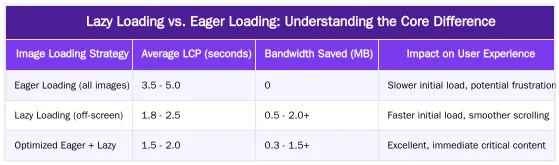
Lazy Loading vs. Eager Loading: Understanding the Core Difference
The difference between lazy loading and eager loading is when the browser fetches resources. Eager loading fetches all resources on page load. Lazy loading defers loading non-critical resources until they enter the user’s viewport. This difference impacts initial page speed and perceived performance.
What is Lazy Loading for Web Images?
Lazy loading defers loading images and media until required. Only images visible in the user’s viewport (“above the fold”) load initially. As the user scrolls, off-screen images are fetched just before they become visible. This reduces initial page load times, conserves bandwidth, and improves Core Web Vitals, particularly Largest Contentful Paint (LCP).
What is Eager Loading and Its Purpose?
Eager loading downloads all resources, including images, as the web page renders. While inefficient for pages with many images, it is essential for critical content that must be visible instantly. For medical websites, this includes a surgeon’s profile picture or a primary procedure image at the top of the page.
How Image Loading Strategies Impact Core Web Vitals for Medical Sites
Core Web Vitals are metrics Google uses to measure user experience, influencing search rankings. For medical websites, good Core Web Vitals scores are important for patient trust and visibility. Image loading strategies significantly impact these scores, particularly Largest Contentful Paint (LCP), which measures the loading performance of the largest content element in the viewport.
Optimizing Largest Contentful Paint (LCP) with Smart Loading
A fast LCP is crucial for medical sites, as patients expect immediate visual feedback. Lazy loading reduces LCP by loading only the most critical, visible images first. This minimizes initial data transfer and rendering time, allowing main content to appear quickly. Google recommends an LCP under 2.5 seconds; for competitive medical niches, a sub-2.0s LCP on procedure pages is a strategic advantage. This retains patient attention and encourages engagement.
First Input Delay (FID) and Cumulative Layout Shift (CLS) Considerations
Lazy loading primarily benefits LCP, but its implementation can affect First Input Delay (FID) and Cumulative Layout Shift (CLS). FID measures interactivity; CLS measures visual stability. Poorly implemented lazy loading, like not reserving image space, can cause layout shifts that negatively impact CLS. It can also delay the main thread, affecting FID. Specifying image dimensions and using native browser lazy loading mitigate these issues for a stable user experience.
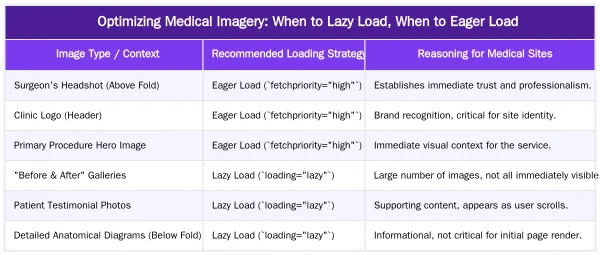
Optimizing Medical Imagery: When to Lazy Load, When to Eager Load
The choice between lazy and eager loading depends on an image’s importance and position on the page. For medical websites, this balances performance with the need to convey trust and visual information.
Eager Loading Critical ‘Above the Fold’ Medical Content
Images immediately visible “above the fold” should be eager loaded to establish credibility and context. Examples include a surgeon’s headshot, the clinic’s logo, and hero images on procedure pages. To prioritize these images, developers can use the `fetchpriority=”high”` attribute in HTML. This signals to the browser that the resources are critical for the initial render, ensuring they appear without delay.
Strategic Lazy Loading for ‘Before & After’ Galleries and Supporting Visuals
Lazy loading is ideal for extensive image galleries like “before & after” portfolios, patient testimonials, or detailed diagrams further down a page. These images are not critical for the initial view but become relevant as the user scrolls. Lazy loading reduces initial page weight for faster load times. Modern browsers support native lazy loading with the `loading=”lazy”` attribute on `` tags, preferred for its simplicity. For complex scenarios or older browser support, JavaScript solutions can be used but require careful implementation to avoid layout shifts.
Beyond Speed: User Experience, Trust, and Cost of Retrieval for Medical Sites
Image loading strategies influence more than page speed; they affect user experience, patient trust, and a search engine’s “Cost of Retrieval” (CoR). For medical clinics, these impacts are crucial.
Perceived Performance and Patient Trust in Healthcare
A fast, smooth website conveys professionalism and reliability, building trust with potential patients. Slow-loading pages, especially on mobile, can create a perception of unprofessional service. For sensitive medical information, a responsive experience can be a deciding factor. Optimized image delivery contributes to this perceived performance, reinforcing a clinic’s credibility.
Reducing Search Engine’s Cost of Retrieval (CoR) with Efficient Image Delivery
Search engines like Google use a “Cost of Retrieval” model, allocating a crawl budget to index content. Technically efficient websites that load quickly and use fewer resources are “cheaper” to crawl. Optimized image loading, using lazy loading and compression, reduces the server load and bandwidth for Googlebot. This efficiency allows Google to crawl more pages more frequently, leading to better indexing and potentially higher rankings. Abdurrahman Şimşek’s semantic SEO approach emphasizes these technical foundations to make medical websites efficient for search engines, reducing the Cost of Retrieval and improving SEO performance.
Implementing Smart Image Loading for Aesthetic Clinics: An Expert Approach
For aesthetic clinics and plastic surgeons, intelligent image loading is foundational to a digital strategy. As a London-based Semantic SEO Strategist and Web Developer for medical clinics, Abdurrahman Şimşek integrates these technical optimizations into a semantic SEO framework. This ensures every part of a website contributes to its performance, authority, and E-E-A-T (Experience, Expertise, Authoritativeness, Trustworthiness).
Integrating Image Optimization into a Semantic SEO Framework
Image optimization is a critical component of a high-performance technical architecture. Within a semantic SEO framework, optimized image loading makes content like “before & after” galleries accessible and fast. This contributes to topical authority by making content easily consumable by users and search engines. A clean semantic HTML5 structure with efficient resource loading signals to Google that a website is well-maintained and authoritative. This technical excellence underpins E-E-A-T signals for YMYL (Your Money Your Life) medical websites, reinforcing the surgeon’s credentials and the clinic’s trustworthiness. For more on E-E-A-T, see Google’s helpful content guidelines.
Technical Implementation: Native Lazy Loading vs. JavaScript Solutions
The most straightforward method for deferred image loading is native lazy loading, implemented by adding `loading=”lazy”` to the `` tag. This browser-level feature is efficient and supported by modern browsers. For critical images that must load instantly, use the `fetchpriority=”high”` attribute with eager loading. In scenarios like complex carousels or for older browsers, JavaScript-based lazy loading libraries may be necessary, but require careful implementation to avoid issues like Cumulative Layout Shift (CLS) or increased JavaScript payload. Continuous testing and monitoring of Core Web Vitals with tools like Google PageSpeed Insights are essential for optimal performance. For more technical details, see web.dev’s image optimization guide.
The SEO Advantage: Faster Sites, Higher Rankings, More Patients
Smart image loading strategies improve page speed and user experience, which are drivers of search engine performance and patient acquisition for medical and aesthetic clinics.
Boosting Local Organic Search Visibility for London Clinics
Faster mobile loading times impact local “near me” search rankings. For clinics in London postcodes like Harley Street, Kensington, or Chelsea, high visibility in local search is crucial. Google prioritizes fast, mobile-friendly websites for local queries. Optimizing image delivery can improve rankings and attract more local patients. This technical advantage supports a Harley Street SEO strategy.
Translating Technical Performance into Patient Bookings
A strong technical foundation with optimized image loading improves the user journey. Patients are more likely to stay on a fast-loading site, explore services, and complete a booking or inquiry form. Reduced bounce rates and increased time on page are positive engagement signals for search engines. This can lead to better search rankings, more organic traffic, and a higher conversion rate for patient bookings. Efficient resource delivery also lowers the Cost of Retrieval for search engines, enhancing SEO and patient conversion funnels.
Elevate Your Medical Website’s Performance and Patient Engagement
Optimizing image loading with lazy and eager loading strategies is critical for a high-performing medical website. This technical foundation enhances user experience, builds patient trust, and improves search engine visibility. For aesthetic clinics and plastic surgeons, these optimizations are necessary to attract patients through local organic search.
Conclusion
Strategic implementation of lazy and eager loading improves medical website performance. Prioritizing critical visuals while deferring non-essential ones achieves faster page speeds, improves Core Web Vitals, and enhances the patient experience. This leads to better search engine rankings, increased visibility, and more patient bookings. To ensure your medical website has a strong technical foundation, contact us. You can also Book a Semantic SEO Audit or reach out via Direct WhatsApp Strategy Line: +90 506 206 86 86.
Frequently Asked Questions
What is the simple difference between lazy loading vs eager loading?
Eager loading downloads all images on a page as soon as it starts to load, regardless of whether they are visible to the user. Lazy loading vs eager loading differs significantly as lazy loading defers the download of off-screen images until the user scrolls down to them, prioritizing the loading of critical, visible content first. This approach optimizes initial page load times and improves perceived performance.
For a surgeon’s website, which images should be eager loaded?
Any critical image that appears “above the fold” (visible without scrolling) should be eager loaded. This typically includes the main hero image on a procedure page, the clinic’s logo, or essential navigation icons. Eager loading this content is crucial for achieving a good Largest Contentful Paint (LCP) score, which directly impacts user perception of speed and SEO.
Is lazy loading always the best choice for ‘before and after’ galleries?
Yes, lazy loading is almost always the superior choice for extensive image galleries, especially those with many “before and after” photos. It dramatically improves the initial page load time by not forcing the user to download dozens of images they may never scroll to see. This creates a much better user experience and reduces bandwidth consumption for visitors.
How does the choice between lazy loading vs eager loading impact Core Web Vitals?
The choice between lazy loading vs eager loading significantly impacts Core Web Vitals, particularly Largest Contentful Paint (LCP) and First Contentful Paint (FCP). Eager loading too many images can negatively affect these metrics by delaying the rendering of visible content. Conversely, strategic lazy loading improves these scores by prioritizing critical content, leading to a faster perceived load time and better user experience.
Does the choice between lazy loading vs eager loading affect mobile users more?
Yes, the impact of the choice between lazy loading vs eager loading is much greater on mobile users. Mobile devices often operate on slower network connections and have less processing power. Lazy loading provides a significant performance benefit on mobile by reducing initial data download and processing, making the site feel much faster and more responsive for patients on the go.
How can I get expert help optimizing my medical website’s image loading strategy?
For expert guidance on optimizing your medical website’s image loading strategy and overall semantic SEO, you can book a Semantic SEO Audit with Abdurrahman Şimşek. Alternatively, you can reach out directly via his WhatsApp Strategy Line at +90 506 206 86 86 for personalized advice. This ensures your site benefits from a holistic approach to performance and search visibility.
Ruxi Data brings together multi-model AI, automated website crawling, live indexation checks, topical authority mapping, E-E-A-T enrichment, schema generation, and full pipeline automation — from crawl to WordPress publish to social posting — all in one platform built for agencies and freelancers who run on results.