
Keyword Research Cosmetic Procedures: Uncovering Niche Patient Intent
Effective keyword research cosmetic procedures guides clinics in attracting high-value patients for niche aesthetic services. This strategy involves understanding unique patient search intent, moving beyond broad terms to target specific long-tail keywords and question keywords. By leveraging semantic keyword grouping and SERP analysis, clinics can develop an entity-centric content foundation. This approach ensures content addresses patient anxieties and desired outcomes, building trust and authority in the YMYL sector. It ultimately drives qualified leads and secures a consistent patient pipeline.
Abdurrahman Şimşek, a Semantic SEO Strategist, provides expert guidance on optimizing digital presence for specialized medical fields. This content offers actionable strategies for clinics to enhance visibility and connect with their target audience through precise keyword targeting and content alignment.
To explore your options, contact us to schedule your consultation. You can also reach us via: Book a Semantic SEO Audit, Direct WhatsApp Strategy Line: +90 506 206 86 86
Effective keyword research cosmetic procedures attracts high-value patients to niche aesthetic services in competitive markets like London. This guide reveals strategies to connect with individuals seeking specialized treatments by uncovering patient intent, leveraging semantic grouping, and building a content foundation that drives qualified leads. These techniques establish a strong online presence and secure a patient pipeline for 2026.
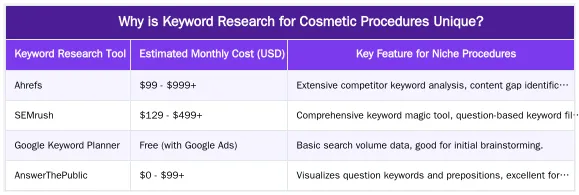
Why is Keyword Research for Cosmetic Procedures Unique?
Keyword research for aesthetic treatments differs from other industries because of the sensitive nature of medical decisions and patient concerns. It requires understanding individual needs over broad search volume. Identify precise, long-tail phrases reflecting patient questions, anxieties, and desired outcomes to create content that addresses their journey. This focus builds trust and authority in a YMYL (Your Money Your Life) sector.
Beyond Broad Terms: Targeting Patient Intent
Generic terms like “liposuction” attract a wide audience but often lack specific intent. Niche cosmetic procedures require delving into patient query nuances. Consider phrases like “non-surgical fat reduction for stomach” or “cost of Vaser lipo in London.” These descriptive queries indicate a patient is further in their decision-making process, seeking solutions or cost information. Targeting these terms connects with qualified prospects.
The YMYL Factor: Trust and E-E-A-T in Keyword Strategy
Medical content is YMYL, demanding high standards of Expertise, Experience, Authoritativeness, and Trustworthiness (E-E-A-T). This impacts keyword selection and content creation. Health-related keywords require content from verified experts, backed by evidence, and regularly updated. Keyword selection must align with the clinic’s E-E-A-T to ensure information is accurate and builds patient confidence. Learn more about YMYL on Wikipedia.
Uncovering Patient Search Intent: From Questions to Conversions
Categorizing patient search intent is critical for creating content for each stage of the patient journey. Intent is classified as informational (seeking knowledge), commercial (researching services/products), or navigational (looking for a specific website). Understanding these nuances helps clinics create a content strategy that guides patients from curiosity to consultation.
Mapping Search Intent to the Patient Journey
The patient journey has distinct stages. Early-stage awareness involves informational queries like “what is rhinoplasty?” or “benefits of breast augmentation.” Consideration-stage searches are more specific, such as “rhinoplasty recovery time London” or “types of dermal fillers.” Conversion-focused intent includes phrases like “best rhinoplasty surgeon Harley Street” or “book consultation for facelift.” Mapping keywords to these stages provides relevant content at each touchpoint. This approach is a core component of a comprehensive plastic surgery SEO blueprint.
Leveraging Question Keywords for Informational Content
Question keywords (who, what, when, where, why, how) address patient concerns and build trust. These queries reveal specific anxieties, curiosities, and decision-making factors. For example, “how much does a tummy tuck cost in London?” or “what are the risks of liposuction?” Creating detailed, expert-backed content around these questions establishes clinics as authoritative sources. This answers patient queries, demonstrates transparency, and fosters a connection with potential clients.
Semantic Keyword Grouping & SERP Analysis for Niche Procedures
Understanding topical clusters and entities beyond individual keywords uncovers content gaps and opportunities for niche procedures. This semantic strategy aligns with how search engines process information, helping clinics build topical authority instead of ranking for isolated terms. This method reduces the “Cost of Retrieval” for search engines by providing structured, interconnected knowledge.
Building Topical Authority with Semantic Keyword Clusters
Semantic keyword grouping organizes related terms around a central topic or entity. For “breast augmentation,” this includes related concepts like “implant types,” “recovery timeline,” “surgeon qualifications,” “cost factors,” and “potential risks.” Covering these interconnected concepts in a content cluster signals expertise to search engines. This approach establishes topical authority through an Entity-Attribute-Value (EAV) model, making the content more valuable and authoritative.
Deconstructing SERPs: Identifying Gaps and Opportunities
SERP (Search Engine Results Page) analysis means examining top-ranking pages for target keywords to understand their intent, depth, and format. This reveals what Google considers the best answer for a query. For niche procedures, analyzing competitor content can uncover unaddressed questions, missed angles, or neglected formats (e.g., videos, comparison tables). Identifying these weaknesses allows a clinic to create superior content that fills these gaps and outranks competitors. A detailed guide on this process can be found in deconstructing SERP intent.
Essential Tools & Techniques for Cosmetic Procedure Keywords
Identifying relevant search terms requires combining specialized tools with manual techniques. Automated platforms provide data, but understanding patient psychology and medical terminology comes from direct engagement and expert consultation. This dual approach ensures an accurate keyword strategy.
Utilizing Ahrefs & SEMrush for Niche Keyword Discovery
SEO tools like Ahrefs and SEMrush uncover keywords. For niche procedures, use their features to:
- Keyword Explorer/Magic Tool: Input broad terms (e.g., “facelift”) and filter for long-tail variations, question keywords, and low-difficulty terms.
- Competitor Analysis: Analyze competitor websites to see which keywords they rank for, identifying terms you might be missing.
- Content Gap Analysis: Compare your site’s rankings against competitors to find keywords where they rank, but you do not.
- SERP Features: Identify opportunities for featured snippets by looking for question-based queries that trigger “People Also Ask” boxes.
These tools provide data on search volume, keyword difficulty, and traffic to guide content strategy. Explore Ahrefs keyword research features and learn about SEMrush keyword tools.
Beyond Tools: Brainstorming Procedure-Specific Terms
Tools cannot replicate human insight. Brainstorming and qualitative research uncover procedure-specific terminology and patient concerns.
- Patient Interviews: Direct conversations with current or prospective patients reveal their exact language, fears, and desired outcomes.
- Forum Analysis: Online forums (e.g., Reddit, RealSelf) are rich sources of authentic patient questions, slang, and emotional drivers.
- Surgeon Consultation: Collaborating with surgeons provides insights into the medical nuances of procedures, common patient misconceptions, and frequently asked questions during consultations.
- Google Autocomplete & Related Searches: Typing a procedure into Google and observing autocomplete suggestions or “Related searches” at the bottom of the SERP can reveal unexpected long-tail variations.
This qualitative data complements tool-based research for a patient-centric keyword approach.
| Search Intent Type | Patient Goal | Example Keyword for Cosmetic Procedures |
|---|---|---|
| Informational | Understand a procedure, learn about options. | “what is a non-surgical nose job” |
| Commercial Investigation | Compare providers, research costs, look for reviews. | “best plastic surgeon London reviews” |
| Transactional | Ready to book, find contact details. | “book breast augmentation consultation Harley Street” |
| Navigational | Find a specific clinic or surgeon’s website. | “Dr. Smith plastic surgeon website” |
Implementing an Entity-Centric Keyword Strategy for Growth
An entity-centric approach is an advanced strategy for cosmetic procedures. This methodology, championed by semantic SEO strategists like Abdurrahman Şimşek, acknowledges that search engines understand concepts and relationships, not just keywords. Focusing on entities builds topical authority and attracts high-value patients.
From Keywords to Entities: A Holistic SEO Mindset
In an entity-centric framework, a procedure like “Rhinoplasty” is a core entity. Instead of targeting keywords, the strategy defines its attributes: “recovery time,” “anesthesia type,” “cost,” “potential side effects,” “ideal candidates,” and “before and after results.” Each attribute becomes a content focus, linked semantically to the main entity. This creates an authoritative content structure that addresses all facets of the procedure, signaling expertise to search engines and patients.
Future-Proofing Your Strategy with Semantic Architecture
Google’s algorithms are evolving beyond keyword matching to understand relationships between concepts. An entity-based approach aligns with this evolution by structuring content around medical entities and their attributes. This semantic architecture ensures ranking stability and makes websites more resilient to algorithm updates. Building a semantic content network reduces Google’s “Cost of Retrieval,” making information easier to process and rank, which attracts qualified patients.
Maximizing Your Reach: Attracting High-Value Patients
The goal of keyword research is to translate online visibility into patient acquisitions. A well-executed strategy increases visibility to the right audience, drives quality traffic, and leads to more consultations for London clinics. This ensures marketing contributes to clinic growth.
Connecting Keyword Performance to Patient Acquisition
Tracking keyword success goes beyond monitoring rankings or traffic. It involves linking keyword performance to consultation bookings and conversions. Analyzing which keywords drive the most qualified leads helps clinics refine content and targeting. For example, if “liposuction cost London” leads to consultations, it is a high-intent keyword warranting further optimization. This data-driven feedback loop is essential for maximizing ROI.
Building a Sustainable Pipeline of Qualified Leads
Entity-driven keyword research creates an evergreen content asset that attracts patients searching for specialized services. Establishing topical authority and addressing patient intent at every stage builds a sustainable pipeline of qualified leads. This reduces reliance on paid advertising, fosters organic growth, and positions the clinic as an authority. A semantic content network ensures the clinic’s online presence remains relevant, securing long-term success.
Partner with a Semantic SEO Expert for Your Clinic’s Growth
SEO for niche cosmetic procedures requires specialized expertise. Abdurrahman Şimşek, a London-based Semantic SEO Strategist, specializes in building high-authority Semantic Content Networks for medical clinics, skin clinics, and plastic surgeons. With over 10 years of experience, he uses advanced methodologies like EAV modeling and Ruxi Data to optimize for Google’s algorithms, helping your clinic dominate local search across Harley Street and premium London postcodes. Partner with an expert who understands the private healthcare market.
Conclusion
Keyword research for cosmetic procedures requires understanding patient intent, building trust, and establishing topical authority. Using semantic grouping, entity-centric strategies, and SERP analysis helps clinics connect with high-value patients seeking specialized treatments. This approach, informed by E-E-A-T principles, ensures organic growth and a patient acquisition pipeline. To improve your clinic’s online presence and secure a position in the London private healthcare market, contact us. You can also Book a Semantic SEO Audit or reach out via Direct WhatsApp Strategy Line: +90 506 206 86 86.
Frequently Asked Questions
What is the initial step in keyword research cosmetic procedures?
The initial step involves moving beyond generic terms to identify specific, long-tail phrases patients actually use. This includes brainstorming their questions, concerns, and desired outcomes, like ‘non-surgical fat reduction for stomach’ or ‘cost of Vaser lipo in London’. Effective keyword research cosmetic procedures focuses on these precise queries to attract highly qualified leads.
How do you determine patient search intent during keyword research cosmetic procedures?
To determine patient intent, analyze the Search Engine Results Page (SERP) for your target terms. If top results are educational blog posts, the intent is informational; if they are clinic service pages, it’s commercial or transactional. Aligning your content with this intent is crucial for successful keyword research cosmetic procedures.
Why are ‘question keywords’ particularly important for aesthetic clinics?
Question keywords, such as ‘how long is recovery from a facelift?’, are vital as they capture patients in the early research phase. Answering these questions thoroughly on your website positions your clinic as an expert authority and builds trust. This strategy is key for effective keyword research in the aesthetic sector.
Should clinics target keywords with low search volume when conducting keyword research cosmetic procedures?
Yes, for niche aesthetic treatments, low-volume, high-specificity keywords are often the most valuable. A term like ‘ethnic rhinoplasty specialist Harley Street’ may have low volume but indicates extremely high commercial intent, leading to more qualified patient inquiries. This approach is fundamental to successful keyword research cosmetic procedures.
What essential tools aid in effective keyword research cosmetic procedures?
Tools like Ahrefs, SEMrush, and AnswerThePublic are indispensable for data-driven analysis. They help uncover search volumes, identify competitor strategies, and reveal the exact questions potential patients are asking online. These tools streamline the process of identifying valuable terms for aesthetic clinics.
How can Abdurrahman Şimşek assist with advanced keyword research cosmetic procedures?
Abdurrahman Şimşek, a Semantic SEO Strategist, specializes in medical and plastic surgery SEO, leveraging his Semantic SEO Framework. He can conduct a comprehensive audit to identify high-value keywords and build an entity-centric strategy for your clinic. You can book a Semantic SEO Audit at abdurrahmansimsek.com/contact/ to get started.
Ruxi Data brings together multi-model AI, automated website crawling, live indexation checks, topical authority mapping, E-E-A-T enrichment, schema generation, and full pipeline automation — from crawl to WordPress publish to social posting — all in one platform built for agencies and freelancers who run on results.