
Internal Redirect Chains: Optimizing Crawl Efficiency and Link Equity
Internal redirect chains degrade crawl efficiency and dilute link equity by forcing search engine crawlers through multiple URL hops. This article details how these technical SEO issues impact medical websites, consuming valuable crawl budget and weakening internal link signals. Understanding HTTP status codes like 301 and 302 is crucial for effective redirect management. Strategies for detection using tools like Screaming Frog and log file analysis, alongside methods for resolution, are presented to restore site performance and improve content discoverability within semantic SEO frameworks.
Abdurrahman Şimşek, a Semantic SEO Strategist, offers expert guidance on identifying and resolving these technical issues. His approach focuses on restoring link equity and optimizing crawl paths for enhanced search engine performance, particularly for complex medical content.
To explore your options, contact us to schedule your consultation. You can also reach us via: Book a Semantic SEO Audit, Direct WhatsApp Strategy Line: +90 506 206 86 86
Internal redirect chains are technical SEO issues that erode a medical website’s crawl efficiency and link equity. This article defines chained redirects, explains their SEO impact on complex medical sites, and provides strategies for finding and fixing them. Optimizing your site’s redirect profile enhances performance, improves patient acquisition, and contributes to a semantic SEO framework.
What Are Internal Redirect Chains and Why Do They Matter for SEO?
Internal redirect chains occur when a URL redirects multiple times before its final destination. A chain might look like URL A → URL B → URL C → URL D, instead of a direct path. These sequences often arise from site migrations, CMS changes, or outdated internal links. For medical websites, where rapid indexing of new procedures is paramount, these inefficiencies hinder search engine visibility.
Search engines follow redirect paths, but each hop consumes crawl budget and can dilute the link equity (PageRank) passed between pages. Signals from internal links that establish topical authority are weakened. For a medical clinic, this impacts how quickly new service pages or physician profiles are discovered and ranked, affecting patient acquisition.
Understanding HTTP Status Codes: 301 vs. 302
HTTP status codes define the redirect type. A 301 redirect signifies a permanent move. Search engines typically pass most link equity from the old URL to the new one. This is the preferred status code for permanent URL changes.
A 302 redirect indicates a temporary move, suggesting the content has relocated and the original URL might return. Search engines pass little to no link equity through a 302 redirect. Misusing 302s for permanent changes impacts SEO by preventing the new page from accumulating the old one’s authority, causing potential ranking losses.
How Do Redirect Chains Harm Your Medical Site’s Crawl Efficiency?
Crawl efficiency is critical for medical websites, where content is often Your Money Your Life (YMYL). Redirect chains impede this efficiency by forcing search engine bots to make multiple requests to reach content. This wastes crawl budget, which is problematic for large sites with extensive medical libraries or physician profiles. Instead of discovering new content, bots traverse unnecessary redirect hops.
These chains also dilute link equity. Each redirect can diminish the authority passed to the final destination, weakening the ranking potential of key pages. This can delay indexing of new procedure pages, treatment information, or surgeon biographies, which are vital for patient trust and E-E-A-T signals. Inefficient crawling leads to slower content discovery, reduced organic visibility, and missed patient engagement.
The ‘Cost of Retrieval’ for Complex Medical Content
The “Cost of Retrieval” is the resources (time, processing power, bandwidth) a search engine uses to discover, crawl, and index content. Redirect chains increase this cost for complex medical content hubs. When Googlebot encounters a long redirect sequence, it processes each hop, consuming more resources than a direct link. This overhead can cause less frequent crawling of other pages, delaying the indexing of medical updates or new services.
Optimizing for a lower Cost of Retrieval is a principle of technical SEO, especially for YMYL domains. Abdurrahman Şimşek, a Semantic SEO Strategist, emphasizes that a clean redirect profile creates a more efficient crawling process, so medical information is discovered without unnecessary resource expenditure. Learn more about reducing Cost of Retrieval for medical websites.
Detecting Internal Redirect Chains: Tools & Techniques
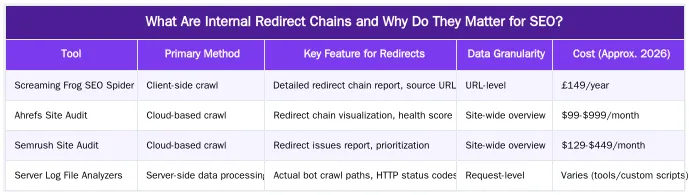
Identifying redirect chains requires specialized tools. A site audit is the starting point. These tools simulate how a search engine spider traverses your website, reporting on redirect paths and their length. Combining client-side crawls with server-side log analysis provides a full picture of how search engines interact with your redirects.
Identify the chains and the internal links that initiate them. Fixing the source internal links is more effective than adding more redirects. Regular monitoring prevents new chains from forming as a site evolves.
Leveraging Screaming Frog and Site Audits
Screaming Frog SEO Spider is a desktop tool for identifying redirect chains. Crawling your website generates a “Redirect Chains” report, which lists all URLs in a redirect sequence, detailing each hop and the final destination. It also highlights the source pages linking to the initial redirect, pinpointing where to update internal links. Integrating this into a site audit addresses redirect issues alongside other technical optimizations.
Other site audit tools like Ahrefs, Semrush, or Sitebulb offer similar functions and may present data visually. These tools can identify internal and external redirect chains, providing a complete view of your site’s redirect landscape.
The Role of Log File Analysis in Identifying Crawl Paths
Client-side crawlers like Screaming Frog identify potential redirect chains, but server log file analysis shows how search engine spiders actually traverse your site. Log files record every server request, including status codes. Analyzing these logs shows if Googlebot is hitting a redirect chain, how long it spends there, and which pages it prioritizes.
This server-side data reveals the impact of your redirect setup on search engine crawling. It confirms if bots are crawling identified chains and helps prioritize fixes based on bot behavior. Explore log file analysis for SEO.
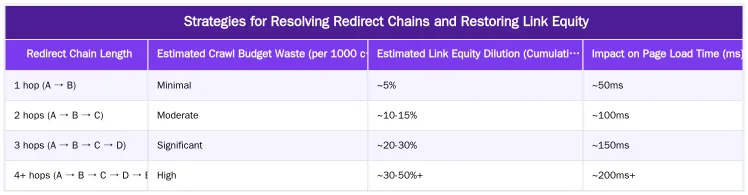
Strategies for Resolving Redirect Chains and Restoring Link Equity
After identifying redirect chains, eliminate them by updating internal links to point directly to the final destination URL. This “flattening” ensures search engines and users reach content in one hop, preserving link equity and optimizing crawl paths. For example, if page A redirects to B, which redirects to C, update all internal links pointing to A or B to point directly to C.
Consolidating multiple redirects is also effective. If several old URLs point to the same new page, ensure each one redirects directly to the final destination, not through an intermediary. This minimizes hops and maximizes authority transfer. When implementing new redirects, use 301s for permanent changes and point them to the canonical version of the page.
Prioritizing Fixes: Impact vs. Effort
Prioritize fixing chains that impact high-value pages, such as medical procedure pages, surgeon biographies, or high-traffic content. Longer chains (3+ hops) should be addressed first, as they waste more crawl budget and risk greater link equity dilution. Consider the impact on patient acquisition and topical authority.
A prioritization matrix can help: identify chains affecting pages with high organic traffic or conversions, then assess the effort to update the internal links. Focus on high-impact, low-effort fixes first. For guidance on redirect best practices, consult Google Search Central on redirects.
Optimizing for YMYL: Abdurrahman Şimşek’s Approach to Redirect Management
For YMYL (Your Money Your Life) medical websites, redirect management is more than a technical fix. Abdurrahman Şimşek, a London-based Semantic SEO Strategist with over 10 years of experience, treats redirect chains as part of building topical authority and E-E-A-T (Expertise, Experience, Authoritativeness, Trustworthiness). A clean redirect profile helps Google efficiently crawl and understand relationships between medical entities, reinforcing site authority.
His methodology, using the Ruxi Data Semantic Engine, focuses on a site architecture that minimizes search engine Cost of Retrieval. This involves fixing existing chains and designing future site changes to prevent new ones. For plastic surgeons and aesthetic clinics, this approach ensures content like procedure pages and surgeon profiles is accessible to search engines, supporting patient acquisition.
The Impact on Semantic Content Networks and Entity Recognition
Efficient crawling and a clear redirect profile help Google recognize and connect entities within a medical site’s semantic content network. When search engines can navigate between related medical topics without redirects, they better understand the site’s topical depth and expertise. This clarity helps Google associate specific procedures with expert surgeons and relevant conditions.
Direct paths to content reinforce the internal linking structure, which passes authority and relevance signals between related entities. This contributes to stronger topical authority, making the site a more trusted source for search engines and patients.
Beyond the Fix: Long-Term Benefits of a Clean Redirect Profile
An optimized redirect strategy provides long-term advantages. The primary benefit is improved crawl budget allocation. With fewer wasted crawls on redirect chains, search engine bots can index new or updated medical content faster. This leads to faster visibility for new procedures, research, or clinic announcements.
A clean redirect profile enhances user experience by reducing page load delays from multiple redirects. Smoother navigation contributes to lower bounce rates and higher engagement. These signals and preserved link equity boost SEO performance and drive patient leads.
Proactive Redirect Management for Future Site Changes
Preventing new redirect chains is as important as fixing existing ones. Establish processes for redirect management during site updates, content changes, or migrations. This includes updating internal links when a URL changes, using 301 redirects for permanent moves, and regularly auditing for new redirect issues. A content management system (CMS) can assist, but human oversight is essential.
Educating content creators and web developers on redirect best practices reduces future problems. Integrating redirect checks into pre-launch checklists for new pages or sections catches issues before they impact performance. For guidance on redirect best practices, refer to Moz’s guide on redirect chains.
Ready to Eliminate Crawl Efficiency Killers?
Internal redirect chains hinder your medical website’s visibility and patient acquisition. Addressing these technical issues improves efficiency, authority, and user experience. If your medical practice faces technical SEO challenges like persistent redirect issues, expert guidance can help.
As a specialist in semantic SEO for medical clinics and plastic surgeons, Abdurrahman Şimşek offers strategies to optimize your site’s technical foundation, build topical authority, and enhance E-E-A-T. Don’t let crawl efficiency killers impede your growth. Book a Semantic SEO Audit or reach out via WhatsApp Strategy Line: +90 506 206 86 86 to improve your website’s performance.
Frequently Asked Questions
How do internal redirect chains negatively impact a medical website’s SEO?
Internal redirect chains force search engine crawlers to make multiple requests to reach a final URL, consuming valuable crawl budget. For large medical sites with many procedure pages, this inefficiency can lead to slower indexing of new content and a lower overall SEO performance. It also dilutes link equity, preventing the full authority from passing to the intended destination.
What is the most common cause of internal redirect chains?
The most frequent cause of internal redirect chains is a series of site migrations or URL structure changes over time without updating the original internal links. For example, an old HTTP link pointing to a non-WWW URL which then redirects to a WWW URL and finally to an HTTPS URL creates a multi-step chain. This often happens when sites evolve without a comprehensive redirect strategy.
Can I use a tool like Screaming Frog to identify all internal redirect chains?
Yes, Screaming Frog’s SEO Spider is an excellent tool for identifying internal redirect chains. By running a crawl and viewing the ‘Redirect Chains’ report, you can visualize the entire path of redirects and identify the source URLs that need to be updated to point directly to the final destination. This helps in systematically addressing these crawl efficiency killers.
Is there an acceptable number of redirects in an internal redirect chain?
Ideally, there should be zero internal redirects; every link should point to the final 200 OK destination. While a single 301 redirect is often unavoidable for legacy URLs, any internal redirect chain involving two or more hops should be fixed immediately to preserve crawl efficiency and link equity. Multiple redirects signal poor site maintenance to search engines.
How does fixing internal redirect chains help with Cost of Retrieval (CoR)?
Fixing internal redirect chains directly reduces the Cost of Retrieval (CoR) for search engines. By providing a direct path to content, you minimize the resources (time, bandwidth) Google needs to crawl and understand your site, which is a positive signal for technical health. This optimization allows search engines to crawl more of your valuable medical content with the same budget.
How can Abdurrahman Şimşek help my medical site fix complex redirect issues?
Abdurrahman Şimşek, a Holistic SEO Strategist, specializes in identifying and resolving complex technical SEO issues like redirect chains within a semantic SEO framework. You can book a Semantic SEO Audit to get a tailored strategy for your medical website. Alternatively, reach out directly via WhatsApp at +90 506 206 86 86 for a strategy discussion.
Ruxi Data brings together multi-model AI, automated website crawling, live indexation checks, topical authority mapping, E-E-A-T enrichment, schema generation, and full pipeline automation — from crawl to WordPress publish to social posting — all in one platform built for agencies and freelancers who run on results.