
Internal Link Audit: Sculpting Link Equity for SEO
An internal link audit systematically reviews a website’s internal hyperlinks to optimize search engine crawling, indexing, and content understanding. This process identifies and rectifies issues like broken links, redirect chains, and orphan pages that hinder SEO performance and user experience. For medical websites, a thorough internal link audit is crucial for establishing E-E-A-T signals and building topical authority around specific medical entities. By pruning ineffective links and sculpting link equity, sites can improve crawl depth, consolidate relevance, and ensure valuable medical content achieves optimal visibility and patient acquisition.
Abdurrahman Şimşek, a Semantic SEO Strategist, specializes in optimizing digital authority for medical clinics. His expertise in semantic engineering and holistic SEO ensures internal linking strategies reinforce E-E-A-T, particularly for YMYL content, enhancing search engine understanding and patient trust.
To explore your options, contact us to schedule your consultation.
An internal link audit is a systematic review of a website’s internal links that optimizes how search engines crawl, index, and understand content. For London’s medical clinics, an internal linking strategy establishes E-E-A-T (Experience, Expertise, Authoritativeness, and Trustworthiness) and builds topical authority. This guide details how to audit and prune ineffective internal links to enhance site performance, improve patient acquisition, and ensure medical content reaches its audience.
What is an Internal Link Audit and Why is it Crucial for Medical Websites?
An internal link audit is a review of all hyperlinks connecting pages within a single domain. Its goal is to improve crawl efficiency and consolidate link equity, helping search engines discover and rank important procedure and surgeon pages. The audit identifies and rectifies issues that hinder search engine understanding and user navigation.
For YMYL (Your Money Your Life) medical websites, an internal link audit directly impacts E-E-A-T signals. Clear, logical internal linking guides users and search engines to authoritative content like surgeon biographies, research-backed procedure descriptions, and patient testimonials. This structure helps Google understand relationships between medical entities on your site, reinforcing your clinic’s expertise and trustworthiness in specific medical specialties. Without structured internal linking, high-quality medical content may lack visibility, impacting patient acquisition and trust.
Identifying and Diagnosing Common Internal Linking Issues
Detecting Broken Links, Redirect Chains, and Orphan Pages
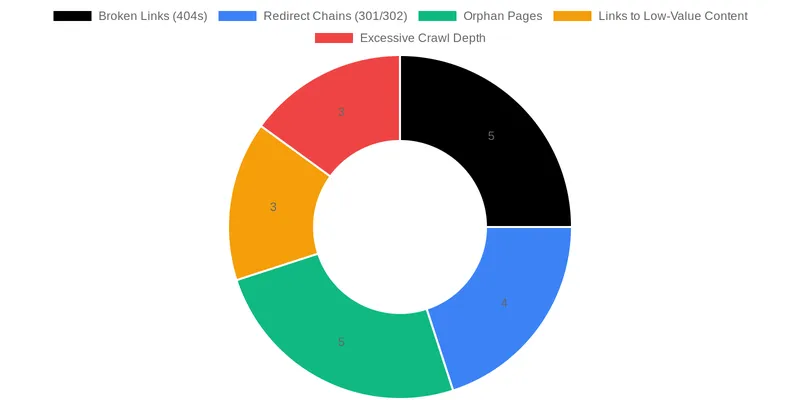
Broken internal links (404 errors) lead users and search engines to non-existent pages, wasting crawl budget and creating a poor user experience. On a medical site, a patient seeking procedure information may encounter a dead end, leading them to a competitor. Redirect chains occur when a page redirects multiple times to reach its destination. These chains slow page loading, dilute link equity, and consume crawl depth, making it harder for search engines to process site content. Orphan pages have no internal links pointing to them. They are invisible to search engine crawlers and users, so valuable content like a post-operative care guide or a surgeon’s publication may never be discovered or ranked.
Uncovering Low-Value Links and Content Decay
An internal link audit also uncovers links to low-value, outdated, or irrelevant content. This signals content decay, which is problematic for medical information requiring constant updates for accuracy and authority. Linking to thin or obsolete content dilutes link equity passed to important pages and weakens topical relevance. For instance, a link from a procedure page to a blog post on a superseded treatment can confuse search engines about your most current, authoritative information.
How to Conduct a Comprehensive Internal Link Audit for Your Clinic
An internal link audit requires a systematic approach and the right tools. For medical clinics, prioritize content that impacts patient trust and acquisition.
Leveraging Tools: Screaming Frog, Ahrefs, and Google Search Console
Crawl your website using a tool like Screaming Frog SEO Spider. It identifies broken links, redirect chains, and visualizes site architecture, including crawl depth. Export the internal links report to analyze anchor text and destination pages. Complement this with a site audit from Ahrefs for a broader view of your link profile and site health. Google Search Console helps identify crawl errors, index coverage issues, and pages Google considers important but may be buried in your site structure.
Prioritizing Issues: Impact on E-E-A-T and Patient Journey
Prioritize fixes based on their impact on E-E-A-T signals and the patient journey. Broken links on high-traffic procedure pages or surgeon profiles require immediate attention. Redirect chains to critical conversion pages (e.g., consultation forms) also warrant urgent attention. Integrate orphan pages with vital medical information or patient resources into your site’s navigation. Ensure your most authoritative content—procedure guides, surgeon bios, and patient education articles—is accessible and well-linked. This prioritization supports business objectives and enhances the patient experience.
Pruning Ineffective Links: Sculpting Link Equity and Topical Relevance
Link pruning is removing or modifying ineffective internal links to consolidate link equity, improve topical relevance, and enhance search engine understanding. It is critical for medical websites where precision and authority are paramount. Eliminating low-value connections directs authority to your most important pages.
Strategies for Removing or Reworking Low-Value Internal Links
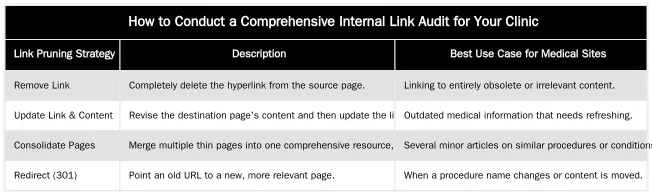
To identify low-value internal links, consider the destination page’s relevance, quality, and freshness. For medical content, assess if a linked page is outdated, thin, or no longer aligns with current medical best practices. Strategies include:
- Removal: If a linked page is obsolete or irrelevant, remove the link.
- Update and Rework: For outdated pages with some value, update the content and re-evaluate the link. Ensure anchor text reflects the updated content.
- Consolidation: If multiple low-value pages cover similar topics, consolidate them into one authoritative resource. Redirect old URLs to the new page and update all internal links.
- Noindex/Nofollow: For pages that must exist but have no SEO value (e.g., old promotional pages), consider noindexing them and nofollowing internal links, but use this sparingly.
This ensures every internal link serves a purpose, strengthening site architecture.
Reclaiming Link Equity and Reinforcing Topical Hubs
Pruning reclaims diluted link equity and redirects it to important pages. This reinforces topical hubs: central pages covering a broad medical topic that link to specific sub-topics. Strengthening these hubs enhances E-E-A-T signals for specific medical specialties. For example, pointing all relevant internal links to a “Breast Augmentation Guide” (a topical hub), rather than scattering them, consolidates its authority. This also helps reduce the ‘Cost of Retrieval’ for Googlebot, making your site more efficient to crawl and understand. A sculpted internal linking structure communicates your site’s semantic network and highlights core areas of expertise.
Maintaining a Healthy Internal Link Profile: Ongoing Strategies
An optimized internal link profile requires ongoing maintenance. Regular audits and proactive strategies ensure your medical website performs well and adapts to new content and search algorithms.
Establishing a Regular Internal Link Audit Schedule
Medical websites with frequently updated content or expanding services should schedule regular internal link audits. For smaller clinics, a quarterly review may suffice; larger practices with extensive content hubs may benefit from monthly or bi-monthly checks. Align this schedule with your content cadence and major website updates. Regular audits catch broken links, identify new orphan pages, and ensure new content is integrated into your semantic network. This prevents issues from accumulating and impacting site performance. For a detailed workflow, consider implementing a structured internal linking audit workflow.
Integrating Internal Linking into Your Content Creation Workflow
To maintain a healthy internal linking profile, integrate it into your content creation workflow. When publishing new medical content, consider its place in your topical map. Identify existing pages to link from and new pages the content should link to. This ensures new content contributes to topical relevance and link equity distribution. Training content creators on anchor text and contextual linking best practices is also crucial. This strategy, combined with regular content pruning for SEO, keeps your internal linking structure supportive of your semantic SEO goals.
Conclusion
An internal link audit and pruning are indispensable for any medical website aiming for high visibility and authority in 2026. This process resolves technical issues like broken links and redirect chains, sculpts link equity, reinforces topical relevance, and reduces the Cost of Retrieval for search engines. For YMYL sites, this translates to stronger E-E-A-T signals, helping Google recognize your clinic’s expertise and trustworthiness. Maintaining a clean, logical internal linking structure ensures London’s private healthcare providers can prioritize critical medical content, improving organic performance and patient engagement.
Frequently Asked Questions
What is the primary goal of an internal link audit for a medical website?
The primary goal is to improve crawl efficiency and consolidate link equity. By finding and fixing broken links, redirect chains, and links to low-value pages, an internal link audit ensures that search engines can easily discover and rank your most important procedure and surgeon pages. This optimization is vital for medical content in the YMYL space.
How can a clinic identify “ineffective” internal links?
Ineffective links are those pointing to outdated or irrelevant content, 404 pages, or long redirect chains that hinder user experience and search engine crawling. Tools like Screaming Frog or Google Search Console can help crawl your site and identify these issues. A thorough review of your linking structure ensures every connection serves a clear purpose for users and SEO.
What is link pruning and why is it necessary for medical sites?
Link pruning is the strategic process of removing internal links that point to low-quality, outdated, or irrelevant pages. This is crucial for medical sites to prevent diluting valuable link equity and to guide both users and search engines towards the most authoritative and current information. It helps maintain a clean and focused site architecture.
How often should a plastic surgery practice conduct an internal link audit?
For a dynamic medical website that regularly adds new content, a quarterly internal link audit is highly recommended. This proactive approach helps maintain a healthy site architecture and prevents the accumulation of SEO issues. Regular checks are essential for sustaining rankings in the competitive YMYL space.
Does removing an internal link mean I should also delete the page it links to?
Not necessarily. First, evaluate the target page’s value and relevance. If the page itself is valuable but the link is out of context, simply remove the link. If the page is outdated or thin, consider updating it, redirecting it to a more relevant page, or deleting it if it serves no purpose.
How can Abdurrahman Şimşek assist with my clinic’s internal link audit?
Abdurrahman Şimşek offers specialized semantic SEO strategies, including comprehensive internal link audit services for medical clinics in London. We focus on optimizing your site’s architecture to build topical authority and enhance E-E-A-T, crucial for competitive YMYL sectors. Contact us to discuss a tailored strategy for your London-based practice and sculpt your digital authority.
Ruxi Data brings together multi-model AI, automated website crawling, live indexation checks, topical authority mapping, E-E-A-T enrichment, schema generation, and full pipeline automation — from crawl to WordPress publish to social posting — all in one platform built for agencies and freelancers who run on results.