
Instant Indexing Automation: Accelerating Content Discovery & SEO
Instant indexing automation enables webmasters to programmatically notify search engines like Google and Bing about new or updated content immediately. This guide details how protocols such as IndexNow and the Google Indexing API facilitate rapid content discovery, bypassing traditional crawling delays. Implementing these tools significantly improves indexing speed and optimizes crawl budget, ensuring valuable content appears in search results faster. Understanding these proactive submission methods is crucial for enhancing SEO performance and maintaining competitive visibility in the evolving digital landscape. The article provides practical steps for integrating these APIs, including Python scripts and WordPress plugins, to streamline content visibility.
This content, provided by abdurrahmansimsek.com, offers practical guidance on leveraging advanced SEO automation techniques. It focuses on actionable strategies for improving content visibility and search engine performance through efficient indexing practices.
To explore your options, contact us to schedule your consultation.
Achieving rapid content visibility is paramount for digital success in 2026, and instant indexing automation is at the forefront of this evolution. This guide explores how protocols like IndexNow and the Google Indexing API empower webmasters to proactively inform search engines about new or updated content, significantly accelerating content discovery. Understanding and implementing these tools can dramatically improve your site’s SEO performance and ensure your valuable content reaches its audience faster than ever before.
What is Instant Indexing Automation & Why it’s Crucial for SEO in 2026?
Instant indexing automation refers to the process of programmatically notifying search engines about new, updated, or deleted web pages immediately after changes occur. This proactive approach bypasses the traditional waiting period for search engine crawlers to discover content, leading to significantly faster indexing and improved visibility. In 2026, this capability is crucial for maintaining a competitive edge in search results.
The core purpose of this automation is to minimize the delay between content publication and its appearance in search engine results pages (SERPs). For businesses, this means new products, services, or critical information can be discovered by potential customers almost instantly. For publishers, it ensures timely news and articles gain immediate traction.
The Evolving Landscape of Content Discovery
Traditionally, search engines relied on crawling websites to discover new and updated content. This method, while effective, can be slow, especially for large sites or those with infrequent updates. The evolving landscape of content discovery in 2026 demands more efficiency. Proactive submission methods, such as those offered by IndexNow and the Google Indexing API, supplement traditional crawling. They provide a direct channel for webmasters to signal content changes, ensuring that valuable information is processed and indexed with greater speed and precision. This shift empowers site owners with more control over their content’s journey into search results.
IndexNow vs. Google Indexing API: Understanding the Protocols
Two primary protocols facilitate instant indexing: IndexNow and the Google Indexing API. While both aim to accelerate content discovery, they differ in their scope, adoption, and specific use cases. Understanding these distinctions is key to implementing an effective indexing strategy.
How IndexNow Works for Broad Content Discovery
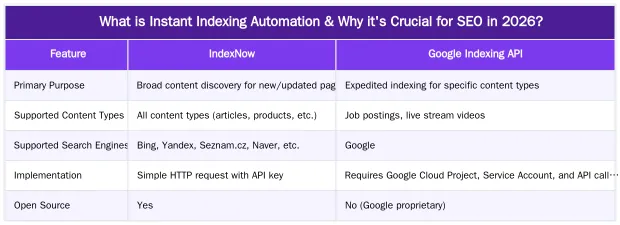
IndexNow is an open-source protocol that allows websites to notify participating search engines about new, updated, or deleted URLs. Launched by Microsoft Bing and adopted by other search engines like Yandex, it provides a simple HTTP request mechanism. When a page changes, the website sends a ping to the IndexNow endpoint, including the URL. This immediate notification prompts the search engines to crawl and potentially index the content much faster than waiting for their regular crawling schedule. IndexNow significantly aids broad content discovery and helps optimize crawl budget by directing crawlers only to pages that have changed. For a deeper dive, explore our comparison of Google Indexing API vs. IndexNow in 2026.
Google Indexing API: Specific Use Cases & Continued Relevance in 2026
The Google Indexing API serves a more specialized purpose. It was initially designed for specific content types: job postings (structured data using JobPosting) and live stream videos (using BroadcastEvent). This API allows webmasters to directly submit URLs for these content types, ensuring they are indexed rapidly. Despite discussions about its broader applicability, the Google Indexing API continues to function in 2026 for its intended use cases. For other content types, Google recommends traditional methods like sitemaps and the URL Inspection tool in Google Search Console. Therefore, the answer to “Does the Google Indexing API still work in 2026?” is yes, but with specific content type limitations.
Implementing Instant Indexing: A Practical Guide to Automation
Implementing instant indexing requires a structured approach, whether you opt for manual setup or full automation. The goal is to establish a reliable mechanism for notifying search engines about your content changes.
Getting Started: API Keys and Basic Setup
To use the Google Indexing API, you first need to set up a Google Cloud Project, enable the Indexing API, and create a service account. This service account will generate a JSON key file containing your API key. You then grant this service account ownership of your site in Google Search Console. This process answers “How to get an API key for Google Indexing API?” For IndexNow, the setup is simpler. You generate an API key (a UUID) and place a text file containing this key in your site’s root directory. This file verifies your ownership and authorizes submissions to the IndexNow network.
Automating Submissions: Scripts, Plugins, and Integrations
Automating URL submission is where the real efficiency of instant indexing shines. For developers, a custom Python script can monitor your content management system (CMS) for changes and automatically send URLs to both the Google Indexing API (for eligible content) and the IndexNow endpoint. This involves writing code to detect new posts or updates and then making the appropriate API calls. For WordPress users, several plugins offer built-in IndexNow integration and, in some cases, Google Indexing API support, simplifying the process significantly. These plugins often integrate with your publishing workflow, submitting URLs automatically upon publication or update. The concept of SEO automation extends beyond simple submission, encompassing monitoring, reporting, and strategic adjustments. For detailed integration steps, refer to our guide on Google Indexing API integration in 2026.
Beyond the Basics: Maximizing Indexing Speed & Crawl Budget with Advanced Strategies
While direct submission protocols are powerful, a holistic approach to indexing speed and crawl budget optimization yields superior results. Advanced strategies integrate these tools into a broader SEO framework.
Strategic Content Updates and Log File Analysis
Strategic content updates involve more than just publishing new pages. Regularly reviewing and updating existing high-value content can refresh its relevance and signal to search engines that it remains current. Combining this with log file analysis provides critical insights. Log files reveal how search engine bots interact with your site, showing which pages are crawled, how frequently, and if any issues prevent access. By analyzing these patterns, you can identify pages that are under-crawled or frequently updated, then prioritize them for instant indexing submission. This data-driven approach refines your content discovery strategy, ensuring resources are allocated efficiently.
Optimizing Your Crawl Budget Workflow for Efficiency
Crawl budget refers to the number of URLs a search engine bot will crawl on your site within a given timeframe. Instant indexing protocols can significantly influence this by reducing the need for bots to discover changes through exhaustive crawling. By proactively notifying search engines of new or updated content, you direct their crawl budget towards valuable pages, rather than allowing it to be spent on unchanged or low-priority content. This optimization ensures that important pages are indexed quickly, improving overall indexing speed. Techniques like proper internal linking, canonicalization, and managing faceted navigation also contribute to an efficient crawl budget workflow. Learn more about optimizing your crawl budget workflow for better performance.
Solving the Indexing Lag: How Ruxi Data Automates Submissions for Peak Performance
The manual management of instant indexing across multiple protocols can be time-consuming and prone to error. Ruxi Data offers a streamlined solution, automating submissions to both IndexNow and the Google Indexing API, eliminating the need for complex scripts or constant monitoring. This integrated approach ensures your content achieves peak visibility without manual intervention.
Ruxi Data’s platform is designed to detect content changes on your website in real-time. Upon publication or update, it automatically dispatches the relevant URLs to the appropriate indexing endpoints. This includes sending eligible job postings and live streams to the Google Indexing API, and all other content types to the IndexNow network, which is then picked up by Bing, Yandex, and other participating search engines. This comprehensive coverage ensures maximum content discovery across the search ecosystem.
Seamless Integration with Google Search Console & Bing Webmaster Tools
Ruxi Data integrates directly with essential search engine platforms like Google Search Console and Bing Webmaster Tools. This connectivity provides a unified dashboard where you can monitor the indexing status of your submitted URLs, track crawl errors, and analyze performance metrics. This centralized view simplifies the management of your SEO efforts, offering clear insights into how your content is being discovered and indexed by search engines. It transforms complex data into actionable intelligence, allowing for informed strategic adjustments.
Real-World Impact: Faster Rankings and Enhanced SEO Automation
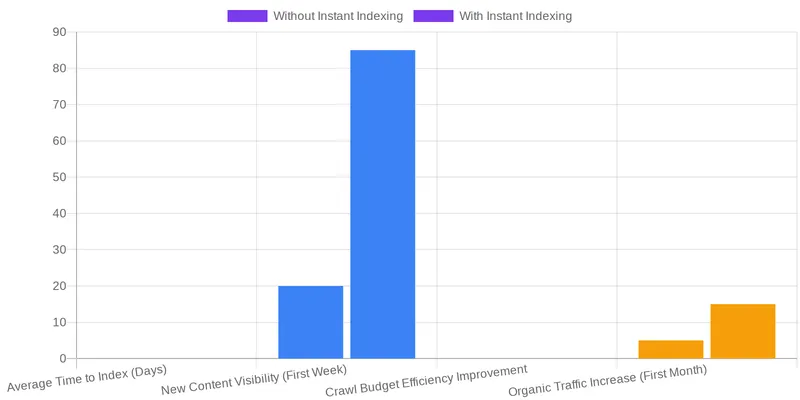
Leveraging an integrated platform for instant indexing automation translates into tangible benefits. Faster content discovery means your new or updated pages can rank sooner for relevant queries, capturing traffic and engagement ahead of competitors. This enhanced SEO automation reduces the operational burden on your team, freeing up resources to focus on content creation and strategic planning. The result is improved organic visibility, more efficient crawl budget utilization, and a more responsive presence in search results, ultimately contributing to business growth.
Ready to Accelerate Content Discovery? Start Automating Your Indexing Today
Accelerating content discovery is no longer an option but a necessity for competitive SEO in 2026. By embracing instant indexing automation through protocols like IndexNow and the Google Indexing API, you can ensure your valuable content reaches search engines and users with unprecedented speed. Eliminate the indexing lag and enhance your site’s visibility.
Explore how Ruxi Data can streamline your instant indexing efforts, providing a robust, automated solution for seamless content submission and monitoring. Take control of your content’s journey into search results and unlock faster rankings today.
Frequently Asked Questions
Does Ruxi Data automate submissions to both IndexNow and Google’s Indexing API for instant indexing automation?
Yes, our platform features built-in, fully automated integration with both protocols. When you publish new content or update existing pages via Ruxi Data, the URL is automatically submitted to both Google and the IndexNow network (including Bing and Yandex) to request immediate crawling. This proactive approach significantly accelerates content discovery.
Why is instant indexing automation important for an SEO strategy in 2026?
Instant indexing automation gives you a significant competitive edge, especially for time-sensitive content and news. It ensures search engines discover your new pages or updates immediately, reducing the time to rank and preventing competitors from scraping and ranking your content first. This rapid discovery is crucial for maintaining relevance and authority in fast-moving digital landscapes.
Do I need to set up my own API keys to utilize this instant indexing feature?
Yes, for security and ownership, you will need to generate your own API keys from Google Cloud Platform and Bing Webmaster Tools. Our platform provides a simple, step-by-step guide to facilitate this process. Once configured, the system handles submissions automatically, making the process completely hands-off.
Can instant indexing automation help with fixing pages that are ‘Discovered – currently not indexed’?
While it’s not a guaranteed fix for all indexing issues, proactively signaling updates via these APIs can encourage Google to recrawl and re-evaluate pages. For content stuck in the ‘Discovered’ state, sending a strong, immediate signal upon content refresh can often resolve the issue by prompting a re-evaluation. This method significantly improves the chances of getting such pages indexed faster.
How can I monitor the success of the automated indexing process?
Ruxi Data includes a Google Index Monitoring tool to track your content’s visibility. After a URL is published and pinged via the APIs, our system periodically checks its indexing status directly on Google. You receive a clear report showing which of your automated posts have been successfully indexed and when, providing full transparency on your instant indexing automation efforts.
What are the main benefits of implementing instant indexing automation for my website?
Implementing instant indexing automation significantly accelerates content discovery by search engines like Google, Bing, and Yandex. This ensures your new or updated content appears in search results much faster, improving visibility and potentially boosting organic traffic. It also helps in managing crawl budget more efficiently, as search engines are explicitly informed about changes.
Ruxi Data brings together multi-model AI, automated website crawling, live indexation checks, topical authority mapping, E-E-A-T enrichment, schema generation, and full pipeline automation — from crawl to WordPress publish to social posting — all in one platform built for agencies and freelancers who run on results.