
Healthcare Knowledge Base: Building Semantic Topical Authority
Building a healthcare knowledge base transforms digital presence by establishing deep topical authority in the medical landscape. This semantic content network organizes medical information around core entities, creating a structured data repository that enhances clinical accuracy and patient education. Unlike traditional blogs, a knowledge base uses entity-based SEO and a robust content architecture to signal expertise, experience, authoritativeness, and trustworthiness (E-E-A-T) to search engines. This approach ensures comprehensive topic coverage and machine readability, driving sustainable organic growth and improving visibility for healthcare providers.
Abdurrahman Şimşek, a Semantic SEO Strategist, specializes in developing advanced content architectures for healthcare. His expertise focuses on leveraging semantic principles and structured data to build authoritative medical knowledge graphs, ensuring high E-E-A-T for YMYL content.
To explore your options, contact us to schedule your consultation. You can also reach us via: Book a Semantic SEO Audit, Direct WhatsApp Strategy Line: +90 506 206 86 86
A robust online presence is critical for healthcare providers, but traditional content strategies often fall short. Building a healthcare knowledge base with a semantic approach can transform a digital footprint, establishing unparalleled topical authority and driving sustainable organic growth in the competitive medical landscape. This structured content repository moves beyond simple articles, creating an interconnected web of medical information that search engines and patients alike can easily understand and trust. It is designed to comprehensively cover medical topics, ensuring clinical accuracy and enhancing a practice’s digital expertise, experience, authoritativeness, and trustworthiness (E-E-A-T).
What is a Healthcare Knowledge Base and Why Does it Matter for Medical SEO?
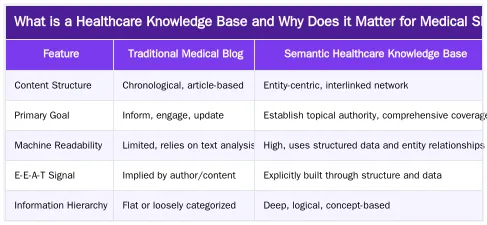
A healthcare knowledge base is a structured, interlinked network of medical entities, distinct from a traditional blog, designed for comprehensive topic coverage and machine readability. It serves as a centralized, authoritative source of information on specific medical conditions, procedures, and treatments. For medical SEO, it is fundamental because it directly addresses Google’s emphasis on E-E-A-T (Experience, Expertise, Authoritativeness, Trustworthiness) for Your Money Your Life (YMYL) topics. By presenting information in an organized, interconnected manner, a medical knowledge repository signals deep topical authority to search engines, improving visibility and trust. This structured approach ensures that complex medical information is accessible and verifiable, crucial for patient education and search engine understanding.
Beyond Blogs: The Structured Power of Medical Knowledge
Traditional medical blogs often feature chronological posts, which, while informative, may lack the deep interlinking and structured hierarchy necessary for comprehensive topic coverage. A semantic content network, however, organizes information around core medical entities, creating a cohesive and machine-readable resource. This architecture allows search engines to better understand the relationships between different medical concepts, enhancing the website’s overall authority. For instance, a blog might have separate posts on “Rhinoplasty Recovery” and “Types of Rhinoplasty,” while a knowledge repository would interlink these, positioning them as facets of the overarching “Rhinoplasty” entity. This systematic approach is vital for establishing a strong online presence in the healthcare sector, contributing to a robust medical knowledge graph.
The Semantic Foundation: Building a Knowledge Base with Entities and Structured Data
A semantic approach forms the backbone of an effective medical knowledge repository. This involves moving beyond simple keyword matching to understanding the underlying entities, their attributes, and their relationships within the medical domain. Entity-Attribute-Value (EAV) modeling is central to this process. For example, “Rhinoplasty” is an entity, “recovery time” is an attribute, and “2-4 weeks” is its value. By explicitly defining these components, content becomes machine-readable, allowing search engines to grasp complex medical concepts with greater precision. Structured data, particularly Schema.org markup, plays a critical function here. Implementing relevant schema types like `MedicalProcedure`, `Physician`, and `MedicalCondition` directly communicates the content’s context and relationships to search engine algorithms. This foundational layer is essential for building a robust medical knowledge graph.
Mapping Medical Concepts: From Keywords to a Semantic Content Network
The shift from keyword-centric SEO to entity-based SEO is fundamental for modern medical content. Instead of targeting individual keywords, the focus moves to comprehensively covering medical entities and their associated concepts. This process underpins the creation of a semantic content network, where each piece of content contributes to a holistic understanding of a topic. A well-defined medical ontology, which is a formal representation of knowledge within the medical domain, contributes significantly to this structure. It ensures that terms are consistently defined and related, creating a clear information hierarchy. By adopting an EAV model, medical practices can build a content architecture that mirrors how search engines process information, leading to stronger topical authority. This approach helps reduce the search engine’s “Cost of Retrieval” by providing clear, unambiguous data, further enhanced by a strategic content silo architecture.
Designing Your Healthcare Knowledge Base for E-E-A-T and Patient Education
Structuring content within a medical knowledge repository to meet YMYL (Your Money Your Life) standards and demonstrate E-E-A-T requires meticulous attention to detail. Clinical accuracy is paramount; all information must be fact-checked and attributed to qualified medical professionals. An effective information hierarchy ensures that patients can easily navigate complex topics, moving from general overviews to specific details. This involves creating clear categories, subcategories, and internal links that guide users through related content. The goal is to provide comprehensive patient education content that is both accessible and authoritative. Content should address common patient questions, concerns, and decision-making factors, presented in an easy-to-understand language while maintaining scientific rigor. This approach not only serves patients but also signals to search engines that the website is a trustworthy source of medical information, aligning with Google’s helpful content guidelines.
Implementing Advanced Medical Schema for Enhanced Entity Recognition
The practical application of various medical schema types is crucial for enriching a knowledge repository and improving Google’s understanding of medical entities and their relationships. For instance, `MedicalBusiness` schema defines the clinic, `Physician` schema details the expertise of individual doctors, and `MedicalProcedure` schema describes specific treatments. These structured data elements provide explicit signals to search engines about the nature and context of the content. By implementing advanced medical schema, medical websites can achieve enhanced entity recognition, leading to better visibility in rich results, knowledge panels, and potentially influencing AI Overviews. This precise semantic markup helps Google connect disparate pieces of information, solidifying the website’s position as an authoritative source and improving its overall content architecture.
Achieving Dominance: How a Semantic Knowledge Base Drives Organic Growth
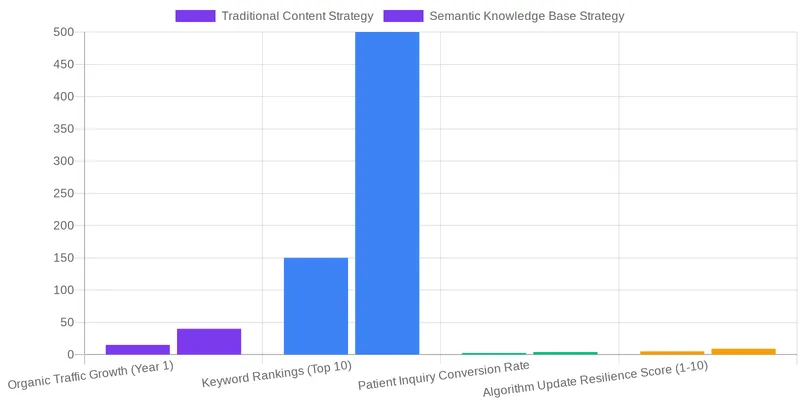
Implementing a semantic medical knowledge repository yields tangible results in terms of organic growth and market dominance. By systematically covering medical topics with depth and precision, websites achieve improved rankings for a wider array of relevant queries. This leads to a significant increase in organic traffic, as search engines recognize the site as a definitive source of information. Enhanced patient acquisition follows naturally, as prospective patients find trustworthy, comprehensive answers to their health questions directly on the clinic’s website. Beyond immediate gains, a well-constructed knowledge repository offers long-term resilience against algorithm updates. Its inherent structure and E-E-A-T signals make it less susceptible to fluctuations, ensuring sustained visibility and trust. This strategic asset transforms a website into an authoritative hub, fostering patient confidence and loyalty.
The Pathway to Algorithm-Proof Topical Authority in Healthcare
A well-constructed medical knowledge repository builds deep topical authority, making a medical website an undeniable expert source in its niche. This goes beyond simply having many pages; it involves demonstrating comprehensive understanding and interconnectedness of all related concepts. When Google perceives a website as having a complete “topical authority state” on a medical subject, it is more likely to prioritize that content in search results. This sustained visibility and trust are critical for private healthcare providers operating in competitive markets like London. By systematically addressing every facet of a medical topic, from basic definitions to advanced procedures, a website becomes an indispensable resource for both patients and search engines. This strategic approach is non-negotiable for long-term success, as detailed in why topical authority is non-negotiable for medical practices.
Ready to Build Your Algorithm-Proof Healthcare Knowledge Base?
Establishing a robust, semantic healthcare knowledge base is a strategic imperative for any medical practice aiming for sustained organic growth and digital authority. This advanced approach ensures your content is not only found but also trusted by both patients and search engines. If your clinic is ready to transform its online presence and dominate its niche, leveraging semantic SEO and cutting-edge web development is the next step.
Book a Semantic SEO Audit to discover how a tailored strategy can elevate your practice. For immediate consultation, reach out via Direct WhatsApp Strategy Line: +90 506 206 86 86. Alternatively, contact us to explore how Abdurrahman Şimşek can build your high-authority semantic content network.
Frequently Asked Questions
What is the difference between a blog and a healthcare knowledge base?
A blog typically presents content in a chronological, article-based format, often covering various topics without deep interconnections. In contrast, a healthcare knowledge base is a highly structured, interlinked network of content built around specific medical entities and concepts. Its purpose is to comprehensively cover a topic, establishing deep, machine-readable topical authority and enhancing E-E-A-T. This semantic approach makes information more accessible and trustworthy for both users and search engines.
How does Ruxi Data facilitate the construction of a healthcare knowledge base?
Ruxi Data automates the creation of the underlying Entity-Attribute-Value (EAV) structure and topical maps, which form the blueprint for a robust healthcare knowledge base. It intelligently identifies medical entities, their attributes, and the complex relationships between them. This automation allows for the scalable and coherent construction of a comprehensive content repository, significantly streamlining the development process.
Does a solo practitioner need a healthcare knowledge base?
Absolutely. Even for a solo practitioner, a structured healthcare knowledge base focused on their specific area of expertise is immensely powerful. It allows them to compete effectively with larger institutions by demonstrating unparalleled depth of knowledge in their niche. This deep expertise is a critical factor in YMYL (Your Money Your Life) SEO, building trust and authority with both patients and search engines.
How do you ensure the information in a healthcare knowledge base is always up-to-date?
We implement a dynamic content refresh workflow, often automated, that flags content for review based on new medical research, evolving best practices, or changes in clinical guidelines. The highly structured and interlinked nature of a healthcare knowledge base makes updating information significantly more efficient than managing updates across a traditional, disparate blog. This ensures accuracy and relevance, which are paramount in healthcare.
How does a healthcare knowledge base reduce the Cost of Retrieval?
By pre-organizing information into a clear, semantic hierarchy with strong internal linking and structured data, a healthcare knowledge base makes it incredibly easy for search engines to crawl and understand your content. This optimized structure minimizes the effort search engines need to process and index your information. This efficiency directly reduces the computational “Cost of Retrieval” for Google, potentially leading to better visibility and ranking.
How can I start building a semantic healthcare knowledge base for my practice?
Abdurrahman Şimşek, a Holistic SEO Strategist and Semantic Engineer, specializes in this area. You can book a Semantic SEO Audit to assess your current digital footprint and outline a tailored strategy. Alternatively, for direct consultation, reach out via the WhatsApp Strategy Line at +90 506 206 86 86.
Ruxi Data brings together multi-model AI, automated website crawling, live indexation checks, topical authority mapping, E-E-A-T enrichment, schema generation, and full pipeline automation — from crawl to WordPress publish to social posting — all in one platform built for agencies and freelancers who run on results.