
Google Quality Rater Guidelines: Elevating Surgical Content Trust
Google’s Quality Rater Guidelines provide the foundational framework for evaluating search result quality, particularly crucial for surgical content. This article details how these guidelines apply to medical websites, emphasizing the stringent standards for Your Money Your Life (YMYL) topics. Understanding E-E-A-T (Experience, Expertise, Authoritativeness, Trustworthiness) and the Needs Met rating scale is essential for achieving high page quality. Adhering to these principles builds patient trust, improves organic rankings, and establishes credibility for surgical and aesthetic medicine practices.
Abdurrahman Şimşek, a Semantic SEO Strategist, specializes in optimizing medical content to align with Google’s stringent quality standards. This expertise helps surgical practices enhance their online visibility and establish robust digital authority.
To explore your options, contact us to schedule your consultation. You can also reach us via: Book a Semantic SEO Audit, Direct WhatsApp Strategy Line: +90 506 206 86 86
Google’s Quality Rater Guidelines (QRG) are essential for medical websites in the surgical sector to achieve high search visibility. This article explains the QRG’s application to surgical content, providing strategies for London’s private healthcare clinics. It covers E-E-A-T, YMYL, and Needs Met to build patient trust, improve organic rankings, and establish credibility in aesthetic medicine.
Understanding Google’s Quality Rater Guidelines (QRG) for Medical SEO
The Quality Rater Guidelines (QRG) are a public document for Google’s human search quality raters. These raters evaluate search result quality, providing feedback that helps Google refine its algorithms. While raters do not directly influence rankings, their evaluations provide the framework for what Google considers high-quality content, especially for Your Money Your Life (YMYL) topics like surgical procedures.
What are the QRG and Why Do They Matter for Surgeons?
The QRG define “high-quality” versus “low-quality” pages. Understanding these guidelines is paramount for surgeons and medical clinics because Google applies heightened scrutiny to YMYL content. Feedback from human raters informs Google’s algorithmic updates. Aligning content with these guidelines is crucial for organic search visibility and patient trust. Ignoring them can reduce rankings and online presence.
YMYL & Surgical Content: The High Stakes of Page Quality
YMYL, or “Your Money Your Life,” is content that could impact a person’s health, financial stability, or safety. Surgical and aesthetic medical content is YMYL because it affects physical well-being and involves substantial financial investment. Google’s quality raters apply stringent standards to YMYL pages, requiring accuracy, credibility, and helpfulness to ensure user safety.
Defining YMYL in the Context of Plastic Surgery
Information on surgical procedures, health advice, and clinic services is YMYL. A page detailing a rhinoplasty procedure, for instance, impacts a patient’s health decisions and financial outlay. Low-quality YMYL content—with inaccuracies, misleading claims, or no expert authorship—risks user safety. Google’s algorithms penalize such content, which can cause severe ranking drops. For a comprehensive understanding of compliance, refer to our YMYL SEO Compliance: A Practical Checklist for Medical Websites.
Needs Met: Satisfying Patient Search Intent with Precision
The “Needs Met” rating scale in the QRG assesses how well a page satisfies a user’s query. For surgical content, this means providing comprehensive, accurate, and patient-centric information that addresses all aspects of a query. A page on “breast augmentation recovery” should detail recovery times, post-operative care, potential complications, pain management, and when to seek medical advice. Content that fully meets a user’s needs receives higher Needs Met ratings, signaling its value to Google.
E-E-A-T in Practice: Building Trust & Authority for Surgeons
E-E-A-T (Experience, Expertise, Authoritativeness, Trustworthiness) is the cornerstone of QRG compliance for medical content. For surgeons, demonstrating E-E-A-T is a requirement for establishing credibility with search engines and patients. Each E-E-A-T component must be communicated across a clinic’s digital presence.
Demonstrating Expertise and Authoritativeness
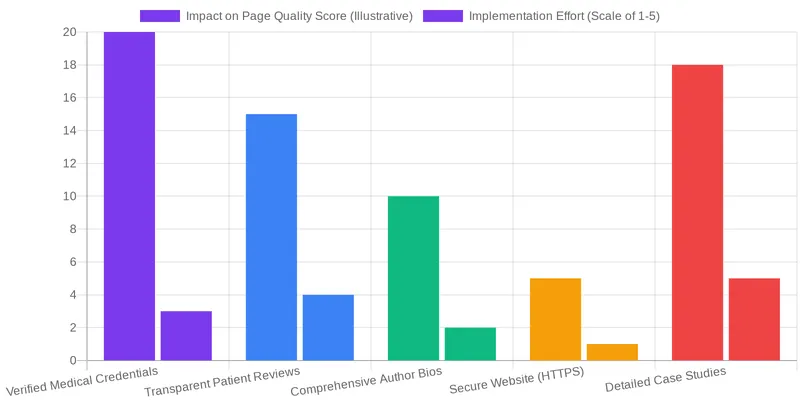
Surgeons must showcase their qualifications, certifications, experience, and specializations. This includes displaying General Medical Council (GMC) registration, Royal College memberships, and sub-specialty board certifications. Detailed author bios on content pages, comprehensive ‘About Us’ sections, and links to external professional profiles (e.g., LinkedIn, professional society pages) reinforce author expertise and website reputation. These signals demonstrate the professional’s knowledge and standing to raters and algorithms.
Cultivating Trustworthiness and Experience Signals
Trustworthiness is built through transparency and verifiable information, including clear pricing, genuine patient testimonials, and detailed case studies with before-and-after photos (with consent). Secure website infrastructure (HTTPS), privacy policies, and clear medical disclaimers are non-negotiable. Patient reviews on platforms like Google Business Profile, Doctify, or Trustpilot demonstrate real-world experience and contribute to website reputation. Main and supplementary content (e.g., procedure descriptions, patient guides, FAQs) must support these E-E-A-T signals.
Optimizing Surgical Content for QRG: A Semantic SEO Approach
A Semantic SEO approach addresses the google quality rater guidelines for London’s private healthcare clinics. This method focuses on entities and their relationships, not just keywords, to create a comprehensive understanding of medical topics. This structured approach satisfies QRG requirements by providing clear, accurate, and contextually relevant information.
From Keywords to Entities: Structuring High-Quality Medical Information
Instead of targeting keywords like “rhinoplasty cost,” a semantic approach focuses on the entity “Rhinoplasty” and its attributes: “average cost,” “recovery time,” “potential risks,” “benefits,” and “surgeon qualifications.” Defining and interlinking these entities and attributes (Entity-Attribute-Value, or EAV modeling) creates content that is comprehensive for patients and understood by search engines. This structured data reduces Google’s ‘Cost of Retrieval,’ helping algorithms process and rank high-quality medical information. This strategy is detailed in our guide on Knowledge Graph and E-E-A-T SEO.
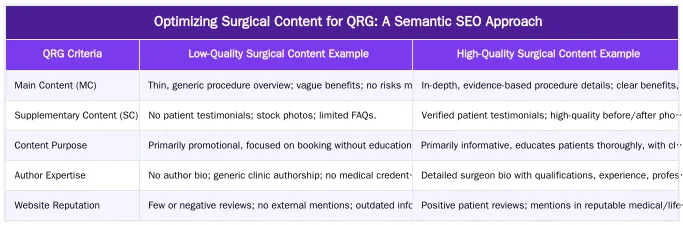
Low vs. High-Quality Surgical Content: A QRG Comparison
The QRG distinguishes between low and high-quality surgical content. High-quality content has depth, accuracy, and demonstrates E-E-A-T, while low-quality content lacks these elements.
Beyond the Guidelines: Future-Proofing Medical Content with Ruxi Data
Content must be future-proofed, not just meet current quality guidelines. Semantic infrastructure like Ruxi Data provides an advantage for medical clinics. It helps automate and scale content strategies that align with QRG expectations for sustained organic growth.
Automating Topical Authority and E-E-A-T Signals
Ruxi Data analyzes SERPs at scale to identify topical gaps and E-E-A-T opportunities, not just keywords. This allows for building content networks that cover a patient’s entire journey and query. By automating entity and relationship identification, Ruxi Data helps clinics build topical authority. This data-driven approach ensures content is accurate, expert-authored, and structured to satisfy QRG, making it resilient to algorithmic updates. For more on this, see our article on AI Content for YMYL Framework.
The Competitive Edge for London’s Private Healthcare
The London private healthcare market is highly competitive. Using semantic infrastructure like Ruxi Data provides a strategic advantage. It enables clinics to produce content that surpasses Google’s quality expectations for YMYL topics. This leads to stronger organic rankings, more patient inquiries, and an authoritative digital presence.
Partner with a Specialist for QRG-Compliant Medical SEO
Navigating Google’s Quality Rater Guidelines and YMYL requirements demands specialized expertise for surgical and aesthetic clinics. Partnering with a medical SEO and semantic engineering specialist is crucial for organic growth and patient trust. Abdurrahman Şimşek offers strategies to ensure your content complies with guidelines and builds lasting topical authority.
Conclusion
The Google Quality Rater Guidelines are foundational for medical practices in organic search. For surgical content, adherence to E-E-A-T principles, understanding YMYL, and satisfying patient needs are non-negotiable. Using a semantic SEO approach and tools like Ruxi Data, London’s private healthcare clinics can build content networks that establish trust and drive patient acquisition. To improve your clinic’s online presence and ensure QRG compliance, contact us. You can also Book a Semantic SEO Audit or reach out via Direct WhatsApp Strategy Line: +90 506 206 86 86.
Frequently Asked Questions
How do the Google Quality Rater Guidelines influence search algorithms?
The QRG is a document used by human quality raters to evaluate the quality of search results. While it’s not a direct ranking algorithm, it provides a clear framework for what Google considers a high-quality page, which directly influences how its algorithms are designed and refined. This feedback helps Google continuously improve its search engine’s understanding of quality.
How do the Google Quality Rater Guidelines define ‘Expertise’ for surgical content?
For surgical content, these guidelines emphasize that expertise must be formal and medical. Content should be written or produced by individuals with accredited medical qualifications. A blog post about rhinoplasty by a board-certified plastic surgeon demonstrates high E-E-A-T, unlike one by a general content writer.
What is the ‘Needs Met’ scale and how does it apply to surgical procedure pages?
The ‘Needs Met’ scale assesses how thoroughly a page fulfills a user’s search query. For surgical procedure pages, a high-quality page ‘Fully Meets’ user needs by offering comprehensive details on candidacy, risks, recovery, costs, and the surgeon’s experience. This ensures all likely patient questions are answered on a single, authoritative page.
How do the Google Quality Rater Guidelines instruct raters to assess a clinic’s reputation?
Raters are instructed to search for external, independent reputation information about the website, clinic, and surgeon. They look for reviews, news articles, and mentions in professional medical societies. A lack of reputation or widespread negative reviews is a strong signal of low quality, according to the Google Quality Rater Guidelines.
Can a well-designed surgical page still receive a low Page Quality rating according to the guidelines?
Yes, absolutely. Even a professionally designed page will receive a low rating if its main content is inaccurate, lacks a clear author, or has a negative reputation. For surgical content, accuracy, authoritativeness, and trustworthiness are far more critical than mere aesthetics.
How can I ensure my medical website complies with these guidelines for better SEO?
To ensure compliance and improve your medical website’s SEO, consider a specialized semantic SEO audit. Abdurrahman Şimşek offers expert guidance in semantic SEO architecture and medical SEO strategies for clinics. You can book a Semantic SEO Audit directly or use the WhatsApp Strategy Line at +90 506 206 86 86 for immediate assistance.
Ruxi Data brings together multi-model AI, automated website crawling, live indexation checks, topical authority mapping, E-E-A-T enrichment, schema generation, and full pipeline automation — from crawl to WordPress publish to social posting — all in one platform built for agencies and freelancers who run on results.