
Google Indexing API: Instant Content Discovery & SEO Advantage
The google indexing api offers a direct, powerful method to notify Google of new or updated pages, ensuring near-instant crawling and indexing. Mastering the google indexing api is crucial for competitive real-time SEO in 2026, optimizing crawl budget, and accelerating content discovery. This guide details its functionality, benefits for technical SEO, and step-by-step implementation, including integration into modern content publishing workflows. Leveraging the google indexing api significantly shortens the time from publication to search visibility, providing a distinct advantage over traditional sitemap submissions.
Abdurrahman Simsek is committed to delivering cutting-edge, ethical SEO strategies that drive tangible results. Our expertise ensures you receive accurate, actionable insights for optimizing your digital presence. We prioritize clarity and practical application, empowering businesses to navigate complex technical SEO challenges effectively.
To explore your options, contact us to schedule your consultation.
The google indexing api provides a direct and powerful way to notify Google when your website’s pages are added or removed, prompting near-instant crawling. In the fast-paced digital landscape of 2026, mastering this tool is no longer optional—it’s essential for competitive real-time SEO, efficient content discovery, and maximizing your site’s visibility. This guide covers how the API works, its profound benefits for crawl budget, step-by-step implementation, and how it integrates into a modern, automated SEO workflow to keep you ahead of the curve.
What Is the Google Indexing API and How Does It Work?
The Google Indexing API is a direct notification system that allows website owners to tell Googlebot to crawl specific pages immediately. Unlike traditional methods that rely on sitemaps and organic discovery, the API pushes notifications for new, updated, or deleted URLs, significantly shortening the time between publishing and appearing in search results. This process ensures your most critical content is indexed with unprecedented speed.
Technically, the process works by sending authenticated requests to Google’s API endpoints. You must first set up a project in the Google Cloud Platform, create a dedicated service account, and grant it ownership permissions in your Google Search Console. Once configured, you can send POST requests containing the URL you want processed. The API has two primary request types:
- URL_UPDATED: Notifies Google that a new page has been published or an existing one has been modified. Googlebot will schedule a crawl promptly.
- URL_DELETED: Informs Google that a page has been permanently removed, accelerating its de-indexing from search results.
This direct communication channel bypasses the normal crawl queue, making it a cornerstone of modern technical SEO strategy for time-sensitive content.
Key Benefits of Using the API for SEO in 2026
In 2026, the speed of information is a primary ranking factor, and leveraging the google indexing api offers a distinct competitive advantage. The benefits extend far beyond simply getting pages crawled faster; they fundamentally change how you manage your site’s presence on Google.
The most significant benefit is achieving instant content indexing. For industries like news, e-commerce with flash sales, or job boards, being first to index means capturing the initial wave of user traffic. When a competitor’s content takes hours or days to appear, your API-submitted page can be live in minutes. This is the essence of real-time SEO—aligning your content’s visibility with real-world events as they happen.
Secondly, the API ensures that critical updates are reflected quickly. Imagine you’ve corrected a major pricing error or updated vital product information. Waiting for a standard recrawl introduces risk. With an API call, you can push the update to Google immediately, ensuring users see the most accurate information. As a SaaS provider, we’ve seen clients use this to instantly index new feature pages and documentation, directly impacting user adoption and support ticket volume. According to Google’s own documentation, this method keeps search results fresher for users.
Finally, it enhances your overall content strategy. Knowing your content will be indexed rapidly allows for more agile and responsive publishing. You can react to market trends, publish breaking news, or update service offerings with confidence that your efforts will be visible on SERPs almost instantly.
A Step-by-Step Guide to Implementing the Google Indexing API
Setting up the google indexing api involves a few technical steps, but the process is straightforward if followed carefully. This setup creates a secure connection between your website and Google’s services.
Initial Setup in Google Cloud & Search Console
- Create a Google Cloud Project: Go to the Google Cloud Platform console and create a new project. If you already have one, you can use it.
- Enable the API: Within your new project, navigate to the “APIs & Services” dashboard and enable the “Indexing API.”
- Create a Service Account: In the “Credentials” section, create a new service account. Give it a descriptive name (e.g., “indexing-api-user”) and grant it the “Owner” role for simplicity, though more granular permissions are possible.
- Generate a JSON Key: After creating the service account, generate a private key in JSON format. This file will be downloaded to your computer—keep it secure, as it grants access to the API on your behalf.
- Grant Access in Google Search Console: Open your website’s property in Google Search Console. Go to “Settings” > “Users and permissions.” Add a new user, using the service account’s email address (found in the JSON key file or your Cloud project) as the user. Grant it “Owner” permission.
With the authentication complete, you can now send requests. This is typically done via a script (Python, Node.js, etc.) or through plugins for platforms like WordPress. For a more detailed walkthrough, see our complete 2026 integration guide. The key is to automate these requests as part of your content publishing workflow for maximum efficiency.
Optimizing Crawl Budget: A Deeper Dive
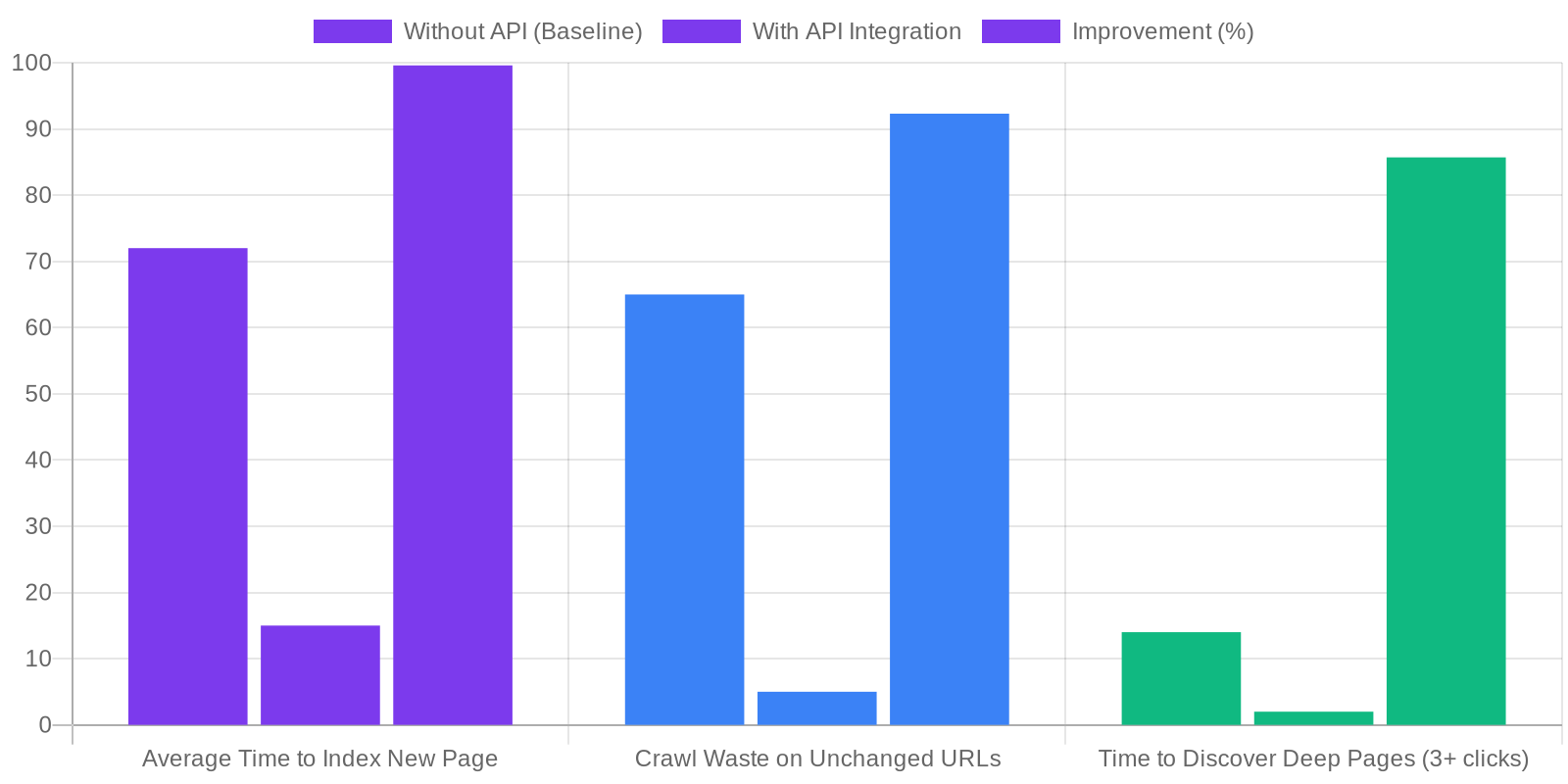
Crawl budget—the number of pages Googlebot can and wants to crawl on your site within a given timeframe—is a finite resource. For large websites, especially SaaS platforms with thousands of documentation pages or e-commerce sites with vast product catalogs, crawl budget optimization is critical. Wasting this budget on unchanged pages means new or updated content may be discovered slowly, if at all.
The google indexing api is a game-changer for this. Instead of relying on Googlebot to passively discover changes by re-crawling your entire site, the API allows you to proactively tell it exactly where to look. When you publish a new blog post or update a key landing page, you send a single, targeted request. Googlebot can then allocate its resources to that specific URL, ignoring the thousands of other pages that haven’t changed.
This surgical approach preserves your crawl budget for what matters most. It ensures that your most important content is always fresh in Google’s index and helps Googlebot discover pages deeper within your site architecture more efficiently. The result is a more effective and efficient crawl pattern that directly impacts your site’s overall SEO performance.
Google Indexing API vs. IndexNow: A 2026 Comparison
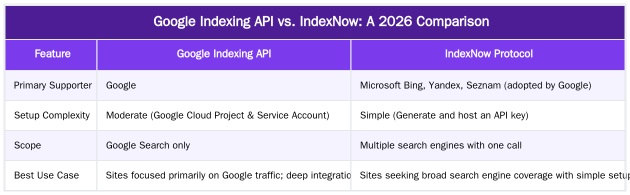
While the google indexing api is a powerful tool, it’s not the only player in the instant indexing space. IndexNow is an open protocol, initially developed by Microsoft Bing and Yandex, that serves a similar purpose. As of 2026, Google has also adopted the protocol, making the choice between them more nuanced.
The primary difference lies in their origin and scope. The Google Indexing API is a proprietary, Google-specific solution that requires authentication via Google Cloud. It offers the most direct and reliable pipeline to Googlebot. IndexNow, on the other hand, is an open standard. With a single API call, you can notify multiple search engines—including Bing, Yandex, and now Google—about content changes. Its setup is often simpler, requiring just a generated API key placed on your server.
So, which should you use? For businesses whose traffic is overwhelmingly from Google, using the google indexing api remains the most robust strategy. However, for maximum reach across all search engines, a hybrid approach is best. Many modern SEO tools and plugins now support both, allowing you to ping the Google API directly while also sending an IndexNow request to cover other engines. Explore our detailed comparison of Indexing API vs. IndexNow to decide the best fit for your strategy.
Integrating the API into Your Automated SEO Workflow
The true power of the google indexing api is unlocked when it moves from a manual tool to a fully integrated part of your content publishing workflow. Manually submitting URLs is inefficient and misses the point. The goal is to create a system where indexing happens automatically, in real-time, without human intervention.
For SaaS companies and modern digital businesses, this means integrating API calls directly into your Content Management System (CMS) or CI/CD (Continuous Integration/Continuous Deployment) pipeline. Here’s how it works in practice:
- On New Content Publication: When an editor clicks “Publish” on a new blog post, a server-side script is triggered. This script automatically formats and sends a `URL_UPDATED` request to the Google Indexing API.
- On Content Updates: If a page is edited and saved, the same script triggers, notifying Google of the change.
- On Content Deletion: When a page is unpublished or deleted, a `URL_DELETED` request is sent, ensuring outdated content is removed from the index promptly.
This level of automation transforms SEO from a reactive discipline to a proactive, programmatic function. At Abdurrahman Simsek, we specialize in building these automated SEO workflows for our clients. By connecting your publishing platform to the API, you ensure that every content action has an immediate and corresponding impact on your search visibility, creating a seamless and highly efficient system.
Future-Proof Your SEO Strategy with the Indexing API
As search engines become more sophisticated and AI-driven, the emphasis on real-time data and fresh content will only intensify. The google indexing api is not just a tool for 2026; it’s a foundational piece of a future-proof SEO strategy. By adopting it now, you are aligning your website with the direction search is heading: instant, relevant, and hyper-fresh results.
Mastering this API ensures you can compete in an environment where speed is paramount. It gives you control over your content’s lifecycle in Google’s index, optimizes your site’s resources, and builds a more resilient and agile digital presence. Don’t let your content wait in line. Take control of your indexing and secure your competitive edge for years to come.
Ready to implement an automated, real-time SEO strategy? Let our experts at https://abdurrahmansimsek.com help you integrate the Indexing API and build a workflow that drives results.
Conclusion
The google indexing api has evolved from a niche tool to an indispensable component of modern technical SEO. It offers unparalleled speed for content indexing, provides a strategic solution for crawl budget optimization, and enables the creation of powerful automated workflows. By understanding and implementing this API, you can ensure your most important content is seen by Google and your audience the moment it goes live. To stay competitive in 2026 and beyond, embracing instant indexing isn’t just an option—it’s a necessity. Visit us at https://abdurrahmansimsek.com to discover how we can elevate your SEO strategy.
Frequently Asked Questions
What is the primary purpose of the google indexing api?
The google indexing api allows website owners to directly notify Google about new or updated pages, prompting near-instant crawling. This significantly reduces the time it takes for fresh content to appear in search results. Using the API is a proactive way to manage how your most time-sensitive content is discovered.
Is the google indexing api a replacement for sitemaps?
No, the API is not a replacement for sitemaps. Sitemaps remain essential for helping Google discover all the URLs on your site and understand its overall structure. The google indexing api complements sitemaps by providing immediate notifications for specific, high-priority URLs that need to be crawled right away.
What types of content are best for the google indexing api?
Officially, Google recommends the API for pages with `JobPosting` or `BroadcastEvent` structured data. However, many SEOs use the google indexing api for any time-sensitive content where immediate indexing offers a competitive edge, such as news articles, new blog posts, or critical page updates.
What are the main SEO benefits of instant content indexing?
Instant indexing provides faster visibility in search results, improves crawl budget efficiency by directing Googlebot to your most important pages, and creates quicker ranking opportunities. This is especially valuable for responding to trending topics or publishing critical updates on news or Your Money or Your Life (YMYL) websites.
How does the Google Indexing API differ from IndexNow?
Both tools aim for faster indexing, but the Google Indexing API is a proprietary solution that works only with Google Search. In contrast, IndexNow is an open-source protocol supported by multiple search engines, including Bing and Yandex. This allows you to notify several platforms with a single API call for broader reach.
Are there usage limits or quotas for the API?
Yes, Google sets usage quotas to prevent system abuse. By default, projects typically have a quota of 200 publish requests per day and 600 requests per minute. You can monitor your usage and request a higher quota through the Google Cloud Console if your website’s publishing volume requires it.
Ruxi Data brings together multi-model AI, automated website crawling, live indexation checks, topical authority mapping, E-E-A-T enrichment, schema generation, and full pipeline automation — from crawl to WordPress publish to social posting — all in one platform built for agencies and freelancers who run on results.