
Entity SEO Saas: Building Your Brand’s Knowledge Graph
A successful entity SEO SaaS strategy is crucial for competitive advantage in 2026, moving beyond keywords to build a machine-readable understanding of your brand. This article details how to implement entity SEO SaaS by building your brand’s Knowledge Graph, leveraging structured data, and optimizing for semantic search. Readers will learn to establish their SaaS company as an undeniable authority, enhancing E-E-A-T signals and improving visibility. Mastering entity SEO SaaS ensures your brand, products, and personnel are recognized as distinct, authoritative entities within the evolving search landscape, directly impacting online growth and bottom line.
Abdurrahman Simsek is committed to delivering cutting-edge SEO strategies that prioritize accuracy, ethical practices, and measurable outcomes. Our expertise ensures your SaaS brand implements robust entity SEO solutions designed for long-term success and sustained authority in the digital sphere.
To explore your options, contact us to schedule your consultation.
A successful entity SEO SaaS strategy is the definitive competitive advantage in 2026, moving beyond simple keywords to build a deep, machine-readable understanding of your brand. In a landscape dominated by AI-driven search and semantic understanding, this approach is no longer optional—it’s the core of sustainable online growth. This article breaks down how to build your brand’s Knowledge Graph, leverage structured data, and implement a future-proof strategy that establishes your SaaS company as an undeniable authority in its niche, directly impacting your visibility, E-E-A-T signals, and bottom line.
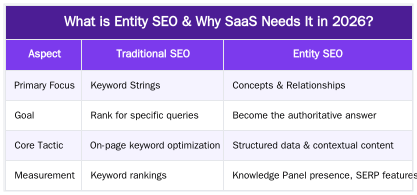
What is Entity SEO & Why SaaS Needs It in 2026?
Entity SEO is the practice of optimizing your online presence around well-defined concepts or “entities”—such as people, places, organizations, or products—rather than just keywords. Its core purpose is to help search engines like Google understand the context, relationships, and attributes of your brand, solidifying your place in their massive database, the Knowledge Graph. For SaaS companies in 2026, this is critical for demonstrating authority and trustworthiness (E-E-A-T).
Beyond Keywords: Understanding Semantic Search
For years, SEO focused on matching the “strings” of text in a user’s query to the keywords on a page. Today, search engines have evolved. Thanks to advancements like Google’s BERT and MUM, they now practice semantic search, focusing on the meaning and intent behind a query. They don’t just see words; they see concepts and the relationships between them. An effective `entity seo saas` strategy ensures your brand, products, and key personnel are recognized as distinct, authoritative entities within this semantic web.
The SaaS Advantage: Why Entities Matter More Now
SaaS products are often complex, with specific features, integrations, and use cases that are difficult to capture with keywords alone. Entity SEO allows you to define your product as an entity with specific properties (e.g., “CRM Software”), relationships (e.g., “integrates with Slack”), and attributes (e.g., “developed by YourCompany Inc.”). This clarity helps search engines confidently recommend your solution for highly specific, high-intent queries, giving you a significant edge in a crowded market.
Building Your SaaS Knowledge Graph with Entity SEO
At the heart of entity SEO is the creation of your brand’s own private Knowledge Graph. This isn’t a physical file but rather the sum of all the structured and unstructured data that search engines use to understand who you are, what you do, and how you relate to the wider world. When Google can confidently connect your brand entity to your product entities and your founder entity, your authority skyrockets.
Identifying Key Entities for Your SaaS Brand
The first step is to identify and define your core entities. For a typical SaaS company, these will include:
- Organization: Your company name, logo, founding date, headquarters.
- Products/Services: Each specific software offering (e.g., “Project Management Tool,” “Analytics Platform”).
- People: Your CEO, key executives, and notable experts on your team.
- Concepts: The core problems you solve or the industry you serve (e.g., “Customer Relationship Management,” “Enterprise SEO”).
- Events: Your annual user conference or significant webinars.
Each of these named entities should have a “home” on your website—a definitive page that serves as the primary source of truth, such as your About Us page, product pages, or author bios.
Connecting the Dots: Entity Relationships and Context
Identifying entities is only half the battle. The real power of an `entity seo saas` approach comes from establishing clear relationships between them. You must explicitly state these connections in your content and code. For example, a blog post by your CEO (Person entity) about a new feature for your software (Product entity) that solves a specific industry problem (Concept entity) creates a powerful web of context. This interconnectedness proves to search engines that you are not just a collection of pages, but a cohesive, authoritative organization.
Practical Entity SEO Strategy for SaaS Brands
Transitioning from a keyword-first to an entity-first mindset requires a practical, multi-faceted approach. It involves telling search engines exactly what your content is about using their own language (structured data) and creating content that reinforces those connections. This is the foundation of a modern `entity seo saas` program.
Leveraging Structured Data and Schema Markup
Schema markup is a vocabulary of code that you add to your website to explicitly define your entities. By using types like `Organization`, `SoftwareApplication`, and `Person` from Schema.org, you remove all ambiguity for search engine crawlers. For a SaaS product, you can specify its name, operating system, application category, and even customer reviews. This detailed markup is a cornerstone of any advanced entity SEO strategy, directly feeding the Knowledge Graph and enabling rich results in the SERPs.
Content Strategy for Entity Recognition
Your content must consistently reinforce your core entities. Create comprehensive pillar pages for your main products and services. Write blog posts that connect your software to the problems it solves. Develop author bios that establish your team’s expertise. Use internal linking strategically to show the relationships between these pages. For example, link from a blog post about “improving team collaboration” to your “Project Management Tool” product page, strengthening the semantic connection between the concept and the solution.
Automating SaaS Entity SEO: The Ruxi Data Advantage
Manually identifying, mapping, and marking up every entity for an enterprise-level SaaS company is a monumental task. As pioneers in semantic technologies, we at Ruxi Data have developed solutions to automate this complex process. An automated approach to `entity seo saas` not only saves hundreds of hours but also ensures a level of precision and scale that is impossible to achieve manually, future-proofing your strategy against algorithm updates.
Streamlining Entity Identification and Mapping
Our platform uses Natural Language Processing (NLP) to scan your entire website and competitor landscape, automatically identifying key entities and their relationships. It discovers what concepts Google already associates with your brand and where gaps exist. This data-driven approach removes guesswork, allowing you to focus on creating content that fills those gaps. Learn more about how we enable knowledge graph automation to build a comprehensive entity map at scale.
Integrating with Google’s Knowledge Graph API
True authority comes from aligning your brand’s entity data with Google’s own understanding. Our tools can interact directly with the Google Knowledge Graph Search API to reconcile your defined entities with Google’s existing database. This process helps resolve ambiguities and strengthens the connection between your website and your official Knowledge Panel. By automating this reconciliation, we ensure your SaaS brand is represented accurately and authoritatively across Google’s ecosystem.
E-E-A-T & Beyond: Benefits of Entity SEO for SaaS
The rewards of a well-executed `entity seo saas` strategy extend far beyond simple rankings. By establishing your brand as a clear, authoritative entity, you directly influence the core signals that search engines use to determine quality and trust. This leads to tangible business outcomes, from increased visibility to higher conversion rates.
Enhancing E-E-A-T Signals for Trust
E-E-A-T (Experience, Expertise, Authoritativeness, and Trustworthiness) is paramount in 2026. Entity SEO is one of the most powerful ways to build it. When Google recognizes your company, its products, and its leaders as distinct entities with established expertise in a specific niche, your authoritativeness grows. This trust signal is a powerful ranking factor, especially for high-stakes B2B SaaS decisions.
Securing Richer SERP Features
A strong entity presence makes you eligible for a wide array of valuable SERP features. This includes a branded Knowledge Panel, which acts as a virtual billboard for your company, as well as rich results like product reviews, pricing, and FAQs directly in the search results. These features increase your SERP real estate, boost click-through rates, and provide answers to users before they even visit your site.
Measuring the Impact of Your Entity SEO Efforts
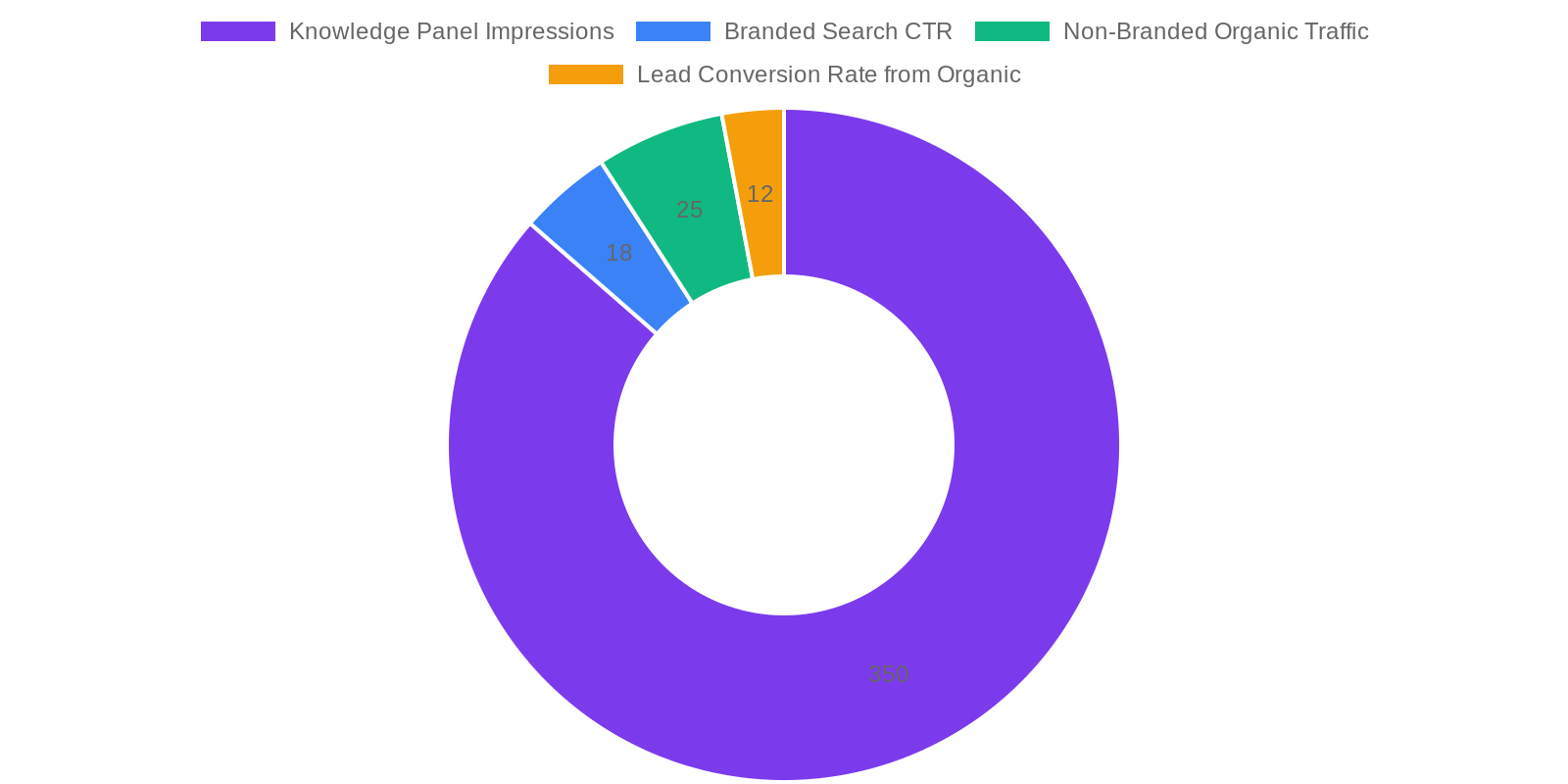
Unlike traditional SEO, measuring the success of an `entity seo saas` strategy requires looking beyond keyword rankings. The goal is to measure your brand’s growing authority and visibility within the search engine’s knowledge base. This means focusing on a new set of KPIs that reflect your presence and prominence as a recognized entity.
Key Performance Indicators (KPIs) to Track
To gauge your progress, monitor these key metrics:
- Knowledge Panel Presence: Track the number of impressions and clicks your brand’s Knowledge Panel receives in Google Search Console.
- SERP Feature Ownership: Measure how often your pages appear in rich results, “People Also Ask” boxes, and featured snippets for your target topics.
- Branded vs. Non-Branded Traffic Growth: A successful strategy will lift both, but a rise in non-branded traffic for topical queries is a strong sign of growing authority.
- Entity Salience Scores: Use NLP tools to measure how prominently your key entities are mentioned and understood in your content and across the web.
Tools for Monitoring Entity Performance
While Google Search Console is a great starting point, specialized tools are needed for deeper analysis. Semantic SEO platforms can help you track entity recognition, analyze SERP features at scale, and monitor how your Knowledge Graph is developing over time. These tools provide the concrete data needed to prove the ROI of your `entity seo saas` investment and refine your strategy.
The Future of Search: Entity SEO in 2026 and Beyond
As search engines become answer engines, the importance of `entity seo saas` will only intensify. The future of search is not about finding a list of blue links; it’s about providing direct, authoritative answers. Brands that have invested in building a robust, well-defined Knowledge Graph will be the ones that AI-driven search assistants and conversational interfaces trust and recommend. This is your opportunity to build a lasting competitive moat that protects your brand’s visibility for years to come.
Conclusion
In 2026, winning in search requires moving from matching strings to building meaning. An effective entity SEO SaaS strategy is the blueprint for achieving this, transforming your brand from a simple website into a recognized, authoritative entity in Google’s eyes. By identifying your core entities, defining their relationships through content and structured data, and leveraging automation, you can build a powerful Knowledge Graph that enhances E-E-A-T, captures valuable SERP real estate, and drives sustainable growth. Ready to build your brand’s authority for the future of search? Explore how we can help at https://abdurrahmansimsek.com.
Frequently Asked Questions
What is Entity SEO and why is a strong entity seo saas strategy crucial in 2026?
Entity SEO is the practice of defining and connecting key concepts (entities) related to your brand, like your company, products, and key people. For SaaS brands, this helps search engines understand your authority and context beyond just keywords. A successful entity seo saas strategy is vital for building a robust Knowledge Graph and enhancing E-E-A-T signals.
How does structured data like Schema markup improve an entity seo saas strategy?
Schema markup is a code vocabulary that explicitly defines entities on your website for search engines. Using types like Organization and Product translates your content into a language Google understands, helping it accurately build your Knowledge Graph. This structured data is a foundational component of any effective entity seo saas plan.
What are the main benefits of a strong Knowledge Graph for an entity seo saas campaign?
A strong Knowledge Graph increases brand visibility in search results, often leading to rich snippets and prominent Knowledge Panel features. It builds trust and authority by presenting clear, consistent information to both users and search engines. This ultimately drives more qualified traffic and improves conversion rates for your SaaS offerings.
How does Entity SEO for SaaS directly support E-E-A-T signals?
Entity SEO directly strengthens your E-E-A-T (Experience, Expertise, Authoritativeness, Trust) signals. By clearly defining your organization, authors, and product expertise through structured data and consistent content, you provide Google with verifiable proof of your authority. This helps establish your brand as a trusted and expert entity within its niche.
What are the first steps for implementing an entity seo saas strategy?
Start by identifying your core brand entities, such as your company name, key products, founders, and unique concepts. Ensure this information is consistent across all online platforms, from your website to social media profiles. Then, implement relevant Schema markup and create comprehensive content that clearly defines and connects these entities.
Ruxi Data brings together multi-model AI, automated website crawling, live indexation checks, topical authority mapping, E-E-A-T enrichment, schema generation, and full pipeline automation — from crawl to WordPress publish to social posting — all in one platform built for agencies and freelancers who run on results.