
Entity SEO 2026: Mastering Knowledge Graphs for Saas Brands
Entity SEO 2026 is crucial for SaaS brands aiming for robust digital presence. This guide explains how to build a strong Knowledge Graph, moving beyond keywords to semantic understanding. It details strategies for optimizing your brand as a distinct entity, enhancing visibility and authority. Learn to leverage structured data, JSON-LD, and E-E-A-T principles to ensure Google accurately comprehends your SaaS offerings. Mastering entity seo 2026 ensures your brand thrives in the evolving semantic web, improving search engine recognition and user trust.
Abdurrahman Simsek provides insights into advanced SEO strategies, focusing on practical applications for SaaS businesses. This content delivers actionable guidance on leveraging semantic search and brand entity optimization to secure a competitive edge in digital marketing.
To explore your options, contact us to schedule your consultation.
Understanding entity seo 2026 is paramount for SaaS brands aiming to establish a robust digital presence. This comprehensive guide demystifies entity-based optimization, explaining how it underpins Google’s Knowledge Graph and provides actionable strategies for building a strong digital identity for your SaaS business. By focusing on entities rather than just keywords, brands can achieve greater visibility, authority, and trust within search engine results. This article outlines the practical steps and strategic considerations necessary for SaaS companies to thrive in the semantic web of 2026.
What is Entity SEO in 2026 & Why it Matters?
Entity SEO in 2026 refers to the optimization process that helps search engines understand your brand, products, and services as distinct, real-world “entities” rather than just collections of keywords. This approach moves beyond traditional keyword matching, focusing on the semantic relationships between concepts, enabling search engines to provide more accurate and contextually relevant results. For SaaS brands, this means ensuring Google comprehends what your software does, who it serves, and its unique value proposition.
The Shift to Semantic Understanding
Search engines have evolved significantly from simple keyword matching to a sophisticated understanding of “things” and their relationships. This semantic shift, powered by advancements in artificial intelligence and machine learning, allows Google to interpret user intent more accurately. Instead of merely identifying keywords on a page, search algorithms now connect those keywords to known entities, their attributes, and their connections within a vast knowledge base. This deeper comprehension facilitates more intelligent search results and personalized user experiences.
Why SaaS Brands Can’t Ignore Entity SEO Now
For SaaS brands, establishing a clear entity profile is crucial for several reasons. It enhances brand recognition, builds authority, and improves visibility in competitive markets. When Google recognizes your SaaS product as a distinct entity, it can display rich results, Knowledge Panels, and better match your offerings to complex user queries. This leads to increased organic traffic, higher conversion rates, and a stronger overall digital footprint. Ignoring entity-based optimization risks your brand being misunderstood or overlooked by modern search engines.
How Google’s Knowledge Graph Recognizes Your SaaS Brand
Google’s Knowledge Graph is a vast semantic network that stores information about real-world entities and their interconnections. For a SaaS brand, this means Google attempts to identify your company, its software applications, key personnel, and related concepts. When your brand is recognized as an entity within the Knowledge Graph, it gains a distinct digital identity, allowing Google to present comprehensive information directly in search results, often through a Knowledge Panel.
Connecting the Dots: Entities, Attributes, and Relationships
The Knowledge Graph operates by identifying entities (e.g., your SaaS company, its CEO, specific software features), their attributes (e.g., company founding date, software version, pricing model), and the relationships between them (e.g., “Company X develops Software Y,” “Person Z is the CEO of Company X”). Google gathers this data from various sources, including Wikipedia, Wikidata, official websites, and structured data. By explicitly defining these connections, SaaS brands can help Google build a more accurate and complete understanding of their ecosystem. Learn more about this process at Knowledge Graph and E-E-A-T SEO.
The Power of Semantic Search and NLP
Semantic search and Natural Language Processing (NLP) are foundational to how Google identifies and processes entities. NLP allows search engines to understand the meaning and context of language on your website, extracting entities and their relationships from unstructured text. Semantic search then uses this understanding to match user queries with relevant entities, even if the exact keywords are not present. For SaaS, this means content that clearly describes your software’s functionality, benefits, and target audience, using natural language, significantly aids entity recognition.
Building Your Brand’s Knowledge Graph: A Practical Guide
Actively contributing to and strengthening your brand’s presence in Google’s Knowledge Graph requires a multi-faceted approach. This involves strategic implementation of structured data, creating entity-rich content, and cultivating strong off-page signals. Each element plays a vital role in how search engines perceive and categorize your SaaS brand.
Implementing Strategic Schema Markup (JSON-LD)
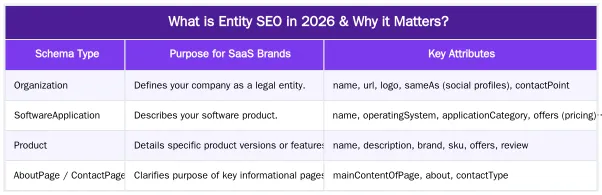
Schema Markup, particularly in JSON-LD format, is the most direct way to communicate entity information to search engines. For SaaS brands, specific schema types are crucial. Implementing `Organization` schema defines your company, `SoftwareApplication` schema describes your product, and `Product` schema details specific offerings. These markups explicitly tell Google about your brand’s name, official website, social profiles, product features, pricing, and reviews. Consistent and accurate schema implementation across your website is fundamental for entity recognition. A detailed guide is available at Entity Schema Markup Guide.
Crafting Entity-Rich Content & Topic Clusters
Content strategy must evolve to focus on entities. This means creating content that not only uses relevant keywords but also explicitly defines and links to your brand’s core entities and related industry concepts. Developing topic clusters around your SaaS product’s functionalities, use cases, and target industries helps build topical authority. Each piece of content should contribute to a comprehensive understanding of your brand’s expertise within its niche. This approach signals to Google that your brand is a knowledgeable authority on specific subjects. Explore more on this at Entity SEO for SaaS 2026.
Automating Entity SEO for SaaS: Ruxi Data’s Approach
The complexity of implementing comprehensive entity optimization can be a significant challenge for SaaS businesses. Specialized tools can automate and streamline these intricate tasks. Solutions like Ruxi Data are designed to address the unique requirements of the SaaS industry, simplifying the process of defining and connecting brand entities within the digital ecosystem.
Streamlining Schema Generation and Entity Identification
Automated platforms can significantly reduce the manual effort involved in generating and deploying schema markup. Ruxi Data, for instance, automates the creation of `SoftwareApplication`, `Organization`, and `Product` schema, ensuring accuracy and compliance with Google’s guidelines. These systems also identify key industry entities relevant to a SaaS brand, helping to build a more robust and interconnected Knowledge Graph profile. This automation ensures that critical entity information is consistently communicated to search engines across all digital properties. Further insights into automation are available at Knowledge Graph SEO Automation.
Integrating E-E-A-T Signals for Enhanced Brand Authority
Automated solutions extend beyond just schema generation; they can also help integrate and amplify E-E-A-T (Experience, Expertise, Authoritativeness, and Trustworthiness) signals. By systematically connecting a SaaS brand to its founders, key team members, and their respective credentials, automated tools help Google understand the human expertise behind the software. This includes linking to professional profiles, publications, and industry contributions, thereby enhancing the brand’s perceived authority and trustworthiness in its domain. Such integration is vital for establishing a credible and recognized brand entity.
E-E-A-T and Brand SERP Optimization in 2026
E-E-A-T is a critical factor in how Google assesses the quality and trustworthiness of content and, by extension, the entities behind it. For SaaS brands, demonstrating strong E-E-A-T signals directly influences their ability to rank, appear in Knowledge Panels, and build a positive brand reputation. Optimizing your Brand SERP (Search Engine Results Page) is about controlling the narrative Google presents about your brand.
Demonstrating Expertise, Experience, Authority, and Trustworthiness
To bolster E-E-A-T, SaaS brands must actively showcase the expertise and experience of their team, particularly those involved in content creation and product development. This involves creating author profiles with clear credentials, linking to industry contributions, and ensuring all information is factually accurate and well-supported. Authority is built through consistent, high-quality content that addresses user needs, while trustworthiness comes from transparent business practices, positive customer reviews, and secure website infrastructure. Google’s guidelines on quality raters emphasize these elements heavily, making them central to any successful entity optimization strategy. For more on Google’s quality guidelines, refer to their official documentation on creating helpful, reliable, people-first content.
Monitoring and Enhancing Your Brand’s Search Presence
Brand SERP optimization involves actively monitoring what appears when someone searches for your brand name. This includes your website, social media profiles, news articles, reviews, and the Knowledge Panel. Proactive management ensures that positive and accurate information dominates. By consistently updating your official profiles, engaging with customers, and addressing any misinformation, SaaS brands can shape their digital narrative. A well-optimized Brand SERP reinforces your entity’s credibility and helps control the first impression users get of your company.
Measuring Success: Key Metrics for Entity-Driven SaaS SEO
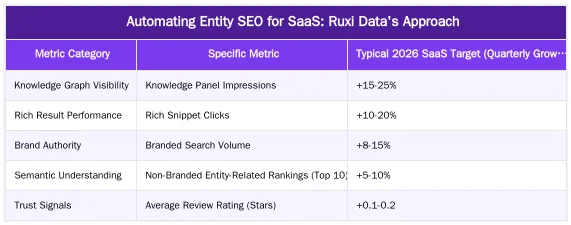
Tracking the effectiveness of entity-focused SEO strategies requires a different set of metrics than traditional keyword-based approaches. For SaaS brands, success is often reflected in enhanced brand visibility, improved semantic understanding by search engines, and ultimately, better organic performance. Focusing on specific indicators helps gauge progress and refine strategies.
Tracking Knowledge Panel Visibility and Rich Results
A primary indicator of successful entity optimization is the appearance and completeness of your brand’s Knowledge Panel. Metrics to track include the frequency of Knowledge Panel display, the accuracy of information within it, and any associated rich results (e.g., star ratings, pricing, availability) that appear for your software product. Monitoring impressions and clicks on these enhanced search features provides direct insight into how well Google understands and presents your brand as an entity. Increased visibility in these areas signifies stronger entity recognition.
Analyzing Semantic Search Performance and Brand Mentions
Beyond direct Knowledge Panel metrics, analyzing semantic search performance involves looking at rankings for conceptual queries that don’t necessarily contain your brand name but are highly relevant to your product’s function or industry. Tracking brand mentions across the web, including unstructured data sources, helps assess how widely your brand entity is recognized and discussed. Tools that monitor sentiment around these mentions can also provide valuable qualitative data. This holistic view helps understand the broader impact of your entity SEO efforts.
Future-Proofing Your SaaS Brand with Advanced Entity Strategies
As search technology continues its rapid evolution, particularly with the rise of AI and conversational interfaces, advanced entity strategies are essential for future-proofing your SaaS brand. Proactive adaptation ensures your brand remains discoverable and relevant in emerging search environments.
Adapting to AI-Powered Search and Generative Experiences
The landscape of search is increasingly dominated by AI-powered systems and generative search experiences. These systems rely heavily on a deep understanding of entities and their relationships to synthesize answers and provide rich, contextual information. For SaaS brands, this means ensuring your entity data is not only present but also highly accurate and interconnected. Optimizing for these new paradigms involves focusing on comprehensive entity definitions, clear attribute assignments, and robust semantic connections within your content. This preparation ensures your brand’s information is readily available for AI models to interpret and present.
The Role of Voice Search and Conversational AI
Voice search and conversational AI interfaces are becoming more prevalent, demanding that brands optimize for natural language queries. These technologies thrive on well-defined entities, as they aim to provide direct, concise answers. For SaaS, this means structuring your content and schema to answer specific questions about your product, its features, and its benefits in a clear, unambiguous manner. A strong entity foundation enables your brand to be the authoritative source for relevant voice queries, positioning your SaaS product effectively in the evolving conversational search ecosystem. For further reading on the future of search, consider resources from reputable technology publications like Wired’s AI section.
Conclusion
In 2026, mastering entity-based optimization is no longer optional for SaaS brands; it is a fundamental requirement for digital visibility and authority. By strategically implementing structured data, crafting entity-rich content, and actively building E-E-A-T signals, your brand can establish a robust presence within Google’s Knowledge Graph. This approach ensures search engines accurately understand and trust your offerings, leading to enhanced recognition and improved organic performance. Embrace these advanced strategies to future-proof your SaaS brand and secure its position in the evolving semantic web. To begin building your brand’s Knowledge Graph and elevate your digital presence, explore the solutions at abdurrahmansimsek.com.
Frequently Asked Questions
How does Ruxi Data specifically help with entity seo 2026 for a SaaS business?
Ruxi Data automates the generation of `SoftwareApplication`, `Organization`, and `Product` schema markup. It also identifies key industry entities from SERP analysis, allowing you to create content that explicitly connects your brand to established concepts within Google’s Knowledge Graph, a crucial factor for entity seo 2026.
What is entity seo 2026 and why is it important for SaaS brands?
Entity SEO in 2026 refers to the optimization process that helps search engines understand your brand, product, and services as distinct concepts or ‘entities.’ This approach is vital for SaaS brands to build authority and trust, ensuring greater visibility in Google’s semantic search environment.
What is the first step to building a brand’s Knowledge Graph presence for effective entity seo 2026?
The initial step involves establishing a clear, consistent digital footprint across the web. This includes creating a comprehensive Google Business Profile, securing a Wikipedia page if relevant, and deploying `Organization` schema markup on your website to explicitly define your brand entity to search engines for improved understanding.
How do internal links contribute to Entity SEO?
Internal links help Google understand the relationships between different concepts (entities) on your website. By linking from a page about a feature to a page about your product, you are programmatically defining that relationship, strengthening your site’s semantic structure and overall entity recognition.
Is it possible to remove incorrect information from my brand’s Knowledge Panel?
Yes, you can suggest edits to a Knowledge Panel directly through the ‘Feedback’ or ‘Suggest an edit’ button. Providing strong, consistent structured data on your own site that refutes the incorrect information significantly increases the likelihood of your suggested change being accepted by Google.
Does Entity SEO replace traditional keyword research?
No, entity-based optimization complements traditional keyword research by shifting focus from simple word strings to underlying concepts. Your keyword strategy should evolve to identify key entities related to your topic, which then informs your content and schema markup efforts for better search engine understanding.
Ruxi Data brings together multi-model AI, automated website crawling, live indexation checks, topical authority mapping, E-E-A-T enrichment, schema generation, and full pipeline automation — from crawl to WordPress publish to social posting — all in one platform built for agencies and freelancers who run on results.