
Entity Reconciliation: Unifying Your Brand’s Digital Identity
Entity reconciliation is a critical SEO strategy for resolving brand ambiguity and ensuring search engines accurately understand and represent a brand as a unique, cohesive entity. This article outlines a data-driven workflow for effective entity reconciliation, detailing how to identify, match, and consolidate disparate brand mentions across the web. By systematically addressing inconsistencies, brands can build a robust digital identity that Google’s Knowledge Graphs can confidently interpret, leading to enhanced visibility, authority, and improved SEO branding. Understanding and implementing entity reconciliation is essential for future-proofing a brand’s online presence.
Drawing on extensive expertise in digital strategy, AbdurrahmanSimsek.com is committed to delivering data-driven solutions that enhance online presence and build lasting brand authority. Our approach prioritizes accuracy, ethical practices, and measurable outcomes, ensuring clients achieve a unified and impactful digital identity.
To explore your options, contact us to schedule your consultation.
In an increasingly complex digital landscape, resolving brand ambiguity is paramount for online success. This article delves into entity reconciliation, a critical SEO strategy that ensures search engines accurately understand and represent your brand as a unique, cohesive entity across the web, eliminating confusion and boosting your digital presence. By consolidating fragmented online information, brands can build a robust digital identity that search engines like Google can confidently interpret, leading to enhanced visibility and authority in 2026 and beyond. This comprehensive guide will outline a data-driven workflow to achieve this.
What is Entity Reconciliation and Why It’s Crucial for Your Brand’s SEO?
Entity reconciliation is the process of identifying, matching, and consolidating disparate data points that refer to the same real-world entity – in this context, your brand – across various digital sources. Its primary goal for SEO is to eliminate brand ambiguity, ensuring search engines accurately understand and represent your brand as a unique, unified entity. This leads to clearer search engine understanding, improved representation in search results, and a stronger digital identity.
In the vast expanse of the internet, information about your brand can be scattered across websites, social media, directories, and news articles. This fragmentation often leads to inconsistencies in how your brand is named, described, or associated with other entities. Entity reconciliation systematically addresses these discrepancies, creating a cohesive digital footprint that search engines can easily interpret and trust.
Understanding Brand Ambiguity in the Digital Landscape
Brand ambiguity arises when search engines encounter conflicting or incomplete information about your brand. This could be due to variations in your brand name (e.g., “Abdurrahman Simsek,” “AbdurrahmanSimsek.com,” “Abdurrahman Simsek SaaS”), outdated information, or even similar names shared by other businesses. Without clear, consistent signals, Google struggles to confidently connect all relevant data to a single, authoritative brand entity.
This confusion hinders accurate brand representation, impacting everything from Knowledge Panel accuracy to overall search visibility. When search engines cannot definitively identify your brand, they may fail to surface relevant content, dilute your authority, and ultimately diminish the user experience for those seeking your products or services. Resolving this ambiguity is a cornerstone of modern SEO branding.
How Google Builds Brand Understanding: Knowledge Graphs & Entities
Search engines, particularly Google, rely heavily on entities and their relationships to understand the real world. An entity is a distinct, identifiable thing or concept, such as a person, place, organization, or product. Google’s Knowledge Graph is a vast database of interconnected entities and their attributes, built by collecting and connecting information from countless sources across the web.
When Google encounters your brand, it attempts to match it to an existing entity in its Knowledge Graph or create a new one. This involves analyzing text, structured data, and contextual signals to form a comprehensive profile. This understanding is crucial because it influences how your brand appears in search results, including the coveted Knowledge Panels, rich snippets, and direct answer boxes. A well-defined entity ensures Google can confidently display accurate and authoritative information about your brand.
Leveraging `sameAs` Schema and Structured Data for Disambiguation
One of the most powerful tools for entity disambiguation is the implementation of `sameAs` schema markup. This structured data property explicitly tells search engines that various URLs (e.g., your official website, social media profiles, Wikipedia page, Crunchbase listing) all refer to the *same* entity – your brand. By linking these authoritative sources, you provide clear, unambiguous signals to Google, reinforcing your unified digital identity.
Beyond `sameAs`, other structured data types like `Organization` schema, `LocalBusiness` schema, and `Product` schema further contribute to building a robust entity profile. These markups allow you to define key attributes of your brand, such as its official name, address, contact information, and relationships to other entities. Consistent and accurate structured data is a fundamental component of effective entity reconciliation, helping search engines to process entities with greater precision.
A Data-Driven Workflow for Resolving Brand Ambiguity
Implementing entity reconciliation requires a methodical, data-driven approach. This workflow systematically identifies, analyzes, and resolves inconsistencies, ensuring your brand presents a unified front to search engines. It’s an iterative process that combines automated tools with human oversight to achieve optimal results.
Key Steps: From Identifying Mentions to Data Cleansing
- Comprehensive Data Collection: Begin by gathering all possible mentions, citations, and profiles of your brand across the web. This includes your official website, social media, business directories, news articles, review sites, and any other platforms where your brand appears.
- Named Entity Recognition (NER): Utilize advanced NLP techniques, specifically Named Entity Recognition, to automatically identify potential entities within the collected text data. This helps pinpoint all variations of your brand name and related terms.
- Clustering and Matching Algorithms: Apply sophisticated algorithms to group related mentions and identify potential matches. These algorithms look for similarities in names, addresses, contact details, and contextual information to cluster data points that likely refer to the same entity.
- Discrepancy Identification and Resolution (Data Cleansing): This crucial step involves identifying conflicting or inconsistent information within the clustered data. For example, different phone numbers or addresses for the same brand. Data cleansing then involves standardizing names, correcting errors, and updating outdated information to ensure consistency.
- Validation and Integration: Once discrepancies are resolved, validate the reconciled entity data against authoritative sources. Integrate this cleaned, unified data back into your digital properties, updating structured data, website content, and directory listings accordingly.
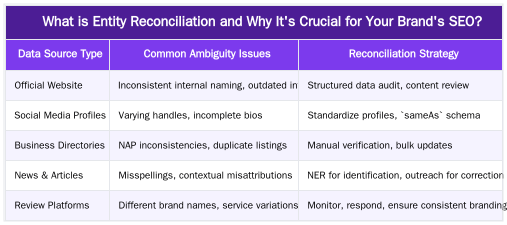
This iterative process ensures continuous improvement in your brand’s digital identity. Here’s a comparison of common data sources and their reconciliation challenges:
Beyond the Basics: Advanced Entity Reconciliation with SaaS
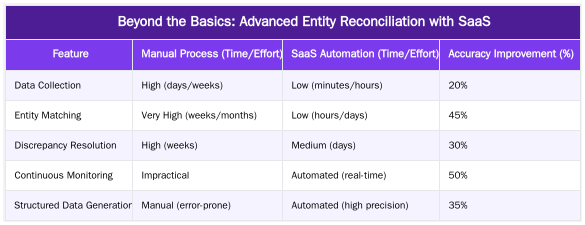
While manual entity reconciliation is possible for smaller brands, the sheer volume and dynamic nature of online data make it impractical for most businesses. This is where advanced SaaS solutions, like those offered by AbdurrahmanSimsek.com, become indispensable. Our platforms are designed to automate complex matching processes, leveraging cutting-edge AI and machine learning to achieve higher accuracy and provide scalable solutions for businesses with extensive digital footprints.
AbdurrahmanSimsek.com specializes in providing sophisticated tools that address the common pain points of brand ambiguity. We understand that generic data matching isn’t enough; our solutions focus on the specific nuances of brand identity and SEO outcomes. By automating the identification, clustering, and resolution of brand mentions, we empower businesses to maintain a pristine digital identity without the heavy manual lift, positioning them as leaders in their respective niches.
Automating Disambiguation: AI, Machine Learning, and NLP in Action
Modern SaaS tools for entity reconciliation harness the power of artificial intelligence (AI), machine learning (ML), and natural language processing (NLP) to transform the disambiguation process. NLP algorithms can analyze the context of brand mentions, even performing sentiment analysis, to better understand the nuances of how your brand is perceived and referenced online. Machine learning models are trained on vast datasets to predict potential matches with remarkable accuracy, continuously learning and improving over time.
AI-driven systems offer continuous monitoring, detecting new brand mentions and potential inconsistencies in real-time. This proactive approach ensures that your brand’s entity profile remains accurate and up-to-date, adapting to evolving online discussions and preventing new instances of brand ambiguity. These technologies overcome challenges like data volume, varying linguistic patterns, and the constant influx of new information, providing a robust framework for comprehensive entity reconciliation.
What Are the Tangible Benefits of Effective Entity Reconciliation?
Successful implementation of entity reconciliation yields a multitude of measurable outcomes and long-term advantages for brands. The most immediate benefit is a significant improvement in how search engines perceive and display your brand, directly impacting your online visibility and authority. This strategic effort translates into concrete gains across your digital presence.
Brands can expect enhanced Knowledge Panel accuracy, ensuring that Google’s authoritative summary of your business is always correct and comprehensive. This consistency builds trust with users and search engines alike. Furthermore, a unified brand identity leads to increased organic traffic as search engines become more confident in surfacing your content for relevant queries. Ultimately, entity reconciliation strengthens your brand’s authority, reputation, and overall digital footprint.
Measuring Success: Improved Knowledge Panels and Search Visibility
Tracking the success of your entity reconciliation efforts involves monitoring several key metrics. A primary indicator is the appearance and accuracy of your brand’s Knowledge Panel in Google Search Results. Look for consistent information, correct logos, and accurate links to your official properties. Any improvements here signify Google’s enhanced understanding of your brand entity.
Beyond Knowledge Panels, observe your Brand SERP (Search Engine Results Page) for brand-related queries. Are you dominating the first page with your own properties? Are there fewer irrelevant or conflicting results? Monitor changes in search visibility for both exact brand name queries and related terms. Tools like Google Search Console and other SEO analytics platforms can help track organic traffic increases, keyword rankings for brand terms, and overall brand reputation signals. For more details on Knowledge Panels, refer to Google Search Central documentation.
Ready to Unify Your Brand’s Digital Identity?
In 2026, a clear, unified digital identity is no longer optional; it’s a fundamental requirement for SEO success and brand authority. Entity reconciliation is the strategic imperative that ensures your brand is accurately understood and prominently featured by search engines. By eliminating brand ambiguity, you pave the way for enhanced visibility, increased trust, and superior organic performance.
Don’t let fragmented data hold your brand back. Discover how AbdurrahmanSimsek.com’s advanced SaaS solutions can streamline your entity reconciliation process, transforming your digital presence. Visit AbdurrahmanSimsek.com today to learn more about our data-driven workflows and unlock your brand’s full potential in search.
Conclusion
Effective entity reconciliation is a cornerstone of modern SEO, crucial for any brand aiming to thrive in the complex digital landscape of 2026. By systematically identifying, matching, and consolidating all online information related to your brand, you eliminate ambiguity and provide search engines with the clear, consistent signals they need to accurately understand and represent you. This process directly translates into improved Knowledge Panels, enhanced search visibility, and a stronger, more trustworthy brand identity.
Leveraging advanced SaaS solutions, particularly those incorporating AI, machine learning, and NLP, offers a scalable and highly accurate approach to this intricate task. Don’t leave your brand’s digital identity to chance. Take control of your online narrative and ensure your brand stands out as a unique, authoritative entity. Explore how AbdurrahmanSimsek.com can empower your brand with cutting-edge entity reconciliation strategies and tools. Visit AbdurrahmanSimsek.com to begin your journey toward a unified and powerful digital presence.
Frequently Asked Questions
What is the primary goal of entity reconciliation for SEO?
The main goal is to eliminate brand ambiguity for search engines like Google. Effective entity reconciliation consolidates all your brand’s online mentions and properties into a single, cohesive identity, ensuring you are not confused with other entities that have a similar name. This process helps establish your brand as the authoritative source of information about itself.
How does entity reconciliation solve the problem of brand ambiguity?
Brand ambiguity occurs when your name is similar to another company, person, or concept, which confuses search engines. The process of entity reconciliation directly addresses this by creating clear, consistent signals across the web that connect all mentions back to your unique brand entity. This helps Google’s Knowledge Graph accurately understand who you are and what you do.
What is the first step in entity reconciliation for a brand with a common name?
The first step is to establish authoritative profiles that act as a source of truth, such as a Google Business Profile and a Wikidata page. You should then use Organization schema on your website with `sameAs` properties linking to these core profiles. This provides a strong foundation for your ongoing entity reconciliation strategy.
How do unlinked brand mentions affect entity reconciliation?
Unlinked mentions are still valuable, as Google’s algorithms can often associate them with your brand. However, converting these mentions into links provides a much stronger and more direct signal for search engines. Actively building links is a key tactic for a successful entity reconciliation strategy.
Can I edit my Google Knowledge Panel to help with entity reconciliation?
Yes, after you claim your Knowledge Panel, you can suggest edits to correct information. Google reviews these suggestions and compares them against information found across the web. Keeping your Knowledge Panel accurate is a crucial part of maintaining a clear digital identity and supports your overall entity reconciliation efforts.
Ruxi Data brings together multi-model AI, automated website crawling, live indexation checks, topical authority mapping, E-E-A-T enrichment, schema generation, and full pipeline automation — from crawl to WordPress publish to social posting — all in one platform built for agencies and freelancers who run on results.