
Entity-based Content Audits: Aligning With Google’s Knowledge Graph
An entity-based content audit is a crucial workflow for aligning content with Google’s Knowledge Graph, moving beyond keywords to real-world concepts. This guide details how to conduct an entity-based content audit to enhance topical authority and search visibility. Readers will learn to leverage semantic SEO principles, understand Google’s NLP, and implement structured data for improved content modeling. Mastering the entity-based content audit ensures content provides comprehensive, semantically rich information that truly answers user intent, crucial for modern search algorithms.
AbdurrahmanSimsek.com is dedicated to providing cutting-edge SEO strategies grounded in deep technical understanding and ethical practices. Our content reflects a commitment to delivering actionable insights that drive tangible results and foster long-term digital growth for our clients. We prioritize accuracy and clarity to empower businesses with effective search engine optimization.
To explore your options, contact us to schedule your consultation.
In 2026, mastering Google’s Knowledge Graph is crucial for SEO success. This guide dives into entity-based content audits, a powerful workflow to align your content with how Google truly understands information. We’ll explore what these audits entail, why they’re essential for topical authority, and how to implement them effectively to boost your search visibility. Understanding entities moves beyond simple keywords, focusing on the real-world concepts that drive modern search engine algorithms.
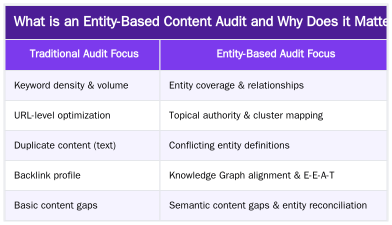
What is an Entity-Based Content Audit and Why Does it Matter?
An entity-based content audit is a systematic review of your existing content, focusing on how well it covers and relates to specific real-world concepts (entities) recognized by search engines. Its core purpose is to align your content strategy with Google’s semantic understanding, moving beyond traditional keyword matching. This approach is increasingly vital in 2026 as search algorithms prioritize contextual relevance and topical authority.
Keywords vs. Entities: A Fundamental Shift in SEO
Traditional SEO often centered on optimizing for specific keywords, sometimes leading to content that felt unnatural or lacked depth. Entity-based SEO represents a fundamental shift. Instead of just matching words, it focuses on the underlying meaning and context. An entity is a distinct, identifiable concept—a person, place, thing, or idea—that Google understands and stores in its Knowledge Graph. By optimizing for entities, you ensure your content provides comprehensive, semantically rich information that truly answers user intent.
The Role of Google’s Knowledge Graph in Modern Search
Google’s Knowledge Graph is a vast, interconnected database of facts about millions of entities and their relationships. It allows Google to move beyond simple string matching to understand the “things, not strings” behind a search query. When you search for “Eiffel Tower,” Google doesn’t just look for pages with those words; it understands the Eiffel Tower as a specific landmark entity, its location, height, history, and related entities like Paris or Gustave Eiffel. Aligning your content with this semantic network is key to modern semantic SEO success.
How Google’s Knowledge Graph & NLP Drive Entity Understanding
Google’s ability to understand content at a deep, semantic level is powered by two critical technologies: its Knowledge Graph and Natural Language Processing (NLP). These work in tandem to identify, categorize, and connect entities within your content, forming the bedrock of modern search relevance. Understanding these mechanisms is crucial for any effective entity-based content audit.
Leveraging the Knowledge Graph API for Entity Extraction
The Knowledge Graph API provides programmatic access to Google’s vast repository of entities and their relationships. For SEOs, this means the ability to identify relevant entities for a specific domain or topic, understand their attributes, and see how they connect to other concepts. By querying the Knowledge Graph API, you can uncover the semantic landscape surrounding your target topics, informing your content strategy and ensuring you cover all essential related entities. This is a foundational step in optimizing for Google’s Knowledge Graph.
Understanding Google’s NLP API for Content Analysis
Google’s Natural Language Processing (NLP) API is a powerful tool that helps analyze text for entities, sentiment, and syntax. When Google crawls your content, its NLP algorithms process the text to identify all named entities (people, organizations, locations, events, etc.), categorize them, and determine their salience within the document. This deeper semantic insight allows Google to understand the core topics and sub-topics discussed, ensuring your content is accurately indexed and ranked for relevant queries. It’s how Google moves from reading words to understanding ideas.
Your Step-by-Step Workflow for an Entity-Based Content Audit
Conducting an entity-based content audit requires a structured approach that moves beyond traditional keyword analysis. This workflow ensures you systematically identify, map, and optimize your content for semantic relevance, building robust topic clusters and strengthening your overall authority. This practical guide outlines the key stages from initial research to actionable insights.
Identifying Core Entities and Topic Clusters
The first step involves thorough research to identify the primary and secondary entities relevant to your niche. This goes beyond simple keyword research; it’s about understanding the conceptual landscape. Utilize tools like Google’s Knowledge Graph API, SERP analysis for top-ranking pages, and competitor analysis to uncover the entities Google associates with your target topics. Group these entities into logical topic clusters, forming a comprehensive content model that dictates your content creation and optimization efforts. This foundational content modeling ensures a holistic approach.
Mapping Content to Entities: A Gap Analysis Approach
Once your core entities and topic clusters are defined, audit your existing content. Map each piece of content to the entities it covers, both explicitly and implicitly. This process reveals significant content gap analysis opportunities. Identify pages that only partially cover an entity, those that miss crucial related entities, or entirely new entities for which you have no content. This mapping helps pinpoint areas for content enrichment, consolidation, or the creation of new, semantically rich articles. It’s about ensuring comprehensive entity coverage across your entire site.
Enhancing E-E-A-T with Entity Reconciliation & Structured Data
In 2026, Google’s E-E-A-T (Experience, Expertise, Authoritativeness, Trustworthiness) guidelines are more critical than ever. An entity-based content audit directly contributes to E-E-A-T by ensuring your content is not only relevant but also consistently accurate and authoritative in Google’s eyes. This is achieved through meticulous entity reconciliation and strategic implementation of structured data.
The Importance of Entity Reconciliation for Topical Authority
Entity reconciliation is the process of identifying and matching different data records or mentions that refer to the same real-world entity across various sources. For your website, this means ensuring that every mention of a specific entity (e.g., your company, a product, an industry expert) is consistently represented and linked. This consistency is crucial for building topical authority. When Google sees a unified, unambiguous representation of an entity across your site and the broader web, it reinforces your expertise and trustworthiness. Learn more about a robust entity reconciliation workflow to streamline this process. It helps Google confidently associate your brand with specific knowledge domains, a key aspect of E-E-A-T principles.
Implementing Schema Markup for Entity Visibility
Schema markup, based on Schema.org vocabulary, is a form of structured data that explicitly tells search engines about the entities on your page and their relationships. By adding Schema.org types like Person, Organization, Product, or Article, and defining their properties (e.g., name, description, sameAs links to Wikipedia or social profiles), you enhance entity visibility. This not only helps Google accurately understand your content but also increases your eligibility for rich results, Knowledge Panels, and other enhanced SERP features. Consistent and accurate Schema markup is a powerful signal of authority and trustworthiness, directly supporting your Knowledge Graph and E-E-A-T SEO efforts.
Automating Your Entity Audit: The Ruxi Data Advantage
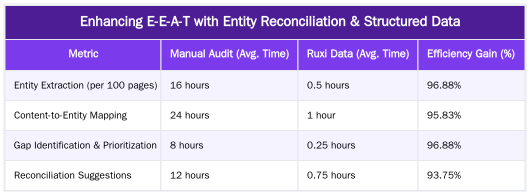
Manually conducting a comprehensive entity-based content audit can be a daunting, time-consuming task. This is where automation becomes invaluable. Ruxi Data is specifically designed to streamline this complex process, leveraging advanced technology to provide efficient and accurate content analysis, gap identification, and reconciliation. It transforms a labor-intensive project into an actionable, data-driven workflow.
Streamlining Entity Extraction and Content Mapping at Scale
Ruxi Data connects directly to Google’s Knowledge Graph API and utilizes sophisticated NLP algorithms to automatically extract relevant entities for your domain. It then crawls your existing content, intelligently mapping each page to its primary and secondary entities. This automated process identifies not only what entities are present but also their prominence and relationships within your content. This capability is particularly beneficial for large websites or SaaS platforms, where manual entity mapping would be impractical. It provides a scalable solution for entity SEO for SaaS businesses.
Identifying Gaps and Opportunities for Topical Authority
Beyond simple extraction, Ruxi Data’s automation excels at identifying critical content gap analysis opportunities. By comparing your content’s entity coverage against the semantic landscape of your industry, the platform pinpoints areas where your content lacks depth, misses crucial related entities, or fails to establish strong connections within topic clusters. It also flags potential inconsistencies that require entity reconciliation. These actionable insights empower you to strategically enrich your content, strengthen your topical authority, and ensure your website is perceived as a comprehensive resource by search engines.
Unlock Deeper Insights: The Impact of Entity-Driven Content
Embracing an entity-based content audit is more than just an SEO tactic; it’s a strategic shift towards building truly authoritative and future-proof content. By aligning with Google’s semantic understanding, you unlock deeper insights into user intent, enhance your E-E-A-T signals, and significantly improve your search visibility. This approach ensures your content resonates with both human users and advanced AI algorithms, driving sustainable organic growth. The benefits extend to improved rankings, higher quality traffic, and a stronger brand presence in the digital landscape.
Conclusion
Entity-based content audits are no longer optional; they are a strategic imperative for modern SEO. By embracing this workflow, you align your content with Google’s sophisticated understanding of information, building unparalleled topical authority and E-E-A-T. This semantic SEO approach ensures your content is not just found, but truly understood and valued by search engines and users alike. Ready to transform your content strategy and achieve lasting visibility? Explore how Ruxi Data can automate your entity-based content audits and unlock your full potential by visiting abdurrahmansimsek.com.
Frequently Asked Questions
What is an entity-based content audit and how is it different from a traditional audit?
An entity-based content audit evaluates your content’s alignment with real-world concepts (entities) in Google’s Knowledge Graph, not just keywords. Unlike traditional audits that focus on keyword density, this process analyzes how well you cover topics and the relationships between them. This helps build topical authority and improve search engine understanding.
What is the main deliverable from an entity-based content audit?
The primary output is a prioritized action plan designed to strengthen your site’s topical authority. This includes a list of new content to create, existing pages to update, and specific internal linking opportunities. An effective entity-based content audit also provides structured data recommendations to better define your brand and its relationships to other entities.
Why is an entity-based content audit important for YMYL websites?
For Your Money or Your Life (YMYL) sites, establishing E-E-A-T (Experience, Expertise, Authoritativeness, Trustworthiness) is critical. An entity-based content audit is crucial for this, as it helps connect your content to recognized authoritative entities, such as medical organizations or expert authors. This process clarifies your expertise and authority to Google, which is a key ranking factor in sensitive niches.
How can automation help with an entity-based content audit?
Automation tools streamline the process by connecting to Google’s Knowledge Graph API to identify relevant entities for your domain. The software then crawls your site to map existing content to these entities, quickly highlighting content gaps and opportunities. This saves significant manual effort and provides a data-driven foundation for your content strategy.
How does entity reconciliation improve E-E-A-T?
Entity reconciliation clarifies your brand’s identity to search engines, which is fundamental to E-E-A-T. By using structured data (like sameAs links to official profiles) and consistent content, you resolve ambiguity around your brand entity. This helps Google confidently recognize your organization or authors as authoritative sources on a topic.
How long does it take to see results after implementing audit recommendations?
While results vary, you can often see initial positive changes in how Google understands your brand within 2-4 weeks of implementing technical and content updates. Significant improvements in search rankings and visibility typically follow over the next 2-3 months. Consistent effort in aligning your content with key entities yields the best long-term results.
Ruxi Data brings together multi-model AI, automated website crawling, live indexation checks, topical authority mapping, E-E-A-T enrichment, schema generation, and full pipeline automation — from crawl to WordPress publish to social posting — all in one platform built for agencies and freelancers who run on results.