
Entity Attribute Value SEO: Structuring Medical Content for Semantic Search Dominance
Entity Attribute Value SEO revolutionizes how medical practices, particularly plastic surgeons, achieve dominant topical authority and minimize search engine Cost of Retrieval. This guide details leveraging the EAV model to structure complex medical information, enabling search engines to build deeper knowledge graphs and understand content with greater precision. By moving beyond keyword recognition, EAV modeling facilitates robust information retrieval and critical YMYL query ranking. Implementing this semantic database approach is essential for sustained digital growth in healthcare.
Abdurrahman Şimşek, a Semantic SEO Strategist, provides expert guidance on implementing advanced data modeling techniques like EAV to enhance online visibility. This content delivers actionable strategies for medical practices seeking to optimize their digital presence through structured data and semantic understanding.
To explore your options, contact us to schedule your consultation. You can also reach us via: Book a Semantic SEO Audit, Direct WhatsApp Strategy Line: +90 506 206 86 86, Hire as Semantic SEO Architect
Discover how entity attribute value seo is revolutionizing how medical practices, especially plastic surgeons, achieve dominant topical authority and minimize search engine Cost of Retrieval (CoR) in 2026. This guide provides a practical roadmap to leveraging the EAV model for enhanced online visibility. By structuring complex medical information, EAV SEO enables search engines to understand content with greater precision, directly impacting a practice’s ability to rank for critical YMYL (Your Money Your Life) queries. Understanding and implementing this semantic approach is essential for any medical professional aiming for sustained digital growth.
What is Entity-Attribute-Value (EAV) SEO for Medical Practices?
The Entity-Attribute-Value (EAV) model is a data structure used to describe entities where the number of attributes (properties) that can be used to describe them is vast, sparse, or changes frequently. For medical practices, this means structuring complex information about procedures, conditions, and treatments in a way that search engines can easily process. This semantic database approach moves beyond simple keyword recognition, allowing search engines to build a deeper, contextual understanding of your content.
The Core Components: Entity, Attribute, Value Explained
In the EAV model, an Entity is the core subject, such as “Rhinoplasty.” An Attribute describes a characteristic of that entity, like “Recovery Time” or “Anesthesia Type.” The Value is the specific data point for that attribute, such as “1-2 weeks” or “General Anesthesia.” This structured approach provides explicit relationships between pieces of information, contrasting sharply with traditional keyword-based content strategies that often lack this semantic clarity. For instance, a plastic surgeon’s website can detail every aspect of a procedure using this framework.
Beyond Keywords: How EAV Fuels Semantic Understanding
EAV modeling enables search engines to construct richer knowledge graphs. Instead of merely matching keywords, they comprehend the relationships and context surrounding medical topics. This is particularly critical for YMYL (Your Money Your Life) content, where accuracy, comprehensiveness, and trustworthiness are paramount. By presenting information in a structured EAV format, medical websites signal their authority and expertise, fostering a deeper semantic understanding that benefits both search engines and users seeking reliable health information. This method helps search engines connect disparate pieces of information, forming a cohesive picture of a medical practice’s offerings and expertise.
Implementing EAV SEO: A Practical Guide for Medical Websites
Implementing EAV modeling for a medical website involves a systematic approach to data organization and semantic markup. The goal is to transform unstructured content into a machine-readable format that search engines can easily interpret. This process begins with identifying the core subjects of your practice and then meticulously defining their characteristics and associated data points. Proper implementation ensures that every piece of medical information contributes to a cohesive, authoritative digital presence.
Identifying Core Medical Entities and Attributes
Start by identifying the primary entities on your website. For a plastic surgeon, these might include specific procedures (e.g., “Facelift,” “Liposuction”), conditions treated (e.g., “Ptosis,” “Rhinophyma”), or even the surgeons themselves (e.g., “Dr. Jane Doe”). For each entity, define its relevant attributes. For “Facelift,” attributes could be “Procedure Duration,” “Anesthesia Used,” “Ideal Candidate,” “Potential Risks,” and “Expected Results.” Documenting these entities and attributes forms the backbone of your EAV structure. This foundational step ensures that all critical information is accounted for and categorized appropriately.
Structuring Data with Schema Markup and Ontologies
Once entities and attributes are identified, the next step is to implement them using structured data formats like Schema.org markup. For medical practices, relevant schema types include MedicalBusiness, Physician, and MedicalProcedure. These JSON-LD snippets embed EAV data directly into your website’s HTML, making it accessible to search engines. Beyond basic schema, consider developing a custom ontology or leveraging existing medical ontologies (e.g., SNOMED CT) to define relationships between entities more precisely. This advanced semantic database approach enhances the clarity and interconnectedness of your medical content, further reducing the Cost of Retrieval for search engines. For automated knowledge graph construction, exploring tools and strategies for knowledge graph SEO automation becomes essential.
Leveraging Ruxi Data for Automated EAV Modeling and GEO
The complexity of manual EAV modeling for extensive medical content can be substantial. This is where specialized infrastructure like Ruxi Data becomes invaluable. Ruxi Data is designed to automate the process of EAV modeling and topical map generation, transforming clinical expertise into structured data. This automation significantly reduces the effort required to implement advanced semantic strategies, allowing medical practices to focus on patient care while their digital presence is optimized for modern search engines. Abdurrahman Şimşek leverages this infrastructure to build high-authority Semantic Content Networks for London’s private healthcare sector.
Automating Topical Maps with Semantic Infrastructure
Ruxi Data’s semantic engine automates the identification of entities, attributes, and values from existing content, then maps these relationships into comprehensive topical clusters. This process generates a robust topical authority state for healthcare domains. For plastic surgeons, this means automatically identifying all related procedures, conditions, and patient concerns, then structuring this information to cover entire topics exhaustively. This automation ensures that content is not only semantically rich but also organized in a way that signals deep expertise to search engines, enhancing overall information retrieval efficiency.
Optimizing for AI Overviews and Generative Search
As search engines evolve towards AI Overviews and generative search experiences, the importance of structured, semantically rich data grows. EAV modeling, especially when automated by systems like Ruxi Data, prepares medical websites for this future. Generative Engine Optimization (GEO) for aesthetic surgery, for instance, relies on the ability of AI to synthesize information from highly structured sources. By providing clear, entity-rich data, medical practices increase their likelihood of being featured prominently in AI-generated summaries and answers, driving qualified patient leads from these emerging search interfaces.
Measuring Success: Key Metrics for EAV-Driven Medical SEO
Tracking the impact of EAV implementation requires a shift from traditional keyword-centric metrics to those reflecting semantic understanding and topical authority. For medical practices, success is measured not just by traffic volume, but by the quality of patient inquiries and the overall visibility within specific medical domains. Monitoring these key performance indicators provides insights into the effectiveness of your structured data strategy and its contribution to business growth.
Tracking Organic Visibility and Topical Authority Growth
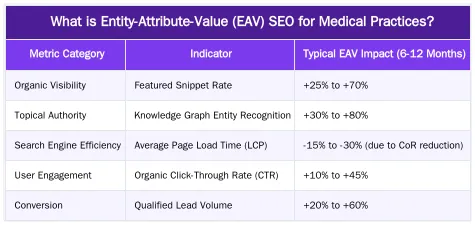
Key metrics include organic visibility for long-tail, semantically related queries, and the growth of your website’s knowledge graph presence. Monitor the number of entities recognized by search engines, the breadth of topics for which your site ranks, and the increase in featured snippets or rich results. Tools that analyze knowledge graph saturation and topical coverage can provide a clearer picture of your site’s authority. An entity-based content audit can help identify gaps and opportunities for further EAV optimization.
Patient Acquisition and Conversion Metrics
Ultimately, the goal for medical practices is patient acquisition. Track conversion rates from organic search, focusing on specific procedures or services. Monitor the volume and quality of appointment bookings, contact form submissions, and direct calls originating from organic traffic. EAV SEO, by improving semantic understanding, often leads to more qualified leads because search engines are better at matching user intent with highly relevant, authoritative content. This precision in information retrieval translates directly into higher-value patient interactions.
Strategic Considerations for London’s Private Healthcare Sector
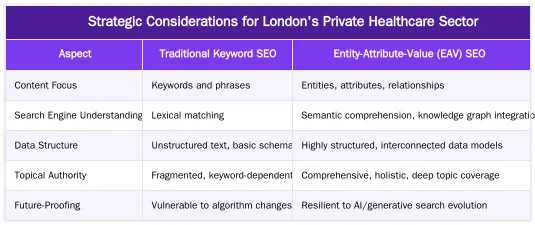
The London private healthcare sector presents a unique landscape for digital marketing. High competition, discerning patients, and stringent regulatory environments (like GDPR) demand a sophisticated SEO approach. EAV modeling offers a strategic advantage by allowing clinics and surgeons to articulate their specialized services and expertise with clarity and precision, standing out in a crowded market. This is particularly relevant for Harley Street and Central London aesthetic clinics, where reputation and authority are paramount.
Navigating YMYL and E-E-A-T in a Competitive Market
For YMYL content in London’s private healthcare, E-E-A-T is non-negotiable. EAV modeling provides the structural foundation to demonstrate this. By explicitly linking procedures to qualified physicians, detailing medical credentials, and structuring patient outcome data, clinics can build an undeniable signal of trustworthiness and expertise. This is crucial for attracting patients who are making critical health decisions. The semantic database approach ensures that every piece of information contributes to a holistic representation of authority.
Future-Proofing Medical Websites in 2026
The digital landscape in 2026 is increasingly driven by AI and semantic understanding. Websites that have adopted an EAV framework are inherently better positioned for future search algorithm updates and the rise of generative AI. For London’s medical practices, this means investing in a strategy that ensures long-term visibility and relevance. By building a robust semantic content network, clinics can secure their position as authoritative sources of medical information, attracting and retaining patients in a competitive and evolving market. This proactive approach to information retrieval and data modeling is key to sustained online success.
Conclusion
The adoption of an Entity-Attribute-Value (EAV) model is no longer an optional enhancement but a fundamental requirement for medical practices seeking dominant online visibility and topical authority in 2026. By meticulously structuring medical information, EAV SEO enables search engines to understand content with unprecedented clarity, significantly reducing their Cost of Retrieval (CoR). This approach not only strengthens E-E-A-T signals but also future-proofs your digital presence against evolving search algorithms and the rise of generative AI. For medical clinics and plastic surgeons, particularly in competitive markets like London, leveraging EAV modeling is a strategic imperative for attracting qualified patient leads and establishing lasting authority. To explore how this advanced semantic strategy can transform your practice’s online presence, contact us today. You can also Book a Semantic SEO Audit, reach us via Direct WhatsApp Strategy Line: +90 506 206 86 86, or Hire as Semantic SEO Architect.
Frequently Asked Questions
How does entity attribute value seo apply to a plastic surgeon’s website?
For a procedure like ‘Rhinoplasty’, the ‘Entity’ is the procedure itself. ‘Attributes’ are ‘Recovery Time’, ‘Anesthesia Type’, and ‘Procedure Cost’. ‘Values’ would be ‘1-2 weeks’, ‘General’, and ‘£5,000 – £8,000’. This structured data, central to entity attribute value seo, is highly valuable for search engines, allowing them to understand medical content with precision.
Is implementing Entity-Attribute-Value SEO a technical process?
Yes, implementing entity attribute value seo involves deep data modeling and advanced schema markup. Our process leverages Ruxi Data to automate the extraction and structuring of these EAV pairs from clinical content, making it scalable and efficient for medical practices.
Can entity attribute value seo help a medical site appear in AI Overviews?
Absolutely. AI Overviews rely on structured, unambiguous data to generate concise answers. An EAV model, a core component of entity attribute value seo, provides this clarity, making your content a prime source for generative AI by clearly defining entities and their properties.
What’s the first step to implementing an entity attribute value seo strategy?
The initial step is an entity-based content audit. This involves identifying the core entities (e.g., surgeons, procedures, conditions) within your practice’s content and mapping out their key attributes and values. This blueprint is crucial for building a robust semantic architecture for effective entity attribute value seo.
How does entity attribute value seo enhance traditional keyword research?
It significantly enhances it by shifting focus from mere text strings to the real-world concepts they represent. This approach, fundamental to entity attribute value seo, leads to the creation of more relevant, authoritative, and contextually rich content. By understanding entities, search engines can better match user intent beyond simple keywords.
How can Abdurrahman Şimşek help my medical practice with EAV modeling?
Abdurrahman Şimşek specializes in semantic SEO architecture for medical and plastic surgery clinics. You can book a Semantic SEO Audit to assess your current content and develop a tailored EAV strategy, or contact directly via WhatsApp at +90 506 206 86 86 for a strategy discussion. This will help your practice achieve dominant topical authority and optimize for search engine understanding.
Ruxi Data brings together multi-model AI, automated website crawling, live indexation checks, topical authority mapping, E-E-A-T enrichment, schema generation, and full pipeline automation — from crawl to WordPress publish to social posting — all in one platform built for agencies and freelancers who run on results.