
EAV Modeling SEO: Structuring Medical Content for Knowledge Graphs and Authority
EAV modeling SEO revolutionizes medical website visibility by structuring content for machine readability. This approach enhances presence in Google’s Knowledge Graph and reduces the Cost of Retrieval for search engines. It transforms complex medical information into an entity-attribute-value framework, enabling deeper search engine comprehension. By adopting this semantic data model, medical websites build robust, machine-readable content, crucial for competitive niches and strong entity-based SEO.
Abdurrahman Şimşek, a Semantic SEO Strategist, details how EAV modeling transforms medical content into machine-readable data. This framework builds algorithm-proof topical authority and optimizes for the Cost of Retrieval, future-proofing medical practice visibility.
To explore your options, contact us to schedule your consultation. You can also reach us via: Book a Semantic SEO Audit, Direct WhatsApp Strategy Line: +90 506 206 86 86
Discover how eav modeling seo can revolutionize your medical website’s visibility and authority. This guide provides a practical framework for structuring your content to be highly machine-readable, enhancing your presence in Google’s Knowledge Graph and reducing the Cost of Retrieval for search engines. This approach is particularly crucial for competitive medical niches like plastic surgery in London, where precision and trust are paramount. Understanding this semantic data model allows for deeper search engine comprehension of complex medical information.
What is EAV Modeling and Why is it Crucial for Semantic SEO?
Entity-Attribute-Value (EAV) modeling is a data structure that organizes information into three distinct components: an entity, its attributes, and the corresponding values. This flexible approach allows for the representation of complex, sparse data where entities may possess numerous optional characteristics. For semantic SEO, EAV modeling is fundamental because it enables search engines to understand content not just as keywords, but as interconnected concepts and relationships, which is vital for high-stakes YMYL (Your Money Your Life) medical information.
This structured data model moves beyond traditional keyword matching. It helps search algorithms interpret the context and meaning behind medical terms and procedures. By explicitly defining entities and their properties, medical websites can present information in a way that aligns with how search engines build their knowledge graphs, leading to more accurate and relevant search results.
Understanding Entities, Attributes, and Values in SEO
In the context of medical SEO, these components clarify information for both users and machines. An Entity represents a distinct object or concept, such as ‘Rhinoplasty Procedure’ or ‘Dr. Jane Smith’. An Attribute describes a characteristic or property of that entity, like ‘Recovery Time’ or ‘Specialty’. The Value is the specific data point for that attribute, such as ‘2-4 weeks’ or ‘Plastic Surgeon’.
For example, for the entity ‘Breast Augmentation’, attributes could include ‘Procedure Type’, ‘Anesthesia’, ‘Typical Cost Range’, and ‘Potential Risks’. The corresponding values would be ‘Surgical’, ‘General’, ‘£5,000 – £8,000’, and ‘Infection, Capsular Contracture’. This granular breakdown ensures that every piece of information is clearly defined and machine-readable, supporting a robust EAV model for surgical procedures.
How EAV Transforms Medical Content into Machine-Readable Data
EAV modeling provides a systematic way to convert unstructured medical text into organized, machine-readable data. This transformation is critical for search engines to accurately process and present complex health information. By breaking down content into discrete entities, attributes, and values, medical websites can ensure that every detail, from a procedure’s indications to a surgeon’s qualifications, is explicitly defined.
This structured approach significantly improves the accuracy of information retrieval. When a search engine encounters EAV-structured content, it can more easily identify and extract specific facts, reducing ambiguity. This precision is especially important for YMYL content, where misinformation can have serious consequences. EAV helps establish a clear, factual foundation for all published medical information.
Bridging the Gap: From Text to Knowledge Graph
The application of EAV directly supports the construction of Google’s Knowledge Graph. By defining entities like ‘Botox’ and linking them to attributes such as ‘Active Ingredient’ (Value: ‘Botulinum Toxin Type A’) or ‘Common Uses’ (Value: ‘Wrinkle Reduction, Migraine Treatment’), EAV helps search engines build a comprehensive understanding of medical topics. This interconnected web of facts allows Google to answer complex queries directly and display rich snippets.
EAV enables search engines to connect disparate pieces of information across a website and the broader web. This forms a more complete understanding of medical topics, practitioners, and clinics. This structured approach directly supports Google’s efforts to provide authoritative and contextually relevant results, enhancing a site’s overall visibility and trustworthiness within the medical domain. For more on this, explore our knowledge graph optimization guide.
Implementing EAV: A Practical Guide for Structuring Medical Procedure Pages
Applying EAV modeling to medical procedure pages involves systematically identifying key information points and categorizing them. This ensures comprehensive coverage and machine readability. For surgical procedures, common attributes include indications, contraindications, recovery timelines, potential risks, cost ranges, and the qualifications required for the performing surgeon. Each of these becomes an attribute, with specific details serving as values.
The process begins by outlining all relevant data points for a given procedure. Then, these points are mapped to an EAV framework. This structured data can then inform various aspects of your website, including on-page content organization, internal linking strategies, and the generation of schema markup. This systematic approach ensures that every piece of information contributes to a cohesive and understandable data model for search engines.
EAV Template for a Common Cosmetic Procedure
Consider a procedure like ‘Breast Augmentation’. Structuring its information using EAV principles provides clarity and detail. This template demonstrates how entities, attributes, and values are organized, which then directly informs the creation of schema markup like MedicalProcedure JSON-LD.
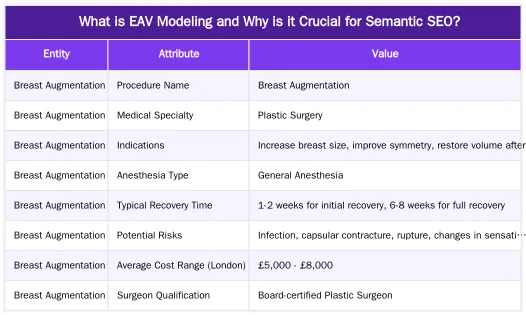
This structured approach makes it easier to generate accurate and detailed schema markup, such as MedicalProcedure schema, which further enhances machine readability. It also provides a clear blueprint for content writers, ensuring all critical information is consistently presented across the site.
Optimizing for Cost of Retrieval with EAV and Ruxi Data
EAV modeling for SEO, particularly when integrated with advanced tools, significantly reduces the ‘Cost of Retrieval’ (CoR) for search engines. CoR refers to the resources (time, processing power, bandwidth) Google expends to crawl, index, and understand a website’s content. Highly structured data, facilitated by EAV, makes content unambiguous and easy for search engine crawlers to process, leading to more efficient indexing and better resource allocation.
For large medical content networks, where information is vast and interconnected, minimizing CoR is crucial. Efficient crawling means more of your valuable medical content gets discovered and understood by search engines. This leads to better visibility and faster indexing of new or updated pages, a significant advantage in competitive markets like London’s private healthcare sector.
Automating Semantic Content Networks with Ruxi Data
Ruxi Data leverages EAV principles to automate the creation of topical maps and semantic content networks. This infrastructure analyzes search engine results pages (SERPs) to identify key entities, attributes, and relationships relevant to a medical niche. It then structures this information, streamlining the process of building comprehensive content hubs for medical clinics and plastic surgeons.
This automation capability ensures that content is not only semantically rich but also consistently structured, reducing manual effort and potential errors. By automating the identification and organization of entities, Ruxi Data helps medical practices scale their content production while maintaining high standards of accuracy and topical relevance. This efficiency gain is vital for establishing and maintaining topical authority. For a deeper dive into this approach, explore semantic SEO for surgeons.
Future-Proofing Your Medical Practice: The EAV Advantage
Adopting an EAV approach for medical SEO offers significant long-term benefits, positioning your practice for sustained success in an evolving search landscape. As search engines become more sophisticated, moving towards understanding intent and context, EAV’s structured data model becomes increasingly valuable. It ensures your content is inherently adaptable to new algorithmic shifts and emerging search paradigms.
This model is particularly relevant for Generative Engine Optimization (GEO) and AI Overviews. AI models rely on well-structured, unambiguous data to synthesize answers. Content organized with EAV principles is more likely to be accurately interpreted and sourced by generative AI, ensuring your medical practice remains discoverable and authoritative. For London clinics, this strategic advantage translates into continued visibility and patient acquisition.
By investing in a robust information architecture today, medical practices can future-proof their digital presence. EAV modeling provides the foundational semantic framework necessary to thrive amidst continuous changes in search technology, securing a competitive edge for years to come.
Ready to Implement EAV? Partner with a Semantic SEO Expert
Implementing effective EAV modeling and a comprehensive semantic SEO strategy requires specialized expertise. For London-based medical clinics and plastic surgeons, partnering with a strategist who understands the nuances of healthcare content and advanced data modeling is essential. Abdurrahman Şimşek specializes in building high-authority Semantic Content Networks tailored for the medical sector.
Leverage deep experience in semantic engineering and technical web development to transform your online presence. Ensure your website is not only visible but also recognized as an authoritative source by search engines and prospective patients. Book a Semantic SEO Audit to discuss a tailored strategy for your practice. Direct WhatsApp Strategy Line: +90 506 206 86 86.
Conclusion
Entity-Attribute-Value (EAV) modeling is a powerful semantic data model that fundamentally changes how medical content is understood by search engines. By structuring information into clear entities, attributes, and values, medical websites can significantly enhance their presence in the Knowledge Graph, improve E-E-A-T signals, and reduce the Cost of Retrieval for crawlers. This approach builds algorithm-proof topical authority, ensuring long-term visibility and relevance in the competitive medical landscape of 2026.
Adopting EAV is a strategic investment in future-proofing your medical practice against evolving search algorithms and the rise of generative AI. For London clinics seeking to dominate local organic search and attract high-value patients, this semantic framework is indispensable. To explore how EAV modeling can elevate your digital strategy, contact us today. Book a Semantic SEO Audit, or reach out via Direct WhatsApp Strategy Line: +90 506 206 86 86.
Frequently Asked Questions
How does eav modeling seo enhance search engine understanding of medical content?
EAV modeling SEO structures information in a machine-readable format, explicitly defining entities, their attributes, and values. This clarity helps search engines like Google accurately interpret complex medical topics, improving your site’s presence in the Knowledge Graph. It reduces the “Cost of Retrieval” for algorithms, making your content more efficiently processed and ranked.
Can you provide a simple EAV model example for a ‘Dermatologist’?
<
Ruxi Data brings together multi-model AI, automated website crawling, live indexation checks, topical authority mapping, E-E-A-T enrichment, schema generation, and full pipeline automation — from crawl to WordPress publish to social posting — all in one platform built for agencies and freelancers who run on results.