
Deferring Non Critical CSS: Optimizing Surgical Page Performance
Deferring non critical css and JavaScript significantly enhances website performance for surgical service pages. This strategy involves delaying non-essential styling and scripting to prioritize above-the-fold content, accelerating initial page display. Optimizing resource loading directly improves Core Web Vitals like Largest Contentful Paint (LCP) by reducing render-blocking resources. Faster loading times build patient trust, improve user experience, and positively impact search rankings, crucial for high-value medical content. Implementing effective deferring non critical css techniques ensures a responsive and professional digital presence.
This article provides actionable strategies for optimizing resource loading, informed by the expertise of Abdurrahman Şimşek, a Semantic SEO Strategist. The insights aim to improve technical SEO and user experience for critical medical websites, aligning with E-E-A-T principles.
To explore your options, contact us to schedule your consultation. You can also reach us via: Book a Semantic SEO Audit, Direct WhatsApp Strategy Line: +90 506 206 86 86
For medical clinics with high-value surgical service pages, optimizing website performance is paramount. Deferring non critical css and JavaScript improves page load times, user experience, and Core Web Vitals. This optimization contributes to better search rankings and patient engagement.
What is Deferring Non-Critical CSS and JavaScript?
Deferring non-critical CSS and JavaScript involves delaying the loading of styling and scripting resources not immediately necessary for the initial display of a webpage. This strategy prioritizes content visible in the user’s viewport, or “above-the-fold” content. By loading only essential resources first, the browser can render primary content faster, improving perceived speed and user experience. This is vital for medical websites, where a responsive digital presence builds patient trust and impacts Core Web Vitals for surgeons.
Understanding Render-Blocking Resources
Render-blocking resources are external files, typically CSS and JavaScript, that prevent a browser from displaying page content until they have been downloaded, parsed, and executed. When a browser encounters these resources in the HTML document’s head, it pauses rendering visible elements. This delay can lead to a blank screen or a slow-loading experience, frustrating users and negatively impacting performance metrics like Largest Contentful Paint (LCP).
Why Optimizing Resource Loading is Critical for Surgical Service Pages
Surgical service pages often contain high-resolution imagery, detailed procedure explanations, and interactive elements like before-and-after galleries or patient testimonials. These components, while crucial for patient education and conversion, can introduce render-blocking challenges. Slow loading times on these pages impact Core Web Vitals such as Largest Contentful Paint (LCP), First Input Delay (FID), and Cumulative Layout Shift (CLS). For You Money or Your Life (YMYL) sites like medical clinics, a fast, responsive experience builds patient trust and signals professionalism. A sluggish page can deter potential patients, leading to higher bounce rates and missed consultation opportunities.
Impact on Largest Contentful Paint (LCP) for Medical Galleries
The Largest Contentful Paint (LCP) metric measures the render time of the largest image or text block visible within the viewport. On surgical service pages, this is often a hero image, embedded video, or before-and-after gallery. These large media files, if not optimized, can inflate LCP scores. Deferring non-critical styling and scripting allows the browser to prioritize the display of these visual elements, ensuring they appear quickly. This optimization helps medical websites achieve an LCP below 2.0 seconds, a benchmark for user experience with image-heavy medical content.
Practical Strategies for Efficient CSS and JavaScript Delivery
Efficient resource delivery uses techniques to ensure only critical assets load initially. This approach minimizes time to first paint and improves page responsiveness. Key strategies include managing JavaScript execution with `async` and `defer` attributes, extracting and inlining essential CSS, and using code splitting for larger applications. These methods reduce the initial payload and allow browsers to render content more quickly.
Async vs. Defer: Choosing the Right JavaScript Loading Strategy
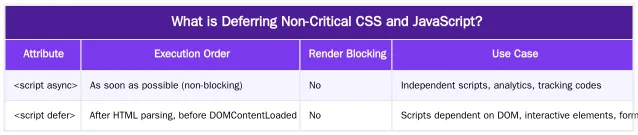
The `async` and `defer` attributes prevent JavaScript files from blocking the browser’s rendering process. `async` scripts download in parallel with HTML parsing and execute as soon as they are available, potentially out of order. `defer` scripts also download in parallel but execute only after the HTML document has been fully parsed, maintaining their relative order. The choice depends on script dependencies and execution timing requirements.
Extracting and Inlining Critical CSS for Above-the-Fold Content
Critical CSS is the minimal set of CSS rules required to style the content visible in the initial viewport. This CSS can be extracted and inlined directly into the HTML document’s “ section. This eliminates a network request for the stylesheet, allowing the browser to render above-the-fold content immediately. The remaining, non-critical CSS can then be loaded asynchronously or deferred, ensuring it doesn’t block the initial render. Tools exist to automate the generation of critical CSS, simplifying this process.
Enhancing E-E-A-T and Reducing Cost of Retrieval for Medical Sites
For medical websites, technical optimizations like deferring non-critical resources are strategic components of establishing Expertise, Experience, Authoritativeness, and Trustworthiness (E-E-A-T). A fast, efficient website signals to users and search engines that it is well-maintained and professionally managed. This technical proficiency contributes to a positive perception of the medical practice. These optimizations also reduce the Cost of Retrieval, a methodology for efficient medical website performance.
Technical Optimization as an E-E-A-T Signal for Surgeons
Google’s E-E-A-T guidelines emphasize website quality and reliability, especially for YMYL topics like health and medicine. A technically sound website with fast load times and smooth user interactions reflects positively on the medical professionals it represents. It demonstrates attention to detail and commitment to the patient journey, from search to consultation. This technical care reinforces the authority and trustworthiness of surgeons and clinics in the London private healthcare market, contributing to a Cost of Retrieval Audit.
Minimizing Search Engine Cost of Retrieval with Smart Loading
The “Cost of Retrieval” refers to the resources (time, bandwidth, processing power) search engines expend to crawl, render, and index a website. Optimizing resource loading by deferring non-critical CSS and JavaScript reduces this cost. Less code means search engine bots can process content more efficiently, improving crawl budget utilization and potentially speeding up indexing of medical content. Abdurrahman Şimşek’s approach uses infrastructure like Ruxi Data to build semantic content networks that minimize this cost, ensuring medical information is accessible and understood by search engines, contributing to a technical SEO framework.
Measuring Performance Improvements and Ongoing Optimization
After implementing resource deferral strategies, measure their impact to confirm improvements and identify further optimization opportunities. Tools like Google PageSpeed Insights and Lighthouse provide reports on website performance, highlighting key metrics and offering recommendations. These tools analyze page loading, rendering, and interactivity, showing how changes affect user experience and search engine crawlability. Performance optimization is an iterative process requiring continuous monitoring and refinement.
Interpreting PageSpeed Insights for Continuous Improvement
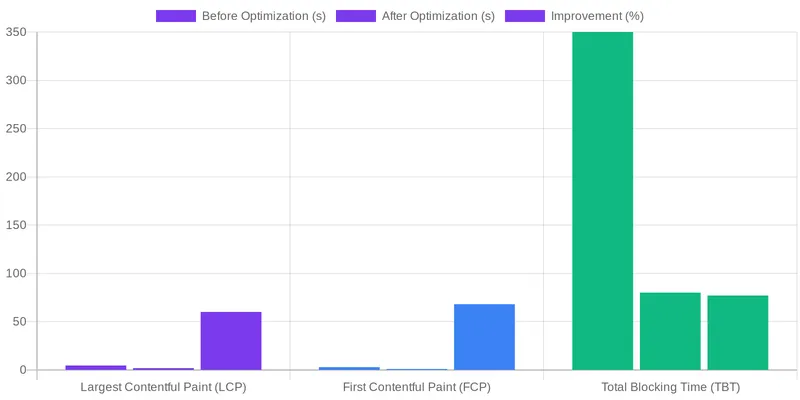
Google PageSpeed Insights provides scores for mobile and desktop performance, along with detailed diagnostics. Focus on metrics like LCP, First Contentful Paint (FCP), and Total Blocking Time (TBT). LCP indicates when the main content is visible, FCP measures when the first pixel is painted, and TBT quantifies how long the main thread was blocked, preventing user input. The “Opportunities” and “Diagnostics” sections offer specific advice, such as “Eliminate render-blocking resources” or “Defer offscreen images.” Regularly reviewing these reports allows for targeted adjustments to maintain optimal performance. For more insights, visit Google PageSpeed Insights.
Future-Proof Your Medical Website: Partner with a Semantic SEO Strategist
Technical optimizations like deferring non-critical CSS and JavaScript are foundational to an SEO strategy for medical clinics. These efforts improve user experience and signal technical excellence to search engines, reinforcing E-E-A-T and reducing the Cost of Retrieval. For London’s medical practices, partnering with a specialist who understands these nuances is crucial. Abdurrahman Şimşek, a Semantic SEO Strategist and Web Developer, specializes in building high-performing, authoritative online presences for plastic surgeons and aesthetic clinics. His expertise ensures your website is optimized for patients and search engines, aligning with a semantic SEO for surgeons approach.
Conclusion
Deferring non-critical CSS and JavaScript is a fundamental step in enhancing the performance of surgical service pages. This contributes to faster load times, improved Core Web Vitals, and a better user experience—all critical for building patient trust and achieving higher search rankings. By prioritizing essential content and managing resource delivery, medical clinics can create a more efficient and authoritative online presence. To improve your website’s performance and patient acquisition, contact us. You can also Book a Semantic SEO Audit or reach out via WhatsApp Strategy Line: +90 506 206 86 86.
Frequently Asked Questions
What does deferring non critical css and JavaScript mean for website performance?
This optimization technique involves delaying the loading of styling and scripting resources that are not immediately essential for the initial display of a webpage. It prioritizes content visible in the user’s viewport, allowing the browser to render primary content faster. By implementing deferring non critical css, perceived page speed and user experience are significantly improved.
Why is deferring non critical css particularly important for surgical service pages?
Surgical service pages are often content-rich with complex layouts, featuring high-resolution images and detailed information. Applying this technique ensures that critical information, like the procedure name and key benefits, loads almost instantly. This is vital for patient engagement, improving Core Web Vitals, and maintaining a professional image for medical clinics.
What is the biggest risk when implementing this optimization strategy?
The primary risk is incorrectly identifying the “critical” CSS, which can lead to a “flash of unstyled content” (FOUC) where the page briefly appears broken. It’s crucial to use precise tools and methods to generate the correct critical path CSS. This ensures a seamless user experience without visual glitches.
Can a WordPress plugin handle loading non-essential CSS and JavaScript automatically?
Yes, many performance and caching plugins, such as WP Rocket or Perfmatters, offer features to automatically generate critical CSS and manage the loading of non-essential resources. However, they often require careful configuration and thorough testing. This ensures compatibility with your specific theme and other plugins, preventing unintended issues.
Will delaying script execution affect features like a booking calendar?
It can if not configured properly. Interactive elements that are not immediately visible, like a booking calendar located further down the page, are ideal candidates for deferred JavaScript. This strategy ensures they don’t impede the initial page load but are fully functional and ready when the user scrolls to them.
How can Abdurrahman Şimşek help my medical website with performance optimizations like deferring non critical css?
Abdurrahman Şimşek, a Semantic SEO Strategist, specializes in optimizing medical and plastic surgery websites for London clinics. He can conduct a comprehensive Semantic SEO Audit to identify performance bottlenecks and implement strategies like deferring non critical css to enhance Core Web Vitals and E-E-A-T. You can book an audit or contact him directly via WhatsApp to discuss a tailored strategy.
Ruxi Data brings together multi-model AI, automated website crawling, live indexation checks, topical authority mapping, E-E-A-T enrichment, schema generation, and full pipeline automation — from crawl to WordPress publish to social posting — all in one platform built for agencies and freelancers who run on results.