
Cost of Retrieval Audit: Optimizing Plastic Surgery Website Rankings
A cost of retrieval audit critically assesses how efficiently search engines crawl, render, and understand a website’s content. For plastic surgery sites, this audit is vital for improving information retrieval and securing higher rankings by minimizing the computational resources search engine bots expend. It ensures efficient crawl budget usage, enhances website performance, and improves indexing API signals. This process directly impacts topical authority and patient attraction by making complex medical content easily digestible for algorithms, ultimately boosting online visibility.
Abdurrahman Şimşek, a Semantic SEO Strategist, specializes in optimizing digital presence through advanced technical SEO and semantic engineering. His expertise focuses on enhancing website efficiency and authority, particularly for competitive YMYL sectors like plastic surgery, ensuring content is both discoverable and trustworthy.
To explore your options, contact us to schedule your consultation. You can also reach us via: Book a Semantic SEO Audit, Direct WhatsApp Strategy Line: +90 506 206 86 86, Hire as Semantic SEO Architect
Is your plastic surgery website struggling to rank despite high-quality content? The answer might lie in your cost of retrieval audit. This comprehensive guide explains what a cost of retrieval audit is, why it’s crucial for medical and aesthetic clinics, and how a specialized semantic SEO approach can transform online visibility. By minimizing the resources search engines need to understand your site, you can achieve dominant topical authority and attract more patients. This analysis focuses on optimizing how search engines crawl, render, and index your valuable medical content.
What is a Cost of Retrieval Audit and Why Does it Matter for Plastic Surgeons?
A cost of retrieval audit is a deep technical analysis assessing how efficiently search engines like Google crawl, render, and understand a website’s content. It directly measures the computational resources and time search engine bots expend to process your pages. For plastic surgery websites, which fall under the Your Money Your Life (YMYL) category, a low retrieval cost is paramount. Search engines prioritize sites that are easy to process, as this signals clarity, authority, and trustworthiness, all critical for medical information. An efficient site allows algorithms to quickly grasp the nuances of complex medical procedures and physician expertise, directly influencing indexing speed and ultimately, search ranking potential.
The concept of retrieval cost extends beyond mere technical speed. It encompasses the clarity of information architecture, the semantic richness of content, and the overall ease with which an algorithm can extract entities and their relationships. For a plastic surgeon’s website, this means ensuring that details about procedures, qualifications, and patient care are not only present but also structured in a way that minimizes the “effort” for a search engine to verify and rank them. This efficiency contributes significantly to establishing and maintaining topical authority within the highly competitive medical aesthetic sector.
Identifying High Cost of Retrieval: Key Indicators & Diagnostic Tools
Recognizing the signs of a high retrieval cost is the first step toward optimization. Common indicators include slow indexing of new content, inconsistent rankings for established pages, and poor performance in Core Web Vitals metrics. Inefficient crawl budget usage, where search engine bots spend excessive time on low-value pages, also signals a high retrieval cost. Diagnostic tools provide the data necessary to pinpoint these issues.
Google Search Console (GSC) offers invaluable insights through its Crawl Stats and Index Coverage reports, revealing how often Googlebot visits your site and which pages are indexed or encountering errors. Log file analysis provides a granular view of bot activity, showing exactly which URLs are being crawled, the frequency, and the server response times. Page speed insights tools, such as Google’s PageSpeed Insights, highlight rendering efficiency and server performance bottlenecks. Interpreting this data allows for targeted interventions to reduce the computational burden on search engines.
Understanding Your Crawl Budget & Indexing Efficiency
Crawl budget refers to the number of pages a search engine bot will crawl on a website within a given timeframe. It is influenced by site size, update frequency, and overall site health. For medical sites, especially those with extensive procedure guides or patient resources, an inefficient crawl budget can lead to critical pages being overlooked or indexed slowly. Pages with high retrieval cost, such as those with excessive JavaScript, large images, or complex server-side processing, consume more crawl budget without delivering proportional value. Optimizing these elements ensures that valuable medical content is prioritized for indexing. For a deeper dive into managing crawl budget, refer to resources on fixing crawl budget issues and log file analysis.
The Critical Role of Core Web Vitals in CoR
Core Web Vitals (CWV) are a set of metrics measuring real-world user experience, directly reflecting a site’s rendering efficiency and server response time. Largest Contentful Paint (LCP) measures loading performance, Cumulative Layout Shift (CLS) quantifies visual stability, and Interaction to Next Paint (INP) assesses interactivity. Poor CWV scores indicate a high retrieval cost because they signal to search engines that the page is difficult or resource-intensive to render and interact with. This directly impacts user experience and, consequently, ranking potential. Improving these metrics means optimizing server response, reducing render-blocking resources, and ensuring a stable visual layout, all of which contribute to a lower retrieval cost for search engines.
Semantic Engineering & Ruxi Data: Minimizing CoR for Medical Authority
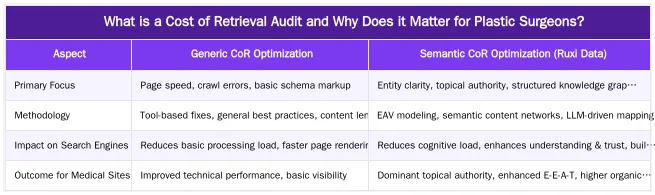
Abdurrahman Şimşek’s approach to minimizing retrieval cost for medical websites leverages semantic engineering and Entity-Attribute-Value (EAV) modeling. This method explicitly defines medical entities—such as specific surgical procedures, physician qualifications, or anatomical areas—and their intricate relationships. By structuring this data, ambiguity for search engines is significantly reduced. The Ruxi Data infrastructure facilitates this process, automating topical maps and EAV modeling to transform complex clinical expertise into a format easily processed by algorithms. This semantic content network makes a plastic surgery site inherently more “understandable” and authoritative to search engines, lowering the computational cost required for them to grasp the site’s expertise and relevance.
Unlike generic SEO, which often focuses on surface-level technical fixes, semantic engineering addresses the fundamental way search engines interpret information. For a plastic surgeon, this means that details about a “rhinoplasty” procedure are not just text on a page, but a clearly defined entity linked to attributes like “recovery time,” “surgeon expertise,” and “patient suitability.” This explicit structuring, powered by Ruxi Data, provides a robust framework that minimizes the cognitive load on search algorithms, allowing them to efficiently build a knowledge graph of your practice and its offerings.
How Ruxi Data Transforms Clinical Expertise into Structured Data
Ruxi Data plays a pivotal role in automating topical maps and EAV modeling, effectively turning complex medical information into a highly structured, machine-readable format. This infrastructure processes vast amounts of clinical expertise, identifying key entities and their attributes, then mapping them into a coherent semantic network. For search engines, this means less computational effort is needed to “learn” about a medical practice’s specializations, procedures, and overall authority. By providing clear, unambiguous signals, Ruxi Data reduces the retrieval cost associated with understanding and validating the expertise presented on a plastic surgery website, leading to more accurate indexing and higher relevance in search results.
Generic vs. Semantic CoR Optimization for Medical Sites
Understanding the distinction between generic and semantic approaches to retrieval cost optimization is crucial for medical practices.
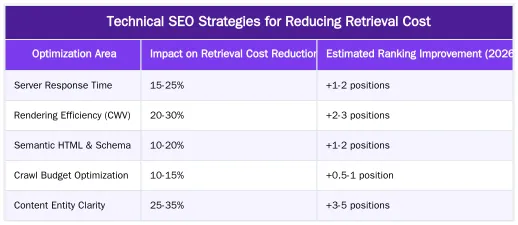
Technical SEO Strategies for Reducing Retrieval Cost
Beyond semantic structuring, robust technical SEO is fundamental to lowering the cost of information retrieval. These strategies focus on optimizing the foundational elements of a website, ensuring that search engine bots can access, process, and understand content with minimal effort. Implementing these technical improvements directly translates to faster indexing, better crawl budget allocation, and improved overall site performance, which are critical for high-authority medical domains.
Key technical interventions include optimizing server response times, enhancing rendering efficiency, and ensuring a clean, semantic HTML structure. Image optimization, minification of CSS and JavaScript files, and efficient resource loading are also vital. These efforts collectively reduce the data transfer volume and processing power required by search engines, making your plastic surgery website a more “cost-effective” resource for them to crawl and rank. For comprehensive guidance on improving site speed, consider resources on WordPress SEO speed optimization.
Optimizing Server Response Time and Rendering Efficiency
Server response time is the duration it takes for a server to respond to a browser request. A slow response directly increases the retrieval cost for search engines, as bots must wait longer to receive content. Optimizing this involves efficient server configuration, robust hosting solutions, and database query optimization. Rendering efficiency, on the other hand, pertains to how quickly a browser (or search engine renderer) can display the page content. This is improved by reducing render-blocking resources like large CSS or JavaScript files, deferring offscreen images, and prioritizing critical content. Fast server response and efficient rendering ensure that search engines can quickly access and process the visual and textual content of your plastic surgery website, minimizing their computational effort.
Leveraging Semantic HTML5 and Structured Data
Clean, semantic HTML5 provides a clear structure for search engines to interpret content. Using appropriate tags like “, `
The Long-Term Benefits of a Low Cost of Retrieval
Optimizing for a low retrieval cost yields significant long-term benefits for plastic surgery websites, extending far beyond mere technical improvements. A site that is efficient for search engines to process is inherently more likely to achieve and sustain higher rankings. This translates to faster indexing of new content, ensuring that your latest procedures or expert insights are discovered and ranked quickly. More efficient crawling also means better allocation of crawl budget, allowing search engines to explore more of your valuable content rather than getting bogged down by inefficient pages.
Crucially, a low retrieval cost contributes directly to enhanced topical authority. When search engines can easily understand the depth and breadth of your expertise in plastic surgery, they are more likely to perceive your site as a leading authority in the field. This improved authority, combined with a superior user experience driven by faster loading and stable layouts, leads to increased organic traffic and, ultimately, a higher rate of patient acquisition for London-based aesthetic clinics. Abdurrahman Şimşek’s 10 years of experience in search engineering for medical clients consistently demonstrates these outcomes.
These improvements are not isolated; they create a virtuous cycle where efficiency begets visibility, and visibility reinforces authority. For medical practices, this means a stronger online presence, more qualified leads, and a robust foundation for sustained digital growth in a competitive market.
Conclusion
A thorough cost of retrieval audit is not merely a technical exercise; it is a strategic imperative for plastic surgery websites aiming for dominant online visibility. By systematically optimizing how search engines crawl, render, and understand your content, you can significantly reduce the computational effort required, leading to faster indexing, improved rankings, and enhanced topical authority. Leveraging semantic engineering and specialized infrastructure like Ruxi Data transforms complex medical expertise into clear, machine-readable signals, ensuring your practice stands out in the competitive London aesthetic market. Prioritizing retrieval efficiency is a direct investment in your digital future, driving organic growth and patient acquisition.
Ready to uncover why your plastic surgery website isn’t ranking and implement a strategy for unparalleled online success? Contact us today to discuss a tailored semantic SEO approach. Book a Semantic SEO Audit, Direct WhatsApp Strategy Line: +90 506 206 86 86, or Hire as Semantic SEO Architect.
Frequently Asked Questions
What is a Cost of Retrieval (CoR) audit?
A cost of retrieval audit is a deep technical analysis that assesses how efficiently search engines can crawl, render, and understand your website’s content. Abdurrahman Şimşek’s methodology analyzes server logs, page speed, and code structure to minimize the resources Google needs to process your site, which is a key ranking factor. This optimization makes your site more accessible and understandable to search engines.
What are the main signs of a high retrieval cost for a website?
Common indicators of a high retrieval cost include persistently slow page load times, poor Core Web Vitals scores, and frequent crawl errors reported in Google Search Console. Additionally, if new content takes an unusually long time to be indexed by search engines, it signals that your site is resource-intensive for them to process. These issues can hinder your site’s visibility and ranking potential.
How does a cost of retrieval audit help a plastic surgery website rank higher?
By lowering the cost of retrieval, we make it significantly easier and more efficient for Google to understand your clinic’s expertise and services. This leads to more frequent crawling, faster indexing of your specialized procedures, and a higher perceived authority in the medical niche. Ultimately, a thorough cost of retrieval audit directly impacts your rankings for competitive terms, attracting more potential patients.
What tools and methods are used for a cost of retrieval audit?
Abdurrahman Şimşek employs a comprehensive suite of tools for a cost of retrieval audit, including server log file analyzers, Google Search Console, and PageSpeed Insights. We also utilize custom Python scripts and the Ruxi Data Semantic Engine to gain a complete picture of crawl behavior, rendering performance, and overall semantic efficiency. This allows for precise identification and resolution of technical bottlenecks.
Is optimizing for retrieval cost a one-time fix or an ongoing process?
It is both a foundational fix and an ongoing strategic process. The initial audit identifies and resolves critical technical issues that impede search engine efficiency. However, maintaining a low retrieval cost requires continuous technical monitoring, especially as new content, images, and features are added to your website. Abdurrahman Şimşek provides strategies for long-term optimization.
How can I get a cost of retrieval audit for my plastic surgery website?
To improve your plastic surgery website’s ranking, you can book a Semantic SEO Audit with Abdurrahman Şimşek, a specialist in medical SEO. This audit will include a detailed cost of retrieval audit to identify and fix technical inefficiencies. You can contact us directly via WhatsApp at +90 506 206 86 86 or visit our website to book a Semantic SEO Audit.
Ruxi Data brings together multi-model AI, automated website crawling, live indexation checks, topical authority mapping, E-E-A-T enrichment, schema generation, and full pipeline automation — from crawl to WordPress publish to social posting — all in one platform built for agencies and freelancers who run on results.