
Core Web Vitals for Surgeons: Mastering LCP for Medical SEO
Understanding core web vitals for surgeons is crucial for medical practices aiming for online success. This guide details how to achieve a sub-2.0 second Largest Contentful Paint (LCP) on surgical procedure pages. A fast LCP directly enhances patient trust, improves conversion rates, and boosts search visibility for medical SEO. The article covers diagnosing LCP bottlenecks using tools like PageSpeed Insights and implementing strategies for image optimization and reducing render-blocking resources. Optimizing LCP is essential for superior user experience and E-E-A-T in healthcare.
High-Performance Web Architecture for Plastic Surgeons & Skin Clinics
Abdurrahman Şimşek, a Semantic SEO Strategist, provides actionable insights for medical professionals to enhance their digital presence. This content offers practical, data-driven strategies to improve website performance and achieve critical Core Web Vitals targets, ensuring optimal patient engagement and search engine ranking. High-Performance Web Architecture for Plastic Surgeons & Skin Clinics
To explore your options, contact us to schedule your consultation. You can also reach us via: Book a Semantic SEO Audit, Direct WhatsApp Strategy Line: +90 506 206 86 86
Why a Sub-2.0s LCP is Critical for Surgical Procedure Pages
Surgical procedure pages are high-stakes informational gateways for potential patients. A Largest Contentful Paint (LCP) under 2.0 seconds ensures the most critical content—often a hero image or headline—loads almost instantly. This immediate visual feedback builds trust, prevents page abandonment, and directly impacts conversion rates for medical practices.
In private healthcare, especially for plastic surgeons, every millisecond counts. A slow-loading procedure page can erode patient confidence. Google’s emphasis on page experience, including Core Web Vitals, means that performance directly influences search rankings. A sub-2.0s LCP differentiates your practice, signaling professionalism and a commitment to user experience (UX).
Understanding Largest Contentful Paint (LCP)
Largest Contentful Paint (LCP) measures the time for the largest content element in the viewport to render. This element is typically a large image, video poster image, or a block of text. Google defines a “good” LCP score as 2.5 seconds or less. For high-value medical content like surgical procedure pages, a sub-2.0 second LCP is a strategic advantage. This faster threshold minimizes perceived loading time and maintains user engagement on Your Money or Your Life (YMYL) topics.
Other Core Web Vitals include Interaction to Next Paint (INP) for responsiveness and Cumulative Layout Shift (CLS) for visual stability. LCP often has the most immediate impact on a user’s first impression of a page’s speed and quality.
Diagnosing LCP Bottlenecks on Your Medical Website
To optimize a slow Largest Contentful Paint, first identify its root causes. Medical websites face challenges from high-resolution imagery, third-party booking integrations, and extensive content. Specific bottlenecks require analysis with dedicated tools.
Leveraging PageSpeed Insights & Google Search Console
Google PageSpeed Insights helps diagnose LCP issues by providing lab data (simulated load) and field data (real user experience). Observe the LCP score and Time to First Byte (TTFB), a foundational element for LCP. A high TTFB indicates server-side delays. Google Search Console’s Core Web Vitals report gives an aggregated performance view to identify widespread issues. Understanding these reports helps in reducing the Cost of Retrieval for users and search engines.
Common LCP Culprits on Procedure Pages
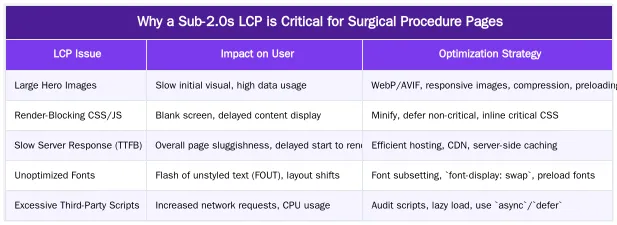
Common causes of slow LCP on medical procedure pages include: large hero images or unoptimized video embeds, which delay rendering; render-blocking JavaScript and CSS; and slow server response time (TTFB) from inefficient hosting, unoptimized databases, or complex server-side processing. Third-party scripts for analytics, chat, or booking can also cause delays if not loaded efficiently.
Actionable Strategies for Sub-2.0s LCP Optimization
Mastering Image & Video Optimization for LCP
Images and videos are often the largest content elements on procedure pages. Convert images to modern formats like WebP or AVIF for better compression. Use the `srcset` attribute for responsive images to serve appropriate sizes for each device. Compress all images. For the LCP element, avoid lazy loading and instead preload critical images using “ to fetch them early.
Streamlining Render-Blocking Resources & Server Response
Render-blocking CSS and JavaScript prevent content rendering until processed. Minify CSS and JavaScript files to remove unnecessary characters. Defer non-critical JavaScript with `defer` or `async` attributes. Inline critical, above-the-fold CSS in the HTML for immediate rendering. Improve server response time (TTFB) by upgrading hosting, optimizing database queries, and using a Content Delivery Network (CDN) to serve assets from closer servers.
| LCP Score (Seconds) | Conversion Rate Impact (Estimated) | Bounce Rate Impact (Estimated) |
|---|---|---|
| < 1.0 | +15-20% | -10-15% |
| 1.0 – 2.0 | +5-10% | -5-10% |
| 2.0 – 2.5 (Google’s “Good”) | Baseline | Baseline |
| 2.5 – 4.0 | -5-10% | +5-10% |
| > 4.0 | -15-20% | +15-20% |
Beyond Speed: LCP’s Role in E-E-A-T and Patient Trust
A fast Largest Contentful Paint contributes to a medical website’s authority and trustworthiness. In healthcare, a good user experience is a trust signal. A fast, stable site reinforces a practice’s credibility and professionalism for potential patients and search engines.
How Page Speed Reinforces Medical E-E-A-T
For Your Money or Your Life (YMYL) topics like medical procedures, Google prioritizes E-E-A-T: Experience, Expertise, Authoritativeness, and Trustworthiness. A fast-loading website signals quality and attention to detail, while a slow site can undermine perceived professionalism. A fast LCP and good user experience communicate reliability and expertise, contributing to a site’s E-E-A-T assessment. Reinforcing expertise with structured data and maintaining a secure HTTPS connection are also foundational trust signals.
Reducing Cost of Retrieval for Enhanced Patient Journeys
Optimizing LCP reduces the “Cost of Retrieval” for search engines and users. For search engines, a faster site uses fewer resources to crawl and index, potentially improving crawl efficiency and rankings. For users, a reduced cost of retrieval improves the patient journey. When procedure pages load quickly, patients access information without frustration, leading to higher engagement and conversions. This experience, including a seamless mobile booking experience, guides patients through the conversion funnel and is a cornerstone of effective Cost of Retrieval optimization.
Why Partner with a Semantic SEO Strategist for LCP Excellence?
Achieving and maintaining Core Web Vitals, especially a sub-2.0s LCP, requires expertise beyond basic technical fixes. For plastic surgeons and aesthetic clinics, a semantic SEO strategist integrates performance optimization into a broader digital strategy. Abdurrahman Şimşek has over 10 years of experience in search engineering, specializing in the medical niche for London clinics.
Abdurrahman Şimşek’s Holistic Approach to Medical Website Performance
Abdurrahman Şimşek’s methodology uses a Semantic SEO Framework and Ruxi Data, extending beyond LCP scores. It includes web development and content architecture focused on Entity-Attribute-Value (EAV) modeling to build high-authority, high-converting websites. This optimizes the site’s technical foundation and semantic content network for search engines and patient experience. His expertise in medical content configuration and building topical authority for aesthetic practices ensures your website loads fast, ranks well, and converts effectively. This knowledge is crucial for medical SEO and achieving a competitive edge.
For further insights into web performance and its impact on user experience, resources like web.dev’s Core Web Vitals documentation provide foundational understanding.
Achieve Elite Performance: Secure Your Sub-2.0s LCP Today
In 2026, a sub-2.0 second LCP on surgical procedure pages is a strategic imperative for patient acquisition and trust. Prioritizing performance delivers a better user experience, reinforcing your practice’s professionalism and expertise. Speed and quality directly impact search visibility and conversion rates. Don’t let slow loading speeds deter potential patients. Partner with an expert in Medical SEO Services for Surgeons to make your website a high-performing, patient-attracting asset.
Optimize your website’s performance to secure a competitive advantage. Ensure your high-converting website is built on speed and semantic excellence.
Conclusion
A sub-2.0 second LCP on surgical procedure pages is a strategic imperative for London’s plastic surgeons. This performance enhances patient trust, engagement, and conversion rates. Prioritizing technical and semantic optimization ensures your digital presence reflects your practice’s quality. Don’t let slow loading speeds deter patients. Book a Semantic SEO Audit today. Direct WhatsApp Strategy Line: +90 506 206 86 86. Hire as Semantic SEO Architect to build a high-converting online presence.
Frequently Asked Questions
Why is a sub-2.0 second LCP critical for surgical procedure pages?
Surgical procedure pages are high-stakes, informational gateways for potential patients. A fast Largest Contentful Paint (LCP) under 2.0 seconds ensures that the most critical content—often a hero image or headline—loads almost instantly, capturing attention and establishing credibility without frustrating delays. This is a key metric for core web vitals for surgeons.
What is the most common cause of poor LCP on medical websites?
The most frequent cause is large, unoptimized images, especially in ‘before and after’ galleries or on detailed procedure pages. Properly compressing and serving images in next-gen formats is the single biggest lever to pull for improving LCP performance for medical practices.
How can optimizing core web vitals for surgeons directly lead to more patient bookings?
Absolutely. A faster, more stable website provides a superior user experience, which reduces bounce rates and increases engagement. By improving core web vitals for surgeons, you build patient trust and make the journey from research to
Ruxi Data brings together multi-model AI, automated website crawling, live indexation checks, topical authority mapping, E-E-A-T enrichment, schema generation, and full pipeline automation — from crawl to WordPress publish to social posting — all in one platform built for agencies and freelancers who run on results.