
Content Velocity Optimization: Scaling Quality Content Production
Content velocity optimization defines the strategic approach to increasing the rate of high-quality content production and publishing. This article details how to streamline editorial workflows, leverage AI automation, and measure production efficiency to achieve scalable content output. It emphasizes maintaining content quality while accelerating publishing frequency, crucial for establishing topical authority and improving SEO visibility. Readers will gain actionable insights into overcoming content bottlenecks and enhancing their content strategy for sustained digital growth and improved content ROI.
Abdurrahman Simsek provides expertise in digital strategy, focusing on practical methods for enhancing content operations. This guide offers data-driven strategies to optimize content production scale and elevate publishing frequency without compromising quality.
To explore your options, contact us to schedule your consultation.
Content velocity optimization is a strategic imperative for modern businesses aiming to scale quality content production and maintain a competitive edge in 2026. This guide explores what content velocity entails, why its optimization is more critical than ever, and how to achieve it without compromising quality. We will delve into advanced AI automation and refined strategic workflows, providing actionable insights to enhance your content output and drive measurable results. Understanding and implementing these strategies is key to sustained SEO success.
What is Content Velocity Optimization in SEO?
Content velocity in SEO refers to the rate at which a brand consistently produces and publishes high-quality, optimized content over a defined period. It encompasses the speed, volume, and quality of content output. Optimizing this velocity means streamlining processes to increase the frequency of valuable content publication without sacrificing its effectiveness or relevance. This approach moves beyond simply generating more content, focusing instead on delivering quality at an accelerated pace, which is critical for modern content marketing success in 2026.
The core components of effective content velocity include efficient ideation, rapid production cycles, thorough optimization for search engines, and consistent publishing frequency. Businesses that master this balance gain a significant advantage, signaling to search engines their active presence and commitment to providing fresh, relevant information. This continuous flow of valuable content helps build topical authority and improves overall search engine visibility.
Why High Content Velocity is Crucial for Modern SEO Success
In the dynamic digital landscape of 2026, a high rate of content production is not merely a competitive advantage; it is a fundamental requirement for robust SEO performance. Search engines prioritize websites that consistently provide fresh, relevant, and high-quality information. Increased publishing frequency directly correlates with improved SERP visibility, as more content means more opportunities to rank for diverse keywords and capture organic traffic.
Consistent content output helps establish and reinforce topical authority within a niche. By covering a wide array of related subjects comprehensively and frequently, a website signals its expertise to search engines. This leads to faster indexing of new content and a stronger overall domain authority. Furthermore, a steady stream of content keeps audiences engaged, encouraging repeat visits and fostering a loyal readership, which indirectly boosts SEO through positive user signals.
The Impact on Search Engine Rankings and Authority
Frequent, relevant content acts as a powerful signal to search engines, indicating an active and authoritative website. Each new piece of content provides an additional entry point for search engine crawlers, leading to more frequent site visits and faster indexing. This consistent activity helps build a strong reputation with algorithms, potentially leading to better rankings across a broader spectrum of search queries. As search engines, including those leveraging advanced AI models, continue to evolve, the emphasis on fresh, comprehensive, and helpful content remains paramount. Google’s approach to AI in search highlights the importance of quality and relevance.
Overcoming Content Bottlenecks and Competitive Gaps
Many organizations face common content bottlenecks, such as slow production cycles, limited resources, and inefficient workflows. These challenges hinder the ability to respond to market trends or capitalize on emerging keyword opportunities. Optimizing content production helps overcome these limitations, allowing businesses to fill content gaps faster than competitors. By streamlining processes and leveraging technology, companies can maintain a proactive stance, ensuring they consistently outpace rivals in content output and market presence.
Strategies for Scaling Quality Content Production
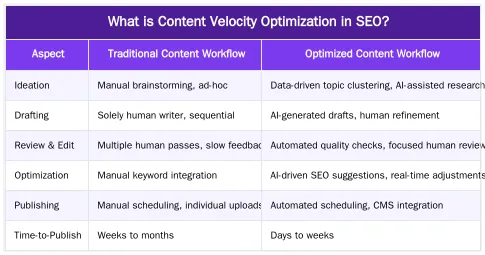
Scaling content production while maintaining high quality requires a strategic approach that integrates efficient workflows, smart planning, and advanced technology. The goal is to maximize output without compromising the value or relevance of each piece. This involves a shift from manual, sequential processes to more integrated and automated systems. Implementing robust content guidelines and clear responsibilities ensures consistency across all content assets.
Consider the contrast between traditional and optimized content creation processes:
Streamlining Your Editorial Workflow for Efficiency
An optimized editorial workflow is the backbone of efficient content production. This involves clearly defining roles and responsibilities for each stage, from content ideation and keyword research to drafting, editing, and publishing. Establishing standardized content guidelines ensures brand voice consistency and quality. Implementing project management tools can centralize communication, track progress, and identify potential bottlenecks. Regular audits of the workflow help identify areas for improvement, ensuring the process remains agile and responsive to evolving needs.
Leveraging Automation & AI for Content Calendar Management
Automation and AI tools are transformative for content calendar management and maintaining a consistent publishing frequency. These technologies can automate tasks such as topic generation based on trending keywords, competitor analysis, and content scheduling. AI-powered platforms can suggest optimal publishing times, manage content distribution across various channels, and even re-purpose existing content. This reduces manual effort, minimizes errors, and ensures a steady, strategic flow of content, allowing teams to focus on higher-level strategy and creative input.
Achieving 10x Content Velocity with AI: Our E-E-A-T Framework
At abdurrahmansimsek.com, we leverage a multi-model AI pipeline to achieve significant increases in content production speed, enabling a 10x content velocity without compromising quality. Our unique offering, Ruxi Data, automates the entire content lifecycle, from initial research to final publication. This advanced AI automation allows human editors to shift their focus from repetitive drafting tasks to strategic oversight, quality assurance, and final approval. The result is a highly efficient system that scales content output while rigorously adhering to E-E-A-T principles.
This framework ensures that every piece of content benefits from both the speed and analytical power of AI and the nuanced judgment and expertise of human professionals. The synergy between AI and human intelligence is crucial for delivering content that is not only high-volume but also deeply authoritative and trustworthy, directly addressing the common concern of quality vs quantity in content creation.
Automating the Content Lifecycle: From Research to Publish
Our AI workflow for content production automates critical stages of the content lifecycle. It begins with AI-driven topic generation and comprehensive keyword research, identifying high-potential areas for content. The multi-model AI pipeline then drafts content, incorporating SEO best practices, factual accuracy, and a consistent tone of voice. This includes optimizing for readability, internal linking, and meta descriptions. Finally, the system facilitates seamless publishing, integrating directly with content management systems. This AI-powered content production significantly reduces time-to-publish, freeing up human resources for strategic tasks.
Ensuring E-E-A-T and Quality at Scale with AI
Maintaining E-E-A-T (Experience, Expertise, Authoritativeness, Trustworthiness) is paramount, especially when scaling content. Our AI is configured to support and enhance these elements by drawing on vast datasets for factual accuracy and contextual relevance. Human editors provide the essential layer of experience and nuanced judgment, reviewing AI-generated content for originality, depth, and alignment with brand voice. This human-in-the-loop approach ensures that every piece of content meets stringent quality standards and aligns with Google’s helpful content guidelines. The AI acts as a powerful assistant, enabling consistency and factual verification at a scale previously unattainable, thereby enhancing the overall trustworthiness and authority of the content.
Measuring Content Production Efficiency & ROI
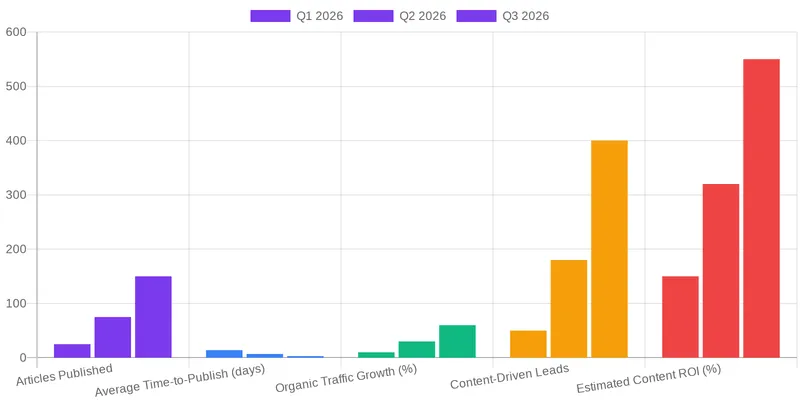
Effective content production requires continuous measurement and analysis to ensure efforts translate into tangible business outcomes. Tracking key metrics provides insights into operational efficiency and the overall impact of content strategies. This data-driven approach allows for iterative improvements, optimizing resource allocation, and proving the value of content initiatives. Without clear metrics, it is challenging to identify bottlenecks, justify investments, or refine strategies for better performance.
Monitoring content performance extends beyond simple page views; it involves understanding how content contributes to lead generation, customer acquisition, and brand loyalty. By linking content efforts to specific business goals, organizations can demonstrate a clear return on investment and build a case for further investment in content velocity strategies.
Key Metrics for Tracking Content Velocity
To gauge content production efficiency, several production metrics should be tracked:
- Volume of Content: Number of articles, blog posts, or pages published per week/month.
- Time-to-Publish: The duration from content brief approval to live publication.
- Revision Cycles: Average number of edits or reviews per content piece.
- Cost Per Piece: Total cost (including labor, tools) divided by the number of content pieces.
- Traffic & Engagement: Organic traffic, bounce rate, time on page, social shares.
- Conversion Rate: Percentage of content visitors who complete a desired action (e.g., sign-up, download).
These metrics provide a holistic view of both the operational efficiency and the audience impact of your content efforts.
Calculating Content Marketing ROI and Proving Value
Calculating content ROI involves attributing revenue or cost savings directly to content marketing efforts. A common methodology is: (Total Revenue Generated by Content – Total Content Marketing Cost) / Total Content Marketing Cost. For example, if content leads to $10,000 in sales and costs $2,000 to produce, the ROI is 400%. Beyond direct revenue, content can generate value through lead nurturing, brand awareness, and customer support, which can be quantified through metrics like reduced support tickets or improved brand sentiment. Regularly reporting on these figures helps justify content investments and refine strategies to maximize returns.
Ready to Accelerate Your Content Velocity?
Optimizing content velocity is a strategic imperative for businesses aiming to dominate the digital landscape in 2026. By embracing advanced AI automation and a refined editorial workflow, you can scale quality content production, build authority, and drive measurable ROI. Don’t let content bottlenecks hold your business back from achieving its full potential. Unlock your content potential today and transform your content strategy with efficient, high-quality output.
Conclusion
Achieving optimal content velocity is no longer a luxury but a strategic necessity for businesses striving for SEO dominance. By understanding its components, addressing common bottlenecks, and implementing advanced strategies like AI automation, organizations can significantly scale their content production without compromising quality. The integration of robust editorial workflows and continuous performance measurement ensures that every piece of content contributes to building authority and driving measurable ROI. Embrace these principles to unlock your full content potential and secure a leading position in your market. Explore how abdurrahmansimsek.com can help you accelerate your content strategy today.
Frequently Asked Questions
What is content velocity optimization in SEO?
Content velocity optimization refers to the strategic process of streamlining content creation and publishing workflows to increase the frequency of high-quality content output. It aims to scale content production efficiently without compromising quality, which is crucial for maintaining a competitive edge and sustained SEO growth.
How can businesses achieve high content production rates without sacrificing quality?
Achieving high content production rates without quality trade-offs is possible through advanced automation and refined strategic workflows. Leveraging AI for tasks like research, drafting, and optimization, combined with human oversight, ensures both speed and adherence to quality standards like E-E-A-T.
What is the ideal content production frequency for SaaS companies?
For SaaS companies, data suggests that publishing 2-4 comprehensive articles weekly is an effective pace for building authority and capturing market share. This consistent output allows for continuous engagement with target audiences and accelerates domain authority growth.
How does AI contribute to improving content velocity?
AI significantly enhances content production efficiency by automating repetitive and time-consuming tasks such as research, initial drafting, fact-checking, and SEO optimization. This allows human teams to focus on strategic planning, creative refinement, and final approvals, dramatically accelerating the overall content pipeline.
How does optimizing content production impact SEO performance?
Optimizing content production directly boosts SEO performance by increasing the volume of high-quality, relevant content available to search engines. Consistent publishing of optimized content improves domain authority, enhances topical relevance, and drives greater organic traffic over time.
Can improvements in content velocity show immediate ROI?
Yes, improvements in content velocity can demonstrate significant ROI relatively quickly. The strategic approach of content velocity optimization often leads to traffic increases of 40% or more within 90 days, due to the compound effect of consistent, quality publishing and accelerated domain authority growth.
Ruxi Data brings together multi-model AI, automated website crawling, live indexation checks, topical authority mapping, E-E-A-T enrichment, schema generation, and full pipeline automation — from crawl to WordPress publish to social posting — all in one platform built for agencies and freelancers who run on results.