
Content Silo Architecture: Boost Your Site’s SEO Authority
Content silo architecture is a strategic SEO method for organizing website content into distinct, thematically related groups. This technical guide details how content silo architecture builds deep topical authority, making it easier for search engines to understand your expertise and rank pages higher. By structuring your website architecture with clear internal linking, content silo architecture prevents keyword cannibalization and enhances overall topical relevance. It improves visibility, optimizes crawl budget, and boosts organic traffic by signaling comprehensive expertise to search engines.
Abdurrahman Simsek provides expert guidance on advanced SEO strategies, including content silo architecture, to help businesses achieve sustainable organic growth. Our commitment to ethical practices and data-driven insights ensures high-quality outcomes, establishing your site as a trusted authority in its niche.
To explore your options, contact us to schedule your consultation.
Struggling to organize your website’s vast content for optimal search engine performance? Content silo architecture is a powerful SEO strategy that structures your site to build deep topical authority, making it easier for search engines to understand your expertise and rank your pages higher. This technical guide will walk you through everything you need to know to implement effective content silos, enhancing your site’s visibility and user experience in 2026 and beyond.
What is Content Silo Architecture and Why Does it Matter for SEO?
The primary goal of implementing a content silo architecture is to group related content together to build high topical relevance for a specific subject, making it easier for search engines to understand your site’s expertise and leading to higher rankings. This strategic organization signals to search engines that your website is a comprehensive authority on particular topics, improving the visibility and ranking potential of all pages within that silo.
Content silo architecture is a method of organizing a website’s content into distinct, thematically related groups. This structure helps search engines like Google understand the hierarchical relationship between your pages, ensuring that link equity flows efficiently and reinforcing your site’s authority on specific subjects. By creating clear topical boundaries, you prevent keyword cannibalization and improve the overall relevance of your content clusters.
The Core Principle: Building Topical Authority and Relevance
At its heart, content silo architecture is about establishing deep topical authority. When you concentrate content around specific subjects, you create a robust network of interconnected pages that collectively cover a topic exhaustively. This concentration makes your site an undeniable expert in a niche, which is highly valued by search engines seeking to provide the most relevant and authoritative results to users. Strong topical relevance leads to better rankings, increased organic traffic, and a more engaged audience.
Physical vs. Virtual Silos: Choosing Your Site’s Foundation
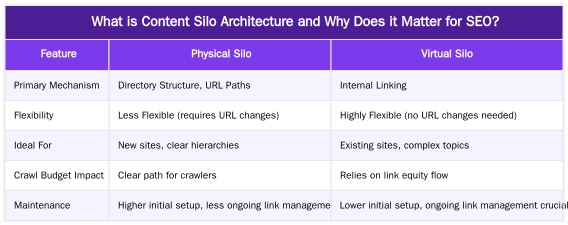
When implementing content silo architecture, you generally have two primary approaches: physical silos or virtual silos. Each method offers distinct advantages and considerations, especially for SaaS or complex websites managing extensive content libraries. Understanding these differences is crucial for selecting the foundation that best suits your site’s structure and SEO goals.
Directory Structure and URL Paths for Physical Silos
Physical silos are built using clear, hierarchical URL structures and subdirectories. For example, a SaaS company might have `/features/`, `/integrations/`, and `/pricing/` as top-level silos, with supporting content nested within them (e.g., `/features/crm-integration/`). This method creates distinct, easily identifiable sections for both users and search engine crawlers. The logical organization of URLs reinforces topical relevance directly within the site’s address, making it straightforward for search engines to categorize your content. While highly effective for new sites or those undergoing a major restructuring, implementing physical silos on an existing site often requires URL changes and careful 301 redirects.
Leveraging Internal Linking for Virtual Silos
Virtual silos, in contrast, rely heavily on strategic internal linking to create topical connections without strict directory structures. This approach is particularly flexible for existing websites with flat URL structures or complex topics that don’t neatly fit into rigid directories. By consistently linking related pages within a topic cluster, you effectively “virtually” group them together. The strength of a virtual silo comes from the careful distribution of link equity and the use of relevant anchor text, guiding search engine crawlers and users through related content. While offering greater flexibility, virtual silos demand meticulous ongoing internal link management to maintain their effectiveness.
Crafting Your Content Silo Strategy: A Practical Implementation Guide
Implementing an effective content silo architecture requires careful planning and execution. This practical guide outlines the essential steps to design and build a robust content structure that enhances your SEO performance. A strategic planning phase, including thorough content mapping and URL structure design, is paramount for long-term success.
Identifying Pillar Pages and Supporting Content Clusters
The first step in building a content silo is to identify your core pillar pages. These are comprehensive, authoritative pieces of content that cover a broad topic. For a SaaS company, a pillar page might be “The Ultimate Guide to CRM Software.” Once identified, you’ll map out supporting content clusters—individual articles or pages that delve into specific sub-topics related to the pillar (e.g., “CRM Features for Sales Teams,” “Integrating CRM with Marketing Automation”). This approach ensures comprehensive topic coverage and establishes your site as a go-to resource. For more on this, explore our guide on building topic clusters.
Designing Your URL Structure and Breadcrumbs for Clarity
An optimal URL structure is critical, especially for physical silos. URLs should be clean, descriptive, and reflect your silo hierarchy. For instance, `/category/sub-category/article-title/` clearly communicates the content’s position within your site’s structure. Additionally, strategically implementing breadcrumbs is vital. Breadcrumbs provide clear navigation paths for users and search engines, showing where a page sits within the site’s hierarchy (ee.g., Home > Category > Sub-Category > Current Page). This not only improves user experience but also reinforces the topical connections within your content silo architecture.
Optimizing Internal Linking for Maximum Silo Power
Internal linking is the backbone of any effective content silo architecture, acting as the circulatory system that distributes link equity and guides search engine crawlers. As experts in SaaS SEO, we understand that strategic internal linking is not just about connecting pages; it’s about reinforcing topical relevance and enhancing user journeys. Leveraging advanced strategies, including automated solutions, can significantly amplify your silo’s power.
Strategic Link Placement and Anchor Text Best Practices
The art of internal linking lies in placing links naturally within your content, ensuring they add value to the reader. Links should flow from supporting pages to pillar pages, and between related supporting pages within the same silo. Crucially, use descriptive, keyword-rich anchor text that accurately reflects the linked page’s content. Avoid generic phrases like “click here.” For example, instead of linking “learn more” to a page about CRM features, use “explore advanced CRM features.” This practice reinforces topical connections for search engines and improves user navigation. Dive deeper into this with our guide on internal linking strategies for silos. Google’s own SEO Starter Guide emphasizes the importance of good internal linking.
Scaling Internal Linking: Leveraging Automation for Large Sites
For large SaaS websites with thousands of pages, manually managing internal links within a content silo architecture can be overwhelming. This is where advanced tools and automation come into play. Automated internal linking solutions can analyze your content, identify topical relationships, and suggest or even implement relevant links at scale. These systems ensure consistent link equity distribution, maintain silo integrity, and free up valuable time for content creators. At Abdurrahman Simsek, we specialize in developing and implementing such advanced strategies to help complex sites optimize their internal linking efficiently. Learn more about automated internal linking.
How Does Content Silo Architecture Impact Crawl Budget and Site Performance?
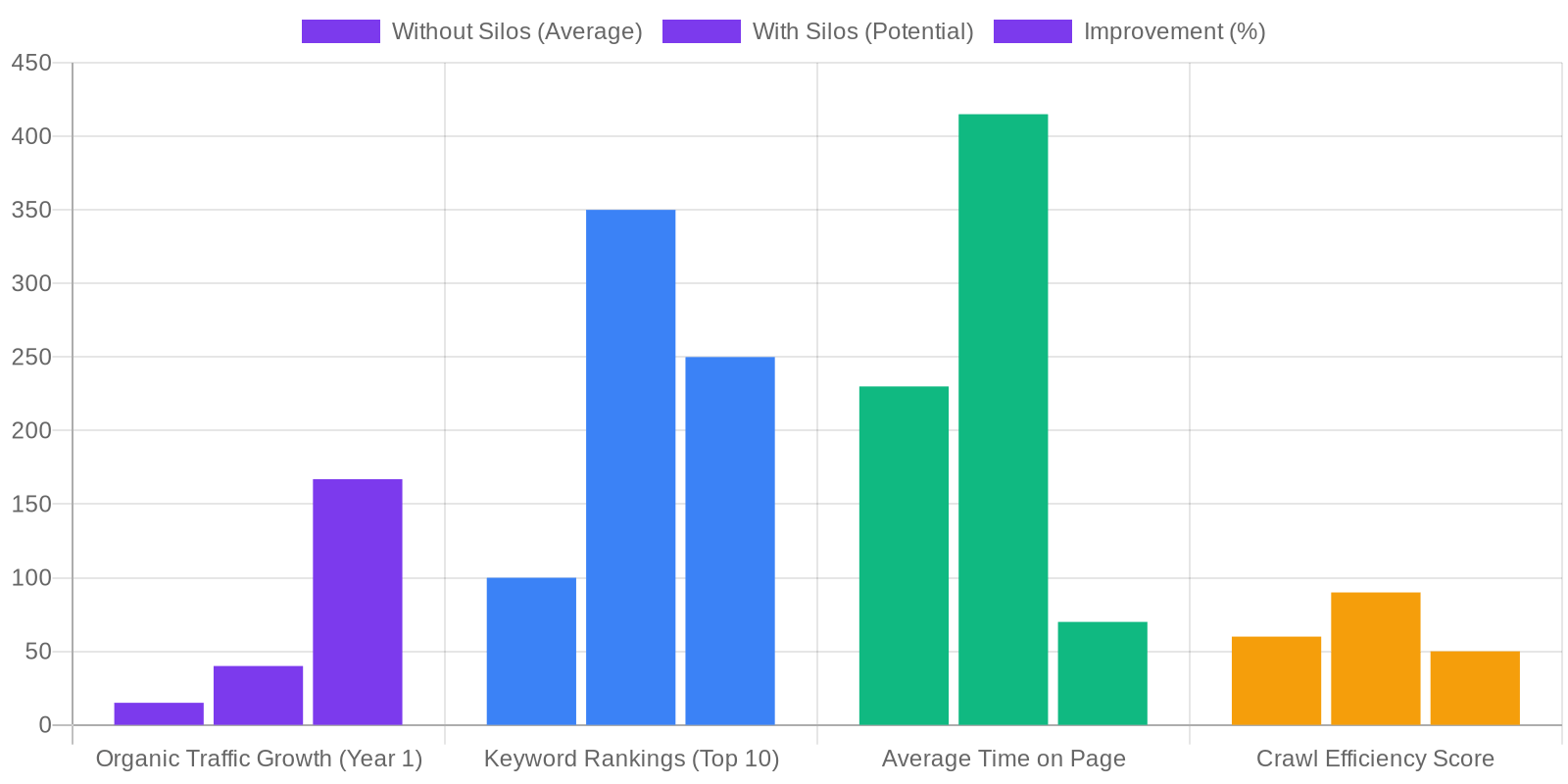
Beyond direct ranking benefits, a well-implemented content silo architecture offers significant technical SEO advantages, particularly concerning crawl budget and indexation efficiency. Search engine bots, like Googlebot, have a finite amount of resources (crawl budget) they allocate to crawling your site. A structured site guides these bots more effectively, ensuring that valuable pages are discovered and indexed promptly, while less important pages don’t consume unnecessary resources.
Enhancing Crawlability and Indexation Efficiency
Clear silo structures, whether physical or virtual, combined with strategic internal linking, create logical pathways for search engine crawlers. When bots encounter a well-organized site, they can efficiently navigate through related content, understand the topical hierarchy, and assign appropriate relevance scores. This enhanced crawlability means that important pages are discovered and indexed more quickly, reducing the likelihood of valuable content being overlooked. By directing crawl budget to your most authoritative and relevant pages, you improve overall indexation efficiency and ensure your content is visible in search results. This structured approach is a cornerstone of effective information architecture. Understanding and optimizing crawl budget is a critical aspect of technical SEO, as detailed by Search Engine Journal.
Elevate Your SEO: Start Building Smarter Content Silos Today
Implementing a robust content silo architecture is no longer optional for serious SEO efforts in 2026; it’s a fundamental strategy for building topical authority and achieving higher rankings. By structuring your content logically, you not only enhance search engine understanding but also significantly improve user experience and site performance. Don’t let your valuable content get lost in the digital noise. Start building smarter content silos today to establish your expertise and dominate your niche. For complex implementations or to explore advanced SEO strategies tailored for SaaS, visit abdurrahmansimsek.com and discover how we can help.
Frequently Asked Questions
What is the main goal of a content silo architecture?
The primary goal is to group related content together to build deep topical relevance for a specific subject. This clear organization helps search engines understand your site’s expertise on that topic. An effective content silo architecture can lead to higher rankings for all pages within the silo.
Should my URL structure reflect my content silo architecture?
Yes, aligning your URL structure with your silo is known as a “physical silo” and is highly recommended for a strong content silo architecture. A logical URL structure, like `domain.com/topic/sub-topic/`, clearly shows the information hierarchy to both users and search engines, reinforcing the thematic relationships between your pages.
What is the difference between a physical and virtual content silo architecture?
A physical content silo architecture uses a hierarchical URL structure and directory folders to group content. In contrast, a virtual silo relies solely on internal linking to create thematic connections, without altering the URL structure. While physical silos are generally more powerful, virtual silos are a viable alternative when URL changes are not possible.
How does a content silo architecture impact SEO and crawl budget?
A well-organized site structure improves SEO by concentrating link equity and topical authority within a specific subject area. This helps search engines crawl your site more efficiently, as related pages are logically grouped and interlinked. By focusing the crawl on thematically relevant sections, an effective content silo architecture makes better use of your site’s crawl budget.
How do breadcrumbs support a content silo?
Breadcrumbs provide a clear navigational path for both users and search engine crawlers, visually reinforcing the hierarchical structure of the silo. They help users understand where they are on your site and make it easy to navigate to higher-level category pages. For SEO, they also help spread link equity from deeper pages back up to the main pillar page.
Ruxi Data brings together multi-model AI, automated website crawling, live indexation checks, topical authority mapping, E-E-A-T enrichment, schema generation, and full pipeline automation — from crawl to WordPress publish to social posting — all in one platform built for agencies and freelancers who run on results.