
Competitor SEO Strategies: Unlocking London Aesthetics Market Dominance
Analyzing competitor seo strategies is crucial for London aesthetics clinics aiming to dominate organic search. This guide details how to deconstruct rivals’ digital footprints, identifying their strengths and weaknesses across keyword profiles, content architecture, and backlink profiles. It covers performing a comprehensive competitor analysis, including SERP analysis and content gap identification, to uncover opportunities. Understanding these strategies allows clinics to refine their own approach, build topical authority, and attract high-value patients in the competitive London market.
Abdurrahman Şimşek, a Semantic SEO Strategist, provides expert guidance on leveraging competitor insights. This content offers actionable frameworks for transforming data into a robust SEO strategy. It emphasizes data-driven decision-making for sustainable organic growth.
To explore your options, contact us to schedule your consultation. You can also reach us via: Book a Semantic SEO Audit, Direct WhatsApp Strategy Line: +90 506 206 86 86
Understanding competitor seo strategies is essential for London aesthetics clinics to dominate organic search. This guide deconstructs how to analyze rivals’ digital footprints, identify their strengths and weaknesses, and use these insights to build an algorithm-proof SEO strategy for the London medical market. Examining top-ranking clinics uncovers opportunities to refine your approach and attract high-value patients from premium London postcodes.
What is Competitor SEO Analysis and Why is it Crucial for London Aesthetics?
Competitor SEO analysis is the evaluation of rival websites’ organic search performance to understand their ranking factors and strategies. For London aesthetics clinics, this process identifies market leaders, uncovers opportunities, and informs digital strategy. It moves beyond knowing business rivals to understanding who dominates the search engine results pages (SERPs) for target medical procedures and treatments.
The London aesthetics market, particularly areas like Harley Street, is highly competitive. Clinics need precise insights to differentiate themselves. Analyzing the digital footprint of top-ranking competitors provides a data-driven roadmap to improve your visibility and authority.
Identifying Your True SERP Competitors in the Aesthetics Niche
Your SERP competitors are not always direct business rivals. Search for target keywords like “lip fillers London” or “rhinoplasty Harley Street.” The websites in the top 5-10 organic results are your primary digital competitors. They have optimized for queries your patients use, making their strategies important to deconstruct. Tools like Ahrefs or SEMrush can uncover these top-ranking domains and their organic presence.
Deconstructing Competitor SEO: Key Pillars to Analyze
Competitor SEO analysis involves dissecting their keyword profiles, content architecture, backlink acquisition tactics, and technical website health. Each pillar offers insights into their success and potential vulnerabilities.
Uncovering Keyword & Content Gaps
Keyword gap analysis identifies terms your competitors rank for that your clinic doesn’t target or ranks poorly for. Use tools like Ahrefs or SEMrush for this analysis. These platforms compare your domain against competitors, revealing shared keywords, unique keywords, and missed opportunities. A content gap analysis identifies topics competitors cover that are absent or superficially addressed on your site. Analyze their top-performing pages to understand their content depth and structure. This process is part of building a comprehensive plastic surgery SEO blueprint.
Analyzing Backlink Profiles and Technical SEO Health
A competitor’s backlink profile indicates their domain authority and trust. Analyze the types of links they acquire (e.g., editorial mentions, directory listings, guest posts) and the referring domains’ authority to uncover link-building opportunities. A technical SEO audit of competitor sites can highlight strengths and weaknesses. Look for fast site speed, mobile-friendliness, and use of structured data (schema markup) for medical entities. These technical elements contribute to search engine crawlability and user experience.
Advanced Competitor Analysis for Topical Authority & E-E-A-T
Advanced competitor analysis assesses semantic content architecture, E-E-A-T (Experience, Expertise, Authoritativeness, Trustworthiness) signals, and optimization for Google’s “Cost of Retrieval” (CoR). This approach provides an advantage in the YMYL (Your Money Your Life) medical niche.
Auditing Competitors for Semantic Gaps and Entity Coverage
To build topical authority, understand how competitors cover entire topics, not just keywords. Analyze their content for entity coverage. For a “rhinoplasty” procedure, do they cover related entities like “nasal anatomy,” “surgical techniques,” “recovery timeline,” and “potential risks” in a structured way? This reveals their Entity-Attribute-Value (EAV) modeling. Semantic gaps are related concepts they miss, which you can address. Optimizing for Google’s Cost of Retrieval (CoR) means structuring content for search engines to easily understand, reducing the computational effort to process your site. Competitor analysis reveals how well rivals achieve this, providing opportunities to present information more efficiently.
Benchmarking E-E-A-T Signals in the London Medical Market
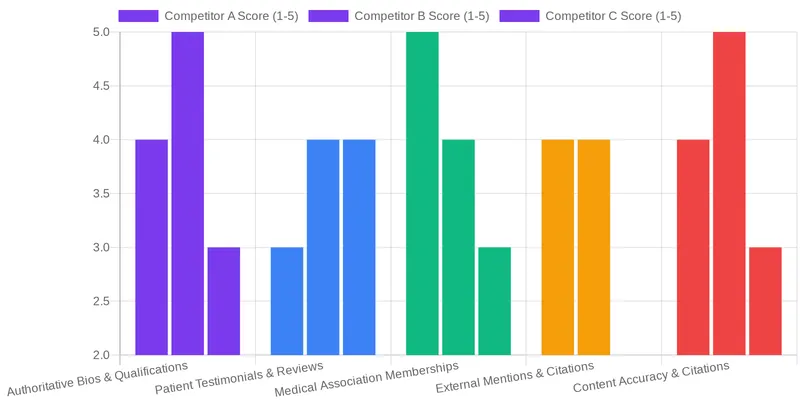
In the YMYL space, E-E-A-T is critical. Benchmark competitor E-E-A-T signals by assessing how they demonstrate credibility. Evaluate their author bios, medical qualifications, patient testimonials, and presence on review platforms. For London clinics, showcasing verifiable expertise and trustworthiness is critical. Analyzing competitors’ “About Us” pages, doctors’ profiles, and engagement with medical associations provides a blueprint for strengthening your E-E-A-T. This is a component of the SEO guide for private healthcare.
Leveraging AI & Automation: From Competitor Data to Actionable Strategy
Abdurrahman Şimşek’s expertise in semantic engineering and data automation transforms competitor data into a strategic advantage for London clinics. Using AI, competitor analysis becomes more efficient and adaptive, moving beyond manual audits to real-time insights.
Automating Competitor Monitoring with Ruxi Data & AI
Ruxi Data, a semantic engine with AI, provides continuous monitoring of competitor SERP movements. This automation identifies trends, flags new content, and tracks ranking shifts in real-time. Clinics receive ongoing, data-driven insights, allowing adaptation to market changes and helping scale content production without compromising E-E-A-T. Explore competitor monitoring automation.
Reverse-Engineering Success: Building Your Semantic Content Network
Insights from competitor analysis, particularly semantic gaps and EAV modeling, are used to design an ‘algorithm-proof’ semantic content network. Understanding how competitors structure their information helps build a content architecture that demonstrates topical authority. This methodology, central to Abdurrahman Şimşek’s approach, ensures content is semantically structured, making it relevant and understandable to search engines. This is the basis of live competitor analysis with AI.
Transforming Insights into a Winning SEO Strategy for Your Clinic
Translate competitor analysis findings into an actionable SEO strategy. Prioritize identified opportunities and develop a roadmap for growth and differentiation in the London aesthetics market. A strategic blueprint ensures actions are data-informed and aim for measurable results.
Prioritizing Opportunities: From Gaps to Growth
Prioritize identified keyword, content, and semantic gaps based on potential impact and feasibility. Create a roadmap for new content, on-page optimization, and targeted link building. Focus on areas where competitors are weak or your clinic is strong. This blueprint for plastic surgery SEO ensures resources are allocated for organic growth and patient acquisition. Refer to the plastic surgery SEO blueprint.
Ready to Outrank Your London Aesthetics Competitors?
The London aesthetics market requires a strategic approach to SEO. Understanding rivals’ digital footprints through competitor analysis is necessary to achieve a leading position. Using semantic SEO techniques and data-driven insights, your clinic can build a strong online presence and attract high-value patients.
Conclusion
Competitor analysis is foundational to SEO strategy in the London aesthetics market. Examining the keyword profiles, content architecture, backlink strategies, and E-E-A-T signals of top clinics provides actionable insights. Using semantic SEO and automation tools like Ruxi Data transforms these insights into a roadmap for building topical authority and optimizing for Google’s Cost of Retrieval. This approach helps your clinic dominate organic search and attract patients. Book a Semantic SEO Audit or connect via WhatsApp Strategy Line: +90 506 206 86 86.
Frequently Asked Questions
What is the first step in analyzing competitor seo strategies?
The first step is to identify your true SERP competitors, not just the clinics you know of. Search for your main target keywords and analyze the top 5-10 ranking domains. These are your primary digital competitors whose strategies you need to deconstruct.
What can a competitor’s backlink profile tell me about their digital approach?
Analyzing a competitor’s backlinks reveals their digital PR and authority-building strategy. It shows which high-authority medical journals, news outlets, or directories are linking to them, providing a roadmap for your own link-building and outreach efforts.
How does a ‘keyword gap’ analysis help improve my clinic’s search visibility?
A keyword gap analysis identifies valuable keywords your competitors are ranking for, but you are not. This is a highly efficient way to discover new content opportunities and patient queries you may have overlooked, allowing your clinic to capture more market share.
Beyond keywords, what other aspects of competitor seo strategies should I analyze?
Look at their on-page SEO, website structure, and technical performance. Analyze their use of schema markup, site speed (Core Web Vitals), and how they structure their service pages. These technical elements are often key differentiators in competitive rankings.
How often should I perform a deep analysis of competitor seo strategies?
A deep analysis of competitor seo strategies should be done quarterly to capture significant market shifts. However, automated monitoring tools can track their keyword movements, new content, and backlinks on a weekly or daily basis to help you stay ahead of market changes.
How can I get started with a professional analysis of my London aesthetics competitors?
Abdurrahman Şimşek offers a Semantic SEO Audit specifically for London clinics. You can book a comprehensive audit to deconstruct your rivals’ digital footprints and build an algorithm-proof strategy. Alternatively, reach out directly via WhatsApp for a strategy discussion.
Ruxi Data brings together multi-model AI, automated website crawling, live indexation checks, topical authority mapping, E-E-A-T enrichment, schema generation, and full pipeline automation — from crawl to WordPress publish to social posting — all in one platform built for agencies and freelancers who run on results.