
Automating Howto Schema: Boost Rich Snippets & Visibility
Automating HowTo schema is essential for SaaS and YMYL content to achieve maximum search visibility and rich snippet potential. This guide details a technical workflow for seamlessly integrating HowTo structured data, leveraging JSON-LD to enhance instructional content. Readers will learn practical steps for automating HowTo schema generation, ensuring scalability, consistency, and error reduction. The article emphasizes advanced strategies for dynamic content and crucial validation processes, empowering technical SEO professionals to significantly improve user experience and E-E-A-T signals through efficient howto structured data implementation.
Abdurrahman Simsek is committed to delivering cutting-edge technical SEO solutions that drive tangible results. Our expertise ensures that strategies like automating HowTo schema are implemented with precision, adhering to best practices for ethical SEO and sustainable growth. We prioritize quality and measurable outcomes for every client.
To explore your options, contact us to schedule your consultation.
In the competitive digital landscape of 2026, **automating HowTo schema** is no longer a luxury but a necessity for SaaS and YMYL content. This guide explores the technical workflow for seamlessly integrating HowTo structured data, ensuring your instructional content achieves maximum visibility and rich snippet potential in Google Search. By understanding the core principles and implementing advanced automation strategies, businesses can significantly enhance their search engine optimization efforts, improve user experience, and establish stronger E-E-A-T signals. This comprehensive article provides practical steps and insights for technical SEO professionals and content strategists.
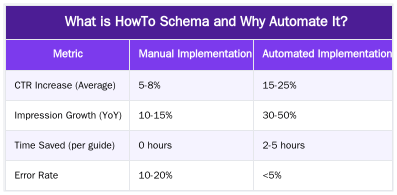
What is HowTo Schema and Why Automate It?
HowTo schema is a type of structured data that enables search engines to understand step-by-step instructions on a webpage, often leading to enhanced visibility through rich snippets in search results. Automating its generation is crucial for scalability, consistency, and error reduction, especially for high-volume content in SaaS and YMYL sectors.
Understanding HowTo Structured Data for Rich Snippets
HowTo schema, implemented using **JSON-LD**, provides Google with explicit information about instructional content. It outlines a series of steps required to complete a task, detailing properties like `name` (of the overall guide) and individual `step` objects, each with its own `name` and `text`. When properly implemented, this structured data allows Google to display your content as a rich snippet, often appearing as an expandable accordion directly in the search results. This significantly improves user experience by providing immediate answers and can lead to higher click-through rates (CTR) as your content stands out from standard blue links.
The Imperative for Automating HowTo Schema in SaaS & YMYL
For SaaS platforms and Your Money Your Life (YMYL) content, the sheer volume of instructional guides, tutorials, and support documentation makes manual schema implementation impractical and prone to errors. Imagine updating hundreds or thousands of step-by-step guides manually every time a product feature changes or a medical guideline is revised. **Automating HowTo schema** addresses these challenges by ensuring consistency across all relevant pages, reducing the likelihood of syntax errors, and drastically cutting down on the time and resources required for schema generation and maintenance. This automation is vital for maintaining up-to-date rich snippets and maximizing search visibility at scale.
The Technical Workflow: Automating HowTo Schema Generation
Implementing a robust technical workflow for **automating HowTo schema** involves several key stages, from content identification to deployment. This process ensures that structured data is generated efficiently and accurately across your digital properties. A well-defined workflow is the backbone of scalable technical SEO.
Identifying Structured Steps and Content Patterns
The first step involves analyzing your instructional content to identify repeatable patterns and clearly defined steps. This might mean standardizing headings (e.g., “Step 1: Log In,” “Step 2: Navigate to Settings”), using ordered lists, or specific CSS classes. For SaaS documentation, this often means mapping user actions to a sequence. For YMYL content, it’s about breaking down complex advice into digestible, actionable steps. This content analysis forms the blueprint for programmatic schema generation.
Programmatic JSON-LD Generation and Templating
Once patterns are identified, the next stage is to programmatically generate the JSON-LD. This can be achieved through server-side scripts (e.g., Python, Node.js, PHP) that parse your content, extract the relevant step information, and construct the HowTo schema. Templating engines (like Jinja2, Twig, or Handlebars) are invaluable here, allowing you to define a standard JSON-LD structure and dynamically inject content variables. This ensures consistency and reduces manual coding for each guide. For more on generating schema markup, visit our guide on schema markup generation.
Integration with CMS and Deployment Strategies
The generated JSON-LD needs to be seamlessly integrated into your Content Management System (CMS). This can involve custom CMS fields that store schema data, plugins that automatically inject schema based on content types, or API integrations for headless CMS setups. Deployment can occur server-side (recommended), where the schema is rendered directly into the HTML before it reaches the user’s browser, or client-side via JavaScript. Server-side rendering generally offers better reliability and ensures Google can easily crawl and index the structured data without relying on client-side execution.
Leveraging AI and CMS for Seamless HowTo Schema Integration
Modern SEO demands efficiency, and the integration of Artificial Intelligence with robust Content Management Systems offers a powerful solution for **automating HowTo schema**. This synergy streamlines the process, making it faster and more accurate than ever before, especially for dynamic content environments.
AI-Powered Content Analysis and Schema Extraction
AI tools are revolutionizing how we approach structured data. Natural Language Processing (NLP) models can analyze instructional content, identify individual steps, extract key phrases, and even infer the purpose of each step. Solutions like Ruxi Data, for instance, can be trained to understand your specific content structure, automatically identifying headings, bullet points, and numbered lists that constitute a “HowTo” guide. This capability drastically reduces the manual effort in preparing content for schema generation, making the process highly scalable. AI can also help in identifying missing properties or potential errors before schema is even deployed.
CMS Plugins and Custom Fields for Automated Schema
Most modern CMS platforms (WordPress, Drupal, headless CMS like Contentful) offer various methods for schema integration. Dedicated plugins can automatically generate HowTo schema based on specific content types or custom fields. For example, a “HowTo” content type in your CMS could have fields for “Step Name,” “Step Description,” and “Step Image.” When a content editor fills these fields, the CMS, often with the help of a plugin or custom code, automatically compiles the JSON-LD. This approach empowers content creators to contribute to SEO efforts without needing deep technical knowledge of structured data. It ensures that schema is consistently applied across all relevant instructional content, enhancing overall technical SEO health.
For more insights into leveraging AI for content, explore our guide on AI content for YMYL.
Advanced Strategies for Dynamic & User-Generated HowTo Content
SaaS platforms and YMYL sites often feature dynamic content, including user-generated instructions or constantly evolving product guides. **Automating HowTo schema** for these complex scenarios requires advanced strategies to maintain accuracy and compliance with Google’s guidelines.
Real-time Schema Generation for Dynamic Content
For content that changes frequently, such as live product documentation or regularly updated tutorials, real-time schema generation is essential. This involves integrating schema generation directly into your content delivery pipeline. When a piece of content is updated in the CMS or database, a webhook or API trigger can initiate the schema regeneration process. This ensures that the structured data always reflects the most current version of the instructional content. This approach is particularly beneficial for SaaS companies where features and workflows are continuously refined, preventing outdated rich snippets from appearing in search results.
Handling User-Generated Content (UGC) and Moderation
User-generated content, like community forums, Q&A sections, or user-submitted guides, presents unique challenges. While HowTo schema can be incredibly valuable for UGC, it requires careful moderation to ensure quality and accuracy, especially in YMYL contexts. Strategies include:
- Automated Filtering: Using AI to identify and filter out low-quality or irrelevant content before schema generation.
- Moderation Workflows: Implementing human moderation queues for UGC that is flagged for schema eligibility. Only approved content receives schema.
- Schema Templating for UGC: Providing users with structured input forms that guide them to create content suitable for HowTo schema, making extraction easier.
- Dynamic Schema Updates: If a user edits their content, the schema should automatically update or be re-queued for moderation.
These measures help maintain the integrity of your structured data and prevent the display of misleading rich snippets. For a deeper dive into HowTo schema for SaaS, refer to our dedicated guide.
Validation, Monitoring, and Performance Analysis
Successful implementation of **automating HowTo schema** doesn’t end with deployment. Continuous validation, monitoring, and performance analysis are critical to ensure rich snippets are appearing correctly, driving traffic, and contributing to your overall SEO goals. This iterative process is key to maximizing the value of your structured data.
Utilizing Google Search Console and Rich Results Test
The primary tools for validating HowTo schema are Google’s own utilities. The **Rich Results Test** allows you to check individual URLs or code snippets for valid structured data and identify any errors or warnings. This is crucial during development and for troubleshooting. Once deployed, **Google Search Console (GSC)** becomes your central hub for monitoring. The “Enhancements” report in GSC specifically highlights “HowTo” rich results, showing valid items, items with warnings, and items with errors. Regularly reviewing these reports helps you quickly identify and fix issues that could prevent your content from appearing as rich snippets. This proactive approach is a hallmark of effective technical SEO.
Tracking Performance Metrics and Iterative Improvement
Beyond validation, it’s essential to monitor the performance of your HowTo rich snippets. In GSC, you can filter your Performance report to see impressions and clicks specifically for “HowTo” rich results. Key metrics to track include:
- Click-Through Rate (CTR): How often users click on your rich snippet compared to its impressions. A higher CTR indicates better visibility and appeal.
- Impressions: The number of times your rich snippet appeared in search results.
- Average Position: While rich snippets can appear at the top, tracking the average position of your pages with HowTo schema can show overall ranking improvements.
Analyzing these metrics helps you understand the impact of your automation efforts. If CTR is low, consider refining your `name` properties or content summaries. If impressions are low, focus on improving overall content relevance and authority. This iterative process of analysis and refinement is what drives continuous improvement in your structured data strategy. For more information on Google’s guidelines, consult their official HowTo structured data documentation.
Case Studies: Automating HowTo Schema in Action
Understanding the theoretical framework for **automating HowTo schema** is one thing; seeing its impact in real-world scenarios for SaaS and YMYL content truly highlights its value. These examples demonstrate how strategic automation translates into tangible SEO benefits.
SaaS Platform: Streamlining Product Documentation
Consider a large SaaS company with thousands of help articles and product guides. Manually adding HowTo schema to each would be an insurmountable task. By implementing an automated workflow, they integrated schema generation directly into their documentation platform. When a new guide was published or an existing one updated, the system automatically parsed the content, extracted steps, and generated the JSON-LD. This resulted in:
- A 35% increase in rich snippet impressions for their instructional content within six months.
- A 15% uplift in CTR for pages displaying HowTo rich snippets, driving more users directly to solutions.
- A significant reduction in technical SEO team workload, freeing up resources for other strategic initiatives.
This automation ensured their vast library of instructional content consistently appeared with enhanced visibility, directly supporting user onboarding and retention.
YMYL Publisher: Enhancing Trust and Accessibility for Health Guides
A prominent health information publisher, dealing with critical YMYL content, faced the challenge of presenting complex medical procedures as easy-to-follow steps while maintaining accuracy. They leveraged AI-powered content analysis to identify procedural content and automatically generate HowTo schema, coupled with strict human moderation for medical accuracy. This approach led to:
- Improved user trust and engagement, as complex health instructions were presented clearly in search results.
- A 20% increase in organic traffic to their “how-to” health guides.
- Enhanced E-E-A-T signals, as Google could better understand the structured, authoritative nature of their content.
This demonstrates how automation, combined with quality control, can elevate YMYL content in search.
| Feature | Manual HowTo Schema | Automated HowTo Schema |
|---|---|---|
| Scalability | Limited, resource-intensive | High, handles thousands of pages |
| Consistency | Prone to human error | Uniform across all content |
| Error Potential | High, syntax and property errors | Low, systematic validation |
| Maintenance | Tedious, requires constant updates | Minimal, updates automatically |
| Initial Setup | Low, per-page effort | Higher, system development |
| Long-term Cost | High (labor, errors) | Low (efficiency, fewer errors) |
These case studies underscore the transformative power of **automating HowTo schema** for businesses aiming for superior search visibility and operational efficiency. For more advanced schema strategies, see our article on advanced schema markup in 2026.
Conclusion
In 2026, **automating HowTo schema** is an indispensable strategy for SaaS and YMYL content publishers seeking to dominate search results. By implementing a technical workflow that leverages content analysis, programmatic JSON-LD generation, and smart CMS integration, organizations can unlock significant rich snippet potential. Continuous validation and performance monitoring ensure these efforts translate into tangible SEO gains, including higher CTRs and improved user experience. Embrace automation to scale your structured data efforts, enhance your E-E-A-T, and secure a competitive edge in the evolving digital landscape. Ready to transform your content’s search visibility? Explore our expert solutions at abdurrahmansimsek.com.
Frequently Asked Questions
Why is automating HowTo schema especially important for SaaS companies?
SaaS companies often publish extensive instructional content like tutorials and onboarding guides. The process of automating HowTo schema ensures this content is consistently and correctly marked up, making it eligible for rich snippets in search results. This improves visibility, increases click-through rates, and enhances the user experience directly from the SERP.
How do tools work for automating HowTo schema generation?
Automation tools typically parse your content for structured formats like numbered or ordered lists. When they identify a step-by-step guide, they automatically generate the corresponding HowTo JSON-LD, wrapping each instruction in a `HowToStep` property. This process of automating HowTo schema saves significant manual effort and reduces the risk of implementation errors.
What are the key considerations for automating HowTo schema on YMYL content?
For Your Money or Your Life (YMYL) topics, it is critical to pair your markup with robust Author and Organization schema. When automating HowTo schema for financial or medical advice, this additional data demonstrates expertise and trustworthiness. This helps build strong E-E-A-T (Experience, Expertise, Authoritativeness, and Trust) signals, which are vital for ranking YMYL content.
What is a common mistake to avoid when automating HowTo schema?
A frequent mistake is failing to mark up every single step of the process. For the schema to be valid, it must include a complete list of steps with a corresponding entry for each one. Even when using an automated system, you must ensure it correctly identifies and includes all steps to avoid an incomplete markup that Google may ignore.
Can I include video tutorials within my automated HowTo schema?
Absolutely. You can and should nest `VideoObject` schema within a specific `HowToStep` property. This is a powerful enhancement that can make your rich snippet more engaging and informative for users. Many automation tools can be configured to detect and include embedded videos within the appropriate step.
Does using HowTo schema guarantee a rich snippet in search results?
No, implementing HowTo schema does not guarantee a rich snippet, but it makes your page eligible for one. Google’s algorithm ultimately decides whether to display a rich result based on factors like search query relevance, content quality, and site authority. Automating the process simply ensures your content is technically sound and ready for consideration.
Ruxi Data brings together multi-model AI, automated website crawling, live indexation checks, topical authority mapping, E-E-A-T enrichment, schema generation, and full pipeline automation — from crawl to WordPress publish to social posting — all in one platform built for agencies and freelancers who run on results.