
Automated Topic Cluster Workflow: Streamlining Topical Authority for SEO
The automated topic cluster workflow is presented as a strategic method for building dominant topical authority. This approach streamlines content creation, internal linking, and semantic optimization, allowing websites to efficiently cover entire topics. It leverages automation to identify subtopics, generate content outlines, and establish a robust content silo structure, enhancing topical relevance and signaling comprehensive expertise to search engines. By reducing manual effort in content gap analysis and internal linking, this workflow accelerates the deployment of a cohesive semantic content network, driving organic traffic and improving visibility.
This content, guided by the principles of Abdurrahman Şimşek, a Semantic SEO Strategist, emphasizes advanced strategies for semantic engineering and E-E-A-T. It provides actionable insights into leveraging automation for enhanced content architecture and sustained topical relevance in competitive digital environments.
To explore your options, contact us to schedule your consultation. You can also reach us via: Book a Semantic SEO Audit (Link: https://abdurrahmansimsek.com/contact/), Direct WhatsApp Strategy Line: +90 506 206 86 86, Hire as Semantic SEO Architect (Link: https://abdurrahmansimsek.com/contact/)
In the competitive digital landscape of 2026, building dominant topical authority is paramount for SEO success. This article explores the power of an automated topic cluster workflow, a strategic approach that streamlines content creation, internal linking, and semantic optimization to establish your website as an undeniable authority in your niche. Understanding and implementing such a workflow allows businesses to efficiently map and cover entire topics, signaling comprehensive expertise to search engines. This method enhances visibility and drives organic traffic by optimizing for how modern search algorithms interpret content relevance and depth.
What are Topic Clusters and How Does Automation Enhance Them?
Topic clusters are an SEO strategy where a central “pillar page” broadly covers a core subject, supported by multiple “cluster content” articles that delve into specific subtopics. These cluster articles link back to the pillar page, and the pillar page links to them, creating a robust internal linking structure. This architecture signals comprehensive topical relevance to search engines, demonstrating deep expertise. Automation enhances this by streamlining the identification, creation, and linking of these content pieces, significantly reducing manual effort and accelerating the establishment of topical authority.
Traditionally, building a content silo required extensive manual research, keyword mapping, content creation, and meticulous internal linking. An automated approach leverages advanced algorithms and machine learning to perform these tasks at scale. This includes identifying relevant subtopics, generating content outlines, and even drafting initial content pieces. The goal is to create a cohesive semantic content network that covers a topic exhaustively, ensuring that search engines recognize the website as a definitive source of information.
The efficiency gained through automation allows for faster content deployment and broader topical coverage. This is particularly beneficial for competitive niches where establishing authority quickly is crucial. By automating repetitive tasks, content strategists can focus on refining the semantic depth and quality of the output, ensuring alignment with user intent and search engine guidelines.
The Strategic Benefits of an Automated Topic Cluster Workflow for SEO
Implementing an automated topic cluster workflow offers several strategic advantages for SEO performance. Firstly, it significantly improves topical relevance. By systematically covering a subject from multiple angles, websites demonstrate a comprehensive understanding, which search engines reward with higher rankings. This structured approach helps build a strong knowledge graph around your core topics.
Secondly, this workflow enhances internal linking, a critical factor for distributing link equity and guiding search engine crawlers. Automated systems ensure that relevant cluster content is consistently linked to its pillar page, strengthening the overall content silo architecture. This not only boosts the authority of individual pages but also improves the discoverability of new content.
Thirdly, an automated content strategy can lead to a reduction in the Search Engine Cost of Retrieval (CoR). When a website’s content is highly organized and semantically rich, search engines expend less computational effort to understand its relevance and context. This efficiency can translate into improved crawl rates, better indexing, and ultimately, higher organic visibility. For specialized sectors like medical clinics, where information accuracy and authority are paramount, minimizing CoR ensures that critical health information is easily accessible and correctly interpreted by search algorithms.
Finally, the scalability of an automated system allows businesses to expand their content footprint rapidly. Instead of manually planning and executing each piece of content, the workflow can generate numerous articles based on a single seed topic, covering a vast array of related queries and long-tail keywords. This broad coverage captures a wider audience and solidifies the website’s position as a go-to resource.
How an Automated Topic Cluster Workflow Functions: A Step-by-Step Guide
An effective automated topic cluster workflow typically follows a structured sequence, leveraging technology at each stage. The process begins with seed keyword identification. This involves selecting a broad, high-value keyword representing a core service or topic. For a plastic surgeon, this might be “rhinoplasty procedures” or “breast augmentation London.”
-
SERP Analysis and Topic Mapping: Automated tools analyze the Search Engine Results Pages (SERPs) for the seed keyword. They identify related entities, common questions, competitor content structures, and semantic gaps. This data is used to generate a comprehensive topic map, outlining potential pillar pages and numerous supporting cluster content ideas. This step often involves advanced natural language processing (NLP) to understand the nuances of user intent.
-
Content Outline Generation: Based on the topic map, the workflow automatically creates detailed content outlines for both pillar and cluster articles. These outlines include suggested headings, subheadings, key points, and entities to cover, ensuring semantic depth and relevance. This stage leverages insights from content gap analysis to ensure unique value.
-
Content Drafting and Optimization: AI-powered content generation tools draft initial versions of the articles, adhering to the generated outlines. These drafts are then optimized for semantic SEO, incorporating related keywords, entities, and answering common user queries. Human oversight remains crucial here for factual accuracy, tone, and brand voice, especially in YMYL (Your Money Your Life) sectors.
-
Programmatic Internal Linking: This is a core component of the automated topic cluster workflow. Once content is drafted, the system identifies relevant internal pages and automatically suggests or implements links between cluster content and pillar pages, and between related cluster articles. This ensures a robust internal linking strategy, distributing authority and improving crawlability. More details on this can be found at automated internal linking workflow.
-
Publishing and Monitoring: The final, human-reviewed content is published. The workflow then continuously monitors performance, tracking rankings, traffic, and user engagement. This data feeds back into the system, allowing for iterative improvements and identification of new content opportunities.
Semantic Engineering and E-E-A-T in Automated Content Architecture
Beyond mere automation, the integration of semantic engineering is critical for building truly authoritative content networks, particularly in YMYL niches like medical and aesthetic surgery. As a Semantic SEO Strategist, Abdurrahman Şimşek emphasizes that semantic engineering focuses on structuring content to explicitly communicate meaning and relationships between entities, aligning with how search engines build their knowledge graphs. This is not just about keywords; it is about conceptual understanding.
For medical clinics and plastic surgeons in London, establishing E-E-A-T (Experience, Expertise, Authoritativeness, Trustworthiness) is non-negotiable. An automated topic cluster workflow, when guided by semantic engineering principles, can significantly bolster E-E-A-T signals. This involves ensuring that content accurately reflects clinical expertise, cites authoritative sources, and uses precise medical terminology. For example, Ruxi Data, a semantic engine, plays a pivotal role in automating the Entity-Attribute-Value (EAV) modeling for surgical procedures, ensuring that every piece of content contributes to a coherent and verifiable knowledge base. This infrastructure is designed to reduce the Search Engine Cost of Retrieval (CoR) by presenting information in a highly structured and unambiguous format.
The role of a Semantic Engineer is to design the content architecture so that automated processes generate content that is not only relevant but also deeply understood by search algorithms. This includes configuring systems to prioritize factual accuracy, integrate specialized schema markup (like MedicalBusiness and Physician JSON-LD), and ensure compliance with data security standards such as GDPR and HIPAA. For instance, a detailed understanding of medical terminology and patient journey mapping, as outlined by organizations like the World Health Organization, is embedded into the automated content generation parameters.
This specialized approach ensures that content for aesthetic practices, particularly those in areas like Harley Street, achieves dominant topical authority by demonstrating verifiable expertise and trustworthiness, which is crucial for patient confidence and search engine recognition.
Best Practices for Implementing an Automated Topic Cluster Workflow
Successful implementation of an automated topic cluster workflow requires adherence to several best practices. Firstly, human oversight and quality control are paramount. While automation streamlines content generation, human editors must review and refine content for accuracy, tone, and brand consistency, especially for sensitive topics in healthcare. This ensures that the content maintains a high standard of E-E-A-T.
Secondly, continuous SERP analysis and adaptation are essential. Search engine algorithms and user intent evolve. The automated system should be regularly updated with fresh SERP data to identify new content opportunities, adjust existing content, and maintain topical relevance. This iterative process ensures the content network remains competitive and effective.
Thirdly, strategic internal linking must be a core component. Beyond simple links, the automated system should identify semantically relevant connections between pages, using diverse and natural anchor text. This strengthens the content silo and improves the flow of authority across the site. For advanced strategies, consider reviewing content silo architecture guide.
Fourthly, focus on user experience (UX). Automated content should still be readable, engaging, and easy to navigate. This includes optimizing for core web vitals, mobile responsiveness, and clear calls to action. A positive user experience signals quality to search engines and encourages longer dwell times.
Finally, integrate with existing SEO tools and analytics. Connecting the automated workflow with tools for keyword research, rank tracking, and analytics provides a holistic view of performance. This data-driven approach allows for precise adjustments and demonstrates the return on investment (ROI) of the automation efforts.
Tools and Technologies Powering Automated Content Silos
The efficacy of an automated topic cluster workflow relies heavily on the sophisticated tools and technologies employed. These range from advanced AI content generators to specialized semantic engines and robust SEO platforms. Understanding these components is key to building a scalable and effective content strategy.
At the core are AI-powered content generation platforms that leverage large language models (LLMs) to draft articles, summaries, and outlines. These tools can process vast amounts of data, understand context, and generate human-like text at scale. They are often integrated with semantic analysis tools that identify entities, relationships, and topical gaps within existing content and competitor landscapes.
For specialized applications, semantic engines like Ruxi Data provide a critical layer of intelligence. These systems go beyond keyword matching to understand the true meaning and context of content, enabling precise EAV modeling and optimizing for Search Engine Cost of Retrieval. They are instrumental in building highly structured and authoritative content networks, especially for complex, high-stakes information like medical procedures.
Furthermore, SEO platforms with API access facilitate the integration of these automated processes into a unified workflow. These platforms offer features for keyword research, competitor analysis, rank tracking, and site auditing, providing the data necessary to feed and refine the automation. Internal linking automation tools are also crucial, programmatically identifying and implementing relevant links across the content cluster.
The table below illustrates some common categories of tools and their estimated market adoption in 2026, showcasing the growing reliance on automation in content strategy.
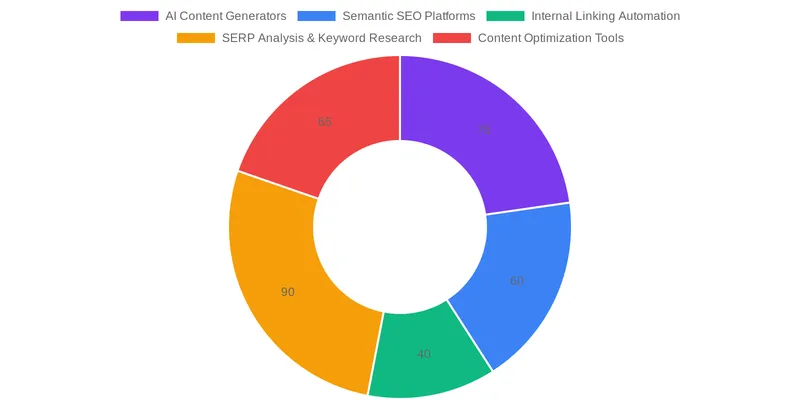
The combination of these technologies creates a powerful ecosystem for scaling content production and achieving superior topical authority.
Measuring Success and Optimizing Your Topical Relevance
Measuring the success of an automated topic cluster workflow involves tracking key performance indicators (KPIs) that reflect both content performance and overall topical authority. This data-driven approach allows for continuous optimization and demonstrates the return on investment. For a deeper dive into ROI, consider measuring topic cluster ROI.
Primary metrics include organic traffic growth to both pillar and cluster pages, keyword rankings for target terms and long-tail variations, and SERP visibility for broad topics. An increase in these areas indicates improved topical relevance and search engine recognition. Beyond traffic, user engagement metrics such as time on page, bounce rate, and conversion rates (e.g., appointment bookings for a medical clinic) provide insights into content quality and user satisfaction.
Another crucial aspect is monitoring internal link performance. Tools can track how link equity flows through the cluster, identifying any broken links or opportunities for further internal linking. This ensures the structural integrity of the content silo. Furthermore, tracking backlink acquisition to pillar pages can indicate external recognition of the site’s authority on a given topic.
Optimization is an ongoing process. This involves regularly performing content gap analysis to identify new subtopics, updating existing content for freshness and accuracy, and refining the automated content generation parameters based on performance data. For YMYL sectors, this also means ensuring that all information remains current with medical guidelines and expert consensus, reinforcing E-E-A-T.
The table below outlines key aspects of manual versus automated content strategy, highlighting the benefits of an automated approach in measurement and optimization.
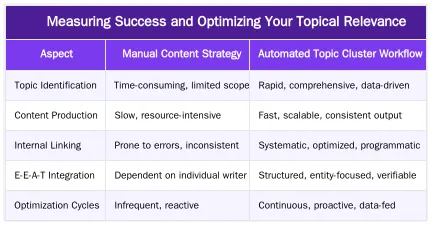
By systematically measuring and optimizing these factors, businesses can ensure their automated content strategy continues to deliver strong SEO results and build enduring topical authority.
Conclusion
An automated topic cluster workflow represents a significant evolution in SEO strategy for 2026, enabling businesses to build dominant topical authority with efficiency and precision. By leveraging semantic engineering and advanced automation, organizations can create comprehensive content networks that not only rank highly but also establish deep expertise and trustworthiness with search engines and users alike. This approach is particularly transformative for specialized sectors like medical clinics and plastic surgeons, where E-E-A-T is paramount. Embracing this strategic shift allows for scalable content production, optimized internal linking, and a measurable reduction in search engine cost of retrieval, ultimately driving sustainable organic growth. To explore how an automated topic cluster workflow can transform your digital presence, consider a specialized consultation.
Ready to elevate your online authority? Book a Semantic SEO Audit today. For direct strategic insights, connect via WhatsApp: +90 506 206 86 86. To implement a robust semantic content network, Hire as Semantic SEO Architect.
Frequently Asked Questions
How does Ruxi Data automate the creation of an entire topic cluster?
Our automated topic cluster workflow begins with a single seed keyword, leveraging AI for deep SERP analysis. This identifies the main pillar page topic and all related subtopics for comprehensive cluster content. The system then generates all necessary articles and programmatically establishes the correct internal linking structure between the pillar and its supporting clusters, ensuring semantic coherence.
Can I define the pillar and cluster topics myself?
Yes, you retain complete control over the content strategy. You can either allow our AI to discover the optimal topic cluster structure based on live SERP data, or you can provide your own pre-defined list of pillar and cluster page topics for the system to generate and link according to your specific vision.
How does the automated internal linking work within the cluster?
The system meticulously ensures every cluster page links contextually up to the central pillar page. It also intelligently identifies opportunities for relevant contextual links between related cluster pages, creating a tightly-knit, semantically-related content hub that search engines can easily understand and value for its depth.
What are the strategic benefits of using an automated topic cluster workflow for SEO?
Implementing an automated topic cluster workflow significantly enhances topical authority by efficiently covering entire subjects. This approach streamlines content creation, ensures robust internal linking, and optimizes for semantic relevance, signaling comprehensive expertise to search engines. It ultimately improves visibility, drives organic traffic, and positions your website as an undeniable authority in your niche.
How long does it take to build and publish a complete topic cluster with this workflow?
What would typically demand weeks or months from a traditional content team can be accomplished in a matter of hours with this efficient process. Depending on the size and complexity of the cluster, such as a pillar with 15 supporting pages, the entire process from research to generation and publishing can be completed in a single day using the automated topic cluster workflow.
How can I implement an automated topic cluster workflow for my business?
Abdurrahman Şimşek specializes in deploying these advanced semantic strategies. To explore how this workflow can transform your topical authority and SEO performance, you can book a Semantic SEO Audit. Alternatively, for direct strategic guidance, reach out via our WhatsApp Strategy Line at +90 506 206 86 86.
Ruxi Data brings together multi-model AI, automated website crawling, live indexation checks, topical authority mapping, E-E-A-T enrichment, schema generation, and full pipeline automation — from crawl to WordPress publish to social posting — all in one platform built for agencies and freelancers who run on results.