Automated Internal Linking: Enhancing Medical Knowledge Bases
Automated internal linking transforms how medical knowledge bases, especially for plastic surgery and aesthetic clinics, manage extensive content. This programmatic approach builds robust content networks, enhancing topical authority and improving patient acquisition. The article details how automated systems establish semantic relationships, distribute link equity, and optimize for search engines. It highlights the strategic application for London-based private healthcare providers to achieve digital dominance and better user experience, ensuring efficient content management and improved search visibility.
Abdurrahman Şimşek, a Semantic SEO Strategist, specializes in building high-authority Semantic Content Networks for medical clinics. His expertise in semantic engineering and Ruxi Data integration provides advanced strategies for optimizing complex medical knowledge bases, ensuring robust topical authority and improved search performance.
To explore your options, contact us to schedule your consultation.
Implementing automated internal linking can transform how medical knowledge bases, particularly for plastic surgery and aesthetic clinics, manage their vast content. This programmatic approach creates a robust, algorithm-proof content network, enhancing topical authority and improving patient acquisition. Understanding its mechanics and strategic application is crucial for London-based private healthcare providers aiming to optimize their digital presence in 2026. This guide explores how automated systems build semantic relationships, distribute link equity, and ultimately drive better SEO performance and user experience.
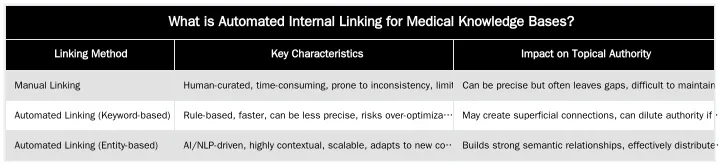
What is Automated Internal Linking for Medical Knowledge Bases?
Automated internal linking is the programmatic process of creating contextual links between related pages on a website, driven by semantic analysis. For medical knowledge bases, this means intelligently connecting articles about specific procedures, conditions, or treatments to other relevant content within the same site. This system improves navigation, distributes link equity, and enhances topical authority, which is vital for YMYL (Your Money Your Life) content.
The Challenge of Scaling Internal Links in Healthcare Content
Medical websites, especially those for plastic surgery and aesthetic clinics, often feature extensive and constantly evolving knowledge bases. Manually adding and maintaining internal links across hundreds or thousands of pages becomes impractical. New content requires revisiting old articles, and outdated links can lead to poor user experience and diluted SEO value. Scalable solutions are essential to manage this complexity efficiently.
Core Benefits: Enhancing User Experience and Search Engine Understanding
Automated links streamline patient navigation, allowing them to easily discover related information, such as pre-operative instructions linked from a procedure page. This improved user experience reduces bounce rates and increases time on site. For search engines, these links clarify content relationships, signaling comprehensive topical depth and helping algorithms understand the site’s overall structure and authority on medical subjects.
How Automated Systems Build Semantic Relationships and Topical Authority
Automated systems analyze content to identify semantic relationships, distributing link equity and reinforcing topical authority. This process moves beyond simple keyword matching, focusing on entities and their connections. For medical entities, this means creating a robust network that signals expertise and trustworthiness to search engines.
From Keywords to Entities: The Semantic Foundation of Automated Linking
Modern automated systems leverage advanced natural language processing to identify entities within content. Instead of linking based on exact keyword matches, they recognize concepts like “Rhinoplasty,” “Dr. Smith,” or “Harley Street Clinic” as distinct entities. This entity-based understanding allows for more precise and contextually relevant internal links, forming the foundation of a strong semantic SEO for surgeons strategy. This approach is critical for building an algorithm-proof content network.
Distributing Link Equity and Reinforcing Content Silos
Effective internal linking strategically passes “link equity” from authoritative pages to other important content, boosting their visibility. Automated linking facilitates the creation and reinforcement of advanced internal linking automation, solidifying content silos or topic clusters around medical specialties. This structured approach helps search engines understand the hierarchy and depth of information on a site, contributing to overall topical authority.
Leveraging Ruxi Data for Intelligent Medical Internal Linking Automation
Abdurrahman Şimşek, a London-based Semantic SEO Strategist, utilizes Ruxi Data to provide a specialized solution for medical clinics. This platform offers intelligent medical internal linking automation, emphasizing a data-driven approach that enhances E-E-A-T (Experience, Expertise, Authoritativeness, Trustworthiness) signals for YMYL content.
Ruxi Data’s Approach: Analyzing SERPs for Contextual Link Opportunities
Ruxi Data analyzes search engine results pages (SERPs) to understand true user intent and identify optimal contextual linking opportunities within medical content. By examining what Google ranks for specific queries, Ruxi Data identifies the semantic gaps and connections that strengthen a site’s topical relevance. This analysis ensures that automatically generated links are not just relevant, but also align with how search engines perceive and value information. This data-driven insight helps clinics build a more effective content network. Google’s own documentation highlights the importance of understanding search intent for effective content organization.
Building an EAV-Driven Internal Linking Architecture for Precision
Ruxi Data integrates with Entity-Attribute-Value (EAV) models to create highly precise and semantically rich internal links. For YMYL content, where accuracy and detail are paramount, an EAV-driven architecture ensures that links connect specific entities (e.g., “Breast Augmentation”) with their relevant attributes (e.g., “Recovery Time,” “Cost,” “Surgeon Qualifications”). This structured approach helps Google understand the intricate relationships within a medical knowledge base, contributing to a stronger EAV model for surgical procedures and overall E-E-A-T.
Implementing and Optimizing Automated Internal Linking: Best Practices
Implementing an effective automated internal linking strategy requires careful planning and ongoing optimization. This involves setting clear rules, integrating with existing platforms like WordPress, and continuous monitoring to ensure quality and relevance. A well-executed strategy enhances both user experience and search engine visibility.
Setting Rules and Parameters for Scalable Linking Strategies
Defining clear rules is essential for quality and relevance. Parameters can include link frequency (e.g., no more than 3 internal links per paragraph), anchor text variations (to avoid over-optimization), and exclusion lists for pages not suitable for automated linking (e.g., contact pages). Systems can be configured to prioritize linking to cornerstone content or specific service pages. This structured approach ensures that the automated internal linking workflow remains effective and beneficial.
Auditing and Monitoring: Ensuring Quality and Avoiding Pitfalls
Regular audits are crucial to maintain the quality of automatically generated links. Monitor for broken links, irrelevant connections, or instances of over-optimization that could negatively impact SEO. Tools like Google Search Console can help identify crawl errors and indexing issues related to internal links. Adapting the strategy based on performance data ensures continuous improvement. This iterative process is a key component of an automated topic cluster linking workflow. For detailed guidance on monitoring, refer to Google Search Console documentation.
The Impact on SEO Performance and Patient Acquisition for Clinics
A well-implemented automated internal linking strategy delivers tangible results for medical clinics. It improves search engine rankings, strengthens E-E-A-T, and ultimately drives more qualified patient leads. This strategic advantage is particularly significant in competitive markets like London’s private healthcare sector.
Boosting Topical Authority and Reducing ‘Cost of Retrieval’
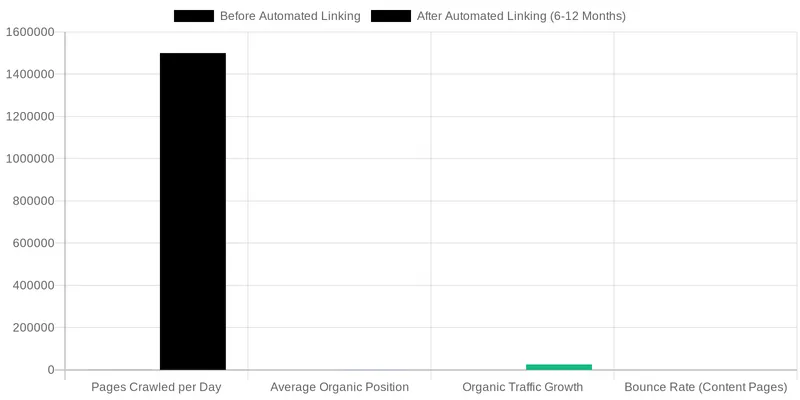
A strong internal link profile signals comprehensive topical authority to Google, indicating that a site is a definitive resource on specific medical subjects. This deep understanding of content relationships also improves crawl efficiency, reducing the “Cost of Retrieval” for complex medical sites. When Googlebot can easily discover and understand all relevant pages, it allocates crawl budget more effectively, leading to better indexing and ranking potential for programmatic SEO efforts.
Future-Proofing Your Medical Website for Generative AI
A semantically rich, well-linked knowledge base is better positioned to be understood and sourced by generative AI models and AI Overviews. These AI systems rely on clear, structured relationships between entities to provide accurate and comprehensive answers. By building a robust internal network, medical clinics ensure their content is easily digestible and attributable by future AI search interfaces, securing their visibility in evolving search landscapes. Understanding how AI processes information is crucial for future-proofing your digital strategy. For more insights, refer to Google’s official blog on generative AI in search.
Ready to Automate Your Medical Knowledge Base’s Internal Linking?
Optimizing internal linking is a cornerstone of advanced SEO, especially for medical knowledge bases. Abdurrahman Şimşek specializes in implementing sophisticated automated internal linking strategies for plastic surgeons and aesthetic clinics in London. Leverage data-driven insights and semantic engineering to build a resilient, high-authority content network. Transform your website’s structure and enhance patient acquisition.
Conclusion
Automated internal linking represents a significant advancement for medical SEO, offering a scalable and precise method to enhance website structure, user experience, and search engine visibility. By leveraging semantic principles and advanced tools like Ruxi Data, clinics can build robust content networks that signal strong topical authority and E-E-A-T. This strategic approach not only improves current SEO performance but also future-proofs medical websites for the evolving landscape of generative AI. To explore how these advanced strategies can benefit your London-based medical practice, visit abdurrahmansimsek.com.
Frequently Asked Questions
How does automated internal linking enhance medical knowledge bases?
Automated internal linking transforms medical knowledge bases by programmatically building a robust content network. It analyzes content for key medical entities, then intelligently connects related articles, distributing link equity and signaling topical authority to search engines. This systematic approach ensures comprehensive coverage and improved discoverability for complex medical topics.
Is automated internal linking more effective than manual methods for large medical sites?
Yes, for extensive medical knowledge bases, automated internal linking is significantly more efficient and precise than manual methods. It ensures no relevant linking opportunities are missed, maintaining a perfectly coherent semantic structure at scale, which is nearly impossible to achieve manually for thousands of pages. This leads to superior SEO performance and content discoverability.
Can an automated internal linking system negatively impact user experience?
A well-designed automated internal linking system, like Ruxi Data’s, prioritizes user experience. It focuses on creating contextually relevant links that genuinely guide users deeper into related medical topics, rather than just linking keywords for SEO. This enhances navigation and helps patients find comprehensive information, improving their journey through your site.
How does this system address common internal linking issues like orphan pages?
This system can effectively identify and resolve existing internal linking problems, such as orphan pages. By mapping all content, it pinpoints pages lacking internal links and then intelligently finds contextual opportunities within existing articles to integrate them, ensuring every piece of valuable medical content is discoverable.
What are the benefits of implementing this linking strategy for London-based medical clinics?
Implementing an intelligent linking strategy offers significant advantages for London-based medical clinics. It enhances your digital presence by building strong topical authority, improving search engine rankings for specialized medical terms, and ultimately driving more qualified patient inquiries and acquisitions. This strategic advantage is crucial in a competitive market like Harley Street.
How can I get started with implementing intelligent internal linking for my clinic?
To explore how intelligent internal linking can benefit your medical practice, you can visit Abdurrahman Şimşek’s website at abdurrahmansimsek.com. We specialize in developing bespoke semantic SEO strategies and implementing advanced content network solutions for clinics in London and beyond.
Ruxi Data brings together multi-model AI, automated website crawling, live indexation checks, topical authority mapping, E-E-A-T enrichment, schema generation, and full pipeline automation — from crawl to WordPress publish to social posting — all in one platform built for agencies and freelancers who run on results.