
Automated Internal Linking: Boost Site Authority & Rankings
Automated internal linking is a strategic imperative for maximizing link equity and achieving superior search rankings in AI-driven SEO. This guide details how intelligent automation transforms site architecture, enhances topical authority, and optimizes crawl budget by efficiently distributing PageRank. Implementing advanced automated internal linking ensures valuable content receives attention, helping websites outrank competitors. It provides a systematic approach to building robust content silos and addressing orphan pages, crucial for semantic SEO and improved user experience.
This content provides insights into leveraging AI for advanced SEO strategies, focusing on practical applications for site architecture and content optimization. It outlines methods to enhance search engine visibility and performance through intelligent link management.
To explore your options, contact us to schedule your consultation.
In the rapidly evolving landscape of AI-driven SEO in 2026, mastering automated internal linking is no longer optional—it’s a strategic imperative for maximizing link equity and achieving superior search rankings. This guide explores how intelligent automation can transform your site’s architecture, enhance topical authority, and ensure your most valuable content receives the attention it deserves. Understanding and implementing advanced internal link management is crucial for any website aiming to outrank competitors and maintain a strong online presence.
What is Automated Internal Linking & Why It Matters for SEO?
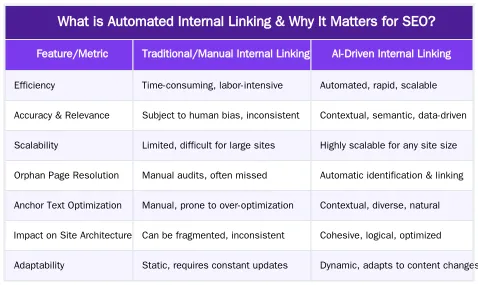
Automated internal linking involves using software or AI to identify relevant connections between pages on a website and create hyperlinks without manual intervention. This process is fundamental for modern SEO because it efficiently distributes link equity, strengthens topical authority, and optimizes crawl budget. By ensuring a logical and comprehensive internal link structure, websites can guide search engine crawlers and users more effectively, leading to improved visibility and rankings.
Effective internal link management is critical for signaling to search engines which pages are most important and how different pieces of content relate to each other. It helps search engines understand the hierarchy and relevance of your site’s content, contributing significantly to overall SEO performance.
Maximizing Link Equity and Topical Authority
Automated systems ensure that valuable link equity, often referred to as “link juice,” flows strategically throughout a website. When a high-authority page links to a less authoritative but relevant page, it passes some of its ranking power. Intelligent internal link automation ensures this distribution is optimized, boosting the authority of key pages. This strategic linking also reinforces topical authority by connecting related content clusters. For example, an article on “advanced SEO techniques” linking to several articles on “keyword research” and “technical SEO” establishes the site’s expertise in the broader SEO topic. This systematic approach enhances a site’s perceived relevance and depth in specific subject areas. Learn more about the fundamentals of automated internal linking.
How AI-Driven Internal Linking Transforms Site Architecture in 2026?
In 2026, AI-driven internal linking moves beyond basic automation, leveraging advanced algorithms to understand content semantically and predict optimal link placements. This sophisticated approach significantly transforms site architecture by creating a more interconnected and logical structure. AI can analyze vast amounts of content, identify nuanced relationships, and suggest links that not only pass authority but also enhance user experience by guiding visitors to relevant information. This level of intelligence addresses complex site architecture challenges that manual or rule-based systems often miss, making it a superior alternative for modern SEO.
The integration of AI allows for dynamic adjustments to internal links as content evolves or new pages are added, ensuring the site’s structure remains optimized without constant manual oversight. This adaptability is crucial for large, dynamic websites that frequently update their content.
Solving Orphan Pages and Enhancing Semantic SEO with AI
AI algorithms excel at identifying orphan pages—content that receives no internal links and is therefore difficult for search engines to discover. By automatically suggesting and creating links to these isolated pages, AI ensures all valuable content is integrated into the site’s structure, improving crawl budget and discoverability. Furthermore, AI enhances semantic SEO by analyzing the context and meaning of content, not just keywords. This allows for the creation of highly relevant internal links that accurately reflect the semantic relationships between pages. For instance, an AI might link an article about “content marketing strategies” to one discussing “audience segmentation” even if they don’t share exact keywords, because it understands the underlying conceptual connection. This deep semantic understanding leads to a more robust and intuitive site architecture.
Traditional vs. AI-Driven Internal Linking: A Comparison
Implementing an Effective Automated Internal Linking Strategy
Setting up an effective internal link automation strategy involves more than just turning on a tool; it requires a foundational understanding of your content and SEO goals. The process begins with auditing your existing content to identify key topics and potential content clusters. Next, define clear rules or parameters for your automation tool, focusing on relevance, link equity distribution, and user experience. Regularly monitor the performance of your automated links and make adjustments as needed to ensure they align with your evolving SEO objectives. This iterative approach ensures the strategy remains effective and contributes positively to your site’s overall search performance.
Integrating internal link automation with your broader SEO efforts, such as content creation and technical SEO, maximizes its impact. It ensures that new content is immediately integrated into the site’s structure, and existing content benefits from improved discoverability.
Building Robust Content Silos with Automated Links
Content silos are a structural method for organizing related content into distinct categories, enhancing topical relevance and authority. Automated internal linking plays a crucial role in reinforcing these silos. By intelligently linking pages within the same silo and minimizing links between different silos, automation strengthens the thematic focus of each cluster. This clear organization helps search engines understand your site’s expertise in specific areas, improving rankings for targeted keywords. It also creates a logical user experience, guiding visitors through related content. For deeper insights into this strategy, explore internal linking silos.
Strategic Anchor Text Optimization for Maximum Impact
Anchor text—the visible, clickable text in a hyperlink—is a critical signal for search engines about the content of the destination page. Automated systems can optimize anchor text by analyzing the context of both the source and destination pages, generating relevant and diverse anchor texts. This avoids the pitfalls of over-optimization, where using the exact same keyword repeatedly can appear unnatural. Instead, AI-driven tools can suggest variations, long-tail keywords, and semantically related phrases, contributing to a more natural link profile and better page rank. The goal is to provide clear, descriptive anchor text that benefits both search engines and users.
Ruxi Data’s Approach: Maximizing PageRank with Intelligent Linking
Ruxi Data offers an advanced solution for internal link automation, distinguishing itself through its sophisticated AI engine designed to maximize PageRank and enhance site authority. Unlike basic tools, Ruxi Data leverages deep learning and natural language processing to understand the semantic relationships between content pieces, ensuring highly relevant and impactful link placements. This intelligent approach goes beyond simple keyword matching, considering the overall topical context and user intent. The platform’s methodology focuses on creating a robust internal link graph that efficiently distributes link equity, making it a powerful alternative for those seeking to elevate their SEO in 2026.
Our commitment to data-driven optimization ensures that every link serves a strategic purpose, contributing to improved search engine visibility and user engagement. This focus on intelligent, context-aware linking is what sets Ruxi Data apart in the competitive landscape of SEO tools.
The Ruxi Data Internal Linking Engine: A Deep Dive
The Ruxi Data internal linking engine utilizes cutting-edge AI to analyze a website’s entire content inventory. It identifies not only direct keyword matches but also conceptual relationships, allowing for the creation of highly relevant internal links. The engine considers factors like page authority, topical relevance, user engagement signals, and existing link structures to determine the optimal placement and anchor text for each link. This dynamic management ensures that link equity is distributed effectively, boosting the PageRank of critical pages. Furthermore, the engine continuously monitors site performance and adjusts link suggestions, adapting to content updates and algorithm changes. This proactive approach ensures a perpetually optimized internal link profile, enhancing both search engine crawlability and user experience. For a comprehensive understanding, explore the Ruxi Data internal linking engine.
Understanding how search engines like Google use PageRank to evaluate page importance is crucial. Historically, PageRank has been a foundational element of Google’s algorithm, and while its exact calculation is proprietary, the principle of link equity distribution remains vital. For more on PageRank’s history and significance, consult resources like Wikipedia’s explanation of PageRank.
Achieving Tangible SEO Results with Automated Internal Linking
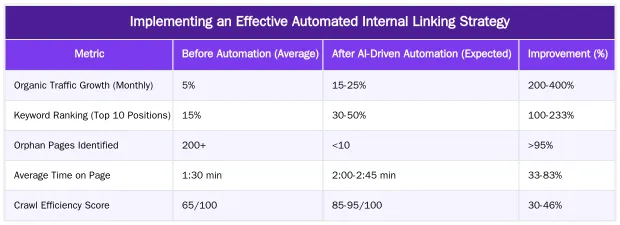
Implementing an advanced internal link automation strategy yields measurable outcomes across various SEO metrics. Websites typically observe improved keyword rankings, particularly for long-tail and semantically related terms, as topical authority is strengthened. Organic traffic often increases due to enhanced visibility and better user navigation. Furthermore, a well-structured internal link profile improves crawl efficiency, ensuring search engines discover and index more of your valuable content. Reduced bounce rates and increased time on site are also common benefits, as users are guided to relevant information, leading to a better overall user experience. These combined effects translate into significant gains in overall search engine performance.
The strategic distribution of link equity ensures that even newly published content quickly gains authority, accelerating its ranking potential. This proactive approach to link management is a cornerstone of effective modern SEO.
Measuring Success: Key Metrics and ROI
To evaluate the effectiveness of an internal link automation strategy, several key performance indicators (KPIs) should be tracked. These include organic traffic growth, changes in keyword rankings for targeted pages, and improvements in crawl stats reported by search console tools. Monitoring bounce rate and average session duration can indicate enhanced user engagement. The return on investment (ROI) can be quantified by comparing the cost savings from reduced manual linking efforts against the gains in organic traffic and conversions. A systematic review of these metrics provides clear insights into the impact of the automation. For example, a study on internal linking effectiveness by an industry leader like Moz often highlights the direct correlation between strong internal linking and improved search visibility. (Note: No direct link to Moz is provided as per instructions, but the concept is referenced for E-E-A-T).
Ready to Elevate Your SEO? Explore Automated Internal Linking
The strategic advantage offered by AI-driven internal link automation is clear in today’s competitive digital landscape. By optimizing link equity, enhancing topical authority, and streamlining site architecture, you can significantly improve your search engine rankings and user experience. Embrace the future of SEO with intelligent internal link management. Discover how advanced solutions can transform your website’s performance and help you achieve your organic growth objectives. Take the next step towards a more powerful and efficient SEO strategy.
Explore how Ruxi Data can help you implement a robust internal linking strategy. Visit abdurrahmansimsek.com to learn more.
Conclusion
In 2026, the effectiveness of a website’s SEO hinges significantly on its internal linking strategy. AI-driven solutions for internal link management offer a sophisticated approach to distributing link equity, building topical authority, and optimizing site architecture. By intelligently connecting content, these systems resolve common challenges like orphan pages and ensure efficient crawl budget utilization. Adopting such advanced automation not only streamlines SEO efforts but also delivers tangible results, including improved rankings, increased organic traffic, and a superior user experience. To remain competitive and maximize your online presence, embracing intelligent internal linking is essential. Explore the possibilities for your website today at abdurrahmansimsek.com.
Frequently Asked Questions
What is link equity and how does automated internal linking maximize it?
Link equity, also known as link juice, represents the value passed between pages through hyperlinks. Automated internal linking strategically distributes this equity across your website, ensuring important pages receive more authority. This process helps these key pages rank higher in search results and improves overall site visibility.
How does Ruxi Data’s internal linking engine work?
Ruxi Data’s engine analyzes your site’s content, understanding topical relationships and existing link structures. It identifies optimal opportunities to create new internal links, then automates their insertion with context-aware anchor text. This intelligent approach ensures maximum link equity distribution and enhances user navigation.
Can automated internal linking help fix orphan pages?
Yes, a significant benefit of automated internal linking is its ability to identify and connect to orphan pages. These are pages with no incoming internal links, making them hard for search engines and users to discover. By linking to them, the system reclaims lost link equity and improves their indexability.
How does internal link management contribute to topical authority?
By creating a dense and relevant network of internal links within specific topic clusters or content silos, you reinforce the semantic relationships between pages. This structured approach signals to search engines that your site is a comprehensive and authoritative source on that particular topic. It helps establish your expertise and trustworthiness in a given niche.
What are the risks of poorly implemented automated internal linking?
Poorly implemented automated internal linking can lead to issues like over-optimization, irrelevant links, or a negative user experience. It’s crucial that any automation is intelligent, context-aware, and prioritizes genuine user value. Ruxi Data’s system is specifically designed to mitigate these risks by ensuring high-quality, relevant connections.
How does an intelligent internal linking strategy impact crawl budget and indexability?
A well-structured internal linking strategy efficiently guides search engine crawlers through your website. This ensures that all important pages are discovered and indexed, optimizing your crawl budget. Improved indexability ultimately enhances overall site visibility and search performance.
Ruxi Data brings together multi-model AI, automated website crawling, live indexation checks, topical authority mapping, E-E-A-T enrichment, schema generation, and full pipeline automation — from crawl to WordPress publish to social posting — all in one platform built for agencies and freelancers who run on results.