
Automated Internal Linking: Scale Link Equity & Topical Authority
Effective automated internal linking is crucial for scaling SEO and building topical authority in 2026. This guide explores leveraging automated internal linking to efficiently distribute link equity, enhance site architecture, and improve user experience. It details advanced strategies, essential tools, and impact measurement, moving beyond manual methods to achieve scalable results. By understanding semantic relationships and creating content silos, websites can optimize crawl budget and establish robust topical authority, ensuring comprehensive link equity distribution across all pages. Automated internal linking transforms how search engines perceive your site’s expertise.
At Abdurrahman Simsek, we apply proven strategies to transform organic performance. Our expertise ensures ethical, high-quality implementations that deliver measurable outcomes, building trust and demonstrating deep understanding in SEO automation. We are committed to helping businesses achieve scalable growth through intelligent, data-driven solutions.
To explore your options, contact us to schedule your consultation.
Effective automated internal linking is the key to scaling your SEO strategy and building topical authority in 2026. Manually linking hundreds or thousands of pages is no longer feasible for growing websites. This guide explores how to leverage SEO automation to distribute link equity, improve site architecture, and enhance user experience efficiently. We will cover advanced strategies, the best tools for the job, and how to measure the significant impact on your organic traffic, moving beyond basic practices to achieve scalable results.
What is Internal Linking and Why Does It Matter in 2026?
An internal link is simply a hyperlink that points from one page on your website to another page on the same domain. While the concept is simple, its strategic implementation is a cornerstone of modern SEO. A well-planned internal linking structure acts as a roadmap for both search engine crawlers and human users, guiding them to your most important content.
In 2026, the importance of a logical site architecture cannot be overstated. For search engines like Google, internal links serve three critical functions:
- Discoverability and Crawlability: Links help search engine bots discover new content and understand the relationships between different pages. A smart structure ensures your entire site is indexed efficiently, optimizing your crawl budget.
- Link Equity Distribution: Pages with high authority (often from external backlinks) can pass that authority, or “link equity,” to other pages through internal links. This process lifts the ranking potential of your entire site.
- Establishing Topical Authority: By interlinking related articles, you create content silos or topic clusters. This signals to search engines that you have deep expertise on a particular subject, which is a powerful ranking factor.
At Abdurrahman Simsek, we’ve seen firsthand how a robust internal linking strategy can transform a SaaS website’s organic performance. It’s not just about adding links; it’s about creating a semantic web of content that reinforces your expertise and provides a seamless user experience.
How Does Automated Internal Linking Work?
Automated internal linking uses software to analyze your content and strategically insert relevant links between pages without manual effort. It leverages Natural Language Processing (NLP) to understand context and semantic relationships, creating a powerful, scalable site architecture that enhances both user experience and SEO performance.
The technology behind automated internal linking has evolved significantly. Instead of just matching keywords, modern systems understand the true meaning and intent behind your content. The process generally follows these steps:
- Content Crawling & Analysis: The tool first crawls your entire website, just like a search engine, to create an index of all your pages and their content.
- Semantic Relationship Mapping: Using advanced NLP and machine learning, the software identifies entities, topics, and concepts within each piece of content. It then maps the semantic relationships between them. For example, it understands that “crawl budget” and “site architecture” are related to “SEO automation.”
- Rule-Based Link Application: You define a set of rules. These can include which anchor text to use, how many links to add per page, and which content clusters should be prioritized. The system then uses these rules to suggest or automatically insert links.
- Dynamic Updates: As you publish new content, the system automatically identifies linking opportunities to and from the new page, ensuring it’s integrated into your site structure immediately.
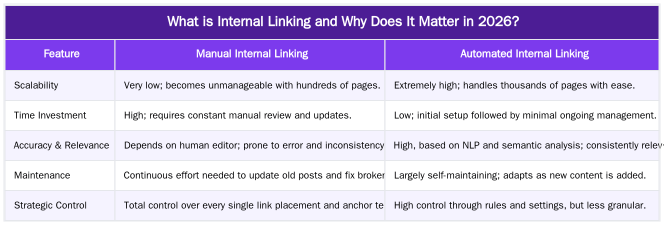
Manual vs. Automated Linking: A Comparative Analysis
Choosing between manual and automated internal linking depends on your site’s size, resources, and strategic goals. While manual linking offers granular control, its limitations become apparent as a site grows. Automated internal linking provides the scale necessary for large, dynamic websites common in the SaaS industry.
Understanding the trade-offs is crucial for making an informed decision. For small blogs, manual linking might suffice. But for enterprise sites with thousands of pages, automation is not a luxury—it’s a necessity for maintaining a competitive edge. Here’s a direct comparison of the two methods.
Advanced Strategies for Scaling Link Equity with Automation
Basic automation is about saving time. Advanced automated internal linking is about building an SEO moat around your business. By moving beyond simple link insertion, you can create a sophisticated site architecture that systematically builds authority and funnels traffic.
Building Dynamic Content Silos
A content silo is a structure where you group related content together to establish topical authority. With automation, you can set rules to ensure that articles within a specific category (e.g., “WordPress SEO”) primarily link to each other. This creates a tight, semantically-related cluster. As you add new posts to the category, the tool automatically weaves them into the existing silo, strengthening the entire topic cluster without manual intervention. This is a core part of a successful internal linking silo strategy.
Strategic Link Equity Distribution
Your website has “power pages”—articles that attract a high number of quality backlinks. Automation tools can identify these pages and be configured to strategically link from them to newer or commercially important pages that need an SEO boost. This systematically channels authority across your site, lifting the performance of your most valuable content.
Eliminating Orphan Pages
Orphan pages are pages with no internal links pointing to them, making them nearly invisible to search engines and users. An automated system can run regular audits to identify these pages. You can then set rules to automatically link to them from relevant parent pages or pillar content, ensuring every piece of content on your site is discoverable and contributing to your SEO goals.
Top Tools and Solutions for Automated Internal Linking
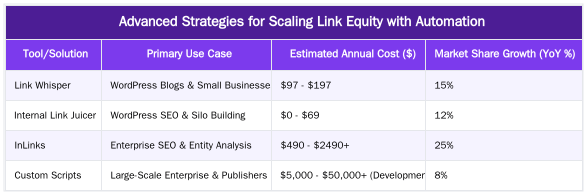
The market for SEO automation tools has matured, offering powerful solutions for businesses of all sizes. For those on popular platforms, dedicated WordPress SEO plugins provide an excellent entry point. Larger enterprises might consider more robust SaaS platforms or even custom-built solutions. The right tool depends on your budget, technical stack, and the scale of your content operations.
Here is a comparison of some leading solutions available in 2026, highlighting their key features and target users. This data helps illustrate the investment required versus the potential return. For a deeper dive, check out our complete automated internal linking guide.
Potential Risks and How to Mitigate Them
While automated internal linking offers immense benefits, a “set it and forget it” approach can lead to problems. Like any powerful tool, it requires oversight and a clear strategy to avoid common pitfalls that could harm your SEO and user experience. At our agency, we emphasize a balanced approach that combines automation with strategic human review.
The primary risk is creating an unnatural or spammy link profile. According to industry best practices, links should always add value for the user. Here’s how to mitigate the most common risks:
- Irrelevant Links: The biggest danger is the software creating links between unrelated topics.
Mitigation: Use category-level rules to restrict linking within topic clusters. Regularly audit suggested links before they go live, especially in the beginning. - Over-Optimization of Anchor Text: Using the same exact-match anchor text repeatedly can trigger spam filters.
Mitigation: Configure your tool to use a variety of anchor text, including long-tail variations, generic phrases (“click here”), and branded terms. Most advanced tools have this functionality built-in. - Poor User Experience: Placing too many links in a single article can make it difficult to read and devalue the links themselves.
Mitigation: Set a maximum number of automated links per page (e.g., 3-5). Ensure links are placed naturally within the flow of the text, not clustered together.
Measuring the Impact of Your Automation Strategy
Implementing an automated internal linking strategy is only half the battle. To justify the investment and refine your approach, you must track its impact on key performance indicators (KPIs). Measuring success allows you to demonstrate ROI and make data-driven decisions for future optimizations.
Start by establishing a baseline before you activate your automation tool. Then, monitor these core metrics over the following weeks and months:
- Organic Traffic & Impressions: Use Google Search Console to track sitewide and page-level increases in impressions and clicks. Look for a gradual uplift in pages that received new internal links.
- Keyword Rankings: Monitor the rankings of target keywords for pages that are now better supported by your internal link structure. An increase in rankings for non-branded terms is a strong success signal.
- Pages Per Session: In Google Analytics 4, an increase in the “pages per session” metric suggests that users are finding the new links helpful and are exploring more of your site.
- Crawl Stats: Check the Crawl Stats report in Google Search Console. An increase in “pages crawled per day” indicates that Googlebot is discovering and indexing your content more efficiently.
- Reduction in Orphan Pages: Use a tool like Ahrefs’ Site Audit or Screaming Frog to track the number of orphan pages. A successful strategy should see this number decrease significantly over time, as shown in our internal linking automation case study.
Get Started with Automated Internal Linking Today
In 2026, winning at SEO requires both intelligence and efficiency. Manual internal linking, while precise, simply cannot keep pace with the demands of a growing content library. By adopting automated internal linking, you empower your team to focus on creating great content while the software builds a powerful, scalable site architecture that drives sustainable organic growth.
This strategic shift from manual labor to intelligent automation is what separates good SEO from great SEO. It allows you to build topical authority, distribute link equity, and improve user experience at a scale that was previously impossible. Ready to automate internal linking and unlock your website’s true potential? Explore the solutions at Abdurrahman Simsek to see how our expertise can transform your SEO strategy.
Conclusion
Embracing automated internal linking is no longer an option for ambitious businesses—it’s a strategic imperative. By leveraging the right tools and advanced strategies, you can build a resilient, interconnected website that dominates search rankings and provides immense value to your users. This technology saves countless hours, eliminates human error, and systematically enhances your site’s authority over time. Don’t let your content exist in a silo. Start building a smarter, more connected website today by exploring the cutting-edge SEO solutions at https://abdurrahmansimsek.com.
Frequently Asked Questions
What is automated internal linking and why is it important for SEO?
Automated internal linking is the process of using software to programmatically create links between pages on your website. It is crucial for modern SEO because it efficiently distributes link equity, improves site crawlability for search engines, and strengthens your site’s topical authority at scale. This process saves significant time compared to manual linking efforts.
What are the main benefits of using automated internal linking?
The primary benefit is scalability; you can manage a complex link structure across thousands of pages without manual effort. Using automated internal linking also ensures consistent distribution of link equity, helps search engines discover your content faster, and significantly improves user navigation. It also helps identify and connect orphan pages, ensuring all content contributes to your SEO.
How does automated internal linking build topical authority?
By systematically creating a dense network of contextually relevant links, automated internal linking signals deep expertise on a subject to search engines. This interconnected content cluster demonstrates comprehensive coverage of a topic. This reinforcement helps Google understand your site is an authority, which can lead to higher rankings for related keywords.
Is automated internal linking safe for SEO?
Yes, when implemented correctly, it is a safe and highly effective SEO strategy. The key is to use smart tools that prioritize semantic relevance and create natural-looking, varied anchor text. Avoid solutions that create spammy, irrelevant links, and always maintain control to review and adjust the automated suggestions.
How does a strong internal linking structure affect a site’s crawl budget?
A well-planned internal linking structure guides search engine crawlers efficiently through your most important content. This optimized crawl path helps you make the most of your crawl budget. It ensures that valuable pages are discovered and indexed more frequently by search engines like Google.
Ruxi Data brings together multi-model AI, automated website crawling, live indexation checks, topical authority mapping, E-E-A-T enrichment, schema generation, and full pipeline automation — from crawl to WordPress publish to social posting — all in one platform built for agencies and freelancers who run on results.