
Author Schema Eeat: Building Expert Signals for Digital Authority
Understanding author schema eeat is crucial for establishing digital authority and boosting search rankings. This article details how to programmatically implement author schema eeat using structured data like Person schema to build robust expert signals. Readers will learn to enhance their digital identity, improve E-E-A-T, and leverage author authority for YMYL topics and knowledge panel visibility. Mastering author schema eeat ensures content stands out by clearly attributing expertise to identifiable authors, vital for trust and credibility.
At AbdurrahmanSimsek.com, we are committed to providing cutting-edge SEO strategies that prioritize accuracy, ethical implementation, and measurable outcomes. Our expertise in structured data and E-E-A-T optimization empowers businesses to build strong digital identities and achieve sustainable search visibility.
To explore your options, contact us to schedule your consultation.
In the evolving landscape of SEO, demonstrating Expertise, Experience, Authoritativeness, and Trustworthiness (E-E-A-T) is paramount, especially for Your Money Your Life (YMYL) topics. This article will demystify author schema E-E-A-T, explaining how to programmatically build expert signals that enhance your digital identity and boost search engine rankings. Discover the power of structured data in establishing credible author profiles and learn actionable strategies for implementation. We will explore how automated solutions can streamline this critical process, ensuring your content stands out in 2026 and beyond.
What is Author Schema and Why is it Crucial for E-E-A-T?
Author schema, specifically the Person schema markup, is a form of structured data that provides search engines with explicit information about the creator of a piece of content. This structured data is crucial for E-E-A-T because it helps Google understand who is behind the information, their qualifications, and their credibility. By clearly identifying authors, websites can signal expertise and trustworthiness, which are vital ranking factors.
Defining Person Schema and its Core Components
The Person schema is a specific type of structured data from Schema.org designed to describe an individual. Its core components include essential properties like name, url (linking to an author’s bio page), description (a brief bio or expertise summary), and image (a professional headshot). These elements collectively contribute to a comprehensive author profile, enabling search engines to identify and verify content creators more effectively. Implementing this structured data helps Google connect content to real, identifiable experts, significantly boosting the perceived E-E-A-T signals of your website. This is particularly important for demonstrating the expertise behind content, a key aspect of Google’s quality guidelines Source 1. Without clear author identification, content can appear anonymous, diminishing its authority in the eyes of search algorithms.
How Author Schema Builds Digital Identity & Expert Signals
Author schema plays a pivotal role in constructing a cohesive digital identity for content creators. By interlinking an author’s various online presences, it forms a robust network of expert signals. This interconnectedness helps search engines, particularly Google, to confidently attribute content to a verified individual, thereby strengthening the overall E-E-A-T of the content and the publishing entity. A well-defined digital identity through author schema contributes significantly to an author’s visibility and credibility in search results.
The Power of the ‘sameAs’ Property for Authority
The sameAs property within Person schema is a powerful tool for consolidating an author’s digital footprint. It acts as a bridge, linking an author’s profile on your website to their verified social media accounts (e.g., LinkedIn, X/Twitter), academic profiles (e.g., university pages, ResearchGate), industry affiliations, or personal websites. By declaring these connections, you provide search engines with undeniable proof of an author’s existence and their established presence across the web. This consolidation of identity through sameAs is critical for building authority and trustworthiness, as it allows Google to cross-reference and confirm an author’s credentials, directly impacting the strength of your author schema E-E-A-T signals Source 2. It helps Google understand that the same expert is contributing across multiple reputable platforms, reinforcing their status as an authority.
Programmatic Implementation: Building Author Schema at Scale
For websites with extensive content libraries or multiple contributors, manually implementing and maintaining author schema can be a daunting task. Programmatic generation and injection of author schema offer a scalable and efficient solution. This approach ensures consistency, accuracy, and comprehensive coverage across all author profiles, significantly reducing manual effort and potential errors. JSON-LD is the preferred format for structured data, making it straightforward to implement dynamically.
Automating Author Profiles and Structured Data Injection
Automating author profiles involves creating a centralized system, often within a Content Management System (CMS) or a dedicated platform, where author data is stored and managed. When a new article is published, the system automatically retrieves the relevant author information and generates the corresponding Person schema in JSON-LD format. This structured data is then injected into the <head> section of the article page. Best practices include maintaining a single source of truth for author data, ensuring all external links (sameAs properties) are up-to-date, and regularly auditing the schema for validity. This programmatic approach is essential for large-scale content operations aiming to consistently signal author schema E-E-A-T to search engines. For more on automating E-E-A-T content, visit https://abdurrahmansimsek.com/automate-e-e-a-t-content/.
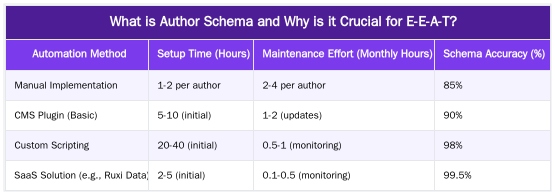
Comparison of Author Schema Implementation Methods (2026 Data)
Beyond Basics: Leveraging Author Schema for YMYL & Knowledge Panels
For Your Money Your Life (YMYL) topics, where inaccurate information can significantly impact users’ health, finances, or safety, author schema is not just beneficial—it’s critical. Google places immense importance on the E-E-A-T of content in these sensitive areas. Properly implemented author schema directly influences Google’s perception of content quality, helping to establish the necessary trust. Furthermore, it plays a significant role in the formation or enhancement of an author’s or brand’s Knowledge Panel, a powerful signal of entity recognition and authority.
Connecting Author Authority to Brand Entity & E-E-A-T
Individual author authority, when meticulously signaled through schema, feeds directly into the broader brand entity and overall E-E-A-T score. There’s a symbiotic relationship: expert authors lend credibility to a brand, and a reputable brand provides a platform for experts. By consistently associating high-E-E-A-T authors with your content, you reinforce your brand’s trustworthiness and expertise in its niche. This strategic use of author schema E-E-A-T helps Google understand that your brand is a hub for credible information, authored by verifiable experts. This is especially crucial for YMYL content, where the stakes are high. For deeper insights into E-E-A-T for YMYL, explore https://abdurrahmansimsek.com/e-e-a-t-for-ymyl-2026/. Understanding how author authority contributes to a brand’s Knowledge Panel is also vital for advanced SEO strategies, as detailed at https://abdurrahmansimsek.com/knowledge-graph-and-e-e-a-t-seo/.
Best Practices for Enhancing Author Authority and Trust
Building robust author authority goes beyond merely implementing schema; it requires a holistic approach to digital identity management. To truly enhance trust and E-E-A-T signals, content creators and publishers must adopt several best practices. These strategies ensure that search engines and users alike recognize the genuine expertise and credibility behind your content, especially for topics demanding high levels of trustworthiness.
Strategies for a Strong Digital Identity
To cultivate a strong digital identity and maximize the impact of author schema E-E-A-T, consider these strategies:
Comprehensive Author Bios: Ensure every author has a detailed bio page on your site, featuring their qualifications, experience, and relevant affiliations.
Consistent Online Presence: Encourage authors to maintain active and professional profiles on platforms relevant to their industry (e.g., LinkedIn, academic journals, industry forums).
Regular Content Contribution: Authors who consistently publish high-quality, relevant content build a stronger track record of expertise.
External Citations and Mentions: Seek opportunities for authors to be cited or mentioned by other authoritative sources, which acts as third-party validation of their expertise.
Schema Validation: Regularly use Google’s Rich Results Test to ensure your Person schema is correctly implemented and free of errors.
Link Building to Author Profiles: Build internal and external links to author bio pages to strengthen their authority signals.
These practices, combined with accurate author schema, create a powerful synergy that elevates an author’s perceived authority and trustworthiness.
Automating Author Schema Management with SaaS Solutions
Managing author schema across a large or growing content ecosystem can be complex and resource-intensive. This is where specialized SaaS solutions, like Ruxi Data, offer a significant advantage. These platforms are designed to streamline the entire process, from creating and updating author profiles to automatically injecting the correct structured data across your website. Such automation is a game-changer for maintaining consistent E-E-A-T signals at scale.
Ruxi Data: A Solution for Scalable E-E-A-T Signals
Ruxi Data provides a robust framework for automated author schema management, directly addressing the challenges of building expert signals programmatically. Our platform allows you to centralize author information, define their expertise, and automatically generate and deploy accurate Person schema (including the critical sameAs properties) across all relevant content. This ensures that every article published benefits from strong author schema E-E-A-T signals without manual intervention. By leveraging Ruxi Data, businesses can:
Ensure consistent and error-free schema implementation.
Rapidly update author information across hundreds or thousands of pages.
Integrate seamlessly with existing CMS platforms.
Monitor schema performance and E-E-A-T impact.
This automated approach frees up valuable SEO and content team resources, allowing them to focus on content creation and strategy, while Ruxi Data handles the technical heavy lifting of expert signal building. For YMYL content, this level of precision and consistency is invaluable, helping to build and maintain trust with both users and search engines. Learn more about our approach to AI content for YMYL at https://abdurrahmansimsek.com/ai-content-for-ymyl-framework/.
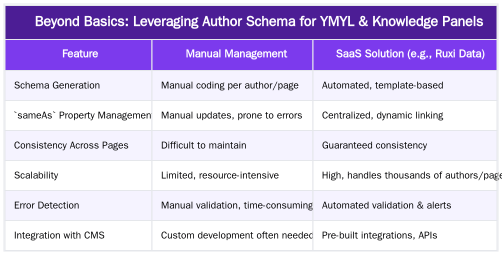
Comparison: Manual vs. SaaS for Author Schema Management
The Impact of Author Schema on SEO and Search Visibility
The strategic implementation of author schema E-E-A-T has a profound and multifaceted impact on SEO and overall search visibility. It’s not merely a technical checkbox; it’s a fundamental component of modern SEO that directly influences how search engines perceive and rank your content. By providing clear, structured signals about your content creators, you unlock several key advantages in the competitive digital landscape of 2026.
Direct Benefits for Ranking and Trust
The direct benefits of robust author schema are significant:
Enhanced E-E-A-T Signals: Explicitly tells Google who the expert is, boosting trust and authority, especially for YMYL topics.
Improved Knowledge Panel Presence: Contributes to the likelihood of an author or brand receiving a Knowledge Panel, increasing visibility and credibility.
Better Understanding of Content Context: Helps search engines connect content to specific entities, leading to more accurate indexing and ranking for relevant queries.
Potential for Rich Results: While not a guarantee, well-implemented schema can sometimes contribute to richer search result snippets, improving click-through rates.
Future-Proofing SEO: As search engines increasingly focus on entity-based search and E-E-A-T, strong author signals become even more critical for long-term ranking success.
By investing in programmatic author schema, you are not just optimizing for today’s algorithms but building a resilient foundation for future SEO performance. This proactive approach ensures your content consistently communicates its inherent value and expert backing to search engines.
Conclusion
In the dynamic world of SEO, establishing and signaling E-E-A-T is no longer optional; it’s a prerequisite for success, particularly for YMYL content. Author schema E-E-A-T provides a powerful, programmatic way to build expert signals, enhance digital identity, and ultimately boost your search engine rankings. By leveraging Person schema, the ‘sameAs’ property, and automated solutions, you can ensure your content is consistently attributed to credible authors, fostering trust and authority. Don’t leave your E-E-A-T signals to chance. Take control of your digital identity and content credibility. Discover how our solutions can help you programmatically build expert signals and elevate your online presence. Visit abdurrahmansimsek.com today to learn more.
Frequently Asked Questions
Why is author schema eeat especially important for YMYL content?
For ‘Your Money or Your Life’ (YMYL) topics, Google’s quality standards are extremely high. Implementing detailed author schema eeat provides clear, machine-readable proof that your content is written by a qualified expert. This directly addresses the Expertise and Authoritativeness components of E-E-A-T, which is critical for YMYL content.
Why is the ‘sameAs’ property important for author schema eeat?
The ‘sameAs’ property is crucial because it links an author’s article to their other verified online profiles, like LinkedIn or an official university page. This helps Google connect the author to a real-world entity, strengthening their digital identity. Properly using ‘sameAs’ is a core component of a strong author schema eeat strategy.
Can implementing author schema eeat help an author get a Google Knowledge Panel?
Yes, it significantly increases the chances, though it is not a guarantee. A strong author schema eeat implementation with ‘sameAs’ links helps Google recognize an individual as a notable entity. This is a foundational step toward being awarded a Knowledge Panel, which is a powerful signal of authority.
How do programmatic solutions automate author schema eeat?
Programmatic tools allow you to create detailed author profiles with credentials, bios, and professional links. The system then automatically injects this structured data into the code of every article the author writes. This ensures consistent and accurate signals are sent to search engines without manual effort.
How can you manage author schema for a site with many guest authors?
Programmatic systems are ideal for managing multiple authors at scale. You can create a unique profile for each contributor, whether they are in-house staff or occasional guests. When publishing, you simply associate the article with the correct author profile to apply the right structured data automatically.
Ruxi Data brings together multi-model AI, automated website crawling, live indexation checks, topical authority mapping, E-E-A-T enrichment, schema generation, and full pipeline automation — from crawl to WordPress publish to social posting — all in one platform built for agencies and freelancers who run on results.