
Auditing Image Compression: Optimizing Galleries for Speed & SEO
Auditing image compression systematically evaluates image size and format to enhance website performance, especially for ‘before & after’ galleries. This guide details how to optimize visual content for faster page load speeds, improved Core Web Vitals like Largest Contentful Paint (LCP), and a superior user experience. It covers choosing between lossless and lossy compression, leveraging next-gen image formats such as WebP and AVIF, and implementing image SEO best practices. Effective image optimization is crucial for building patient trust and reinforcing site authority.
Abdurrahman Şimşek, a Semantic SEO Strategist, provides expert guidance on optimizing digital assets for search engine performance and user engagement. This content delivers actionable strategies for medical practices to enhance their online presence through meticulous image optimization.
To explore your options, contact us to schedule your consultation. You can also reach us via: Book a Semantic SEO Audit, Direct WhatsApp Strategy Line: +90 506 206 86 86
A fast website is necessary to attract and convert high-value patients. This guide to auditing image compression for ‘before & after’ galleries explains how to optimize visual content for faster page load speeds and a better user experience. Efficient image compression impacts Core Web Vitals, reduces Cost of Retrieval, and reinforces site authority and patient trust.
What is Image Compression Auditing and Why it Matters for Medical Galleries?
Image compression auditing is the systematic evaluation of image size and format to reduce file size without losing visual quality. For medical websites with ‘before & after’ galleries, this process is critical to improving page load speed, user experience, and Core Web Vitals like Largest Contentful Paint (LCP). Slow-loading images deter patients and signal a poor user experience to search engines.
An audit ensures visual assets showcasing surgical results load quickly. This improves the patient journey, from research to consultation. Optimizing visual elements is foundational to effective Core Web Vitals for surgeons, particularly for LCP, which measures the loading performance of the largest content element on a page.
The Critical Role of Images in Patient Trust and LCP
‘Before & after’ images build patient trust and demonstrate expertise for plastic surgery and aesthetic clinics. Slow-loading images undermine credibility. Fast-loading visuals reassure patients about the practice’s professionalism and expected outcomes. The Largest Contentful Paint (LCP) metric measures the render time of the largest image or text block in the viewport. In image-heavy galleries, unoptimized images often cause a poor LCP score, impacting user perception and search rankings.
A fast LCP ensures impactful visual content, like a ‘before & after’ photo, appears quickly, capturing patient attention and reinforcing the site’s value proposition. This immediate visual feedback is crucial where visual evidence drives patient decision-making.
Lossless vs. Lossy: Choosing the Right Compression for Surgical Imagery
The distinction between lossless and lossy compression is fundamental to optimizing medical imagery. Lossless compression reduces file size by removing redundant data without discarding information, allowing perfect reconstruction. PNG is a common lossless format. Lossy compression achieves greater file size reduction by permanently removing data, which can slightly degrade image quality. JPEG is a widely used lossy format. ‘Before & after’ photos require a balance between maintaining visual integrity and achieving optimal file sizes.
Lossless compression ensures no detail is lost, but file sizes are often too large for web performance. Lossy compression, applied correctly, significantly reduces file size with minimal perceptible quality loss, making it preferable for most web-based surgical imagery. The goal is to find the optimal compression level that preserves visual details for patient evaluation while ensuring rapid delivery.

Embracing Next-Gen Formats: WebP and AVIF for Superior Performance
Next-gen image formats like WebP and AVIF offer better compression than JPEG and PNG, making them ideal for medical galleries. WebP provides both lossless and lossy compression, achieving 25-34% smaller file sizes than JPEGs and 26% smaller than PNGs for comparable quality. AVIF, based on the AV1 video codec, delivers even greater file size reductions while maintaining high visual fidelity. WebP is widely supported across major browsers, and AVIF support is growing.
Using next-gen image formats ensures ‘before & after’ photos load quickly without compromising the visual integrity needed to showcase surgical results. Converting images to WebP or AVIF can enhance page load speed, improve Core Web Vitals scores, and provide a better experience for prospective patients.
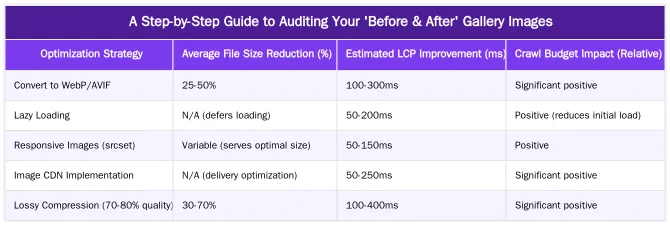
A Step-by-Step Guide to Auditing Your ‘Before & After’ Gallery Images
An image compression audit systematically identifies and rectifies performance bottlenecks. First, use diagnostic tools like Google PageSpeed Insights, GTmetrix, and Lighthouse to pinpoint oversized images. These tools analyze site performance and provide recommendations, highlighting large image files. Prioritize images on high-traffic or critical conversion pages, like main procedure galleries or surgeon profiles.
For each image, assess its format and dimensions. Size images for their display area; a 4000px wide image for an 800px display is inefficient. Use compression techniques with image editing software or online optimizers. Balance file size reduction with quality. This iterative process of identifying, optimizing, and re-evaluating achieves optimal performance across your ‘before & after’ gallery.
Identifying Performance Bottlenecks with Diagnostic Tools
Diagnostic tools like Google PageSpeed Insights and GTmetrix report on site performance and recommend image optimizations. They flag issues like “Serve images in next-gen formats” or “Efficiently encode images.” These recommendations list specific images causing slow load times. Note the file size (in KB or MB) and potential savings from optimization.
Use these results to prioritize which images to address first. Focus on the largest files on critical patient journey pages. Addressing these bottlenecks yields the most significant improvements in page load speed and Core Web Vitals scores, impacting user experience and search visibility. This data-driven approach concentrates efforts for the greatest impact.
Optimizing for Cost of Retrieval: Advanced Image Strategies for Medical SEO
Efficient image optimization reduces a website’s Cost of Retrieval (CoR). CoR is the computational resource Google uses to crawl, process, and index content. Large, unoptimized images increase CoR, consuming crawl budget and hindering the indexing of other content. For medical practices, where topical authority is paramount, minimizing CoR ensures search engines efficiently discover and understand your semantic content network.
Advanced image strategies, like serving correctly sized images, using next-gen formats, and using Content Delivery Networks (CDNs), signal to search engines that your site is resource-efficient. This efficiency can improve crawl rates, indexability, and visibility for plastic surgery SEO terms. A lower CoR supports a more authoritative online presence and your semantic architecture.
The Role of Image CDNs in Reducing CoR and Enhancing Global Reach
Content Delivery Networks (CDNs) optimize image delivery, reducing Cost of Retrieval and enhancing a medical practice’s global reach. A CDN stores copies of static assets, including images, on servers in various geographic regions. When a patient accesses your site, the CDN serves images from the closest server, reducing latency and load times. This minimizes the data transfer burden on your origin server, lowering the CoR for search engine crawlers.
For London-based clinics targeting a wider patient base, a CDN ensures images load quickly for users locally and internationally. Faster image delivery improves user experience and signals a performant, reliable site to search engines, supporting SEO efforts. Offloading image serving to a CDN frees server resources, allowing Googlebot to crawl more efficiently and discover content more readily.
Beyond Compression: Image SEO Best Practices for Patient Conversions
Image SEO extends beyond compression to factors that enhance accessibility, search visibility, and user experience. Descriptive alt text is crucial for accessibility and SEO. It provides context for visually impaired users and helps search engines understand image content, improving image search rankings. Proper file naming with relevant keywords (e.g., `rhinoplasty-before-after-london.webp`) reinforces semantic relevance.
Using the `srcset` attribute for responsive images ensures browsers serve the most appropriate image size for the user’s device and screen resolution. This prevents mobile users from downloading unnecessarily large files, improving their experience and the mobile booking process. These practices make image assets more discoverable and impactful for potential patients.
Structuring ‘Before & After’ Galleries for E-E-A-T and User Engagement
The presentation of ‘before & after’ galleries influences patient engagement and trust. Structure galleries with clear captions providing context (e.g., “Rhinoplasty result at 6 months post-op”). Consistency in lighting, angles, and background ensures a professional, comparable presentation. Obtain explicit patient consent for all published images, adhering to GDPR and ethical guidelines. Well-organized galleries that allow filtering by procedure, age, or concern help patients find relevant examples quickly.
High-quality, ethically presented images reinforce a clinic’s Expertise, Experience, Authoritativeness, and Trustworthiness (E-E-A-T). This builds confidence and encourages engagement, leading to higher conversion rates for medical procedures. Integrating these visuals within an E-E-A-T framework establishes a credible online presence.
The Impact of Image Optimization on Your Practice
Auditing and optimizing image compression yields tangible benefits for medical practices. Improved page load speeds lead to better Core Web Vitals scores, a critical Google ranking factor. This can enhance search visibility and organic rankings, attracting more prospective patients. Faster loading ‘before & after’ galleries improve user experience, reducing bounce rates and encouraging longer site visits.
Optimized imagery fosters patient trust, as a professional, fast-loading site reflects positively on the quality of care. A streamlined patient journey, from initial interaction to consultation, increases inquiries and bookings for high-value procedures. In medical SEO, image optimization is a strategic advantage that drives business growth.
Transform Your Medical Website’s Performance
Optimizing ‘before & after’ galleries and website performance requires expertise in technical SEO and semantic architecture. To dominate local search and attract high-value patients in the London private healthcare market, partner with a specialist.
Book a Semantic SEO Audit or connect via our Direct WhatsApp Strategy Line: +90 506 206 86 86.
Conclusion
Image compression auditing is essential for medical websites with ‘before & after’ galleries. Understanding lossless vs. lossy compression, using next-gen formats like WebP and AVIF, and identifying performance bottlenecks enhances page load speeds and Core Web Vitals. These technical improvements lower the Cost of Retrieval for search engines, improving crawl efficiency and semantic SEO. Optimized, well-structured images build patient trust, reinforce E-E-A-T, and drive higher conversion rates for high-value procedures.
For a tailored strategy, contact us, Book a Semantic SEO Audit, or use our Direct WhatsApp Strategy Line: +90 506 206 86 86.
Frequently Asked Questions
What’s the first step in auditing image compression for a medical gallery?
The initial step involves using performance tools like Google PageSpeed Insights or GTmetrix. These tools help identify the largest image files that are slowing down your critical gallery pages, providing a data-driven starting point for auditing image compression and optimization efforts.
How does choosing between lossy and lossless compression impact auditing image compression for patient photos?
For patient photos, a high-quality lossy compression using modern formats like WebP or AVIF is generally ideal. It significantly reduces file size with minimal perceptible quality loss, which is crucial for effective image optimization. This ensures fast load times while maintaining the necessary detail for medical imagery.
Why is auditing image compression essential to prevent negative impacts on Google ranking?
Uncompressed images are a primary cause of poor Core Web Vitals, particularly a slow Largest Contentful Paint (LCP). Since Google uses these metrics as a ranking signal, a thorough auditing image compression process is essential to improve page speed and maintain visibility in search results.
What role do “next-gen” image formats play when auditing image compression for performance?
Next-gen formats like WebP and AVIF offer superior compression and quality compared to older formats like JPEG and PNG. When auditing image compression, prioritizing these formats allows for significantly smaller file sizes at the same visual quality, leading to faster page loads and improved user experience.
How does an image CDN help with ‘before and after’ galleries?
An image Content Delivery Network (CDN) automatically optimizes and serves images from a server geographically closer to the user, drastically improving load times. Many CDNs also convert images to next-gen formats on the fly, simplifying the entire process of managing a high-performance gallery and supporting your image optimization goals.
How can Abdurrahman Şimşek assist with advanced image optimization and semantic SEO?
Abdurrahman Şimşek, a Holistic SEO Strategist with 10+ years in search engineering, specializes in applying a Semantic SEO Framework to optimize medical websites. You can book a Semantic SEO Audit to transform your site’s performance, including advanced image strategies, by visiting abdurrahmansimsek.com/contact/.
Ruxi Data brings together multi-model AI, automated website crawling, live indexation checks, topical authority mapping, E-E-A-T enrichment, schema generation, and full pipeline automation — from crawl to WordPress publish to social posting — all in one platform built for agencies and freelancers who run on results.