
Attract Rhinoplasty Patients: Build Topical Authority With Semantic SEO
To attract rhinoplasty patients, clinics must implement a semantic content strategy that moves beyond basic keywords. This approach models the ‘rhinoplasty’ entity, mapping the entire patient journey from initial research to high-intent queries. By building topical authority and providing exhaustive, trustworthy YMYL content, practices can significantly reduce patient acquisition costs. This strategy ensures search engines recognize the site as a definitive resource, effectively connecting plastic surgeons with high-value cosmetic surgery leads and improving conversion rates.
Abdurrahman Şimşek, a Semantic SEO Strategist, specializes in developing these advanced content networks. His expertise helps surgical practices establish robust online authority, ensuring their digital presence effectively captures high-intent patient queries and optimizes surgical procedure marketing.
To explore your options, contact us to schedule your consultation.
To attract rhinoplasty patients, clinics need more than basic search engine optimization. A semantic content strategy understands patient intent and establishes a clinic’s authority. This approach connects plastic surgeons with their ideal clientele, reduces patient acquisition costs, and positions their practice as a leader in rhinoplasty. It builds an online presence that attracts high-value patients.
What is a Semantic Content Strategy for Attracting Rhinoplasty Patients?
A semantic content strategy for rhinoplasty moves beyond keyword matching to model the ‘rhinoplasty’ entity. This approach maps the full spectrum of patient queries, concerns, and decision-making processes. It builds topical authority by ensuring a clinic’s website provides exhaustive, accurate, and trustworthy information on the procedure. Search engines then recognize the site as a definitive resource, increasing visibility for high-intent searches.
Beyond Keywords: Understanding the Rhinoplasty Patient Journey
Semantic SEO maps the patient journey from initial research to final decision. Patients begin with broad research, such as “rhinoplasty benefits” or “types of nose surgery.” As their understanding deepens, their queries become more specific and high-intent, like “best rhinoplasty surgeon London” or “rhinoplasty recovery timeline.” A semantic approach ensures content aligns with each stage, addressing informational, commercial, and transactional needs. Identifying these high-intent keywords and structuring content around them is crucial for patient journey mapping and capturing cosmetic surgery leads.
Why Traditional SEO Fails High-Value Rhinoplasty Patient Acquisition
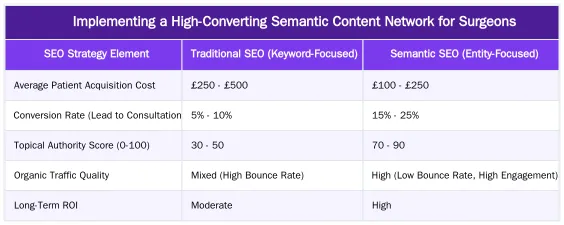
Traditional, keyword-centric SEO fails to acquire high-value cosmetic surgery leads. Focusing on high-volume keywords without understanding intent generates generic traffic, not qualified prospects. This inflates patient acquisition costs by attracting individuals not ready or suitable for surgery. The rhinoplasty decision-making process requires an authoritative online presence that traditional methods cannot provide, leading to low conversion rates.
The Cost of Retrieval (CoR) in Medical Search and YMYL Content
Search engines prioritize content that minimizes their ‘Cost of Retrieval’ (CoR). They favor authoritative, comprehensive, and trustworthy websites that provide relevant answers with minimal effort. For YMYL (Your Money Your Life) medical content like surgical procedures, E-E-A-T (Experience, Expertise, Authoritativeness, Trustworthiness) is paramount. Traditional SEO overlooks the signals required to establish E-E-A-T, making it difficult for clinics to rank for medical queries. Content must demonstrate knowledge and be backed by verifiable credentials to satisfy CoR requirements.
Building Your Rhinoplasty Topical Authority with EAV Modeling
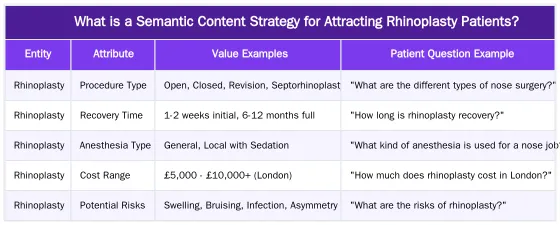
Entity-Attribute-Value (EAV) modeling establishes topical authority for rhinoplasty. EAV modeling breaks down an entity like ‘rhinoplasty’ into its attributes and their values. This maps the knowledge domain, ensuring comprehensive content coverage. Defining these relationships creates a semantic content network that addresses all patient questions, from procedure specifics to recovery and costs. This mapping helps search engines understand a website’s expertise.
Mapping the ‘Rhinoplasty’ Entity: A Practical EAV Example
For the ‘Rhinoplasty’ entity, attributes include ‘Procedure Type,’ ‘Recovery Time,’ ‘Cost Range,’ ‘Anesthesia Type,’ and ‘Potential Risks.’ Each attribute has specific values. This framework informs content creation, ensuring every patient inquiry is addressed. For example, a patient searching for “rhinoplasty recovery” would find detailed information on the ‘Recovery Time’ attribute, including typical durations, post-operative care, and expected milestones. This approach to building topic clusters enhances a clinic’s online authority.
Implementing a High-Converting Semantic Content Network for Surgeons
An interconnected semantic content network guides patients through the decision-making funnel. This architecture ensures all content, from informational articles to service pages, links logically and contextually. The network addresses all patient questions, building trust and demonstrating expertise. Clear information pathways improve conversion rates, turning visitors into patients.
Crafting Service Pages and Blog Content for Maximum Impact
Rhinoplasty service pages must be structured to rank for high-intent keywords. These pages should outline the procedure, benefits, surgeon’s expertise, and patient testimonials, and include relevant schema markup. A plastic surgeon’s blog should support these service pages, covering topics like “rhinoplasty before and after,” “choosing a surgeon,” or “post-operative care.” This approach builds topical authority. A pillar page strategy with cluster content is a conversion rate optimization technique that ensures all patient queries are met.
Why London’s Elite Plastic Surgeons Trust Abdurrahman Şimşek’s Semantic SEO
London’s plastic surgeons, particularly in Harley Street, require a specialized approach to digital visibility. Abdurrahman Şimşek, a Semantic SEO Strategist with over 10 years of experience, builds high-authority semantic content networks for medical clinics and plastic surgeons. His expertise in Information Retrieval and Entity-Attribute-Value (EAV) Modeling helps clinics dominate local organic search and connect with high-value patients. His understanding of the medical YMYL search landscape ensures content is visible and trusted by search engines and patients.
Ruxi Data & E-E-A-T: The Foundation of Medical SEO Success
Ruxi Data is a cornerstone of Abdurrahman Şimşek’s methodology. Ruxi Data automates topical map creation and EAV modeling, reducing the search engine’s Cost of Retrieval (CoR) for medical domains. This automation establishes E-E-A-T signals, which are critical for YMYL content in private healthcare. Using Ruxi Data, clinics build an online presence that signals expertise, authority, and trustworthiness to search engines. This helps semantic SEO for plastic surgeons achieve higher rankings and patient engagement. For further reading on E-E-A-T, consult Google’s Search Quality Rater Guidelines, which emphasize these factors for sensitive topics.
Attract High-Value Patients: Partner with a Semantic SEO Expert Today
To attract rhinoplasty patients and lead in the cosmetic surgery market, a semantic content strategy is indispensable. Partnering with a specialist like Abdurrahman Şimşek provides SEO techniques tailored for medical practices. His expertise can reduce patient acquisition costs, enhance conversion rates, and establish your clinic’s authority in rhinoplasty. Discover more about E-E-A-T content automation and its impact on medical SEO.
Conclusion
Attracting high-value rhinoplasty patients has evolved beyond keyword optimization. A semantic content strategy using Entity-Attribute-Value modeling and an understanding of the patient journey is essential. This approach builds topical authority, optimizes for search engine Cost of Retrieval, and establishes a clinic’s E-E-A-T in the YMYL medical niche. A semantic content network can reduce patient acquisition costs and improve conversion rates. Explore how a tailored semantic SEO strategy can elevate your clinic’s online authority and patient engagement by visiting abdurrahmansimsek.com.
Frequently Asked Questions
What is a ‘semantic content strategy’ for attracting rhinoplasty patients?
It’s an advanced SEO approach that moves beyond simple keywords to model the entire ‘rhinoplasty’ entity. We define its attributes (e.g., recovery time, anesthesia type, cost) and create a network of content that answers every possible patient question. This establishes your website as the definitive authority on the topic to attract rhinoplasty patients.
How does this strategy attract ‘high-value’ patients specifically?
High-value patients conduct extensive research and seek deep expertise before making a decision. Our strategy focuses on creating in-depth, authoritative content addressing complex concerns like revision rhinoplasty or specific techniques. This level of detail helps secure more discerning, qualified patients, effectively filtering out price-shoppers.
Can you use Ruxi Data to find what prospective rhinoplasty patients are searching for?
Yes, Ruxi Data is our core infrastructure for this analysis. It scales to analyze SERPs, identifying the precise questions, attributes, and related topics patients are searching for around nose reshaping. This allows us to automate the creation of a comprehensive topical map that covers the entire patient journey.
Is this approach better than just running Google Ads for ‘rhinoplasty London’ to attract rhinoplasty patients?
While Google Ads provide immediate visibility, a semantic SEO strategy builds a long-term asset for your practice. It establishes your clinic as a trusted authority, attracting organic traffic and patients for years to come. This approach significantly lowers the long-term cost to attract rhinoplasty patients compared to a perpetual ad spend.
How do you optimize visual content to effectively reach potential rhinoplasty clients?
We integrate a technical SEO strategy for all visual assets, including ‘before and after’ galleries. This involves optimizing high-resolution images for speed (LCP), implementing advanced ImageObject and VideoObject schema, and ensuring all visual content is contextually linked within the semantic content network to attract rhinoplasty patients.
How can London clinics begin using this strategy to attract their ideal clientele?
London’s elite plastic surgeons can partner with Abdurrahman Şimşek, a Semantic SEO Strategist specializing in YMYL & E-E-A-T optimization for healthcare. We focus on building topical authority for aesthetic clinics in Harley Street and Central London. Contact us to discuss a tailored strategy for your practice.
Ruxi Data brings together multi-model AI, automated website crawling, live indexation checks, topical authority mapping, E-E-A-T enrichment, schema generation, and full pipeline automation — from crawl to WordPress publish to social posting — all in one platform built for agencies and freelancers who run on results.