
Advanced Semantic HTML: Elevating AI Overviews & Zero-click Search
Implementing advanced semantic HTML is crucial for digital visibility in the AI era. This guide explains how precise HTML5 elements and attributes are vital for dominating AI Overviews and securing zero-click searches. By structuring content with advanced semantic HTML, websites provide clear roadmaps for search algorithms, enhancing AI understanding, improving accessibility, and cementing topical authority. This approach moves beyond basic tags to create a logical content hierarchy, signaling purpose to AI crawlers and improving entity SEO for reliable information extraction.
Abdurrahman Simsek is dedicated to empowering businesses with cutting-edge digital strategies. Our expertise ensures content is optimized for current and future AI search demands, focusing on ethical practices and measurable outcomes. We prioritize clarity and precision to build trust and establish strong online authority for our clients.
To explore your options, contact us to schedule your consultation.
To succeed in the age of AI-driven search, implementing advanced semantic HTML is no longer optional; it is the foundational layer for digital visibility. This guide moves beyond basic tags to explore how precise HTML5 elements and attributes are critical for dominating AI Overviews and winning valuable zero-click searches. By structuring your content with semantic clarity, you provide a direct roadmap for search algorithms, enhancing AI understanding, improving accessibility, and cementing your site’s topical authority for 2026 and beyond.
What Constitutes Advanced Semantic HTML for AI Overviews?
Advanced semantic HTML is the practice of using specific HTML5 elements and attributes to explicitly define the meaning, role, and relationship of content on a webpage for machines. Unlike basic HTML, which relies on generic containers like <div> and <span>, this advanced approach uses descriptive tags such as <article>, <section>, and <figure> to create a clear, logical content hierarchy that AI can easily parse and understand.
This level of structural clarity is precisely what AI Overviews and other generative AI search features need to confidently extract and synthesize information. By signaling the purpose of each content block, you remove ambiguity and help search engines recognize key entities and facts within your text.
Beyond Basic Tags: The AI Imperative for Content Clarity
In the past, search engines relied heavily on keywords and backlinks to infer a page’s topic. Today’s AI models, however, are built to understand context and relationships. A page built with generic `
Using advanced semantic HTML provides that essential structure. It tells an AI crawler, “This block of text is the main article, this is a related sidebar, and this is an image with a caption.” This explicit signaling is crucial for being selected as a reliable source for AI-generated summaries and answers.
How Advanced Semantic Structures Power AI Overviews & Zero-Click Searches
Search engine AI processes a webpage by first analyzing its Document Object Model (DOM), which is directly shaped by your HTML. When the DOM is built with advanced semantic HTML, the AI can instantly identify the page’s primary components and their relationships. This allows it to deconstruct content with high accuracy.
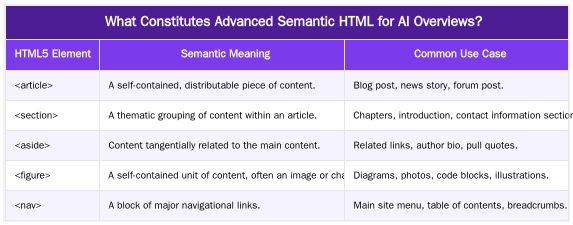
For example, an AI can recognize that content within an `<article>` tag is the core topic, information in an `<aside>` is supplementary, and a `<figure>` with a `<figcaption>` represents a specific visual concept. This clear content hierarchy enables the AI to extract precise facts, figures, and definitions to populate AI Overviews, often leading to a zero-click search where the user gets their answer directly on the results page.
The Role of HTML5 Elements in AI Understanding
Specific HTML5 elements act as signposts for AI. A `<nav>` element clearly marks navigational links, preventing the AI from confusing them with main content. An `<article>` tag isolates a self-contained piece of content, like a blog post or news story, making it a prime candidate for syndication or summarization. By properly structuring content for AI Overviews, you are essentially pre-packaging your information for easy consumption by algorithms.
Mapping Content to Entities for Topical Authority
Entity SEO is about building connections between your content and real-world concepts (people, places, organizations, ideas) in Google’s Knowledge Graph. Using advanced semantic HTML helps solidify these connections. When you wrap a definition in a `<section>` with a clear heading or associate an image of a product with its name in a `<figcaption>`, you are helping the search engine map your text to specific entities.
This process strengthens your website’s perceived topical authority. The more clearly and consistently you define entities and their relationships, the more search engines will trust your site as a definitive source on that topic, increasing your chances of being featured in complex query results.
Implementing Advanced Semantic HTML: A Practical Guide for 2026
Transitioning to advanced semantic HTML involves auditing your existing content structure and adopting a “meaning-first” approach to new content. Instead of asking “How should this look?” ask “What does this content represent?” This shift in mindset is the key to creating AI-friendly web pages.
Start by replacing generic `<div>` elements with more descriptive HTML5 tags wherever possible. Your main blog post should be wrapped in `<main>` and then `<article>`. Thematic subsections within that post should be wrapped in `<section>` tags, each with its own heading. This simple change dramatically improves machine readability.
Choosing the Right HTML5 Elements for Content Structure
Selecting the correct element is crucial for conveying the right meaning. While many elements exist, a core set forms the backbone of most well-structured pages. Understanding their intended purpose is the first step toward effective implementation. For a deeper dive, explore our guide on semantic HTML for SEO.
Integrating Structured Data and Schema Markup for Enhanced AI Signals
Semantic HTML provides the skeleton, while structured data (like Schema.org markup) adds the nervous system. The two work in tandem. Your semantic HTML tells the AI “this is an article,” and your `Article` schema tells it who the author is, when it was published, and what the headline is. This combination creates an incredibly rich, unambiguous signal for search engines.
Always aim to align your structured data with your HTML structure. For example, the `Article` schema should be applied to the content within your `<article>` tag. For comprehensive guidelines, the official Schema.org documentation is the ultimate resource.
Ruxi Data’s Approach: Elevating Content with Semantic Precision
At Ruxi Data, we’ve built our entire methodology around the principle that semantic precision is the key to winning in the new era of search. We recognize that for large-scale enterprises, manually implementing advanced semantic HTML across thousands of pages is not feasible. Our approach focuses on programmatic solutions that analyze content and automatically apply the most appropriate semantic and schematic structures.
This ensures that every piece of content, from a new blog post to a legacy product page, is perfectly optimized for AI interpretation. By focusing on the core principles of entity SEO and technical SEO, we build a foundation that not only performs today but is also resilient to future algorithm updates.
Automating Semantic Markup for Scalability and Accuracy
The primary challenge in enterprise SEO is maintaining consistency and accuracy at scale. Our proprietary tools are designed to parse raw content, identify its components—headings, paragraphs, lists, images, data tables—and wrap them in the correct semantic tags. This automation eliminates human error and ensures that your entire digital footprint communicates clearly with search engines, reinforcing your topical authority with every page published.
A Case Study in Semantic SEO
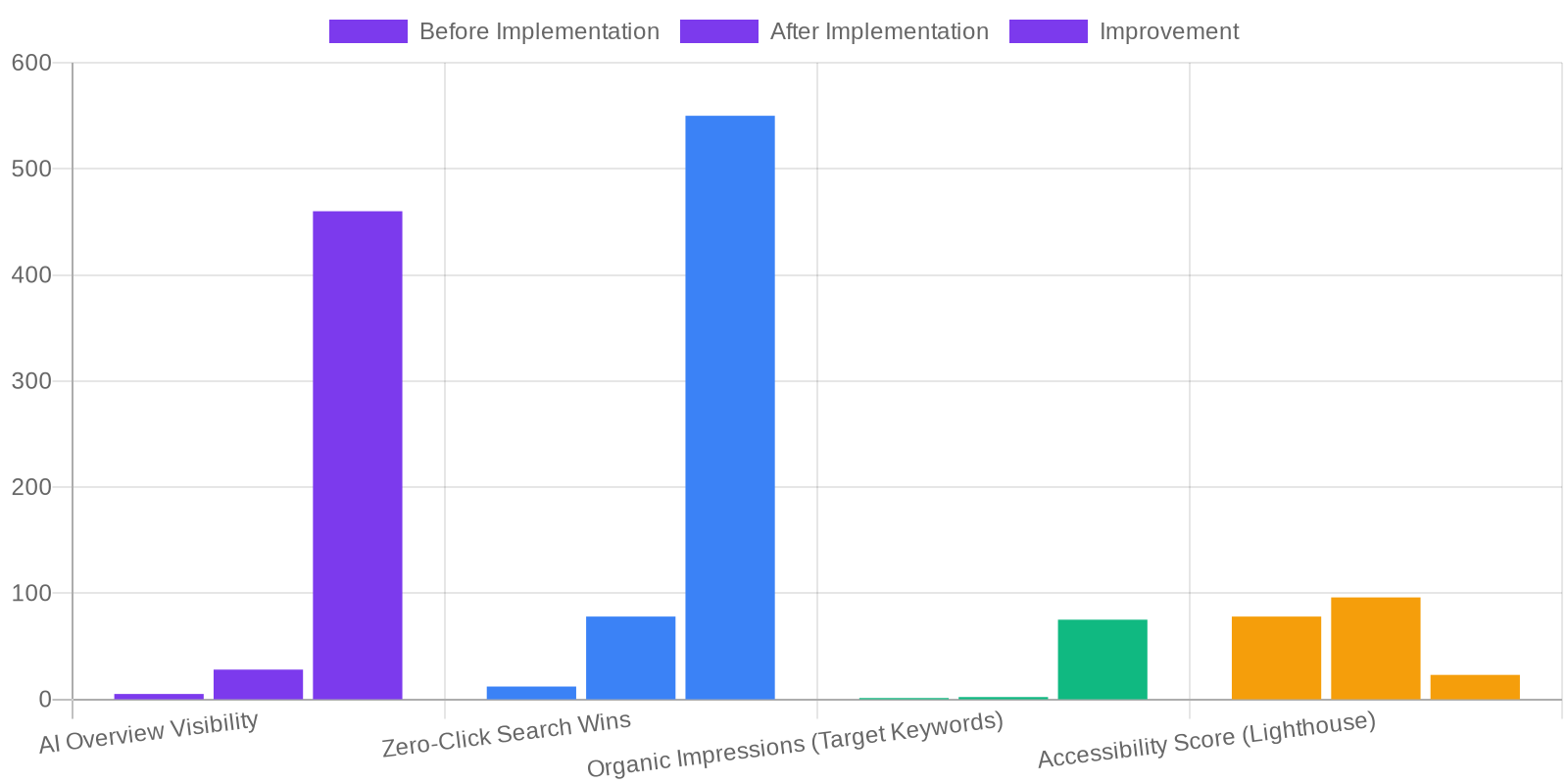
We worked with a B2B SaaS client whose content was high-quality but structurally ambiguous, built almost entirely with `<div>` tags. After a programmatic overhaul to implement advanced semantic HTML and corresponding Schema markup, the results were clear and immediate. This is a testament to how a strong semantic HTML structure for AI Overviews directly impacts performance.
The Measurable SEO Impact of Semantic Precision
The benefits of advanced semantic HTML extend far beyond just appeasing AI. These practices create a cascade of positive effects that directly influence core SEO metrics and business goals. A well-structured page is easier for search engines to crawl and index, which can lead to faster indexing and better visibility for new content.
Furthermore, the clarity provided by semantic tags often results in more relevant and compelling rich snippets in search results, which can significantly boost click-through rates (CTR). When users land on a page that is logically structured, they are more likely to find what they need, leading to a better overall user experience.
From Code to Conversions: The ROI of Semantic HTML
A superior user experience translates directly into business value. Pages with a clear content hierarchy are easier to read and navigate, which can decrease bounce rates and increase time on page. These positive user engagement signals are known to be influential in search rankings. Ultimately, a technical change in your HTML can lead to more engaged visitors who are more likely to convert.
Accessibility as an SEO Ranking Factor
Semantic HTML is the cornerstone of web accessibility. Screen readers and other assistive technologies rely on tags like `<main>`, `<nav>`, and `<header>` to help users navigate a page. By making your site accessible, you are not only serving a wider audience but also aligning with Google’s focus on user experience.
As detailed in the Web Content Accessibility Guidelines (WCAG) from the W3C Web Accessibility Initiative, a commitment to accessibility is a powerful signal of a high-quality, user-centric website. This aligns perfectly with the principles of E-E-A-T (Experience, Expertise, Authoritativeness, and Trustworthiness), making it an indirect but potent ranking factor.
Future-Proofing Your Content Strategy with Advanced Semantics
As search engines become more conversational and answer-oriented, the need for machine-readable content will only intensify. Investing in advanced semantic HTML today is the most effective way to future-proof your content strategy. It prepares your website for a world where your content will be consumed not just by human readers, but by a variety of AI agents, voice assistants, and other platforms.
Your Next Step Towards AI-Ready Content
By prioritizing semantic clarity, you are building a resilient, adaptable digital presence. You ensure that as search technology evolves, your content remains understandable, relevant, and authoritative. This is not just a technical tweak; it is a strategic imperative for long-term SEO success. Explore how to build a robust semantic HTML structure for AI Overviews to get started.
Conclusion
The shift from keyword-centric SEO to an entity-based, AI-driven model is complete. In this new landscape, advanced semantic HTML is the language of success. It provides the structural foundation that allows AI to understand, trust, and feature your content in AI Overviews and zero-click searches. By implementing these practices, you enhance topical authority, improve accessibility, and create a superior user experience that drives tangible business results. To ensure your content is ready for the future of search, visit https://abdurrahmansimsek.com to learn how our solutions can bring semantic precision to your digital strategy.
Frequently Asked Questions
What is considered advanced semantic html for AI Overviews?
Advanced semantic html involves using precise HTML5 elements like <article>, <section>, and <figure> to clearly define your content’s meaning and structure. This practice goes beyond basic tags, creating a logical roadmap that AI systems can easily understand and interpret for generating overviews.
How does advanced semantic html help win zero-click searches?
By providing clear, well-defined content blocks, advanced semantic html makes it easier for AI Overviews to extract precise answers. This increases the likelihood of your content being featured directly in the search results, capturing valuable zero-click positions.
How does advanced semantic html relate to Schema Markup?
Advanced semantic html provides the foundational structure and meaning of your content on the page. Schema Markup then adds a layer of explicit, machine-readable context to that structure, with both working together to give search engines the clearest possible understanding of your information.
Why is understanding advanced semantic html crucial for modern SEO?
SEOs and developers who master advanced semantic html can create content that is inherently more understandable to AI systems like those powering search overviews. This leads to better crawlability, improved accessibility, and a stronger potential to rank for featured snippets and other rich results.
Is advanced semantic html just about using new HTML5 tags?
No, it’s about more than just using tags like <article> or <aside>. True advanced semantic html involves using them correctly to represent the logical structure and relationship between different pieces of content, creating a coherent narrative for both users and machines.
Ruxi Data brings together multi-model AI, automated website crawling, live indexation checks, topical authority mapping, E-E-A-T enrichment, schema generation, and full pipeline automation — from crawl to WordPress publish to social posting — all in one platform built for agencies and freelancers who run on results.