
Using Subfolders for SEO: Structuring Content for Topical Authority
This guide explains how using subfolders for SEO creates a clear, logical site architecture essential for search engine understanding and user experience. Implementing subdirectories, such as `/face/` or `/body/` for medical specialties, establishes a robust content hierarchy. This strategy enhances crawl depth, builds topical authority, and improves content silos, particularly for complex medical website structures. Effective using subfolders for SEO signals deep expertise to search engines, aiding in better indexing and ranking for relevant queries. This approach is crucial for medical clinics aiming to dominate local organic search and attract high-value patients.
Abdurrahman Şimşek, a Semantic SEO Strategist with over 10 years of experience, specializes in building high-authority semantic content networks for medical clinics and plastic surgeons. His expertise in information retrieval and entity-attribute-value modeling ensures robust site architecture for enhanced online visibility.
To explore your options, contact us to schedule your consultation. You can also reach us via: Book a Semantic SEO Audit, Direct WhatsApp Strategy Line: +90 506 206 86 86
This guide explains how using subfolders for SEO, like `/face/` or `/body/` for plastic surgery specialties, creates a clear content hierarchy for complex medical sites. This structure benefits search engines and users, contributes to a semantic content network, and helps medical clinics build topical authority and online visibility in 2026.
What Are Subfolders and Why Are They Essential for SEO?
Subfolders are segments within a website’s URL path, like `example.com/category/page-name/`, that organize content into logical categories. They are essential for SEO because they create a clear content hierarchy that helps search engines understand relationships between pages. This structure aids crawling, indexing, and ranking for relevant queries.
Defining Subfolders vs. Subdomains for Clarity
Subfolders (subdirectories) are extensions of the main domain (e.g., `yourclinic.com/procedures/`), while subdomains are separate entities (e.g., `blog.yourclinic.com`). Subfolders are preferred for SEO because they consolidate content and link equity under a single domain, strengthening its authority. Search engines treat subdomains as separate websites, diluting SEO benefits and requiring independent authority building. Following URL structure best practices consolidates this authority.
The Core Benefits of a Logical URL Structure
A URL structure using subfolders helps search engines understand the site’s content hierarchy, simplifying crawling and indexing. For users, this logical structure provides clear navigation, improving their experience by showing their location and helping them find related information. This clarity reduces bounce rates and encourages engagement, which are positive user signals for search engines.
Implementing Subfolder Strategies for Medical Website Specialties
For medical clinics like plastic surgeons, organizing content by specialty is crucial for user experience and search visibility. Using subfolders enhances a website’s structure, helping patients find procedures and search engines understand the site’s offerings.
Organizing Plastic Surgery Procedures (e.g., /face/, /body/)
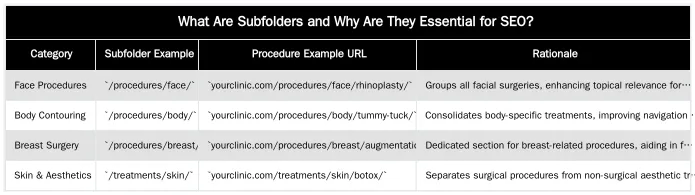
A subfolder structure for plastic surgery logically categorizes procedures. For example, a `/procedures/` folder can branch into `/face/`, `/body/`, `/breast/`, and `/skin/`. Specific procedures would reside within these, such as `/procedures/face/rhinoplasty/` or `/procedures/body/tummy-tuck/`. This structure communicates the site’s content organization to users and search engines.
Best Practices for Medical Content Hierarchy
Subfolder names should be short, descriptive, and keyword-rich where appropriate. Avoid excessive nesting; a maximum of 3-4 levels deep keeps URLs manageable. Consistency in naming conventions and structure across specialties is paramount. This ensures clarity for users and crawlers, allowing efficient indexing and understanding of the site’s medical offerings.
Subfolders and the Semantic SEO Advantage for Medical Clinics
For medical practices, subfolders are a critical component of a semantic content network. Semantic SEO Strategist Abdurrahman Simsek emphasizes that this architectural choice impacts a site’s ability to communicate expertise and relevance to search engines, especially for YMYL (Your Money Your Life) content.
Reducing Cost of Retrieval with Optimized URL Paths
A clear subfolder structure helps search engines efficiently understand and retrieve information, impacting the ‘Cost of Retrieval’. When content is logically organized, crawlers spend fewer resources deciphering the site’s architecture, improving indexing efficiency. For complex medical sites, optimizing URL paths by reducing Cost of Retrieval ensures medical content is discovered and ranked effectively.
Reinforcing Entity Relationships Through Subfolder Design
Subfolders reinforce entity-attribute-value (EAV) relationships, a key aspect of semantic SEO. By grouping content, they help search engines connect medical procedures (entities) with their attributes (e.g., recovery time, benefits, risks) and specialties. For example, `/procedures/face/rhinoplasty/` links ‘rhinoplasty’ to ‘face procedures’. This strengthens the site’s contribution to the search engine’s knowledge graph, signaling expertise and comprehensive coverage. This is vital for medical content, where precision and context are paramount for E-E-A-T signals. Google’s guidelines emphasize a well-structured site for discoverability.
Maximizing Subfolder Impact: Internal Linking and Breadcrumb Navigation
To maximize subfolder benefits, integrate them with internal linking strategies and clear breadcrumb navigation. These elements work together to enhance SEO performance and user experience.
Strategic Internal Linking within Subfolder Silos
Internal linking within subfolder silos reinforces topical relevance and distributes link equity. Pages within the same subfolder should link to each other, signaling their relationship. For instance, within `/procedures/face/`, a ‘rhinoplasty recovery’ page could link to a ‘rhinoplasty before and after gallery’. Linking between related subfolders (e.g., from a ‘rhinoplasty’ page to a ‘facelift’ page) strengthens broader topical hubs. An effective internal linking strategy, potentially automated, helps search engines understand semantic connections, improving crawlability and authority flow.
Implementing Effective Breadcrumb Navigation
Breadcrumb navigation, often mirroring the subfolder structure, shows users their location on the website (e.g., Home > Procedures > Face > Rhinoplasty), simplifying navigation. Breadcrumbs also provide internal linking signals to search engines, reinforcing the site’s content hierarchy and helping crawlers understand page relationships. Nielsen Norman Group research highlights the usability benefits of breadcrumbs.
Ready to Optimize Your Medical Website’s Architecture?
A planned site architecture using subfolders is foundational for SEO success, particularly for medical clinics. A structure that communicates clarity and authority to patients and search engines is paramount for organic growth.
Book a Semantic SEO Audit Today
For plastic surgeons, aesthetic clinic owners, and medical directors in London, optimizing website architecture is a strategic investment. A Semantic SEO audit assesses your URL structure, identifies improvements, and helps build a semantic content network. Book a Semantic SEO Audit or contact the WhatsApp Strategy Line: +90 506 206 86 86.
Conclusion
A logical subfolder structure is fundamental to site architecture, especially for medical websites building topical authority. Organizing content into subdirectories enhances user experience, improves crawlability, and reduces the ‘Cost of Retrieval’ for search engines. This approach, combined with internal linking and breadcrumb navigation, forms the backbone of a semantic content network. For London’s private healthcare providers, mastering these elements is key to organic growth and patient acquisition in 2026. To explore a tailored semantic SEO strategy, contact us, Book a Semantic SEO Audit, or use our Direct WhatsApp Strategy Line: +90 506 206 86 86.
Frequently Asked Questions
What are the primary benefits of using subfolders for SEO on a medical website?
Using subfolders for SEO creates a clear, logical hierarchy for your content, such as `/face/` or `/body/`. This structure helps search engines understand that all pages within a specific subfolder are related, strengthening the topical relevance of that entire section for medical specialties. It significantly improves how search engines crawl and index your site.
How does a well-structured subfolder system improve user experience on a medical website?
<
Ruxi Data brings together multi-model AI, automated website crawling, live indexation checks, topical authority mapping, E-E-A-T enrichment, schema generation, and full pipeline automation — from crawl to WordPress publish to social posting — all in one platform built for agencies and freelancers who run on results.