Semantic HTML AI Overviews: Structuring Content for Generative Search
In 2026, mastering semantic html ai overviews structure is essential for winning AI Overviews and dominating generative search results. This article details how structured HTML provides explicit signals for AI models, enabling precise information extraction and superior content presentation. By leveraging HTML5 semantics and structured data, websites can optimize for generative engine optimization (GEO), ensuring their content is accurately understood, summarized, and featured as definitive answers in AI-driven search experiences. Semantic clarity is critical for AI to differentiate content purpose and build robust knowledge graphs.
Abdurrahman Şimşek, a Semantic SEO Strategist, specializes in Semantic Engineering for E-E-A-T, particularly for YMYL sectors like medical clinics. His approach ensures content architecture provides the contextual signals AI needs to recognize authority and relevance.
To explore your options, contact us to schedule your consultation.
In 2026, mastering semantic html ai overviews structure is essential for winning AI Overviews and dominating generative search results. Structured HTML provides the explicit signals AI models need to understand, extract, and present your content, ensuring your expertise stands out in an AI-driven search landscape.
What is Semantic HTML and Why is it Critical for AI Overviews?
Semantic HTML uses tags that convey meaning about the content they enclose, not just its appearance. This contextual information is critical for AI Overviews because generative AI models rely on understanding a content’s meaning and hierarchical structure to summarize and present information. Without semantic clarity, AI cannot differentiate main content from navigation or supplementary material, leading to less accurate or incomplete generative responses.
In 2026, with generative search engines, an AI’s ability to interpret content’s purpose is critical. Semantic markup guides AI, enabling precise information extraction and increasing the likelihood of your content being featured as a definitive answer in AI Overviews.
Standard vs. Semantic HTML: A Foundational Distinction
Standard and semantic HTML differ in intent. Standard tags like `
Semantic tags like “, `
How Semantic HTML Fuels Generative Engine Optimization (GEO)
Generative Engine Optimization (GEO) is structuring and optimizing content for AI-driven search experiences, with semantic HTML as its backbone. AI models comprehend the context and relationships within a document, not just keywords. Semantic structure provides this context, allowing AI to perform information extraction, identify key entities, and build knowledge graphs.
When content is semantically rich, AI can efficiently parse the document, understanding which parts are main arguments, supporting details, or navigational elements. This efficiency impacts the ‘Cost of Retrieval’ (CoR) for AI. A lower CoR means AI can process content faster and more accurately, making it a more attractive source for generative answers. Websites with poor semantic structure force AI to expend more computational resources to infer meaning, potentially causing their content to be overlooked for more clearly structured alternatives.
For advanced strategies, see technical SEO for AI Overviews.
The AI’s Blueprint: Information Extraction and Entity Understanding
AI models treat semantic tags as a content blueprint. An “ tag indicates primary, self-contained content. Within that article, `
Precise entity recognition is fundamental for AI-generated summaries and answers. If an AI can distinguish a medical procedure from a patient testimonial with proper semantic tagging, it provides more accurate, contextually relevant responses. This improves the quality of AI-generated summaries. Semantic structure also helps populate the knowledge graph, enhancing your site’s topical authority.
Crafting Content for AI: Essential Semantic HTML Tags & Practices
Optimizing for AI Overviews requires strategic use of HTML5 semantic tags. These tags provide explicit signals to AI models, clarifying the role and hierarchy of content elements. Integrating structured data (Schema.org) further enhances AI comprehension. Proper implementation makes content digestible for generative AI.
This approach moves beyond keyword optimization to create an entity-centric content architecture that AI can interpret and use. Adopting these practices improves a website’s chances of appearing in AI-generated summaries and featured snippets.
Key HTML5 Tags for Optimal AI Comprehension
The following HTML5 tags are important for AI comprehension:
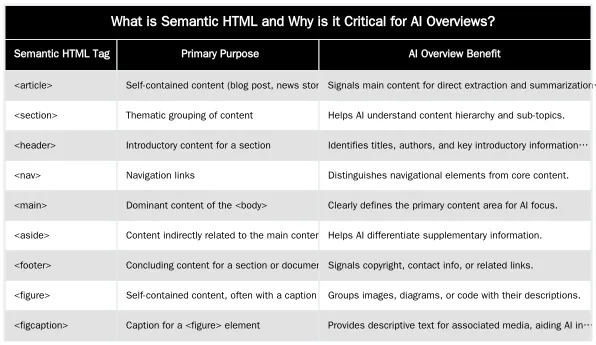
Proper use of `
Beyond Tags: Structuring for Clarity and Context
Beyond tags, the logical flow and presentation of content matter. A clear heading hierarchy (H1-H6) guides AI through the article’s main points and sub-topics. Lists (`
- `, `
- `) allow AI to extract key information or steps as concise answers. Each paragraph (`
`) should focus on a single idea with clear language to prevent ambiguity for AI models.
For example, a medical clinic’s service page should use “ for the main service description, `
` for benefits or FAQs. This structure helps AI identify and retrieve precise answers to queries like “What are the benefits of [procedure]?” or “How long does [treatment] take?”.
Abdurrahman Şimşek’s Approach: Semantic Engineering for E-E-A-T
Abdurrahman Şimşek’s semantic engineering principles build high-authority content networks. As a Semantic SEO Strategist with over a decade of experience, he crafts digital architectures that explicitly signal E-E-A-T (Experience, Expertise, Authoritativeness, Trustworthiness) to AI models, which is crucial for YMYL niches like medical clinics and plastic surgeons in London. His approach integrates advanced semantic HTML with data strategies, ensuring content is trusted and prioritized by generative AI.
His methodology creates a semantic layer that allows AI to verify facts, understand the context of expertise, and recognize the authoritative voice behind the content. This is vital for practices in competitive areas like Harley Street, where verifiable authority is essential for patient acquisition and trust.
Ruxi Data & Entity-Attribute-Value (EAV) Modeling for AI Trust
Abdurrahman Şimşek’s strategy integrates advanced semantic infrastructure like Ruxi Data with Entity-Attribute-Value (EAV) modeling. This framework provides AI with granular, verifiable information about entities (e.g., a medical procedure, a surgeon, a clinic) and their attributes (e.g., qualifications, success rates, location). Explicitly defining these relationships and values makes the content machine-readable and trustworthy.
EAV modeling creates an interconnected web of data that AI can cross-reference, boosting trust and authority signals. This detail supports Algorithmic Authorship, where AI can confidently attribute expertise to the content’s source. For medical content, AI can discern between general health advice and information from a GMC-registered consultant surgeon. This advanced semantic engineering is key to a dominant online presence. Learn more about semantic engineering for AI.
The Tangible Impact: What to Expect from Semantic HTML Optimization?
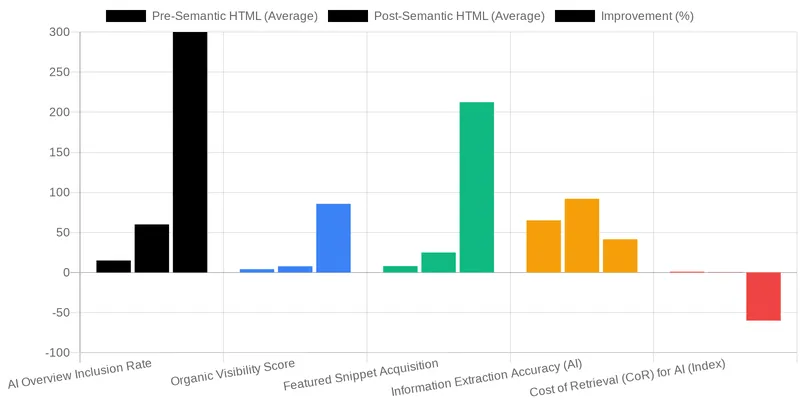
Semantic HTML offers measurable benefits for search visibility and digital presence. Websites with semantic HTML experience improved visibility in AI Overviews because their content is more easily understood and extracted by generative AI. This improves organic rankings, as search engines prioritize clear, structured information. Better AI content comprehension can also lead to higher click-through rates from more relevant and accurate summaries.
For medical practices, this means more patient inquiries and bookings. A plastic surgeon’s website with semantic structure is more likely to have its service descriptions, surgeon bios, and patient testimonials summarized by AI, positioning it as a trusted source. This builds topical authority and establishes the practice as a leader in its field.
Beyond Rankings: Winning the Generative Search Landscape
Semantic HTML benefits extend beyond traditional search rankings. In the 2026 generative search landscape, semantically marked-up content can be directly quoted or summarized by AI, leading to ‘answer box’ visibility and increased brand presence in generative results. This direct exposure makes your content the voice of authority for specific queries, even without a click to your website.
This advantage is valuable for building a ‘Topical Authority State,’ where AI consistently recognizes your website as the definitive source for a topic cluster. A London aesthetic clinic could dominate AI Overviews for queries about specific treatments, dermatological conditions, or surgical procedures. The long-term impact is a sustained competitive edge and a stronger digital footprint.
Impact metrics for websites with comprehensive semantic HTML strategies:
Future-Proof Your Digital Presence: Partner with a Semantic SEO Expert
For plastic surgeons, aesthetic clinic owners, and medical directors in London, securing prominence in AI Overviews is critical for attracting high-value patients. Abdurrahman Şimşek specializes in building high-authority Semantic Content Networks for YMYL niches, ensuring your digital presence is future-proof. Use expert semantic engineering to dominate local organic search across Harley Street and premium London postcodes.
Partner with a specialist in medical SEO and advanced semantic strategies. Contact Abdurrahman Şimşek today to transform your digital strategy and win the generative search landscape.
Conclusion
In 2026, a semantic HTML structure is the foundation for winning AI Overviews and establishing topical authority. By providing explicit context and clarity to generative AI models, websites ensure their content is understood, retrieved, and prominently featured. The shift from keyword-centric optimization to entity-based semantic engineering is a fundamental re-evaluation of how content delivers value. Embracing these principles is essential to thrive in the evolving search ecosystem.
Frequently Asked Questions
How does semantic HTML structure specifically benefit semantic html ai overviews compared to standard HTML?
Standard HTML primarily dictates visual presentation, using generic tags like `
Why is semantic html ai overviews critical for winning AI Overviews?
AI models need to understand the structure and meaning of content to generate reliable summaries. Semantic HTML acts as a clear blueprint, helping the AI distinguish between main content, sidebars, and headers, making your information easier to extract and cite for semantic html ai overviews. This precise structuring ensures your content is prioritized in generative search results.
What is the single most important semantic tag for a blog post to improve its chances in AI Overviews?
The “ tag is fundamental. It clearly defines the primary, self-contained piece of content on the page, signaling to AI that this is the core information it should focus on for generating an overview. This helps AI models isolate and prioritize the main narrative of your post.
How should I use header tags (H1, H2, H3) for optimal AI understanding?
Use a logical, hierarchical structure for your header tags. Your H1 should be the main title, H2s for major sections, and H3s for sub-points or specific questions within those sections. This clear hierarchy allows AI to understand the document’s flow and extract precise answers from well-defined subsections.
Does optimizing for AI Overviews mean I need to completely recode my clinic’s website?
Not necessarily. Often, significant improvements can be made within your existing content management system by focusing on new content. The priority is to ensure key procedure pages and articles are built using a correct semantic HTML structure from the start, and to gradually update older, high-value content.
How can Abdurrahman Şimşek help my clinic implement effective semantic html ai overviews strategies?
Abdurrahman Şimşek specializes in Semantic Engineering and holistic SEO strategies tailored for medical clinics. He can assess your current website, identify critical areas for semantic improvement, and implement structures that enhance your content’s visibility and performance in semantic html ai overviews. This ensures your expertise is accurately represented in generative search.
Ruxi Data brings together multi-model AI, automated website crawling, live indexation checks, topical authority mapping, E-E-A-T enrichment, schema generation, and full pipeline automation — from crawl to WordPress publish to social posting — all in one platform built for agencies and freelancers who run on results.