
Cost of Retrieval SEO: Optimizing Search Engine Processing Efficiency
Understanding cost of retrieval seo is crucial for digital visibility. This article explains how the Cost of Retrieval (CoR) quantifies computational resources search engines expend to crawl, render, and comprehend web content. Lowering your cost of retrieval seo improves crawl budget efficiency and information retrieval, especially vital for medical clinics and plastic surgeons in competitive markets. Optimizing CoR through technical SEO, semantic HTML, and efficient website architecture enhances topical authority and E-E-A-T signals, leading to better indexing and ranking for high-value procedures.
Abdurrahman Şimşek, a Semantic SEO Strategist and Web Developer, specializes in building high-authority semantic content networks for medical clinics. His expertise in information retrieval and EAV modeling helps London-based plastic surgeons and aesthetic clinics achieve superior organic visibility.
To explore your options, contact us to schedule your consultation.
Many web developers overlook a critical technical SEO metric: the cost of retrieval seo. For medical clinics and plastic surgeons, optimizing your website’s computational efficiency is fundamental to achieving superior organic visibility and establishing topical authority in competitive London markets.
What is Cost of Retrieval (CoR) in SEO, Simply Put?
The Cost of Retrieval (CoR) quantifies the computational resources a search engine expends to crawl, render, and comprehend a webpage. A lower CoR indicates an efficient, well-structured website that is less resource-intensive for search engines to process. This efficiency is a positive signal.
Search engines like Google operate on finite resources. On a webpage, they crawl to download raw HTML; render by executing JavaScript and building the Document Object Model (DOM); and analyze content to understand its meaning, entities, and relevance. Each step consumes computational power, and the sum is the Cost of Retrieval. Optimizing this cost allows search engines to process more of your content, which can lead to better indexing and ranking.
Semantic HTML & EAV: The Blueprint for Lower CoR
Two strategies for optimizing Cost of Retrieval for complex medical information are implementing clean semantic HTML and leveraging Entity-Attribute-Value (EAV) modeling. These approaches streamline search engine processing and reduce the effort required for comprehension.
Clean, semantic HTML provides a clear structure that reduces rendering effort, allowing search engines to discern the purpose of content blocks. Complementing this, Entity-Attribute-Value (EAV) modeling for medical data offers a structured way to organize complex information, making it easier for algorithms to understand relationships between medical entities, procedures, and conditions. This lowers the ‘understanding’ cost for search engines.
Structuring Medical Data with EAV Models
EAV modeling is a data architecture pattern defining entities (e.g., “Rhinoplasty Procedure”), their attributes (e.g., “Recovery Time,” “Cost Range,” “Benefits”), and the values for those attributes. For medical clinics, this means defining procedures, conditions, and treatments with machine-readable data points. Instead of unstructured text, EAV provides a tabular representation that search engines can parse efficiently. This reduces ambiguity and the computational load of extracting meaning from natural language, lowering the processing cost for search engines.
Consider the difference in how a search engine might process information about a “Breast Augmentation” procedure:
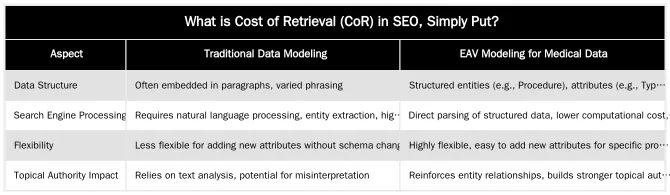
The Role of Semantic HTML in Efficient Processing
Semantic HTML uses appropriate HTML5 tags to convey meaning, not just presentation. Using “ for blog posts, `
Measuring & Optimizing CoR: An Expert’s Approach
Cost of Retrieval is not a directly reported metric, but its impact is observable through performance indicators. Metrics like Core Web Vitals, server log files, and Google Search Console’s crawl statistics provide insights into how efficiently search engines process a site.
As a specialist in semantic engineering for medical clinics, Abdurrahman Şimşek analyzes server response times, page load performance, and content rendering efficiency to mitigate high CoR. Using tools like Ruxi Data’s semantic infrastructure, it is possible to pinpoint where search engines expend excessive resources and implement targeted optimizations.
Key Metrics Indicating High CoR
Several performance metrics serve as indicators of a high Cost of Retrieval:
- Time to First Byte (TTFB): A high TTFB suggests server-side processing inefficiencies. It increases the time and resources a search engine needs to start processing the page.
- Largest Contentful Paint (LCP): A slow LCP indicates the main content takes a long time to render. This can be caused by large images, render-blocking JavaScript, or inefficient CSS, all contributing to higher rendering costs for search engines.
- Server Response Times: Consistently slow server response times signal infrastructure issues or inefficient database queries, forcing search engines to wait longer and consume more resources per page.
- Crawl Stats in Google Search Console: Monitoring the average response time and total crawl requests in Search Console can reveal patterns. An increase in average response time or a decrease in crawled pages per day might indicate a rising CoR. For more details, refer to Google’s documentation on monitoring crawl budget.
Analyzing these metrics helps identify the root causes of high CoR, such as bloated code, inefficient website architecture, or a lack of semantic structure, allowing for targeted solutions.
The ROI of CoR Optimization for London’s Elite Clinics
For plastic surgeons and aesthetic clinic owners in competitive London locales like Harley Street, optimizing the Cost of Retrieval provides business advantages. A website with a lower CoR drives organic growth and enhances market presence.
Reduced CoR means search engines can crawl and understand more content more frequently. This leads to improved indexing and rankings for search terms like “rhinoplasty London” or “dermal fillers Harley Street,” increasing organic traffic from patients seeking your services. A semantically efficient site also supports the demonstration of E-E-A-T for YMYL sites, building long-term topical authority.
Investment in CoR optimization yields a return by making a digital footprint more authoritative. It helps a clinic attract patients and stand out in a competitive market. Studies show a correlation between site speed, efficiency, and higher search rankings, which impacts user experience and conversion rates.
Ready to Transform Your Clinic’s Digital Footprint?
Optimizing the cost of retrieval seo is a fundamental part of medical SEO. For plastic surgeons and aesthetic clinics in London, establishing topical authority requires a specialized approach, as general web developers often lack the semantic engineering expertise for search engine efficiency.
Abdurrahman Şimşek specializes in building semantic content networks for medical practices. By focusing on strategies like EAV modeling and CoR optimization, your website can achieve organic visibility and attract patients. Contact Abdurrahman Şimşek today for a consultation.
Frequently Asked Questions
What is cost of retrieval seo?
The cost of retrieval seo quantifies the computational resources a search engine expends to crawl, render, and comprehend a webpage. A lower CoR indicates an efficient, well-structured website that is less resource-intensive for search engines to process. This efficiency is a positive signal for search engine algorithms.
Why is optimizing the cost of retrieval important for medical clinics?
For medical clinics and plastic surgeons in competitive YMYL (Your Money Your Life) markets, technical efficiency is a key differentiator. A lower retrieval cost allows search engines to index your content faster and understand your expertise more deeply. This provides a significant edge over competitors with bloated, inefficient websites, improving your organic visibility.
What factors increase the cost of retrieval seo for a healthcare website?
Large, unoptimized images, excessive JavaScript, and a complex, non-semantic HTML structure are primary culprits. These elements force search engines to expend more processing power to extract the main content and understand its context. Reducing these inefficiencies directly lowers the overall cost of retrieval seo.
How does an Entity-Attribute-Value (EAV) model impact the cost of retrieval?
An EAV model, when implemented with structured data, presents information in a clear, machine-readable format. This pre-digests complex data for search engines, drastically reducing the processing power needed to understand topics like surgical procedures or medical conditions. It significantly lowers the computational effort required for information retrieval.
Can a standard web developer fully optimize for cost of retrieval seo?
While a developer can address site speed, optimizing for the cost of retrieval seo requires a deep understanding of information retrieval and semantic engineering. It is a specialized SEO discipline focused on how search engines process information, not just how users see a page. An SEO specialist with expertise in semantic structures is crucial for comprehensive optimization.
How can I begin optimizing my clinic’s website for lower retrieval costs?
To start optimizing your clinic’s website for improved computational efficiency, consider a specialized semantic SEO audit. Abdurrahman Şimşek offers expert consulting for London-based medical and aesthetic clinics. You can learn more about our services and schedule a consultation on our website to transform your digital footprint.
Ruxi Data brings together multi-model AI, automated website crawling, live indexation checks, topical authority mapping, E-E-A-T enrichment, schema generation, and full pipeline automation — from crawl to WordPress publish to social posting — all in one platform built for agencies and freelancers who run on results.