Automated Internal Linking: Scaling Medical Content Authority
Automated internal linking programmatically connects semantically related content, crucial for building high-authority medical knowledge bases. This approach enhances information architecture, distributes link equity effectively, and strengthens a site’s semantic content network. For YMYL medical domains, automated internal linking boosts topical authority and E-E-A-T signals by creating a cohesive web of interconnected information. It streamlines content organization and improves search engine crawlability, ensuring comprehensive coverage and understanding of complex medical topics.
Abdurrahman Şimşek, a Semantic SEO Strategist, specializes in leveraging these advanced techniques to build robust semantic content networks for medical clinics. His expertise focuses on optimizing information retrieval and demonstrating E-E-A-T for YMYL healthcare websites.
To explore your options, contact us to schedule your consultation.
Automated internal linking uses programmatic methods to connect semantically related content, enhancing website structure and search engine visibility. This practice builds high-authority medical knowledge bases by strengthening the site’s semantic content network and boosting topical authority, vital for Your Money Your Life (YMYL) medical domains.
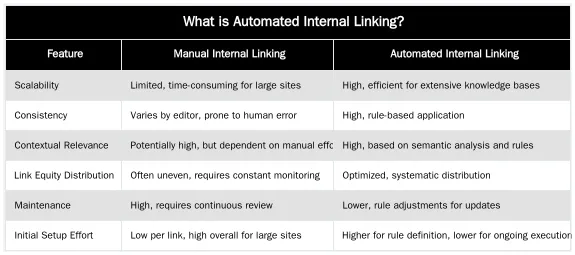
What is Automated Internal Linking?
Automated internal linking programmatically identifies and inserts hyperlinks between pages on the same website. It enhances information architecture, improves search engine crawlability, and distributes link equity. Unlike time-consuming and inconsistent manual linking, automation uses predefined rules and data analysis for relevant connections across a large content repository.
This approach is indispensable for large medical knowledge bases with thousands of articles. It connects content to related topics, creating a cohesive information web that supports user navigation and search engine understanding of the site’s topical depth. Learn more about understanding automated internal linking.
How Does Automated Internal Linking Enhance Medical SEO?
Strategic internal linking is paramount for YMYL (Your Money Your Life) medical websites. It strengthens the site’s semantic content network to demonstrate E-E-A-T (Experience, Expertise, Authoritativeness, and Trustworthiness). By connecting related medical concepts, automated linking helps search engines understand a site’s topical depth and breadth.
It ensures efficient link equity distribution, flowing authority from high-value pages to supporting content. It also optimizes contextual linking, where anchor text signals the relevance of linked pages. For instance, linking “rhinoplasty recovery” to a page on post-operative care with that anchor text reinforces the semantic relationship between the topics.
Boosting E-E-A-T and Topical Authority
Well-structured internal links signal a site’s comprehensive subject understanding to search engines. For YMYL content, where accuracy and reliability are critical, this structure demonstrates topical authority. Each link indicates the linked page provides valuable information on a sub-topic. This interconnectedness helps search engines recognize the site as an authoritative source, enhancing its E-E-A-T signals.
When a medical knowledge base links related articles, such as a “breast augmentation” overview to pages on “implant types” or “recovery timelines,” it builds a semantic content network. This network signals expertise and authority within the plastic surgery domain.
Optimizing Information Architecture for Patient Journeys
Automated linking creates logical pathways for users and search engine crawlers. A well-organized information architecture improves user experience by guiding patients through relevant information, from symptoms to treatment and recovery. For example, a patient researching “acne treatments” can navigate to pages on “chemical peels,” “laser therapy,” and “topical medications.”
This navigation reduces bounce rates and increases engagement as users find answers efficiently. For search bots, a clear internal linking structure improves crawlability, helping them discover and index all pages. Efficient indexing is vital for large medical sites, ensuring all content contributes to visibility and PageRank distribution.
Building a Scalable Automated Linking Workflow
An effective automated internal linking system requires a structured workflow from content analysis to rule implementation. The workflow must be scalable to accommodate growing medical knowledge bases. Python for SEO automation enables data analysis and identifies linking opportunities impractical to find manually.
The process starts with a content audit to identify core entities and their relationships. Linking rules are then defined to ensure contextual relevance and contribute to the semantic content network. This systematic approach reduces manual effort and ensures consistency across thousands of pages.
Defining Content Entities and Relationships
Understanding content entities is the foundation of an automated linking strategy. For medical knowledge bases, this means identifying entities like diseases (“melanoma”), treatments (“Mohs surgery”), procedures (“liposuction”), anatomical terms (“dermis”), and concepts (“skin cancer prevention”). These entities are then mapped to understand their semantic relationships.
This mapping goes beyond keyword matching, involving hierarchical, associative, and causal links between topics. For instance, “rhinoplasty” is related to “nasal anatomy” (associative), “septoplasty” (similar procedure), and “post-operative care” (causal). NLP tools can extract these entities and relationships to form the basis for link suggestions. This structured approach is critical for a scalable automated linking workflow.
Setting Intelligent Linking Rules and Parameters
After defining entities and relationships, establish rules for link placement that dictate when and how links are inserted. Parameters can include semantic similarity scores, anchor text keyword density, content categories, and link depth (e.g., preventing deep pages from linking to the homepage). Rules might also specify a maximum number of links per page to avoid over-optimization.
For example, a rule could state: “If a page discusses ‘dermal fillers’ and contains the phrase ‘hyaluronic acid,’ link to the dedicated ‘hyaluronic acid fillers’ page, using ‘hyaluronic acid fillers’ as anchor text, but only if the target page is not already linked on the current page.” These rules ensure links are contextually relevant and contribute to link equity distribution. This systematic approach is a cornerstone of SEO automation.
Leveraging Ruxi Data for Semantic Content Networks
Specialized platforms like Ruxi Data offer advantages for advanced semantic SEO in complex medical domains. Abdurrahman Şimşek, a London-based Semantic SEO Strategist, uses Ruxi Data to integrate semantic analysis into automated linking strategies. The platform moves beyond keyword matching to understand content relationships for building topic clusters and a semantic content network.
Ruxi Data identifies nuanced connections between medical entities, ensuring semantically precise internal links. This precision is vital for YMYL content, where accuracy impacts E-E-A-T. For London’s private healthcare providers on Harley Street, this semantic engineering translates into higher organic visibility and authority.
Learn more about internal linking automation with Ruxi Data.
Ruxi Data’s Role in Entity-Attribute-Value Modeling
Ruxi Data facilitates Entity-Attribute-Value (EAV) modeling for medical content. This structured data approach defines medical entities (e.g., “Botox”), their attributes (“active ingredient,” “treatment areas,” “side effects”), and corresponding values. This content structure allows Ruxi Data to identify granular relationships between pages.
For instance, it can link a page on “forehead lines” to a page on “Botox” because Botox is a treatment for that attribute. This surpasses keyword co-occurrence, creating an interconnected knowledge base. This semantic understanding helps search engines interpret and rank complex medical information.
Optimizing Cost of Retrieval for Large Medical Sites
The “Cost of Retrieval” (CoR) is the effort search engines expend to understand and retrieve information from a website. Inefficient internal linking on large medical sites increases this cost, hindering crawl budget use and organic visibility. Ruxi Data optimizes the internal linking structure, making it easier for search bots to navigate and comprehend site content.
Linking semantically related pages reduces the ‘cognitive load’ for crawlers. This efficiency helps search engines identify authoritative pages within a topic cluster faster, improving indexing speed and accuracy. The result is a more discoverable, higher-ranking medical website, beneficial for competitive markets like London’s private healthcare sector. Google’s Search Central documentation provides foundational insights into search engine operation.
Measuring the Impact: Topical Authority & Link Equity Gains
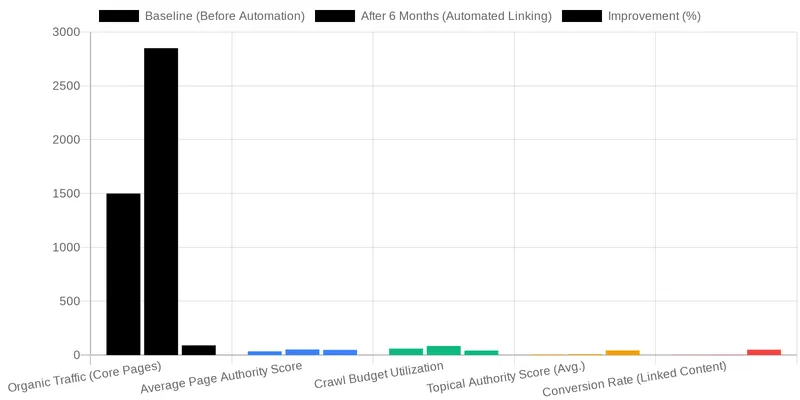
Tracking the success of an automated internal linking strategy demonstrates its value and helps refine the approach. Primary success indicators include improved organic rankings, increased page authority scores, and more efficient crawl budget utilization. These technical improvements translate to business results for medical clinics, like more patient inquiries and bookings.
Systematic link equity distribution gives core service and informational pages the authority signals needed to rank competitively. Higher user engagement (lower bounce rates, longer time on site) indicates the improved information architecture serves patient needs. This site performance improvement shows the ROI of the linking strategy.
Key Metrics for Evaluating Linking Performance
Monitor key performance indicators (KPIs) to assess the impact of automated internal linking. PageRank distribution analysis visualizes authority flow, identifying bottlenecks or under-optimized pages. Topical authority scores from SEO tools quantify the site’s perceived expertise on specific subjects.
Organic traffic to core service and supporting pages is a direct indicator of improved visibility. Tracking conversion rates from pages in the semantic content network shows how the linking strategy guides users toward actions, such as booking a consultation. Monitoring these metrics allows for continuous optimization and ensures the strategy aligns with business objectives. Stanford University’s original PageRank paper provides context for these measurements.
Transform Your Medical Knowledge Base with Semantic Automation
Automated internal linking is a strategic imperative for medical knowledge bases to achieve top organic visibility and E-E-A-T in 2026. A semantic linking workflow enhances topical authority and patient engagement for private healthcare providers. Using tools like Ruxi Data ensures an information architecture that serves search engines and users.
A specialized semantic SEO approach is critical for London plastic surgeons, aesthetic clinic owners, and medical directors targeting Harley Street. Partner with an expert to improve your digital presence and local organic search. Visit abdurrahmansimsek.com to learn how semantic engineering can elevate your medical practice.
Frequently Asked Questions
How does automated internal linking work for medical knowledge bases?
This process leverages data analysis, often with tools like Python or specialized platforms like Ruxi Data, to identify semantically relevant linking opportunities across your website. Predefined rules are then applied to automatically insert these links based on content relationships, significantly reinforcing your site’s topical structure and authority. This approach is crucial for building high-authority medical knowledge bases.
What are the main advantages of implementing automated internal linking for large medical websites?
For medical sites with hundreds or thousands of pages on procedures and conditions, manual linking is highly inefficient and prone to inconsistencies. Implementing automated internal linking ensures every page contributes to a logical, semantically sound architecture, which is crucial for establishing and maintaining topical authority in YMYL niches. It enhances information architecture, improves search engine crawlability, and distributes link equity effectively.
Can incorrect implementation of internal link automation negatively impact SEO?
Yes, if not executed with sophistication. Over-optimization with exact-match anchor text or relying on basic, rule-less plugins can appear manipulative to search engines. A data-driven approach is essential to create natural, helpful links that genuinely enhance user experience and semantic context, avoiding potential penalties.
What is a ‘Semantic Content Network’ in the context of medical SEO?
A Semantic Content Network represents an advanced site architecture where content is interconnected based on its underlying meaning and entity relationships, rather than just keywords. This approach builds a powerful knowledge base that is intuitive for both users and search engines to navigate and understand, crucial for complex medical topics. It strengthens the site’s overall topical authority.
Does automated internal linking completely replace the need for manual link building?
Not entirely. While automation handles the bulk of the work at scale, particularly for extensive medical knowledge bases, strategic manual links remain highly valuable. These often include links from pillar pages to their most critical cluster content, providing the finishing touches to the automated foundation. Automated internal linking provides the scalable foundation, while manual links add strategic depth.
How can I begin transforming my medical knowledge base with semantic automation?
To explore how semantic automation can enhance your medical website’s topical authority and organic growth, you can contact Abdurrahman Şimşek directly. As a London-based Semantic SEO Strategist, he specializes in building high-authority Semantic Content Networks for medical clinics and surgeons. Visit abdurrahmansimsek.com for more information or to schedule a consultation.
Ruxi Data brings together multi-model AI, automated website crawling, live indexation checks, topical authority mapping, E-E-A-T enrichment, schema generation, and full pipeline automation — from crawl to WordPress publish to social posting — all in one platform built for agencies and freelancers who run on results.