
Rhinoplasty Patient Acquisition: Semantic Strategy for High-value Leads
Effective rhinoplasty patient acquisition in competitive markets demands a semantic content strategy. This approach moves beyond isolated keywords, focusing on comprehensive topic coverage and understanding the patient journey. By building topical authority through structured content like pillar pages and topic clusters, clinics can satisfy complex user intent, demonstrate expertise, and attract high-value patients. This strategy ensures search engines recognize your clinic as a definitive resource for rhinoplasty, driving qualified traffic and improving conversion rates.
Abdurrahman Şimşek, a Semantic SEO Strategist with 10 years of experience, specializes in building high-authority semantic content networks for medical clinics and plastic surgeons. His expertise ensures robust digital strategies that enhance trust and visibility in the YMYL search landscape.
To explore your options, contact us to schedule your consultation.
Attracting high-value rhinoplasty patient acquisition in a competitive market like London requires more than basic SEO. A semantic content strategy builds authority and drives patient acquisition by answering every facet of the patient’s journey. Understanding user intent, combined with a content architecture, connects clinics with patients seeking specialized aesthetic procedures.
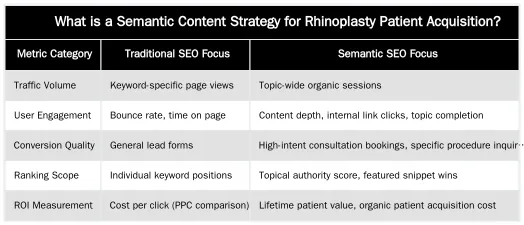
What is a Semantic Content Strategy for Rhinoplasty Patient Acquisition?
A semantic content strategy for rhinoplasty marketing focuses on comprehensive topic coverage and the relationships between entities, not isolated keywords. It satisfies user intent by providing detailed, interconnected information about rhinoplasty, its related concepts, and the patient journey. This approach helps search engines understand your clinic’s expertise, leading to higher rankings and more qualified traffic.
Beyond Keywords: Understanding Patient Search Intent
Patients researching rhinoplasty rarely use single keywords. Their journey involves complex questions, evolving from initial curiosity (“nose job cost”) to specific concerns (“rhinoplasty recovery timeline”) and surgeon selection (“best rhinoplasty surgeon London”). A semantic strategy anticipates these queries, creating content that addresses each stage. A patient’s intent is multifaceted, encompassing medical facts, aesthetic considerations, logistical details, and emotional reassurance.
E-E-A-T & YMYL: Essential for Trust in Medical SEO
For Your Money Your Life (YMYL) topics like plastic surgery, E-E-A-T (Experience, Expertise, Authoritativeness, Trustworthiness) is critical. Google’s quality guidelines emphasize these factors for reliable health and finance information. Demonstrating E-E-A-T builds patient confidence and impacts search rankings. Abdurrahman Şimşek’s medical SEO expertise focuses on configuring content to meet these requirements.
Demonstrating Expertise: Surgeon Bios and Medical Content Configuration
Detailed, verified surgeon biographies are essential. They should highlight credentials, years of experience, specializations, and professional affiliations. For UK clinics, mentioning General Medical Council (GMC) registration is essential. Medical content must attribute authorship to qualified professionals to ensure accuracy and authority. This aligns with Google’s requirements for expert-authored YMYL content and establishes the clinic’s expertise in nose job SEO.
Building Trust: Patient Testimonials and Transparent Information
Authentic patient testimonials, especially video, build trust. Transparent information on procedures, including benefits, risks, expected outcomes, and pricing, is vital. Clear FAQs, using FAQ schema, address common patient concerns. This openness builds reliability, which is crucial for patients considering medical decisions.
Optimizing for Conversion: Content Types That Attract High-Value Patients
Attracting high-value rhinoplasty patients requires content that informs, inspires confidence, and converts. This requires deploying and optimizing specific content types. Competitors often overlook visual content and precise long-tail keyword targeting, creating gap opportunities.
The Power of ‘Before & After’ Galleries and Video Testimonials
High-quality, ethically presented before and after galleries are indispensable. They should showcase diverse patient examples, demonstrating the surgeon’s skill. Video testimonials offer an authentic perspective from satisfied patients. Optimize these visuals with descriptive alt text for images, video transcriptions, and hosting on platforms like YouTube. Organizations like the American Society of Plastic Surgeons emphasize ethical presentation of such content.
Targeting Niche & Long-Tail Keywords: ‘Ethnic Rhinoplasty London’
Targeting specific, long-tail keywords captures qualified leads with clear intent. Phrases like “ethnic rhinoplasty London,” “revision rhinoplasty Harley Street,” or “non-surgical nose job Marylebone” reflect precise patient needs. These queries indicate a patient is seeking a specialist, not just researching. Creating dedicated content for these niche terms ensures your clinic appears for relevant, high-converting searches.
Measuring Success: KPIs for Rhinoplasty Patient Acquisition
Tracking key performance indicators (KPIs) evaluates the effectiveness of a semantic content strategy for rhinoplasty patient acquisition. Analyze organic traffic, engagement metrics, conversion rates, and return on investment (ROI). Continuous analysis allows for improvements to meet patient acquisition goals.
Analyzing Patient Journey Funnels and Conversion Paths
Mapping the patient’s digital journey from initial search to consultation booking is critical. Identify key conversion points like form submissions, phone calls, or appointment scheduling. Analyzing these paths pinpoints where patients engage most and where drop-offs occur. Understanding these funnels allows for targeted optimization to improve acquisition efficiency.
| Stage of Journey | Typical Duration (Days) | Key Engagement Metric | Conversion Rate (%) |
|---|---|---|---|
| Awareness (Initial Search) | 7-14 | Organic Traffic, Impressions | 0.5 – 1.0 |
| Consideration (Research) | 14-30 | Time on Page, Internal Clicks | 2.0 – 5.0 |
| Decision (Comparison) | 7-21 | Consultation Form Fills, Calls | 5.0 – 15.0 |
| Action (Booking) | 1-7 | Appointment Confirmation | 15.0 – 30.0 |
Partner with a Semantic SEO Expert for Your Clinic’s Growth
Securing high-value rhinoplasty patient acquisition in competitive markets like London demands a specialized approach. Abdurrahman Şimşek, a London-based Semantic SEO Strategist with over 10 years of experience, specializes in building semantic content networks for medical clinics and plastic surgeons. His expertise makes a clinic’s online presence authoritative and high-converting. Partner with an expert in medical SEO and semantic engineering.
Conclusion
A semantic content strategy is necessary for plastic surgeons to attract high-value rhinoplasty patients in competitive markets like London. Using topical authority, E-E-A-T principles, and content architecture, a clinic can improve organic search performance and build patient trust. This approach addresses every stage of the patient journey with expert, trustworthy information, leading to successful rhinoplasty patient acquisition. Partner with an expert in medical SEO and semantic engineering.
Frequently Asked Questions
How does a semantic content strategy improve rhinoplasty patient acquisition?
A semantic strategy goes beyond isolated keywords, focusing on comprehensive topic coverage and the relationships between entities. It satisfies user intent by providing detailed, interconnected information about rhinoplasty, which builds trust and authority. This holistic approach naturally attracts and converts high-value patients seeking specialized aesthetic procedures.
What is the key to successful rhinoplasty patient acquisition for high-value cases?
Showcasing expertise in complex cases, such as revision or ethnic rhinoplasty, is crucial. Creating detailed content around these niche areas demonstrates a higher level of skill and attracts a more discerning clientele. This specialized content strategy significantly aids in high-value rhinoplasty patient acquisition.
How do topic clusters support effective rhinoplasty patient acquisition?
Topic clusters organize content around a central ‘pillar page’ (e.g., ‘Rhinoplasty in London’) linked to specific ‘cluster’ articles (e.g., ‘Rhinoplasty Recovery’). This structure provides comprehensive information, establishing your clinic as an authority. It guides potential patients through their research journey, making their decision-making process smoother and leading to better rhinoplasty patient acquisition outcomes.
Why is E-E-A-T important for medical SEO and attracting rhinoplasty patients?
E-E-A-T (Experience, Expertise, Authoritativeness, Trustworthiness) is critical for YMYL (Your Money Your Life) topics like medical procedures. Demonstrating strong E-E-A-T builds patient trust and confidence in your clinic’s services. This directly influences a patient’s decision to choose your practice for a sensitive procedure like rhinoplasty.
What content types are most effective for converting high-value rhinoplasty patients?
Content that addresses specific patient concerns, showcases surgical expertise, and builds trust is highly effective. Detailed procedure guides, surgeon bios, patient testimonials, and case studies with before-and-after photos are crucial. These types of content help potential patients make informed decisions and feel confident in their choice of surgeon.
How can my clinic begin improving its rhinoplasty patient acquisition through semantic SEO?
Partnering with a specialized semantic SEO expert is the best first step. They can conduct a comprehensive audit, develop a tailored content architecture, and implement a strategy focused on your clinic’s unique goals. This ensures your online presence effectively attracts and converts high-value rhinoplasty patients.
Ruxi Data brings together multi-model AI, automated website crawling, live indexation checks, topical authority mapping, E-E-A-T enrichment, schema generation, and full pipeline automation — from crawl to WordPress publish to social posting — all in one platform built for agencies and freelancers who run on results.