
Semantic Internal Linking Strategy: Building Topical Authority and Search Engine Comprehension
A semantic internal linking strategy is essential for establishing robust topical authority and improving information retrieval. This approach connects web pages based on deep contextual and conceptual relevance, moving beyond simple keyword matching. It helps search engines build a comprehensive knowledge graph of your site’s content, reinforcing expertise and guiding users and crawlers efficiently. By structuring content into logical content silos with precise contextual anchor text, a well-executed semantic internal linking strategy ensures your information is accurately interpreted, enhancing overall search engine comprehension and organic visibility.
Abdurrahman Şimşek, a Semantic SEO Strategist, specializes in architecting high-authority semantic content networks for medical clinics. His expertise focuses on leveraging advanced linking strategies to enhance E-E-A-T signals and optimize information retrieval, crucial for YMYL content.
To explore your options, contact us to schedule your consultation. You can also reach us via: Book a Semantic SEO Audit, Direct WhatsApp Strategy Line: +90 506 206 86 86
A semantic internal linking strategy is fundamental for specialized medical practices to achieve organic visibility. This approach moves beyond keyword matching to build contextually relevant relationships between content. By enhancing topical authority and search engine understanding, this strategy ensures a website’s information is efficiently discovered and accurately interpreted for organic performance in 2026 and beyond.
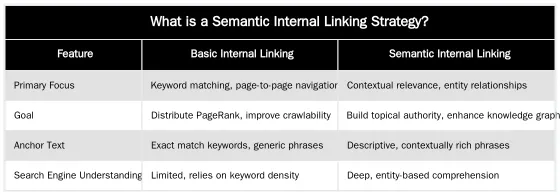
What is a Semantic Internal Linking Strategy?
A semantic internal linking strategy connects web pages based on contextual and conceptual relevance, not just exact keyword matches. This method helps search engines understand relationships between content, building a knowledge graph. It supports information retrieval by signaling topical coverage and reinforcing site authority.
Beyond Keywords: Contextual Relevance in Linking
Shifting from keyword-centric linking to entity- and context-based connections is crucial for SEO. Semantic relevance ensures internal links guide users and crawlers to related content, improving user experience and how search engines interpret site structure. This helps search engines map entities on your site for a more accurate understanding of content meaning and purpose.
Implementing an E-E-A-T-Driven Internal Linking Architecture
An E-E-A-T (Experience, Expertise, Authoritativeness, Trustworthiness)-focused internal linking structure is strategic for medical content. Abdurrahman Simsek, a Semantic SEO Strategist with over 10 years of experience, emphasizes that expert-driven content must be reinforced through linking. This ensures search engines recognize the site’s depth of knowledge and credibility. A technical SEO framework is essential.
A semantic engineer designs this architecture, ensuring every link strengthens the site’s E-E-A-T signals. This involves connecting author bios, medical qualifications, and research citations to relevant procedural or condition-specific pages, not just linking related articles. This approach helps search engines understand the authoritative sources behind medical information, which is crucial for YMYL content.
Leveraging Entity-Attribute-Value (EAV) for Precise Connections
Entity-Attribute-Value (EAV) modeling is a framework for defining entities (e.g., “Rhinoplasty,” “Dr. Smith”) and their attributes (e.g., “recovery time,” “specialization,” “location”). Structuring content with an Entity-Attribute-Value (EAV) SEO model makes internal links precise and semantically rich. For instance, a link from a “Rhinoplasty recovery” page can point to a page detailing “post-operative care instructions” for that procedure, reinforcing the EAV model for surgical procedures. This detail helps search engines map complex medical information, enhancing information retrieval and site understanding.
Optimizing Cost of Retrieval (CoR) with Semantic Linking
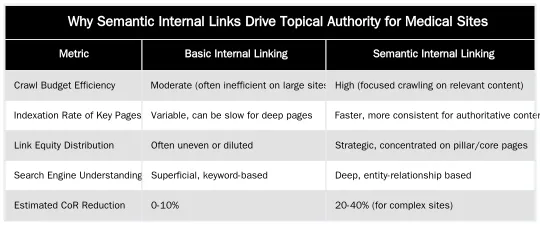
Cost of Retrieval (CoR) is the resources (time, processing power) search engines expend to crawl, index, and understand a website’s content. For complex medical websites, a semantic internal linking strategy can reduce CoR. Clear pathways and semantic relationships guide crawlers effectively, ensuring content is discovered and indexed without wasting crawl budget on unimportant or orphaned pages. This optimization is part of Abdurrahman Simsek’s approach to internal linking automation with Ruxi Data.
Internal linking aids in PageRank sculpting, distributing link equity strategically to high-value pages. This improves the ranking potential of core content and signals to search engines which pages are most important within a topical hierarchy. Reducing CoR leads to faster indexation, better resource allocation, and improved visibility.
Semantic Linking vs. Basic Linking: CoR Impact
Future-Proofing Your Content: Semantic Links for Generative AI
As Generative AI and AI Overviews become more prevalent, a semantic internal linking strategy is essential for future-proofing content. AI models rely on structured, entity-rich content to understand and synthesize information. Content interconnected through semantic links makes it easier for AI to identify entities, their attributes, and their relationships. This increases the likelihood of a medical practice’s information being accurately sourced and presented in AI-generated summaries.
Content with semantic relationships feeds Google’s Knowledge Graph, a critical component for AI understanding. Defining how procedures, conditions, and expert physicians relate to each other makes a digital presence adaptable to evolving search algorithms and AI. This ensures a medical practice remains visible and authoritative in the search landscape of 2026.
Crafting Content for AI Overviews and Knowledge Graph Integration
To optimize for AI Overviews and Knowledge Graph integration, content requires clarity, factual accuracy, and explicit entity definitions. Internal links must reinforce these definitions and relationships. For example, linking a surgical procedure page to its recovery guide, potential risks, and the specialist surgeon creates a dense network of related entities. This structured approach helps AI models grasp the full context of a medical topic, ensuring information is discoverable and trustworthy in AI-driven search.
Frequently Asked Questions
What defines a semantic internal linking strategy versus a basic one?
A semantic internal linking strategy connects web pages based on their contextual and conceptual relevance, moving beyond simple keyword matching. It aims to build a sophisticated network of content that mirrors a knowledge graph, significantly helping search engines understand the deep relationships between different topics on your site. This approach enhances topical authority and improves information retrieval for complex queries.
How do topic clusters and pillar pages integrate with this linking approach?
Pillar pages serve as the central, comprehensive hub for a broad topic, while cluster pages delve into specific subtopics in detail. A strong semantic internal linking strategy ensures all detailed cluster pages link back to their main pillar page. This architecture consolidates topical authority and signals to search engines the depth of expertise on a given subject.
What is the ideal anchor text for a semantically optimized link?
The ideal anchor text is natural, descriptive, and contextually relevant to the content of the linked page. It should accurately inform both users and search engines about the destination page’s content without being over-optimized or appearing spammy. This clarity helps improve user experience and search engine understanding.
How can a semantic internal linking strategy specifically benefit a plastic surgery clinic?
For a plastic surgery clinic, this semantic internal linking strategy connects pages about specific procedures (e.g., ‘rhinoplasty’ or ‘breast augmentation’) to surgeon profiles, patient testimonials, and detailed cost information. This builds a dense, authoritative network that signals deep expertise and E-E-A-T (Experience, Expertise, Authoritativeness, Trustworthiness) on medical topics to Google. It helps patients find comprehensive answers and builds trust.
Can the implementation of a semantic internal linking strategy be automated?
Yes, advanced tools and semantic infrastructure, such as Ruxi Data, can analyze your content to identify relevant linking opportunities automatically. This automation ensures that as your website grows, your semantic internal linking strategy remains consistent and powerful. It helps maintain a robust content network without extensive manual effort.
How can I get expert help to implement a semantic internal linking strategy for my medical practice?
You can book a Semantic SEO Audit directly with Abdurrahman Şimşek to assess your current content network and identify opportunities for improvement. Alternatively, for immediate strategic guidance, you can reach out via the direct WhatsApp Strategy Line. Expert assistance ensures your content builds unmatched topical authority.
Ruxi Data brings together multi-model AI, automated website crawling, live indexation checks, topical authority mapping, E-E-A-T enrichment, schema generation, and full pipeline automation — from crawl to WordPress publish to social posting — all in one platform built for agencies and freelancers who run on results.