
Medical Schema Relationships: Enhancing Healthcare Visibility
Medical schema relationships define how healthcare entities like surgeons, clinics, and treatments are interconnected, providing search engines with a clear map of expertise. This article explains how explicitly linking these entities using structured data, such as Physician, MedicalClinic, and MedicalProcedure schema, enhances online visibility and E-E-A-T. Understanding these medical schema relationships is crucial for private healthcare providers to improve Google Knowledge Graph representation and establish verifiable authority in competitive YMYL sectors. Readers will learn practical implementation strategies for semantic SEO.
Abdurrahman Şimşek, a Semantic SEO Strategist, specializes in building high-authority Semantic Content Networks for medical clinics and plastic surgeons. His expertise in entity-attribute-value modeling and YMYL structured data ensures robust digital presence and topical authority for healthcare providers.
To explore your options, contact us to schedule your consultation.
Medical schema relationships define how entities like surgeons, clinics, and treatments are interconnected, giving search engines a machine-readable map of a practice’s expertise and authority. In medical SEO, structured data alone is insufficient; explicit entity connections are vital. These relationships enhance online visibility and E-E-A-T, particularly for private healthcare providers in competitive markets like London.
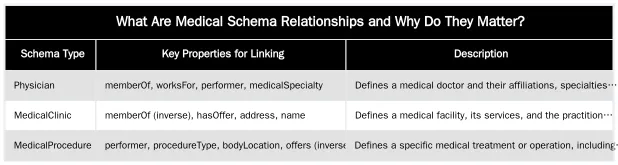
What Are Medical Schema Relationships and Why Do They Matter?
Medical schema relationships are machine-readable connections defining how entities like surgeons, clinics, and treatments are linked. Explicitly mapping these connections with structured data gives search engines like Google a precise understanding of a practice’s context, authority, and relevance for Your Money Your Life (YMYL) topics.
Semantic clarity is critical for Google’s Knowledge Graph. When a website clearly articulates these links, it helps Google build an accurate representation of the medical practice, improving search visibility and trust signals. For instance, connecting a surgeon to their qualifications and clinic creates a verifiable entity profile.
The Core Concept: Entities and Their Connections
A medical ‘entity’ can be a person (surgeon), place (clinic), or concept (medical procedure). Schema.org provides a vocabulary to describe these entities and the properties defining their links. For example, a `Physician` entity can link to a `MedicalClinic` via the `memberOf` or `worksFor` property, while a `MedicalProcedure` can be associated with a `Physician` using the `performer` property. These explicit connections form a semantic web that helps Google understand and rank content accurately.
How Interconnected Data Elevates Your Medical Practice’s E-E-A-T
Explicitly defining relationships between surgeons, their qualifications, clinics, and procedures directly contributes to E-E-A-T (Experience, Expertise, Authoritativeness, and Trustworthiness), which Google uses to assess medical information credibility. When structured data links a surgeon’s `MedicalSpecialty` and `alumniOf` to their `Physician` profile, and that profile to the `MedicalClinic` where they are a `memberOf`, it creates a verifiable chain of authority.
Semantic clarity signals to Google that a practice is a legitimate, authoritative source. Fragmented data, with connections only implied in unstructured text, makes it harder for search engines to validate credentials and build trust. In London’s competitive private healthcare sector, schema relationships are foundational to SEO.
Building Trust Signals Through Semantic Clarity
Clear entity relationships help Google validate a surgeon’s credentials and a clinic’s legitimacy for YMYL topics. Explicitly stating these connections helps search engines combat misinformation and promote authoritative sources. This structured approach helps Google present your practice as a reliable option to patients. To learn how this impacts search, explore implementing advanced medical schema for entity recognition.
Implementing Medical Schema: Linking Surgeons, Clinics & Treatments
Implement medical schema relationships using JSON-LD to connect core medical entities. This structured data provides a roadmap for search engines. The goal is to create an interconnected web of information reflecting your practice. Link `Physician`, `MedicalClinic`, and `MedicalProcedure` entities to help Google understand your services and expertise.
Define each entity separately, then use schema.org properties to establish relationships. For instance, a `Physician` entity can use `memberOf` to link to a `MedicalClinic`. The `MedicalClinic` can use `hasOffer` to point to `MedicalProcedure` entities, which can use `performer` to link back to the `Physician`. This creates a verifiable network of information.
Nesting and Linking: A Practical JSON-LD Example
The following simplified JSON-LD code block illustrates how a `Physician` is linked to a `MedicalClinic`, and how a `MedicalProcedure` is associated with both. This structure provides explicit connections that enhance entity recognition.
Here’s a conceptual snippet:
<script type="application/ld+json">
{
  "@context": "https://schema.org",
  "@graph": [
    {
      "@type": "MedicalClinic",
      "@id": "https://example.com/clinic/#clinic",
      "name": "London Aesthetic Clinic",
      "address": {
        "@type": "PostalAddress",
        "streetAddress": "123 Harley Street",
        "addressLocality": "London",
        "postalCode": "W1G 9PF",
        "addressCountry": "UK"
      },
      "hasOffer": {
        "@type": "Offer",
        "itemOffered": {
          "@type": "MedicalProcedure",
          "@id": "https://example.com/rhinoplasty/#procedure",
          "name": "Rhinoplasty",
          "procedureType": "Cosmetic Surgery",
          "performer": {
            "@id": "https://example.com/dr-smith/#physician"
          }
        }
      }
    },
    {
      "@type": "Physician",
      "@id": "https://example.com/dr-smith/#physician",
      "name": "Dr. Jane Smith",
      "medicalSpecialty": "https://schema.org/PlasticSurgery",
      "memberOf": {
        "@id": "https://example.com/clinic/#clinic"
      },
      "knowsAbout": "Rhinoplasty"
    }
  ]
}
</script>
Advanced Strategies: Beyond Basic Schema for Medical Entities
Advanced schema strategies use semantic engineering to build an interconnected data architecture. Semantic SEO strategist Abdurrahman Şimşek emphasizes that basic markup is insufficient for competitive medical niches. The goal is to define nuanced relationships and demonstrate expertise through properties Google values.
The `knowsAbout` property explicitly states a surgeon’s specific areas of expertise. This goes beyond a general `medicalSpecialty` and provides granular detail reinforcing topical authority. Consistent entity identification using `@id` properties is also critical, ensuring Google recognizes the same entity across pages and consolidating authority signals.
Defining these connections creates a semantic content network Google can parse and trust. This approach is effective for private clinics in London, where demonstrating specialized knowledge attracts patients. For more on structuring data, consider the principles of Entity-Attribute-Value (EAV) SEO.
Demonstrating Niche Expertise with ‘knowsAbout’
The `knowsAbout` property explicitly states a surgeon’s specialized knowledge in procedures, conditions, or patient demographics. It signals deeper expertise than a broad specialty alone, solidifying authority in niche areas. For example, a plastic surgeon might have `medicalSpecialty` of `PlasticSurgery` but also `knowsAbout` “Rhinoplasty techniques for ethnic noses” or “Reconstructive breast surgery after mastectomy.”
<script type="application/ld+json">
{
  "@context": "https://schema.org",
  "@type": "Physician",
  "name": "Dr. Eleanor Vance",
  "medicalSpecialty": "https://schema.org/PlasticSurgery",
  "knowsAbout": [
    {
      "@type": "Thing",
      "name": "Facial Feminization Surgery"
    },
    {
      "@type": "MedicalCondition",
      "name": "Cleft Lip and Palate Repair"
    }
  ]
}
</script>
This explicit declaration helps Google understand the surgeon’s value proposition and match them with specific patient queries. More information on schema.org properties is available in the official Schema.org documentation.
Measuring the Impact of Robust Medical Schema on Search Visibility
Well-defined medical schema relationships improve search visibility and patient acquisition. Structured data can increase visibility in rich results like carousels, enhanced snippets, and the Google Knowledge Graph. These visual enhancements can drive higher click-through rates (CTRs).
Schema enhances Google’s understanding of medical entities, important for AI-driven search and generative engine optimization (GEO). When Google’s algorithms, including AI Overviews, can identify and connect surgeons, clinics, and treatments, your content is more likely to be sourced as authoritative. This is vital for private healthcare providers in London, where attracting patients begins with a strong online presence.
Monitoring these improvements and connecting them to patient acquisition goals is essential. Tracking rich result and Knowledge Panel metrics provides evidence of schema’s impact on organic performance.
Tracking Rich Results and Knowledge Panel Gains
Google Search Console’s Rich Results Status Reports help monitor structured data performance. These reports show detected schema types, errors, and valid item counts. Tracking impressions and clicks for rich results shows how schema enhances search appearance. An increase in impressions for `MedicalProcedure` rich results indicates the schema is effectively communicating your services to Google.
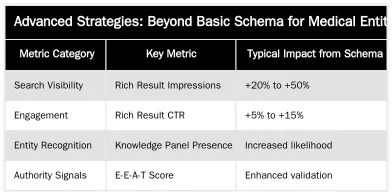
Observing the presence and accuracy of your clinic’s and surgeons’ Knowledge Panels can indicate improved entity recognition. These benefits contribute to brand authority and patient trust. For more on optimizing schema for medical professionals, refer to medical schema for surgeons.
Future-Proof Your Clinic: Partner with a Semantic SEO Expert
In London’s competitive private healthcare market, mastering medical schema relationships is necessary for organic growth. The complexity of these data structures requires specialized expertise. Abdurrahman Şimşek, a London-based Semantic SEO Strategist, specializes in building Semantic Content Networks for medical clinics, skin clinics, and plastic surgeons.
Partnering with an expert in medical SEO and semantic engineering ensures your practice leverages structured data effectively. This approach helps your clinic improve local organic search across Harley Street and premium London postcodes, attracting patients by communicating expertise to search engines. Secure your clinic’s future by implementing a semantic strategy.
Conclusion
Defining medical schema relationships is fundamental to achieving online visibility and establishing E-E-A-T for medical practices. Linking surgeons, clinics, and treatments through structured data gives search engines the clarity to understand and trust your expertise. This semantic approach enhances rich results and Knowledge Graph presence and future-proofs your digital strategy against evolving search algorithms. For private healthcare providers in London, implementing these relationships is non-negotiable. To explore how semantic SEO can transform your clinic’s online presence, visit abdurrahmansimsek.com.
Frequently Asked Questions
What is the primary benefit of defining medical schema relationships?
Defining medical schema relationships creates a clear, machine-readable map of how entities like surgeons, clinics, and treatments are interconnected. This helps search engines understand your practice’s context and authority, which is critical for YMYL topics. It significantly improves entity recognition and overall SERP visibility for healthcare providers.
How do medical schema relationships enhance a surgeon’s association with multiple clinic locations?
You can use `MedicalClinic` schema for each location and reference the surgeon’s `Physician` entity using properties like `employee` or `member`. This explicitly defines the surgeon’s affiliations, strengthening local signals and clarifying their professional presence across different practices for search engines.
Which schema properties are key for defining medical schema relationships between a surgeon and their specialized treatments?
The `knowsAbout` or `specialty` property within the `Physician` schema is ideal for this purpose. By linking to `MedicalProcedure` or `MedicalCondition` entities, you explicitly state the surgeon’s areas of expertise, reinforcing their E-E-A-T signals to search engines.
How do structured data connections between surgeons and clinics impact local SEO?
By explicitly linking a `Physician` to a `MedicalClinic` with a physical address, these structured data connections strengthen local signals. This helps Google confidently display the surgeon in local pack results for relevant queries in their geographic area, boosting local visibility and patient acquisition.
Why is the ‘sameAs’ property important for a surgeon’s professional profiles in structured data?
The `sameAs` property is crucial for entity reconciliation, consolidating a surgeon’s digital identity across the web. You should use it within the `Physician` schema to link to authoritative profiles like the GMC register, LinkedIn, or hospital staff pages, enhancing their authority and trust signals for search engines.
How can I get started with implementing advanced structured data for my medical practice?
To implement advanced structured data and optimize your site’s semantic network, consider partnering with a specialist in medical SEO. An expert can help configure complex entity relationships, ensuring your practice leverages structured data effectively for improved search visibility and E-E-A-T. You can learn more about our services or contact us for a consultation.
Ruxi Data brings together multi-model AI, automated website crawling, live indexation checks, topical authority mapping, E-E-A-T enrichment, schema generation, and full pipeline automation — from crawl to WordPress publish to social posting — all in one platform built for agencies and freelancers who run on results.