
Fixing Indexing Issues Medical: Boost Visibility & Topical Authority
Fixing indexing issues medical websites face is crucial for online visibility and patient acquisition. This guide outlines a 2026 technical audit framework to diagnose common indexing problems, including those related to crawl budget, index bloat, and YMYL content. Readers will learn to identify pages not indexed by Google, interpret Google Search Console’s index coverage report, and implement strategic fixes. Understanding these technical aspects ensures medical content achieves proper indexing, bolstering topical authority and attracting target patients.
Abdurrahman Şimşek, a Semantic SEO Strategist, offers expertise in diagnosing and resolving complex indexing challenges for medical clinics. His approach integrates technical web development with semantic engineering to build high-authority content networks, ensuring critical medical information is discoverable.
To explore your options, contact us to schedule your consultation.
In the competitive landscape of 2026, ensuring your medical website is properly indexed by Google is paramount for visibility and patient acquisition. This comprehensive guide delves into diagnosing and fixing indexing issues medical websites face, providing a technical audit framework to identify and resolve common pitfalls that hinder online presence and dilute hard-earned topical authority. Understanding how search engines discover and process your content is fundamental for any medical practice aiming to attract patients in London, Harley Street, or other premium locations.
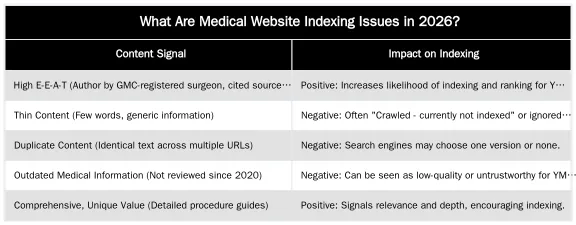
What Are Medical Website Indexing Issues in 2026?
Indexing issues occur when search engines like Google fail to discover, crawl, or add a webpage to their index. For medical websites, this directly translates to a loss of visibility for critical services, procedures, and expert information. An unindexed page cannot rank in search results, making it invisible to potential patients seeking healthcare solutions. These problems are particularly impactful for Your Money Your Life (YMYL) content, where accuracy and authority are paramount.
In 2026, indexing challenges extend beyond simple technical errors. Modern content management systems (CMS) and dynamic web applications can inadvertently create vast numbers of low-value pages, leading to a phenomenon known as index bloat. This dilutes the overall authority of a medical domain and wastes valuable crawl budget.
Understanding Index Bloat & Its Impact on YMYL Content
Index bloat refers to a situation where a significant portion of a website’s indexed pages offers minimal value to users or search engines. For medical websites, this often manifests as automatically generated tag pages, category archives with thin content, filtered search results, or outdated blog posts. While technically crawlable, these pages consume crawl budget without contributing meaningfully to topical authority.
For YMYL content, index bloat is particularly detrimental. Google prioritizes high-quality, authoritative medical information. When a site presents a large volume of low-value pages alongside expert-reviewed content, it can signal a lack of overall content quality control. This can hinder the indexing and ranking of truly valuable pages, impacting patient trust and acquisition for clinics in competitive areas like London’s Harley Street.
Why Are Your Medical Pages Not Getting Indexed by Google?
Several factors can prevent medical pages from being indexed, ranging from fundamental technical misconfigurations to content quality deficiencies. Identifying the root cause is the first step toward resolution. These issues can significantly impact a clinic’s ability to reach patients searching for specific treatments or specialists.
Common Technical Roadblocks: Robots.txt, Noindex & Canonical Tags
Technical directives often inadvertently block search engine access. A misconfigured robots.txt file can instruct search engines not to crawl specific directories or even entire sites. This is common for staging environments or development sites that accidentally go live without an updated robots.txt.
The ‘noindex’ meta tag or X-Robots-Tag HTTP header explicitly tells search engines not to index a page. While useful for internal search results or administrative pages, its accidental application to critical service or doctor profile pages can render them invisible. Incorrect canonicalization, where a page points to a different URL as its preferred version, can also lead to indexing issues if the canonicalized URL is itself blocked or irrelevant. Understanding these technical nuances is crucial for effective fixing indexing issues medical websites encounter.
Content Quality & E-E-A-T: The Unindexed Page Dilemma
Beyond technical barriers, content quality plays a significant role in indexing decisions, especially for YMYL medical topics. Google’s algorithms prioritize content demonstrating high Experience, Expertise, Authoritativeness, and Trustworthiness (E-E-A-T). Pages with thin content, meaning very little unique or valuable information, are often deprioritized or left unindexed.
Duplicate content, whether internal or external, can confuse search engines about which version to index, potentially leading to none being indexed. For medical websites, ensuring that all content, from procedure descriptions to blog posts, is original, accurate, and clearly attributed to qualified medical professionals is essential for indexing and ranking success.
Conducting a 2026 Technical Audit for Indexing Health
A thorough technical audit is essential for identifying and resolving indexing problems. For medical websites, this audit must be comprehensive, utilizing various tools and methodologies to ensure all valuable content is discoverable. This proactive approach is key to maintaining a strong online presence for clinics and practitioners.
Mastering Google Search Console’s Index Coverage Report
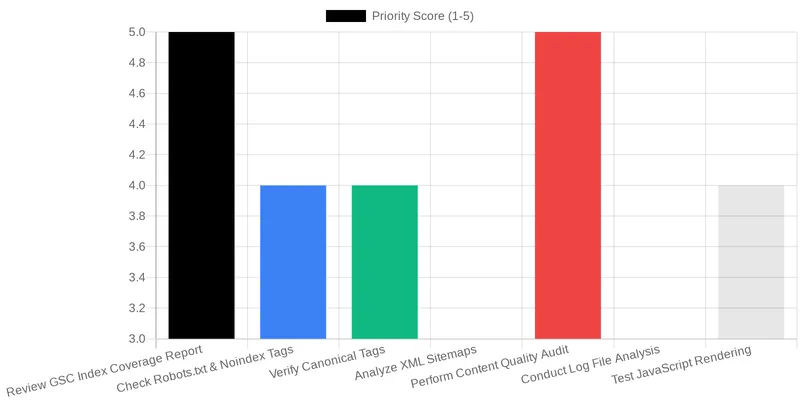
Google Search Console (GSC) remains the primary tool for monitoring indexing status. The Index Coverage Report provides crucial insights into how Google views your site. Key statuses to investigate include ‘Excluded,’ ‘Crawled – currently not indexed,’ and ‘Discovered – currently not indexed.’ The ‘Excluded’ category often points to pages blocked by robots.txt, ‘noindex’ tags, or canonicalization issues. ‘Crawled – currently not indexed’ indicates Google has seen the page but deemed its content not valuable enough for inclusion, often due to thinness or low E-E-A-T. ‘Discovered – currently not indexed’ suggests Google knows about the page but hasn’t prioritized crawling it yet, possibly due to crawl budget constraints or perceived low importance. Regularly reviewing these reports is fundamental for any strategy aimed at improving indexing. [1]
Advanced Diagnostics: Log File Analysis & JavaScript Rendering
For larger medical websites, log file analysis offers a granular view of Googlebot’s activity. By examining server logs, you can see which pages Googlebot crawls, how frequently, and if it encounters any errors. This helps in understanding crawl budget allocation and identifying areas where Googlebot might be spending too much time on low-priority pages, or missing critical ones. Optimizing crawl budget ensures that valuable medical content is prioritized.
Modern medical websites often rely heavily on JavaScript for dynamic content and user interfaces. If not implemented correctly, JavaScript can hinder Google’s ability to render and index page content. Tools like Google Search Console’s URL Inspection tool can show how Google renders a page, revealing if critical content is missing. Addressing JavaScript rendering issues is vital for ensuring all content is visible to search engines.
Leveraging Semantic SEO for Superior Medical Website Indexing
Beyond addressing individual technical faults, a holistic semantic SEO strategy inherently prevents many indexing issues. This approach focuses on building a robust content network that clearly communicates topical authority to search engines, ensuring that all valuable medical content is not only discoverable but also understood in context.
Beyond Technical Fixes: Building an Indexable Semantic Content Network
Semantic engineering principles ensure that a medical website’s architecture and content are designed for optimal search engine understanding from the outset. This involves structuring content around entities (e.g., specific medical conditions, treatments, or specialists) and their relationships. A well-constructed semantic content network naturally guides Google to your most important pages, establishing clear topical relevance and preventing issues like index bloat by design. By defining clear content hierarchies and internal linking strategies based on semantic relationships, search engines can efficiently crawl and index the most authoritative information, enhancing the overall discoverability of a clinic’s services.
The Abdurrahman Şimşek Approach: Holistic Indexing for Harley Street Clinics
Abdurrahman Şimşek specializes in applying these advanced strategies for high-value medical clients in competitive markets, including Harley Street, Marylebone, and Mayfair. His approach integrates technical SEO with deep semantic understanding, ensuring that private healthcare providers, plastic surgeons, and aesthetic clinics achieve superior indexing and topical authority. By leveraging Ruxi Data for semantic infrastructure integration, Abdurrahman crafts websites where every piece of valuable medical content is strategically positioned for maximum visibility. This holistic method prioritizes both the technical health of the site and the semantic depth of its content, leading to sustained organic growth and patient acquisition in London’s elite medical landscape.
Secure Your Medical Website’s Visibility: Partner with an Expert
Effective indexing is the foundation of online visibility for any medical practice. Without it, even the most expertly crafted content remains unseen. Proactively addressing and fixing indexing issues medical websites face is not merely a technical task; it is a strategic imperative for patient acquisition and establishing digital authority.
Don’t Let Indexing Issues Hinder Your Patient Acquisition
A fully indexed, high-authority medical website is essential for attracting high-value patients. If your medical website struggles with indexing or you seek to build a robust semantic content network, expert assistance can provide a clear path forward. Explore advanced strategies like the Google Indexing API in 2026 for immediate content visibility. Partner with a specialist who understands the nuances of medical SEO and the competitive London private healthcare market.
Conclusion
Ensuring your medical website is fully indexed and understood by search engines is a continuous, multifaceted process. From resolving technical roadblocks like robots.txt and canonicalization errors to enhancing content quality and E-E-A-T, each step contributes to a more discoverable and authoritative online presence. For medical clinics in London and beyond, a strategic approach to indexing, underpinned by semantic SEO principles, is crucial for attracting and converting patients. By prioritizing both technical health and content relevance, medical practices can secure their visibility and achieve sustainable organic growth.
For a comprehensive technical audit and a tailored semantic SEO strategy for your medical website, visit abdurrahmansimsek.com.
Frequently Asked Questions
What is the most common indexing issue for medical websites, and how does it impact visibility?
Index bloat is a frequent problem, often caused by a CMS generating thousands of low-value, thin content pages like tags or archives. These pages waste crawl budget, dilute topical authority, and can prevent more critical procedure or author pages from being properly indexed. Addressing this is a primary step in fixing indexing issues medical websites encounter.
How does a 2026 technical audit assist in fixing indexing issues medical websites commonly face?
A modern technical audit focuses on advanced challenges such as diagnosing JavaScript rendering problems on interactive elements and ensuring mobile-first indexing compatibility. These are critical for complex medical websites that often utilize sophisticated web technologies. Such an audit provides a comprehensive roadmap for effectively resolving these indexing challenges.
My new medical blog post isn’t indexed; what’s the first step for fixing indexing issues?
Use the URL Inspection tool in Google Search Console immediately. It will inform you if the page is known to Google, if it’s crawlable, and if any technical issues like a ‘noindex’ tag or a canonical pointing elsewhere are preventing its indexing. This tool is invaluable for diagnosing specific page problems and initiating the process of fixing indexing issues medical content faces.
What does the ‘Discovered – currently not indexed’ status indicate for medical content?
This status means Google found your page but decided not to crawl it at that time, often due to server overload, perceived low quality, or insufficient priority. Improving site performance, enhancing content quality, and strengthening internal linking can encourage Google to crawl and index these pages. This is a common hurdle when addressing indexing problems.
Is using the Google Indexing API beneficial for medical content, especially when fixing indexing issues?
Yes, for time-sensitive updates, the Google Indexing API is highly beneficial. When you publish a new procedure page or update critical medical information, using this API can significantly speed up the time it takes for Google to crawl and index the new content, which is vital in the YMYL (Your Money Your Life) space. It helps ensure timely visibility for important health information.
How can an expert like Abdurrahman Şimşek assist with fixing indexing issues medical websites face?
Abdurrahman Şimşek, a London-based Semantic SEO Strategist, specializes in comprehensive technical audits and semantic engineering for medical clinics. His 10+ years of experience ensure a holistic approach to identifying and resolving complex indexing problems, boosting topical authority, and securing optimal visibility for practices in competitive areas like Harley Street. His expertise is crucial for effective fixing indexing issues medical websites encounter.
Ruxi Data brings together multi-model AI, automated website crawling, live indexation checks, topical authority mapping, E-E-A-T enrichment, schema generation, and full pipeline automation — from crawl to WordPress publish to social posting — all in one platform built for agencies and freelancers who run on results.