
Advanced Medical Schema: Optimizing Entity Recognition for Healthcare
Implementing advanced medical schema transforms how search engines interpret medical entities, significantly enhancing E-E-A-T signals for healthcare providers. This article details how structured data, specifically JSON-LD, enables precise entity recognition for physicians, clinics, and procedures. By defining complex relationships, advanced schema populates Google’s Knowledge Graph, improving visibility and trust. Readers will learn to move beyond basic markup to create comprehensive entity definitions, optimize for rich snippets, and reduce the cost of retrieval, ultimately boosting search performance and patient acquisition in competitive markets.
Abdurrahman Şimşek, a Semantic SEO Strategist, specializes in building high-authority Semantic Content Networks for medical clinics. His expertise in holistic SEO strategy, semantic engineering, and medical SEO ensures precise implementation of structured data for optimal search engine understanding and performance.
To explore your options, contact us to schedule your consultation.
Implementing advanced medical schema optimizes a healthcare provider’s digital presence. Structured data transforms how search engines understand medical entities, enhancing E-E-A-T (Experience, Expertise, Authoritativeness, Trustworthiness) and boosting visibility in competitive markets like London’s private healthcare sector. Moving beyond basic markup enables entity recognition, improving search performance and patient acquisition.
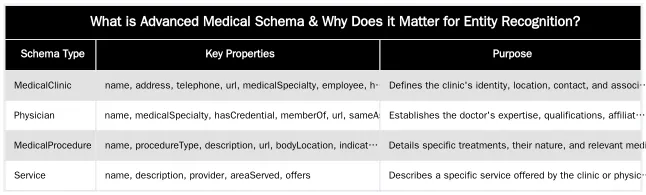
What is Advanced Medical Schema & Why Does it Matter for Entity Recognition?
Advanced medical schema uses structured data markup to define complex relationships between medical entities like physicians, clinics, and procedures. This helps search engines like Google understand the context, expertise, and services of a medical practice. It enables entity recognition, which underpins how search engines build their Knowledge Graph and evaluate E-E-A-T signals for YMYL (Your Money Your Life) content.
Beyond Basic Markup: Defining Complex Medical Entities
Basic schema might only include a clinic’s name and address. Advanced structured data defines a physician’s specialties, conditions treated, and professional affiliations. It outlines medical procedures offered, including their indications, contraindications, and typical recovery times. This data allows search engines to understand a medical entity’s operations and expertise, moving beyond keyword matching to semantic understanding.
The Role of Schema in Google’s Knowledge Graph for Medical Practices
Structured data directly feeds Google’s Knowledge Graph, a repository of facts about entities and their relationships. Well-implemented schema populates a Knowledge Panel for a clinic or physician, displaying verified information in search results. This enhances visibility, establishes authority, and provides users with trustworthy data. Google’s documentation emphasizes the role of structured data in enhancing search appearance.
How Do You Implement Nested Medical Schema for Comprehensive Entity Definition?
Implementing nested medical schema uses JSON-LD (JavaScript Object Notation for Linked Data). This method defines a primary entity and embeds related entities within its structure, creating an interconnected data model. This involves nesting `Physician` entities within a `MedicalClinic` entity, and associating `MedicalProcedure` entities with the clinic and specific physicians. This ensures search engines understand your services and expertise.
Structuring Physician, Clinic, and Procedure Relationships with JSON-LD
The hierarchy begins with the `MedicalClinic` as the overarching entity. Within this, `Physician` entities are nested, detailing their roles and specialties. Each `MedicalProcedure` entity is linked to the clinic offering it and the physicians performing it. This creates a relationship map for search engines.
{
  "@context": "https://schema.org",
  "@type": "MedicalClinic",
  "name": "London Aesthetic Clinic",
  "address": {
    "@type": "PostalAddress",
    "streetAddress": "123 Harley Street",
    "addressLocality": "London",
    "postalCode": "W1G 9PF",
    "addressCountry": "UK"
  },
  "hasMap": "https://maps.app.goo.gl/...",
  "url": "https://londonclinic.com",
  "medicalSpecialty": "PlasticSurgery",
  "description": "A leading clinic for aesthetic procedures in Harley Street.",
  "employee": [
    {
      "@type": "Physician",
      "name": "Dr. Jane Doe",
      "medicalSpecialty": "PlasticSurgery",
      "hasCredential": "FRCS",
      "url": "https://londonclinic.com/dr-jane-doe",
      "sameAs": [
        "https://www.linkedin.com/in/drjanedoe",
        "https://gmc-uk.org/doctors/..."
      ],
      "performerIn": [
        {
          "@type": "MedicalProcedure",
          "name": "Rhinoplasty",
          "procedureType": "SurgicalProcedure",
          "description": "Corrective nose surgery.",
          "url": "https://londonclinic.com/rhinoplasty"
        }
      ]
    }
  ]
}
Essential Properties for Robust Medical Entity Markup
Key properties for medical structured data include `sameAs` to link to authoritative external profiles (e.g., GMC registration, LinkedIn), `medicalSpecialty` for categorization, and `hasOffer` to detail services and pricing. Other properties are `acceptedPaymentMethod`, `address`, `telephone`, `url`, and a `description`. For `Physician` entities, `alumniOf`, `hasCredential`, and `memberOf` (for professional organizations) enhance the profile. These properties provide granular data, ensuring search engines accurately represent the medical entity.
Advanced Strategies: Schema for Entity-Attribute-Value (EAV) Modeling & GEO
Medical structured data enables precise entity definition through Entity-Attribute-Value (EAV) modeling. This approach, with its influence on Generative Engine Optimization (GEO) and AI Overviews, is a strategic advantage. Abdurrahman Şimşek’s work in semantic engineering integrates these concepts, positioning medical practices for future search algorithms and AI-driven information retrieval.
Leveraging Schema for Entity-Attribute-Value (EAV) Modeling
EAV modeling structures data by defining entities (e.g., “Rhinoplasty”), their attributes (e.g., “recovery time,” “anesthesia type,” “cost range”), and the values for those attributes. Schema properties align with EAV principles. A `MedicalProcedure` schema can include properties like `typicalRecoveryTime`, `anesthesiaTechnique`, and `hasOffer` (with `priceSpecification`) for granular data representation. This detail helps search engines understand each procedure, making content more discoverable. Entity-Attribute-Value (EAV) SEO for medical practices.
Schema’s Influence on Generative Engine Optimization (GEO) and AI Overviews
With generative AI in search engines, structured, entity-rich schema is critical. Content with detailed structured data is more digestible and attributable for large language models. This increases the likelihood that a medical practice’s information is extracted for AI Overviews, conversational search, or other generative formats. Schema’s clear entity definitions and relationships enable AI to source and synthesize information, positioning clinics for visibility in evolving search. Industry discussions highlight the importance of structured data for AI-driven search.
Optimizing for Rich Snippets & Reducing Cost of Retrieval with Schema
Advanced medical schema improves search visibility through rich snippets and reduces Google’s ‘Cost of Retrieval.’ Structured data enhances search appearance and optimizes how efficiently search engines process content. This benefit is crucial for competitive markets, ensuring medical information is seen and indexed.
Unlocking Rich Snippets: Enhancing Visibility for Medical Services
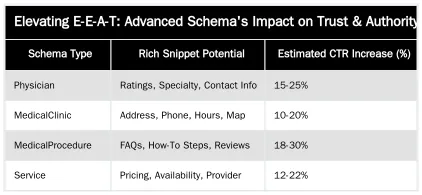
Specific schema types can trigger rich snippets, which are enhanced search results displaying additional information. For medical practices, examples include star ratings for a `Physician`, FAQ sections for `MedicalProcedure` pages, or contact information and opening hours for a `MedicalClinic`. These snippets improve click-through rates (CTR) by providing users with relevant information. For example, a `MedicalProcedure` page with `FAQPage` schema can display patient questions and answers in the SERP.
Schema’s Role in Optimizing ‘Cost of Retrieval’ for Complex Medical Sites
Google’s ‘Cost of Retrieval’ is the computational resources required for Googlebot to crawl, process, and understand a website’s content. For complex medical websites, structured data reduces this cost. When information is defined through schema, Googlebot can extract entities and their relationships efficiently. This efficiency can impact crawl budget, indexing speed, and site performance, especially for large sites.
Ready to Transform Your Clinic’s Online Presence with Advanced Medical Schema?
Implementing advanced medical schema is a strategic imperative for medical practices seeking online visibility and authority. It is a cornerstone of semantic SEO, ensuring search engines recognize your expertise and present it to patients. For London’s private healthcare sector, this precision is a necessity. Discover how a tailored semantic SEO strategy can benefit your practice by visiting Abdurrahman Şimşek’s website.
Frequently Asked Questions
What makes medical schema ‘advanced’ versus basic implementation?
Advanced medical schema goes beyond simply marking up a clinic’s name and address. It involves nesting multiple schema types—like Physician, MedicalProcedure, and MedicalClinic—and using properties such as `sameAs` to connect website entities to authoritative external profiles. This comprehensive approach builds a robust entity definition for Google, enhancing understanding and visibility.
How does advanced medical schema contribute to E-E-A-T?
Implementing advanced medical schema directly signals Expertise, Authoritativeness, and Trust to search engines. By explicitly defining a surgeon’s qualifications, linking to their medical licenses, and detailing procedures they perform, you provide machine-readable proof of their credentials. This structured data helps Google recognize and validate the healthcare provider’s standing.
Can implementing sophisticated structured data help my clinic appear in rich results?
Yes, this is a primary benefit of using detailed structured data. Correctly implemented schema can make your pages eligible for rich results in the SERPs, such as FAQ snippets, review stars, and detailed information about procedures. These enhanced listings significantly increase click-through rates and attract more potential patients.
Do I need a developer to implement advanced medical schema?
While plugins can handle basic schema, implementing nested and interconnected advanced medical schema often requires direct editing of JSON-LD scripts. A developer or a technical SEO specialist is highly recommended to ensure the code is valid, accurately reflects the entities on the page, and adheres to best practices. This expertise prevents errors and maximizes schema’s impact.
How does this sophisticated structured data help Google understand who we are?
It removes ambiguity by explicitly defining your medical entities. Instead of Google guessing that “Dr. John Smith” is a plastic surgeon in London, the schema explicitly states it, linking to his official registration and defining his specialty. This process of entity recognition helps solidify your place in Google’s Knowledge Graph, improving search accuracy.
How can I get started with implementing advanced medical schema for my London clinic?
To begin enhancing your clinic’s online presence with advanced medical schema, consider consulting with a specialist in medical SEO. Experts like Abdurrahman Şimşek can help design and implement a tailored structured data strategy. This ensures your London private healthcare practice accurately communicates its expertise and services to search engines.
Ruxi Data brings together multi-model AI, automated website crawling, live indexation checks, topical authority mapping, E-E-A-T enrichment, schema generation, and full pipeline automation — from crawl to WordPress publish to social posting — all in one platform built for agencies and freelancers who run on results.